
Verwandte Artikel zu Mathematical Logic (Undergraduate Texts in Mathematics)
Mathematical Logic (Undergraduate Texts in Mathematics) - Hardcover
Buch 121 von 170: Undergraduate Texts in Mathematics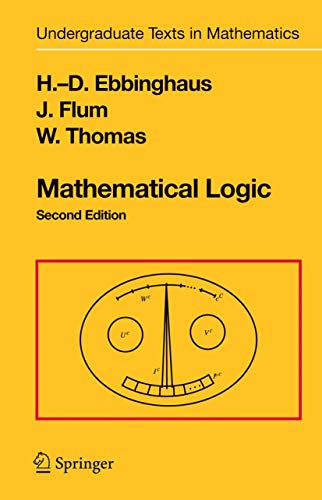
Inhaltsangabe
What is a mathematical proof? How can proofs be justified? Are there limitations to provability? To what extent can machines carry out mathe matical proofs? Only in this century has there been success in obtaining substantial and satisfactory answers. The present book contains a systematic discussion of these results. The investigations are centered around first-order logic. Our first goal is Godel's completeness theorem, which shows that the con sequence relation coincides with formal provability: By means of a calcu lus consisting of simple formal inference rules, one can obtain all conse quences of a given axiom system (and in particular, imitate all mathemat ical proofs). A short digression into model theory will help us to analyze the expres sive power of the first-order language, and it will turn out that there are certain deficiencies. For example, the first-order language does not allow the formulation of an adequate axiom system for arithmetic or analysis. On the other hand, this difficulty can be overcome--even in the framework of first-order logic-by developing mathematics in set-theoretic terms. We explain the prerequisites from set theory necessary for this purpose and then treat the subtle relation between logic and set theory in a thorough manner.
Die Inhaltsangabe kann sich auf eine andere Ausgabe dieses Titels beziehen.
Von der hinteren Coverseite
The book starts with a thorough treatment of first-order logic and its role in the foundations of mathematics. It covers several advanced topics, not commonly treated in introductory texts, such as Trachtenbrot's undecidability theorem Fraisse's characterization of elementary equivalence, Lindstrom's theorem on the maximality of first-order logic, and the fundamentals of logic programming.
„Über diesen Titel“ kann sich auf eine andere Ausgabe dieses Titels beziehen.
Suchergebnisse für Mathematical Logic (Undergraduate Texts in Mathematics)

Beispielbild für diese ISBN
Mathematical Logic, 2nd Edition (Undergraduate Texts in Mathematics)
Anbieter: Zubal-Books, Since 1961, Cleveland, OH, USA
Verkäuferbewertung 5 von 5 Sternen

Zustand: Fine. first printing of the second edition, 291 pp., Hardcover, previous owner's name to the front free endpaper, else fine. - If you are reading this, this item is actually (physically) in our stock and ready for shipment once ordered. We are not bookjackers. Buyer is responsible for any additional duties, taxes, or fees required by recipient's country. Artikel-Nr. ZB1353251
Gebraucht kaufen
EUR 14,69
EUR 4,00 Versand
Versand innerhalb von USA
Versand innerhalb von USA
Anzahl: 1 verfügbar
Beispielbild für diese ISBN
Mathematical Logic
Anbieter: ThriftBooks-Dallas, Dallas, TX, USA
Verkäuferbewertung 5 von 5 Sternen
Hardcover. Zustand: Good. No Jacket. Pages can have notes/highlighting. Spine may show signs of wear. ~ ThriftBooks: Read More, Spend Less. Artikel-Nr. G0387942580I3N00
Gebraucht kaufen
EUR 18,88
Versand gratis
Versand innerhalb von USA
Versand innerhalb von USA
Anzahl: 1 verfügbar
Beispielbild für diese ISBN
Mathematical Logic, 2nd Edition
Anbieter: Labyrinth Books, Princeton, NJ, USA
Verkäuferbewertung 5 von 5 Sternen
Zustand: New. Artikel-Nr. 277833
Neu kaufen
EUR 44,83
EUR 4,00 Versand
Versand innerhalb von USA
Versand innerhalb von USA
Anzahl: 1 verfügbar
Foto des Verkäufers
Mathematical Logic - 2nd Edition
Verlag:
New York : Springer-Verlag, 1994
ISBN 10: 0387942580
ISBN 13: 9780387942582
Gebraucht
Softcover
Anbieter: Klondyke, Almere, Niederlande
Verkäuferbewertung 5 von 5 Sternen
Zustand: Good. Original boards, illustrated with numerous equations, 8vo. Undergraduate Texts in Mathematics.; Name in pen on title page. Artikel-Nr. 343200-ZA30
Gebraucht kaufen
EUR 33,00
EUR 20,00 Versand
Versand von Niederlande nach USA
Versand von Niederlande nach USA
Anzahl: 1 verfügbar
Beispielbild für diese ISBN
Mathematical Logic (Undergraduate Texts in Mathematics)
Anbieter: AproposBooks&Comics, London, Vereinigtes Königreich
Verkäuferbewertung 4 von 5 Sternen

Hardcover. Zustand: Fine. 2nd Edition. Artikel-Nr. ful/080924/HJGHJGHJG
Gebraucht kaufen
EUR 42,36
EUR 17,59 Versand
Versand von Vereinigtes Königreich nach USA
Versand von Vereinigtes Königreich nach USA
Anzahl: 1 verfügbar
Beispielbild für diese ISBN
Mathematical Logic - 2nd Edition Ebbinghaus, H.- D. & J. Flum & W. Thomas
Verlag:
New York : Springer-Verlag, 1994
ISBN 10: 0387942580
ISBN 13: 9780387942582
Gebraucht
Hardcover
Anbieter: BUCHSERVICE / ANTIQUARIAT Lars Lutzer, Wahlstedt, Deutschland
Verkäuferbewertung 5 von 5 Sternen
Hardcover. Zustand: gut. 1994. Mathematical Logic - 2nd Edition In englischer Sprache. pages. Artikel-Nr. BN435156
Gebraucht kaufen
EUR 189,00
EUR 39,95 Versand
Versand von Deutschland nach USA
Versand von Deutschland nach USA
Anzahl: 1 verfügbar