The Rise and Development of the Theory of Series up to the Early 1820s (Sources and Studies in the History of Mathematics and Physical Sciences) - Hardcover
Buch 10 von 59: Sources and Studies in the History of Mathematics and Physical Sciences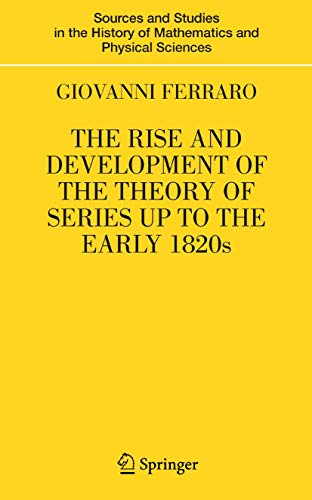
Inhaltsangabe
The theory of series in the 17th and 18th centuries poses several interesting problems to historians. Indeed, mathematicians of the time derived num- ous results that range from the binomial theorem to the Taylor formula, from the power series expansions of elementary functions to trigonometric series, from Stirling’s series to series solution of di?erential equations, from theEuler–MaclaurinsummationformulatotheLagrangeinversiontheorem, from Laplace’s theory of generating functions to the calculus of operations, etc. Most of these results were, however, derived using methods that would be found unacceptable today, thus, if we look back to the theory of series priortoCauchywithoutreconstructinginternalmotivationsandtheconc- tual background, it appears as a corpus of manipulative techniques lacking in rigor whose results seem to be the puzzling fruit of the mind of a - gician or diviner rather than the penetrating and complex work of great mathematicians. For this reason, in this monograph, not only do I describe the entire complex of 17th- and 18th-century procedures and results concerning series, but also I reconstruct the implicit and explicit principles upon which they are based, draw attention to the underlying philosophy, highlight competing approaches, and investigate the mathematical context where the series t- ory originated. My aim is to improve the understanding of the framework of 17th- and 18th-century mathematics and avoid trivializing the complexity of historical development by bringing it into line with modern concepts and views and by tacitly assuming that certain results belong, in some unpr- lematic sense, to a uni?ed theory that has come down to us today.
Die Inhaltsangabe kann sich auf eine andere Ausgabe dieses Titels beziehen.
Von der hinteren Coverseite
The theory of series in the 17th and 18th centuries poses several interesting problems to historians. Most of the results derived from this time were derived using methods which would be found unacceptable today, and as a result, when one looks back to the theory of series prior to Cauchy without reconstructing internal motivations and the conceptual background, it appears as a corpus of manipulative techniques lacking in rigor whose results seem to be the puzzling fruit of the mind of a magician or diviner rather than the penetrating and complex work of great mathematicians.
This monograph not only describes the entire complex of 17th and 18th century procedures and results concerning series, but it also reconstructs the implicit and explicit principles upon which they are based, draws attention to the underlying philosophy, highlights competing approaches, and investigates the mathematical context where the theory originated. The aim here is to improve the understanding of the framework of 17th and 18th century mathematics and avoid trivializing the complexity of historical development by bringing it into line with modern concepts and views and by tacitly assuming that certain results belong, in some sense, to a unified theory that has come down to us today.
Giovanni Ferraro is Professor of Mathematics and History of Mathematics at University of Molise.
„Über diesen Titel“ kann sich auf eine andere Ausgabe dieses Titels beziehen.
Weitere beliebte Ausgaben desselben Titels

Suchergebnisse für The Rise and Development of the Theory of Series up...

Beispielbild für diese ISBN
The Rise and Development of the Theory of Series Up to the Early 1820s
Anbieter: Majestic Books, Hounslow, Vereinigtes Königreich
Verkäuferbewertung 4 von 5 Sternen

Zustand: New. pp. 408 Illus. Artikel-Nr. 7595355
Neu kaufen
EUR 45,24
EUR 7,44 shipping
Versand von Vereinigtes Königreich nach USA
Versand von Vereinigtes Königreich nach USA
Anzahl: 4 verfügbar
Beispielbild für diese ISBN
RISE AND DEVELOPMENT OF THEORY OF SERIES UP TO EARLY 1820S (SOURCES AND STUDIES IN HISTORY OF MATHEMATICS AND PHYSICAL SCIENCES)
Anbieter: Romtrade Corp., STERLING HEIGHTS, MI, USA
Verkäuferbewertung 5 von 5 Sternen

Zustand: New. This is a Brand-new US Edition. This Item may be shipped from US or any other country as we have multiple locations worldwide. Artikel-Nr. ABNR-72098
Beispielbild für diese ISBN
The Rise And Development Of The Theory Of Series Up To The Early 1820s (sources And Studies In The History Of Mathematics And Physical Sciences)
Anbieter: Romtrade Corp., STERLING HEIGHTS, MI, USA
Verkäuferbewertung 5 von 5 Sternen
Zustand: New. This is a Brand-new US Edition. This Item may be shipped from US or any other country as we have multiple locations worldwide. Artikel-Nr. ABNR-92647
Foto des Verkäufers
The Rise and Development of the Theory of Series up to the Early 1820s
Verlag:
Springer New York, Springer New York Dez 2007, 2007
ISBN 10: 0387734678
ISBN 13: 9780387734675
Neu
Hardcover
Anbieter: buchversandmimpf2000, Emtmannsberg, BAYE, Deutschland
Verkäuferbewertung 5 von 5 Sternen
Buch. Zustand: Neu. Neuware -The theory of series in the 17th and 18th centuries poses several interesting problems to historians. Indeed, mathematicians of the time derived num- ous results that range from the binomial theorem to the Taylor formula, from the power series expansions of elementary functions to trigonometric series, from Stirling¿s series to series solution of di erential equations, from theEuler¿MaclaurinsummationformulatotheLagrangeinversiontheorem, from Laplace¿s theory of generating functions to the calculus of operations, etc. Most of these results were, however, derived using methods that would be found unacceptable today, thus, if we look back to the theory of series priortoCauchywithoutreconstructinginternalmotivationsandtheconc- tual background, it appears as a corpus of manipulative techniques lacking in rigor whose results seem to be the puzzling fruit of the mind of a - gician or diviner rather than the penetrating and complex work of great mathematicians. For this reason, in this monograph, not only do I describe the entire complex of 17th- and 18th-century procedures and results concerning series, but also I reconstruct the implicit and explicit principles upon which they are based, draw attention to the underlying philosophy, highlight competing approaches, and investigate the mathematical context where the series t- ory originated. My aim is to improve the understanding of the framework of 17th- and 18th-century mathematics and avoid trivializing the complexity of historical development by bringing it into line with modern concepts and views and by tacitly assuming that certain results belong, in some unpr- lematic sense, to a uni ed theory that has come down to us today.Springer Verlag GmbH, Tiergartenstr. 17, 69121 Heidelberg 408 pp. Englisch. Artikel-Nr. 9780387734675
Neu kaufen
EUR 106,99
EUR 60,00 shipping
Versand von Deutschland nach USA
Versand von Deutschland nach USA
Anzahl: 2 verfügbar
Beispielbild für diese ISBN
The Rise and Development of the Theory of Series Up to the Early 1820s
Anbieter: Revaluation Books, Exeter, Vereinigtes Königreich
Verkäuferbewertung 5 von 5 Sternen
Hardcover. Zustand: Brand New. 1st edition. 389 pages. 9.25x6.25x1.00 inches. In Stock. Artikel-Nr. x-0387734678
Neu kaufen
EUR 155,20
EUR 14,30 shipping
Versand von Vereinigtes Königreich nach USA
Versand von Vereinigtes Königreich nach USA
Anzahl: 2 verfügbar
Foto des Verkäufers
The Rise and Development of the Theory of Series up to the Early 1820s
Verlag:
Springer New York, Springer New York, 2007
ISBN 10: 0387734678
ISBN 13: 9780387734675
Neu
Hardcover
Anbieter: AHA-BUCH GmbH, Einbeck, Deutschland
Verkäuferbewertung 5 von 5 Sternen
Buch. Zustand: Neu. Druck auf Anfrage Neuware - Printed after ordering - The theory of series in the 17th and 18th centuries poses several interesting problems to historians. Indeed, mathematicians of the time derived num- ous results that range from the binomial theorem to the Taylor formula, from the power series expansions of elementary functions to trigonometric series, from Stirling's series to series solution of di erential equations, from theEuler-MaclaurinsummationformulatotheLagrangeinversiontheorem, from Laplace's theory of generating functions to the calculus of operations, etc. Most of these results were, however, derived using methods that would be found unacceptable today, thus, if we look back to the theory of series priortoCauchywithoutreconstructinginternalmotivationsandtheconc- tual background, it appears as a corpus of manipulative techniques lacking in rigor whose results seem to be the puzzling fruit of the mind of a - gician or diviner rather than the penetrating and complex work of great mathematicians. For this reason, in this monograph, not only do I describe the entire complex of 17th- and 18th-century procedures and results concerning series, but also I reconstruct the implicit and explicit principles upon which they are based, draw attention to the underlying philosophy, highlight competing approaches, and investigate the mathematical context where the series t- ory originated. My aim is to improve the understanding of the framework of 17th- and 18th-century mathematics and avoid trivializing the complexity of historical development by bringing it into line with modern concepts and views and by tacitly assuming that certain results belong, in some unpr- lematic sense, to a uni ed theory that has come down to us today. Artikel-Nr. 9780387734675
Neu kaufen
EUR 111,53
EUR 63,88 shipping
Versand von Deutschland nach USA
Versand von Deutschland nach USA
Anzahl: 1 verfügbar