
Verwandte Artikel zu Medical Emergency Teams: Implementation and Outcome...
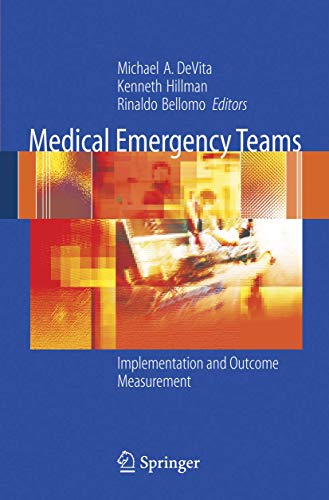
Inhaltsangabe
Why Critical Care Evolved METs? In early 2004, when Dr. Michael DeVita informed me that he was cons- ering a textbook on the new concept of Medical Emergency Teams (METs), I was surprised. At Presbyterian-University Hospital in Pittsburgh we int- duced this idea some 15 years ago, but did not think it was revolutionary enough to publish. This, even though, our fellows in critical care medicine training were all involved and informed about the importance of “C- dition C (Crisis),” as it was called to distinguish it from “Condition A (Arrest). ”We thought it absurd to intervene only after cardiac arrest had occurred,because most cases showed prior deterioration and cardiac arrest could be prevented with rapid team work to correct precluding problems. The above thoughts were logical in Pittsburgh, where the legendary Dr. Peter Safar had been working since the late 1950s on improving current resuscitation techniques, ?rst ventilation victims of apneic from drowning, treatment of smoke inhalation, and so on. This was followed by external cardiac compression upon demonstration of its ef?ciency in cases of unexpected sudden cardiac arrest. Dr. Safar devoted his entire professional life to improvement of cardiopulmonary resuscitation. He and many others emphasized the importance of getting the CPR team to o- of-hospital victims of cardiac arrest as quickly as possible.
Die Inhaltsangabe kann sich auf eine andere Ausgabe dieses Titels beziehen.
Suchergebnisse für Medical Emergency Teams: Implementation and Outcome...

Beispielbild für diese ISBN
Medical Emergency Teams: Implementation and Outcome Measurement
Anbieter: ThriftBooks-Atlanta, AUSTELL, GA, USA
Verkäuferbewertung 5 von 5 Sternen

Paperback. Zustand: Good. No Jacket. Pages can have notes/highlighting. Spine may show signs of wear. ~ ThriftBooks: Read More, Spend Less. Artikel-Nr. G0387279202I3N00
Gebraucht kaufen
EUR 14,42
Versand gratis
Versand innerhalb von USA
Versand innerhalb von USA
Anzahl: 1 verfügbar
Beispielbild für diese ISBN
Medical Emergency Teams: Implementation And Outcome Measurement
Anbieter: Romtrade Corp., STERLING HEIGHTS, MI, USA
Verkäuferbewertung 5 von 5 Sternen
Zustand: New. This is a Brand-new US Edition. This Item may be shipped from US or any other country as we have multiple locations worldwide. Artikel-Nr. ABBB-166059
Beispielbild für diese ISBN
Medical Emergency Teams
Anbieter: Majestic Books, Hounslow, Vereinigtes Königreich
Verkäuferbewertung 4 von 5 Sternen

Zustand: New. pp. 318 50 Illus. Artikel-Nr. 7598607
Neu kaufen
EUR 46,42
EUR 7,58 Versand
Versand von Vereinigtes Königreich nach USA
Versand von Vereinigtes Königreich nach USA
Anzahl: 1 verfügbar
Beispielbild für diese ISBN
Medical Emergency Teams
Anbieter: Biblios, Frankfurt am main, HESSE, Deutschland
Verkäuferbewertung 4 von 5 Sternen
Zustand: Used. pp. 318. Artikel-Nr. 18282074
Gebraucht kaufen
EUR 49,78
EUR 9,95 Versand
Versand von Deutschland nach USA
Versand von Deutschland nach USA
Anzahl: 1 verfügbar
Beispielbild für diese ISBN
Medical Emergency Teams: Implementation and Outcome Measurement
Anbieter: Ria Christie Collections, Uxbridge, Vereinigtes Königreich
Verkäuferbewertung 5 von 5 Sternen
Zustand: New. In English. Artikel-Nr. ria9780387279206_new
Neu kaufen
EUR 61,01
EUR 13,17 Versand
Versand von Vereinigtes Königreich nach USA
Versand von Vereinigtes Königreich nach USA
Anzahl: Mehr als 20 verfügbar
Foto des Verkäufers
Medical Emergency Teams
Verlag:
Springer New York, 2005
ISBN 10: 0387279202
ISBN 13: 9780387279206
Neu
Kartoniert / Broschiert
Anbieter: moluna, Greven, Deutschland
Verkäuferbewertung 5 von 5 Sternen
Kartoniert / Broschiert. Zustand: New. Artikel-Nr. 5909669
Neu kaufen
EUR 64,08
EUR 48,99 Versand
Versand von Deutschland nach USA
Versand von Deutschland nach USA
Anzahl: Mehr als 20 verfügbar
Foto des Verkäufers
Medical Emergency Teams : Implementation and Outcome Measurement
Anbieter: AHA-BUCH GmbH, Einbeck, Deutschland
Verkäuferbewertung 5 von 5 Sternen
Taschenbuch. Zustand: Neu. Neuware - Why Critical Care Evolved METs In early 2004, when Dr. Michael DeVita informed me that he was cons- ering a textbook on the new concept of Medical Emergency Teams (METs), I was surprised. At Presbyterian-University Hospital in Pittsburgh we int- duced this idea some 15 years ago, but did not think it was revolutionary enough to publish. This, even though, our fellows in critical care medicine training were all involved and informed about the importance of 'C- dition C (Crisis),' as it was called to distinguish it from 'Condition A (Arrest). 'We thought it absurd to intervene only after cardiac arrest had occurred,because most cases showed prior deterioration and cardiac arrest could be prevented with rapid team work to correct precluding problems. The above thoughts were logical in Pittsburgh, where the legendary Dr. Peter Safar had been working since the late 1950s on improving current resuscitation techniques, rst ventilation victims of apneic from drowning, treatment of smoke inhalation, and so on. This was followed by external cardiac compression upon demonstration of its ef ciency in cases of unexpected sudden cardiac arrest. Dr. Safar devoted his entire professional life to improvement of cardiopulmonary resuscitation. He and many others emphasized the importance of getting the CPR team to o- of-hospital victims of cardiac arrest as quickly as possible. Artikel-Nr. 9780387279206
Neu kaufen
EUR 121,74
EUR 30,50 Versand
Versand von Deutschland nach USA
Versand von Deutschland nach USA
Anzahl: 2 verfügbar