
Verwandte Artikel zu What Dying People Want: Lessons for Living from People...
Inhaltsangabe
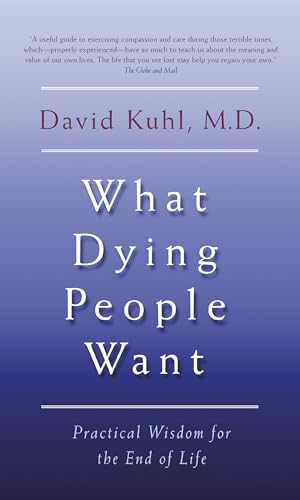
In What Dying People Want internationally renowned palliative care physician Dr. David Kuhl offers a profound and practical book about living with a terminal illness.
Facing death, and the fear and anxiety that arise from it, is part of the human experience. Though much has been done to address the physical pain suffered by those with a terminal illness, western medicine has been slow to understand and alleviate the psychological and spiritual distress that comes with the knowledge of death. In What Dying People Want, Dr. Kuhl begins to bridge that gap.
Dr. Kuhl shows us that we can learn lessons in living from those who are dying, and that it is possible to find meaning and peace in the face of death.
What Dying People Want includes:
• Ways to enhance the doctor/patient relationship
• Guidance on how to hold a family meeting
• An introduction to the process of life review
• Direction in listening and in speaking your truth
“This book started with a research question: What is the daily experience of living with a terminal illness? How does that experience affect your sense of self, your relationship with others, and your understanding of the spiritual? Many of those I interviewed asked me to share what they had given me with others who would follow—those with a terminal illness as well as their friends and family members who would care for them and about them. They asked specifically that I write a book for a general audience, and not only for my colleagues in the medical profession. This is the book that grew out of that research.” —Dr. David Kuhl
Die Inhaltsangabe kann sich auf eine andere Ausgabe dieses Titels beziehen.
Über die Autorin bzw. den Autor
Dr. David Kuhl is the Mohammad H. Mohseni Foundation Chair in Men's Health, Integrity and Wellbeing at Vancouver Coastal Health. He is a professor in the Faculty of Medicine at the University of British Columbia, and his research findings inform the development of clinical programs for community-based organizations across Canada and internationally, where they are applied and delivered by Blueprint, a nonprofit society he co-founded. He worked for a number of years in palliative care, providing medical care for people with cancer in his private practice. He later developed a palliative care program for persons with cancer and AIDS at St. Paul's Hospital in Vancouver. He lives in Vancouver with his family.
Auszug. © Genehmigter Nachdruck. Alle Rechte vorbehalten.
Introduction
Facing Death
Talking about dying is very difficult. We are afraid that talking about death beckons it. We all know death in inevitable; death fascinates and disturbs us; but we don't want it to happen. Maybe, we think, if we don't talk about death, death might not notice us. Maybe if we ignore death, we might delay or even elude it.
For more than fifteen years I have worked, as a doctor, with people who were dying. They taught me many things -- for example, that I didn't know how to talk to them about ding. And peculiar as it may seem, they taught me a lot about living.
Ten years ago, I sat next to a dying woman and wondered about the pain she was experiencing. Her name was Alice. She had cancer. She had been on the palliative care unit of St. Paul's Hospital for a considerable amount of time, and I felt that I knew her well. Every day I went in to hear her report of the nagging pain in her chest. It was no surprise that she had such pain, for she had lung cancer -- inoperable, untreatable lung cancer. But very often we could control patients' pain with medication. Alice's pain seemed not to respond to anything we tried. I experienced a growing sense of frustration and an increasing wish to avoid witnessing her pain. Her anguish was so real, so apparent in her eyes and in the tone of her voice. I didn't want to give in to the sense of emerging incompetence I felt about not being able to help her. Alice was facing death and I was facing a sense of failure.
Team members asked, "Isn't there anything else we can do -- increase her medication, add another drug, call in the music therapist, pastoral care, or perhaps physiotherapy?" The team had cared for many other people with lung cancer. Those people were testimony to the fact that cancer pain could be controlled, shortness of breath usually managed. Logically, we could only assume that Alice's pain was just like that of the other patients, and yet its effect on her was very different.This seemed to be a rare case of pain that could not be controlled. What were we missing? What was different about Alice? What was I to do? How could I understand and treat this woman's pain in a way that could free her of it or at least reduce her suffering?
With a sense of desperation, I entered her room one more time. Her grimace told me that she was still in terrible pain. I decided to ask a question I had never asked a patient before. Holding Alice's hand, I said: "We haven't been too successful in decreasing your pain. I wonder whether it's a possibility that the pain in your chest isn't a pain that's coming from the cancer. I have a sense that it is a pain in your heart, one I can't touch." Her eyes told me that I had said something that rang true for her. She said "Yes, the pain is in my heart. It has to do with my daughter, Ruth. She is marrying a man I do not approve of, and I told her so. My daughter, my only child, did not want to hear that message. I had to tell her because by the time she realizes that he's no good for her, I will no longer be alive. I don't expect ever to be free of this pain, and what's more, unless circumstances change for Ruth, I don't want this pain to be taken away." As we talked, it became clear that she was relieved to finally be speaking with someone about her "real" pain.
Caring for Alice resulted in an "Aha!" for me. As soon as she responded to my question, I knew that unless the situation changed between her and her daughter, Alice would die suffering the loss of relationship with her only child. There were no medications for the anguish she was feeling. It was preposterous of me to think that I could affect the pain that had resulted from a broken relationship between a mother and her daughter.
Alice, like others before her and many since, taught me that dying is more than just a physical event. It is a process that includes one's whole being -- physical, psychological, and spiritual. But Alice's situation resulted in a new insight for me, namely, that I was ill-equipped as a palliative care physician to address or understand what psychological and spiritual pain was all about. Medical school and residency training had not prepared me to meet that challenge. The best I could do was to acknowledge that her pain experience was beyond my skill and training at that time. Why had it been so difficult for me to ask Alice about the "pain in her heart"? Why had it taken me so long to recognize the complexity of her pain? We actually experienced similar emotions (similar in kind but not in degree): her sense of failure as a mother, my sense of failure as a palliative car physician; her anxiety ;about dying, my anxiety about being incompetent. We also shared a deep sense of relief that the unspeakable had finally been spoken.
Alice also taught me that dying is hard work and that for the most part dying includes suffering, some of which may never be resolved. Interestingly, my grandfather said the same thing. He spent the last days of his life in an extended care facility. It was there that he said, "Dying is hard work -- not the physical part, but that part which is the inside of me, the work about who I am, who I have been, and who I will be." Dying presents a challenge we would rather avoid or ignore.
Alice longed for a peaceful death, a time of serenity and completeness. At times, she did appear to experience the peace she longed for. There were also times of grief, anger, and sadness. People who are dying experience all the emotions people feel through the course of a lifetime. As much as they might know fear, loneliness, guilt, shame, and despair, they can also experience hope, joy, and intimacy. Dying is not void of the painful emotion we experience in living. At the same time, dying, like living, presents opportunity for personal growth and development. Dying involved choice. And for some people, the moment of realizing that death is inevitable, that their time is limited, marks the beginning of a new way of being. People generally die as they have lived. They can choose to embrace a particular event, or exist passively as though the inevitable -- in this case death -- is avoidable.
„Über diesen Titel“ kann sich auf eine andere Ausgabe dieses Titels beziehen.
Suchergebnisse für What Dying People Want: Lessons for Living from People...

Beispielbild für diese ISBN
What Dying People Want : Lessons for Living from People Who Are Dying
Verlag:
Anchor Canada, 2003
ISBN 10: 0385658842
ISBN 13: 9780385658843
Gebraucht
Softcover
Erstausgabe
Anbieter: Better World Books: West, Reno, NV, USA
Verkäuferbewertung 5 von 5 Sternen

Zustand: Very Good. First Edition. Pages intact with possible writing/highlighting. Binding strong with minor wear. Dust jackets/supplements may not be included. Stock photo provided. Product includes identifying sticker. Better World Books: Buy Books. Do Good. Artikel-Nr. 4316313-75
Gebraucht kaufen
EUR 6,20
Versand gratis
Versand innerhalb von USA
Versand innerhalb von USA
Anzahl: 1 verfügbar
Beispielbild für diese ISBN
What Dying People Want : Lessons for Living from People Who Are Dying
Verlag:
Anchor Canada, 2003
ISBN 10: 0385658842
ISBN 13: 9780385658843
Gebraucht
Softcover
Erstausgabe
Anbieter: Better World Books, Mishawaka, IN, USA
Verkäuferbewertung 5 von 5 Sternen
Zustand: Good. First Edition. Pages intact with minimal writing/highlighting. The binding may be loose and creased. Dust jackets/supplements are not included. Stock photo provided. Product includes identifying sticker. Better World Books: Buy Books. Do Good. Artikel-Nr. 9005289-6
Gebraucht kaufen
EUR 6,20
Versand gratis
Versand innerhalb von USA
Versand innerhalb von USA
Anzahl: 1 verfügbar
Beispielbild für diese ISBN
What Dying People Want: Lessons for Living from People Who Are Dying
Anbieter: ThriftBooks-Atlanta, AUSTELL, GA, USA
Verkäuferbewertung 5 von 5 Sternen
Paperback. Zustand: Fair. No Jacket. Readable copy. Pages may have considerable notes/highlighting. ~ ThriftBooks: Read More, Spend Less. Artikel-Nr. G0385658842I5N00
Gebraucht kaufen
EUR 6,61
Versand gratis
Versand innerhalb von USA
Versand innerhalb von USA
Anzahl: 1 verfügbar
Beispielbild für diese ISBN
What Dying People Want: Lessons for Living from People Who Are Dying
Anbieter: Revaluation Books, Exeter, Vereinigtes Königreich
Verkäuferbewertung 5 von 5 Sternen
Paperback. Zustand: Brand New. 352 pages. 5.25x0.90x8.65 inches. In Stock. Artikel-Nr. __0385658842
Neu kaufen
EUR 42,40
EUR 11,94 Versand
Versand von Vereinigtes Königreich nach USA
Versand von Vereinigtes Königreich nach USA
Anzahl: 1 verfügbar