
Verwandte Artikel zu On Desperate Ground: The Marines at The Reservoir,...
Inhaltsangabe
"Superb...A masterpiece of thorough research, deft pacing and arresting detail...This war story — the fight to break out of a frozen hell near the Chosin Reservoir — has been told many times before. But Sides tells it exceedingly well, with fresh research, gritty scenes and cinematic sweep."—Washington Post
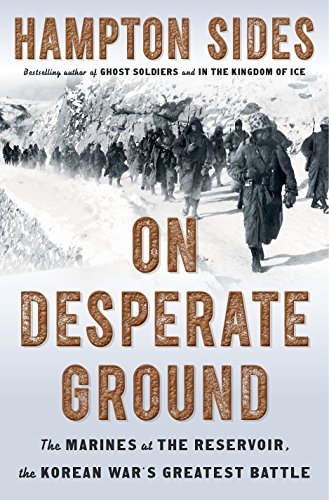
From the New York Times bestselling author of Ghost Soldiers and In the Kingdom of Ice, a chronicle of the extraordinary feats of heroism by Marines called on to do the impossible during the greatest battle of the Korean War
On October 15, 1950, General Douglas MacArthur, Supreme Commander of UN troops in Korea, convinced President Harry Truman that the Communist forces of Kim Il-sung would be utterly defeated by Thanksgiving. The Chinese, he said with near certainty, would not intervene in the war.
As he was speaking, 300,000 Red Chinese soldiers began secretly crossing the Manchurian border. Led by some 20,000 men of the First Marine Division, the Americans moved deep into the snowy mountains of North Korea, toward the trap Mao had set for the vainglorious MacArthur along the frozen shores of the Chosin Reservoir. What followed was one of the most heroic--and harrowing--operations in American military history, and one of the classic battles of all time. Faced with probable annihilation, and temperatures plunging to 20 degrees below zero, the surrounded, and hugely outnumbered, Marines fought through the enemy forces with ferocity, ingenuity, and nearly unimaginable courage as they marched their way to the sea.
Hampton Sides' superb account of this epic clash relies on years of archival research, unpublished letters, declassified documents, and interviews with scores of Marines and Koreans who survived the siege. While expertly detailing the follies of the American leaders, On Desperate Ground is an immediate, grunt's-eye view of history, enthralling in its narrative pace and powerful in its portrayal of what ordinary men are capable of in the most extreme circumstances.
Hampton Sides has been hailed by critics as one of the best nonfiction writers of his generation. As the Miami Herald wrote, "Sides has a novelist's eye for the propulsive elements that lend momentum and dramatic pace to the best nonfiction narratives."
Die Inhaltsangabe kann sich auf eine andere Ausgabe dieses Titels beziehen.
Über die Autorin bzw. den Autor
HAMPTON SIDES is an award-winning editor of Outside and the author of the bestselling histories In the Kingdom of Ice, Hellhound on His Trail, Blood and Thunder, and Ghost Soldiers, which won the PEN Award for Nonfiction. A past fellow of the Santa Fe Institute, he teaches narrative non-fiction at Colorado College.
Auszug. © Genehmigter Nachdruck. Alle Rechte vorbehalten.
Prologue
Morning Calm
In the misting rain, they pressed against the metal skins of their boats and peeked over the gunwales for a glimpse of the shores they were about to attack. Some thirteen thousand men of the First Marine Division, the spearhead of the invasion, had clambered down from the ships on swinging nets of rope and then had crammed themselves into a motley flotilla of craft that now wallowed and bobbed in the channel. Several of the rusty old hulks, having been commandeered from Japanese trawlermen, smelled of sour urine and rotten fish heads. The Marines, many of them green from seasickness, saw the outlines of the charred foothills that rose above the port, and caught the scent of the brackish marshes and the slime of the mudflats. Corsairs, bent-winged like swallows, dove over the city, dropping thousand-pound bombs and sending five-inch rockets deep into hillside nests where the enemy was said to be dug in. Far out at sea, the naval guns rained fire upon the city, damaging tanks of butane that now flared and belched palls of smoke.
On this warm, humid morning of September 15, 1950, the Marines had arrived at their destination halfway around the world, to stun their foe and turn the war around: a surprise amphibious attack, on an immense scale, deep behind the battle lines. Only a few months before, these young men, fresh from their farms and hick towns, had piled into chartered trains and clattered across America to California. Then they climbed aboard transport ships, where many of them did their basic training, learning how to strip and rebuild M1 rifles, drilling on the crowded decks, practicing their marksmanship on floating targets towed from the fantails. They crossed the Pacific and stopped briefly in Japan, then heaved their way through a full-scale typhoon. They rounded the peninsula and moved in convoy up the west coast, through the silted waters of the Yellow Sea.
By the thirteenth of September the ships had begun to concentrate, 261 vessels in all, carrying more than 75,000 men and millions of dollars’ worth of war matériel. On the fourteenth, the armada was closing in on its target: the narrow confines of Flying Fish Channel. The channel led to Inchon, an industrial city of a quarter million people, whose strategically vital but treacherous port served the capital, Seoul.
On the morning of the fifteenth, in the seas west of Inchon, the ships ranged along the horizon, a long line of gray bars stitching through the mist. First came the destroyers Swenson, Mansfield, DeHaven. Then the high-speed transports Wantuck, Horace A. Bass, Diachenko, and the dock landing ship Fort Marion. Then the heavy cruisers Toledo and Rochester and three more destroyers: Gurke, Henderson, and Collett. Following in their mingled wakes came the British light cruisers Kenya and Jamaica, the attack transports Cavalier and Henrico. Farther out at sea lay the fast carriers, from which the Corsairs rose into the skies to make their deadly sorties.
By afternoon, as the Marines drew near the Inchon seawall, enemy rounds zinged across the water surface and mortar shells crashed haphazardly all around. Within a few minutes the Marines would reach the cut-granite ramparts. They would climb over, and they would set foot on the western shores of central Korea.
What was Korea to these young men? Some fate-ravaged place, an inflamed appendix, a wattle of real estate flapping off the face of the mainland. Though some of the units approaching Inchon had spent the past month bolstering United Nations forces at the southern tip of Korea, most of the First Marine Division had no experience with the country. They had little knowledge of Korea’s tragic history, no appreciation for how faithfully this proud culture had held on through centuries of turmoil and besiegement. It was a small nation that history had pushed around—a shrimp among whales. The Mongols had had their way with her, the Manchus, the Russians, the Japanese. Now had come the Americans, nervous young men who knew next to nothing about the place, though some had passed around guidebooks filched from hometown libraries.
Korea, they’d learned, was known as the Hermit Kingdom. The Land of the Morning Calm. Its national dish was a hot mess of fermented cabbage. Some Marines had read with astonishment that in parts of Korea, peasants still nourished their crops with night soil and were known to roast the occasional hound for dinner—these were some of the clichés that were passed around. Korea was said to be a dirt-poor country, mountainous, swept by Siberian winds, sultry during summer and breathtakingly cold in winter.
But what did the travel manuals really know? God created war, Twain wrote, so that Americans would learn geography, and the men of the First Marine Division were about to learn a lot about this tough, sorrowful scrap of land. While some would find a deep affinity for it, many would come to hate it, for all the things it was and for all the things it wasn’t. But to most of them, more than anything, Korea just seemed a long way from home—a long way to come to fight and bleed and die, in a war that was not officially a war, for a cause that at times was not altogether clear, for an endgame that was anybody’s guess.
The Marines had a tradition of being the first to fight, the first to kill, the first to die. They didn’t earn their reputation by asking many questions. In a few months, they would face the armies of the most populous nation on earth and would become engaged in one of the more harrowing clashes in the history of warfare. Many would never return home. But for those who survived, Korea would be forever stamped on their psyches, and on their souls. They would never forget what happened here, even if the majority of their countrymen quickly did.
Now the assault vessels angled past the pitted harbor islands of Inchon and made for the bluff face of the seawall, where the breaking surf left a ring of bone-white foam. The bullets whined and smacked in weird patterns upon the surface. A shell screamed overhead, and the Marines crouched a little tighter into the walls of their boats.
Book One: Seoul
War is the unfolding of miscalculations.
- Barbara Tuchman
1
The Professor
On the Yellow Sea
The amphibious invasion taking place off the jetties and docks of Inchon—an action officially known as Operation Chromite—was among the boldest and most technically complex engagements in modern military annals. The man who conceived the invasion, prevailing over enormous doubts in Washington, was General Douglas MacArthur, and his name would forever be associated with it. But the officer most directly responsible for executing the details of the initial landing, the unsung and largely unknown architect of the Marine assault, was in many ways MacArthur’s opposite. He was Oliver Prince Smith, commander of the First Marine Division, one of the great underrated generals in American history.
From the decks of the command ship USS Mount McKinley, Smith watched the proceedings as best he could through shifting curtains of smoke. He squinted into his field glasses as the ship heaved in the swells. In the distance, the small landing craft, having butted against the seawall, were in position. In the bow of each vessel, Marines raised a pair of scaling ladders, and the waiting boats treaded the water like enormous bugs with antennae quivering. The leathernecks began to scale the ladders and...
„Über diesen Titel“ kann sich auf eine andere Ausgabe dieses Titels beziehen.
Suchergebnisse für On Desperate Ground: The Marines at The Reservoir,...

Beispielbild für diese ISBN
On Desperate Ground: The Marines at the Reservoir, the Korean War's Greatest Battle
Anbieter: World of Books (was SecondSale), Montgomery, IL, USA
Verkäuferbewertung 5 von 5 Sternen

Hardback. Zustand: Good. Superb.A masterpiece of thorough research, deft pacing and arresting detail.This war story -- the fight to break out of a frozen hell near the Chosin Reservoir -- has been told many times before. But Sides tells it exceedingly well, with fresh research, gritty scenes and cinematic sweep.--Washington Post From the New York Times bestselling author of Ghost Soldiers and In the Kingdom of Ice, a chronicle of the extraordinary feats of heroism by Marines called on to do the impossible during the greatest battle of the Korean War On October 15, 1950, General Douglas MacArthur, Supreme Commander of UN troops in Korea, convinced President Harry Truman that the Communist forces of Kim Il-sung would be utterly defeated by Thanksgiving. The Chinese, he said with near certainty, would not intervene in the war. As he was speaking, 300,000 Red Chinese soldiers began secretly crossing the Manchurian border. Led by some 20,000 men of the First Marine Division, the Americans moved deep into the snowy mountains of North Korea, toward the trap Mao had set for the vainglorious MacArthur along the frozen shores of the Chosin Reservoir. What followed was one of the most heroic--and harrowing--operations in American military history, and one of the classic battles of all time. Faced with probable annihilation, and temperatures plunging to 20 degrees below zero, the surrounded, and hugely outnumbered, Marines fought through the enemy forces with ferocity, ingenuity, and nearly unimaginable courage as they marched their way to the sea. Hampton Sides' superb account of this epic clash relies on years of archival research, unpublished letters, declassified documents, and interviews with scores of Marines and Koreans who survived the siege. While expertly detailing the follies of the American leaders, On Desperate Ground is an immediate, grunt's-eye view of history, enthralling in its narrative pace and powerful in its portrayal of what ordinary men are capable of in the most extreme circumstances. Hampton Sides has been hailed by critics as one of the best nonfiction writers of his generation. As the Miami Herald wrote, Sides has a novelist's eye for the propulsive elements that lend momentum and dramatic pace to the best nonfiction narratives. Artikel-Nr. 00105567369
Gebraucht kaufen
EUR 6,41
Versand gratis
Versand innerhalb von USA
Versand innerhalb von USA
Anzahl: 11 verfügbar
Beispielbild für diese ISBN
On Desperate Ground: The Marines at the Reservoir, the Korean War's Greatest Battle
Anbieter: World of Books (was SecondSale), Montgomery, IL, USA
Verkäuferbewertung 5 von 5 Sternen
Hardback. Zustand: Fair. Superb.A masterpiece of thorough research, deft pacing and arresting detail.This war story -- the fight to break out of a frozen hell near the Chosin Reservoir -- has been told many times before. But Sides tells it exceedingly well, with fresh research, gritty scenes and cinematic sweep.--Washington Post From the New York Times bestselling author of Ghost Soldiers and In the Kingdom of Ice, a chronicle of the extraordinary feats of heroism by Marines called on to do the impossible during the greatest battle of the Korean War On October 15, 1950, General Douglas MacArthur, Supreme Commander of UN troops in Korea, convinced President Harry Truman that the Communist forces of Kim Il-sung would be utterly defeated by Thanksgiving. The Chinese, he said with near certainty, would not intervene in the war. As he was speaking, 300,000 Red Chinese soldiers began secretly crossing the Manchurian border. Led by some 20,000 men of the First Marine Division, the Americans moved deep into the snowy mountains of North Korea, toward the trap Mao had set for the vainglorious MacArthur along the frozen shores of the Chosin Reservoir. What followed was one of the most heroic--and harrowing--operations in American military history, and one of the classic battles of all time. Faced with probable annihilation, and temperatures plunging to 20 degrees below zero, the surrounded, and hugely outnumbered, Marines fought through the enemy forces with ferocity, ingenuity, and nearly unimaginable courage as they marched their way to the sea. Hampton Sides' superb account of this epic clash relies on years of archival research, unpublished letters, declassified documents, and interviews with scores of Marines and Koreans who survived the siege. While expertly detailing the follies of the American leaders, On Desperate Ground is an immediate, grunt's-eye view of history, enthralling in its narrative pace and powerful in its portrayal of what ordinary men are capable of in the most extreme circumstances. Hampton Sides has been hailed by critics as one of the best nonfiction writers of his generation. As the Miami Herald wrote, Sides has a novelist's eye for the propulsive elements that lend momentum and dramatic pace to the best nonfiction narratives. Artikel-Nr. 00105352050
Gebraucht kaufen
EUR 6,41
Versand gratis
Versand innerhalb von USA
Versand innerhalb von USA
Anzahl: 5 verfügbar
Beispielbild für diese ISBN
On Desperate Ground: The Marines at The Reservoir, the Korean War's Greatest Battle
Anbieter: Wonder Book, Frederick, MD, USA
Verkäuferbewertung 5 von 5 Sternen
Zustand: Good. Good condition. Good dust jacket. A copy that has been read but remains intact. May contain markings such as bookplates, stamps, limited notes and highlighting, or a few light stains. Artikel-Nr. J09A-02635
Gebraucht kaufen
EUR 6,42
Versand gratis
Versand innerhalb von USA
Versand innerhalb von USA
Anzahl: 1 verfügbar
Beispielbild für diese ISBN
On Desperate Ground: The Marines at the Reservoir, the Korean War's Greatest Battle
Anbieter: ThriftBooks-Atlanta, AUSTELL, GA, USA
Verkäuferbewertung 5 von 5 Sternen
Hardcover. Zustand: Fair. No Jacket. Former library book; Readable copy. Pages may have considerable notes/highlighting. ~ ThriftBooks: Read More, Spend Less. Artikel-Nr. G0385541155I5N10
Gebraucht kaufen
EUR 6,56
Versand gratis
Versand innerhalb von USA
Versand innerhalb von USA
Anzahl: 1 verfügbar
Beispielbild für diese ISBN
On Desperate Ground: The Marines at the Reservoir, the Korean War's Greatest Battle
Anbieter: ThriftBooks-Dallas, Dallas, TX, USA
Verkäuferbewertung 5 von 5 Sternen
Hardcover. Zustand: Good. No Jacket. Pages can have notes/highlighting. Spine may show signs of wear. ~ ThriftBooks: Read More, Spend Less. Artikel-Nr. G0385541155I3N00
Gebraucht kaufen
EUR 6,56
Versand gratis
Versand innerhalb von USA
Versand innerhalb von USA
Anzahl: 1 verfügbar
Beispielbild für diese ISBN
On Desperate Ground: The Marines at the Reservoir, the Korean War's Greatest Battle
Anbieter: ThriftBooks-Dallas, Dallas, TX, USA
Verkäuferbewertung 5 von 5 Sternen
Hardcover. Zustand: Fair. No Jacket. Readable copy. Pages may have considerable notes/highlighting. ~ ThriftBooks: Read More, Spend Less. Artikel-Nr. G0385541155I5N00
Gebraucht kaufen
EUR 6,56
Versand gratis
Versand innerhalb von USA
Versand innerhalb von USA
Anzahl: 1 verfügbar
Beispielbild für diese ISBN
On Desperate Ground: The Marines at the Reservoir, the Korean War's Greatest Battle
Anbieter: ThriftBooks-Dallas, Dallas, TX, USA
Verkäuferbewertung 5 von 5 Sternen
Hardcover. Zustand: Good. No Jacket. Missing dust jacket; Pages can have notes/highlighting. Spine may show signs of wear. ~ ThriftBooks: Read More, Spend Less. Artikel-Nr. G0385541155I3N01
Gebraucht kaufen
EUR 6,56
Versand gratis
Versand innerhalb von USA
Versand innerhalb von USA
Anzahl: 1 verfügbar
Beispielbild für diese ISBN
On Desperate Ground: The Marines at the Reservoir, the Korean War's Greatest Battle
Anbieter: ThriftBooks-Atlanta, AUSTELL, GA, USA
Verkäuferbewertung 5 von 5 Sternen
Hardcover. Zustand: Good. No Jacket. Former library book; Pages can have notes/highlighting. Spine may show signs of wear. ~ ThriftBooks: Read More, Spend Less. Artikel-Nr. G0385541155I3N10
Gebraucht kaufen
EUR 6,56
Versand gratis
Versand innerhalb von USA
Versand innerhalb von USA
Anzahl: 1 verfügbar
Beispielbild für diese ISBN
On Desperate Ground: The Marines at the Reservoir, the Korean War's Greatest Battle
Anbieter: ThriftBooks-Atlanta, AUSTELL, GA, USA
Verkäuferbewertung 5 von 5 Sternen
Hardcover. Zustand: Good. No Jacket. Pages can have notes/highlighting. Spine may show signs of wear. ~ ThriftBooks: Read More, Spend Less. Artikel-Nr. G0385541155I3N00
Gebraucht kaufen
EUR 6,56
Versand gratis
Versand innerhalb von USA
Versand innerhalb von USA
Anzahl: 1 verfügbar
Beispielbild für diese ISBN
On Desperate Ground : The Marines at the Reservoir, the Korean War's Greatest Battle
Verlag:
Knopf Doubleday Publishing Group, 2018
ISBN 10: 0385541155
ISBN 13: 9780385541152
Gebraucht
Hardcover
Anbieter: Better World Books, Mishawaka, IN, USA
Verkäuferbewertung 5 von 5 Sternen
Zustand: Good. Pages intact with minimal writing/highlighting. The binding may be loose and creased. Dust jackets/supplements are not included. Stock photo provided. Product includes identifying sticker. Better World Books: Buy Books. Do Good. Artikel-Nr. 15642591-6
Gebraucht kaufen
EUR 6,92
Versand gratis
Versand innerhalb von USA
Versand innerhalb von USA
Anzahl: 8 verfügbar