
Verwandte Artikel zu To Be a Machine: Adventures Among Cyborgs, Utopians,...
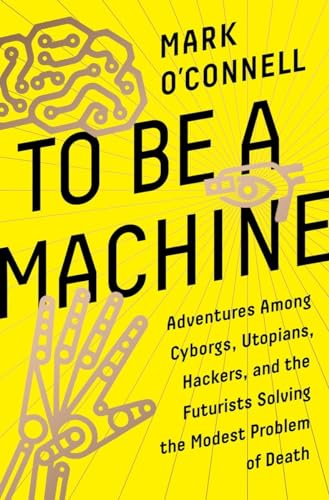
To Be a Machine: Adventures Among Cyborgs, Utopians, Hackers, and the Futurists Solving the Modest Problem of Death - Hardcover
Inhaltsangabe
“This gonzo-journalistic exploration of the Silicon Valley techno-utopians’ pursuit of escaping mortality is a breezy romp full of colorful characters.” —New York Times Book Review (Editor's Choice)
Transhumanism is a movement pushing the limits of our bodies—our capabilities, intelligence, and lifespans—in the hopes that, through technology, we can become something better than ourselves. It has found support among Silicon Valley billionaires and some of the world’s biggest businesses.
In To Be a Machine, journalist Mark O'Connell explores the staggering possibilities and moral quandaries that present themselves when you of think of your body as a device. He visits the world's foremost cryonics facility to witness how some have chosen to forestall death. He discovers an underground collective of biohackers, implanting electronics under their skin to enhance their senses. He meets a team of scientists urgently investigating how to protect mankind from artificial superintelligence.
Where is our obsession with technology leading us? What does the rise of AI mean not just for our offices and homes, but for our humanity? Could the technologies we create to help us eventually bring us to harm? Addressing these questions, O'Connell presents a profound, provocative, often laugh-out-loud-funny look at an influential movement. In investigating what it means to be a machine, he offers a surprising meditation on what it means to be human.
Die Inhaltsangabe kann sich auf eine andere Ausgabe dieses Titels beziehen.
Über die Autorin bzw. den Autor
MARK O'CONNELL is Slate's books columnist, a staff writer at The Millions, and a regular contributor to The New Yorker's "Page-Turner" blog; his work has been published in The New York Times Magazine, The New York Times Book Review, The Observer, and The Independent.
Auszug. © Genehmigter Nachdruck. Alle Rechte vorbehalten.
System Crash
All stories begin in our endings: we invent them because we die. As long as we have been telling stories, we have been telling them about the desire to escape our human bodies, to become something other than the animals we are. In our oldest written narrative, we find the Sumerian king Gilgamesh, who, distraught by the death of a friend and unwilling to accept that the same fate lies in store for him, travels to the far edge of the world in search of a cure for mortality. Long story short: no dice. Later, we find Achilles’ mother dipping him in the Styx in an effort to render him invulnerable. This, too, famously, does not pan out.
See also: Daedalus, improvised wings.
See also: Prometheus, stolen divine fire.
We exist, we humans, in the wreckage of an imagined splendor. It was not supposed to be this way: we weren’t supposed to be weak, to be ashamed, to suffer, to die. We have always had higher notions of ourselves. The whole setup—garden, serpent, fruit, banishment—was a fatal error, a system crash. We came to be what we are by way of a Fall, a retribution. This, at least, is one version of the story: the Christian story, the Western story. The point of which, on some level, is to explain ourselves to ourselves, to account for why it’s such a raw deal, this unnatural nature of ours.
“A man,” wrote Emerson, “is a god in ruins.”
Religion, more or less, arises out of this divine wreckage. And science, too—religion’s estranged half sibling—addresses itself to such animal dissatisfactions. In The Human Condition, writing in the wake of the Soviet launch of the first space satellite, Hannah Arendt reflected on the resulting sense of euphoria about escaping what one newspaper report called “men’s imprisonment to the earth.” This same yearning for escape, she wrote, manifested itself in the attempt to create superior humans from laboratory manipulations of germ plasm, to extend natural life spans far beyond their current limits. “This future man,” she wrote, “whom the scientists tell us they will produce in no more than a hundred years, seems to be possessed by a rebellion against human existence as it has been given, a free gift from nowhere (secularly speaking), which he wishes to exchange, as it were, for something he has made himself.”
A rebellion against human existence as it has been given: this is as good a way as any of attempting to encapsulate what follows, to characterize what motivates the people I came to know in the writing of this book. These people, by and large, identify with a movement known as transhumanism, a movement predicated on the conviction that we can and should use technology to control the future evolution of our species. It is their belief that we can and should eradicate aging as a cause of death; that we can and should use technology to augment our bodies and our minds; that we can and should merge with machines, remaking ourselves, finally, in the image of our own higher ideals. They wish to exchange the gift, these people, for something better, something man-made. Will it pan out? That remains to be seen.
I am not a transhumanist. That much is probably apparent, even at this early stage of the proceedings. But my fascination with the movement, with its ideas and its aims, arises out of a basic sympathy with its premise: that human existence, as it has been given, is a suboptimal system.
In an abstract sort of way, this is something I had always believed to be the case, but in the immediate aftermath of the birth of my son, I came to feel it on a visceral level. The first time I held him, three years ago now, I was overcome by a sense of the fragility of his little body—a body that had just emerged, howling and trembling and darkly smeared with blood, out of the trembling body of his mother, from whom many hours of fanatical suffering and exertion had been required to deliver him into the world. In sorrow thou shalt bring forth children. I couldn’t help but think that there ought to be a better system. I couldn’t help but think that, at this late stage, we should be beyond all this.
Here’s a thing you should not do as a new father, as you perch uneasily on a leatherette maternity ward chair beside your sleeping infant and his sleeping mother: you should not read a newspaper. I did this, and I regretted it. I sat in the postnatal ward of the National Maternity Hospital in Dublin, turning the pages of The Irish Times in gradually mounting horror, browsing through a catalog of human perversity—of massacres and rapes, of cruelties casual and systemic: splintered dispatches from a fallen world—and wondered about the wisdom of bringing a child into this mess, this species. (I seem to remember having a mild head cold at the time; this would not have helped matters.)
Among its many other effects, becoming a parent forces you to think about the nature of the problem—which is, in a lot of ways, the problem of nature. Along with all the other horrors and perversities of the broader human context, the realities of aging and sickness and mortality become suddenly inescapable. Or they did for me, at any rate. And for my wife, too, whose existence was so much more entangled with our son’s in those early months, and who said something during that time that I will never forget. “If I had known how much I was going to love him,” she said, “I’m not sure I would have had him.” The frailty is the thing, the vulnerability. This infirmity, this doubtful convalescence we refer to, for want of a better term, as the human condition. Condition: an illness or other medical problem.
For dust thou art, and unto dust shalt thou return.
In hindsight, it seems like more than mere coincidence that this was the period during which I became obsessed with an idea I’d first encountered close to a decade previously, and which was now beginning to consume my thoughts—the idea that this condition might not be our ineluctable fate. That like nearsightedness or smallpox, it might be set to rights by the intervention of human ingenuity. I was obsessed, that is, for the same reason as I had always been obsessed by the story of the Fall, and the notion of original sin: because it expressed something profoundly true about the deepest strangeness of being human, our inability to accept ourselves, our capacity to believe we might be redeemed of our nature.
Early on in the pursuit of this obsession—a pursuit that had, at that point, yet to lead beyond the Internet into what is fondly referred to as the “real world”—I came upon a strange and provocative text entitled “A Letter to Mother Nature.” It was, as its name suggested, a kind of epistolary manifesto addressed to the anthropomorphic figure to whom, for the sake of clarity, the creation and husbandry of the natural world is often attributed. The text, in an initial tone of mild passive aggression, began by thanking Mother Nature for her mostly solid work on the project of humanity thus far, for raising us from simple self-replicating chemicals to trillion-celled mammals with the capacity for self-understanding and empathy. The letter then smoothly transitioned into full J’accuse mode, briefly outlining some of the more shoddy workmanship evident in the functioning of Homo sapiens: the vulnerability to disease and injury and death, for instance, the ability to function only in highly circumscribed environmental conditions, the limited memory, the notoriously poor impulse control.
The author—addressing Mother Nature as the collective voice of her “ambitious human offspring”—then proposed a total of seven...
„Über diesen Titel“ kann sich auf eine andere Ausgabe dieses Titels beziehen.
Suchergebnisse für To Be a Machine: Adventures Among Cyborgs, Utopians,...

Beispielbild für diese ISBN
To Be a Machine: Adventures Among Cyborgs, Utopians, Hackers, and the Futurists Solving the Modest Problem of Death
Anbieter: World of Books (was SecondSale), Montgomery, IL, USA
Verkäuferbewertung 5 von 5 Sternen

Zustand: Good. Item in good condition. Textbooks may not include supplemental items i.e. CDs, access codes etc. Artikel-Nr. 00105115233
Gebraucht kaufen
EUR 4,70
Versand gratis
Versand innerhalb von USA
Versand innerhalb von USA
Anzahl: 1 verfügbar
Beispielbild für diese ISBN
To Be a Machine: Adventures Among Cyborgs, Utopians, Hackers, and the Futurists Solving the Modest Problem of Death
Anbieter: BooksRun, Philadelphia, PA, USA
Verkäuferbewertung 5 von 5 Sternen
Hardcover. Zustand: Good. With dust jacket. It's a preowned item in good condition and includes all the pages. It may have some general signs of wear and tear, such as markings, highlighting, slight damage to the cover, minimal wear to the binding, etc., but they will not affect the overall reading experience. Ex-Library. Artikel-Nr. 0385540418-11-1-12_29
Gebraucht kaufen
EUR 4,90
Versand gratis
Versand innerhalb von USA
Versand innerhalb von USA
Anzahl: 1 verfügbar
Beispielbild für diese ISBN
To Be a Machine : Adventures among Cyborgs, Utopians, Hackers, and the Futurists Solving the Modest Problem of Death
Verlag:
Knopf Doubleday Publishing Group, 2017
ISBN 10: 0385540418
ISBN 13: 9780385540414
Gebraucht
Hardcover
Anbieter: Better World Books, Mishawaka, IN, USA
Verkäuferbewertung 5 von 5 Sternen
Zustand: Very Good. Former library copy. Pages intact with possible writing/highlighting. Binding strong with minor wear. Dust jackets/supplements may not be included. Includes library markings. Stock photo provided. Product includes identifying sticker. Better World Books: Buy Books. Do Good. Artikel-Nr. 11246474-75
Gebraucht kaufen
EUR 6,77
Versand gratis
Versand innerhalb von USA
Versand innerhalb von USA
Anzahl: 3 verfügbar
Beispielbild für diese ISBN
To Be a Machine : Adventures among Cyborgs, Utopians, Hackers, and the Futurists Solving the Modest Problem of Death
Verlag:
Knopf Doubleday Publishing Group, 2017
ISBN 10: 0385540418
ISBN 13: 9780385540414
Gebraucht
Hardcover
Anbieter: Better World Books, Mishawaka, IN, USA
Verkäuferbewertung 5 von 5 Sternen
Zustand: Good. Former library copy. Pages intact with minimal writing/highlighting. The binding may be loose and creased. Dust jackets/supplements are not included. Includes library markings. Stock photo provided. Product includes identifying sticker. Better World Books: Buy Books. Do Good. Artikel-Nr. 13236748-6
Gebraucht kaufen
EUR 6,77
Versand gratis
Versand innerhalb von USA
Versand innerhalb von USA
Anzahl: 2 verfügbar
Beispielbild für diese ISBN
To Be a Machine: Adventures Among Cyborgs, Utopians, Hackers, and the Futurists Solving the Modest Problem of Death
Anbieter: ThriftBooks-Phoenix, Phoenix, AZ, USA
Verkäuferbewertung 5 von 5 Sternen
Hardcover. Zustand: Very Good. No Jacket. Former library book; May have limited writing in cover pages. Pages are unmarked. ~ ThriftBooks: Read More, Spend Less. Artikel-Nr. G0385540418I4N10
Gebraucht kaufen
EUR 6,89
Versand gratis
Versand innerhalb von USA
Versand innerhalb von USA
Anzahl: 1 verfügbar
Beispielbild für diese ISBN
To Be a Machine: Adventures Among Cyborgs, Utopians, Hackers, and the Futurists Solving the Modest Problem of Death
Anbieter: ThriftBooks-Dallas, Dallas, TX, USA
Verkäuferbewertung 5 von 5 Sternen
Hardcover. Zustand: Good. No Jacket. Pages can have notes/highlighting. Spine may show signs of wear. ~ ThriftBooks: Read More, Spend Less. Artikel-Nr. G0385540418I3N00
Gebraucht kaufen
EUR 7,49
Versand gratis
Versand innerhalb von USA
Versand innerhalb von USA
Anzahl: 1 verfügbar
Beispielbild für diese ISBN
To Be a Machine: Adventures Among Cyborgs, Utopians, Hackers, and the Futurists Solving the Modest Problem of Death
Anbieter: ThriftBooks-Atlanta, AUSTELL, GA, USA
Verkäuferbewertung 5 von 5 Sternen
Hardcover. Zustand: Good. No Jacket. Former library book; Pages can have notes/highlighting. Spine may show signs of wear. ~ ThriftBooks: Read More, Spend Less. Artikel-Nr. G0385540418I3N10
Gebraucht kaufen
EUR 7,49
Versand gratis
Versand innerhalb von USA
Versand innerhalb von USA
Anzahl: 1 verfügbar
Beispielbild für diese ISBN
To Be a Machine: Adventures Among Cyborgs, Utopians, Hackers, and the Futurists Solving the Modest Problem of Death
Anbieter: ThriftBooks-Atlanta, AUSTELL, GA, USA
Verkäuferbewertung 5 von 5 Sternen
Hardcover. Zustand: Very Good. No Jacket. Former library book; May have limited writing in cover pages. Pages are unmarked. ~ ThriftBooks: Read More, Spend Less. Artikel-Nr. G0385540418I4N10
Gebraucht kaufen
EUR 7,49
Versand gratis
Versand innerhalb von USA
Versand innerhalb von USA
Anzahl: 1 verfügbar
Beispielbild für diese ISBN
To Be a Machine: Adventures Among Cyborgs, Utopians, Hackers, and the Futurists Solving the Modest Problem of Death
Anbieter: ThriftBooks-Dallas, Dallas, TX, USA
Verkäuferbewertung 5 von 5 Sternen
Hardcover. Zustand: Good. No Jacket. Former library book; Pages can have notes/highlighting. Spine may show signs of wear. ~ ThriftBooks: Read More, Spend Less. Artikel-Nr. G0385540418I3N10
Gebraucht kaufen
EUR 7,49
Versand gratis
Versand innerhalb von USA
Versand innerhalb von USA
Anzahl: 1 verfügbar
Beispielbild für diese ISBN
To Be a Machine: Adventures Among Cyborgs, Utopians, Hackers, and the Futurists Solving the Modest Problem of Death
Anbieter: WorldofBooks, Goring-By-Sea, WS, Vereinigtes Königreich
Verkäuferbewertung 5 von 5 Sternen
Paperback. Zustand: Very Good. The book has been read, but is in excellent condition. Pages are intact and not marred by notes or highlighting. The spine remains undamaged. Artikel-Nr. GOR012406974
Gebraucht kaufen
EUR 5,80
EUR 6,69 Versand
Versand von Vereinigtes Königreich nach USA
Versand von Vereinigtes Königreich nach USA
Anzahl: 1 verfügbar