
Verwandte Artikel zu Click: The Forces Behind How We Fully Engage with People,...
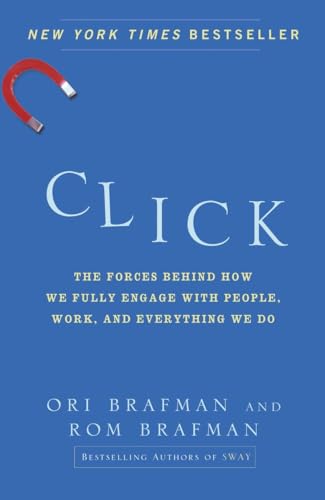
Inhaltsangabe
You know the feeling. You meet someone new—at a party or at work—and you just hit it off. There is an instant sense of camaraderie.
In a word, you “click.”
From the bestselling authors of Sway, Click is a fascinating psychological investigation of the forces behind what makes us click with certain people, or become fully immersed in whatever activity or situation we’re involved in.
From two co-workers who fall head over heels for each other while out to dinner and are married a month later (and fifteen years later remain just as in love), to a team of scientists who changed the world with the magic of their invention, these kinds of peak experiences, when our senses are completely focused on the moment, are something that individuals—and companies—strive to achieve. After all, when you’re in the “zone,” you’re happier and more productive. Why is it that we click in certain situations and with certain people, but not with others? Can this kind of magical connection be consciously encouraged? Is there a way to create such peak experiences, whether on a date or in your job?
According to Ori and Rom Brafman, there is.
In a powerful, story-driven narrative that weaves together cutting-edge research in psychology and sociology, the Brafmans explore what it means to “click”: the common factors present when our brain and senses are fully engaged. They identify five “accelerators” that increase the likelihood of these kinds of magic connections in our work and relationships.
From actors vying for a role on a popular TV series to police officers negotiating with hostage takers, we learn how one can foster an environment where we can click with another person and shape our thinking, behavior, and emotions.
A fascinating journey into how we engage with the world around us, Click will transform our thinking about those moments when we are in the zone and everything seems to fall into place.
Acclaim for Sway:
“A provocative new book about the psychological forces that lead us to disregard facts or logic and behave in surprisingly irrational ways.” –New York Times
“A unique and compulsively readable look at unseen behavioral trends.” –Fortune
"A breathtaking book that will challenge your every thought, Sway hovers above the intersection of Blink and Freakonomics."--Tom Rath, coauthor of the New York Times #1 bestseller How Full Is Your Bucket?
“[An] engaging journey through the workings—and failings—of the mind…Their stories of senselessness…are as fascinating as the lessons we learn from them.” –Fast Company
"Count me swayed--but in this instance by the pull of entirely rational forces. Ori and Rom Brafman have done a terrific job of illuminating deep-seated tendencies that skew our behavior in ways that can range from silly to deadly. We'd be fools not to learn what they have to teach us."--Robert B. Cialdini, author of New York Times bestseller Influence
"If you think you know how you think, you'd better think again! Take this insightful, delightful trip to the sweet spot where economics, psychology, and sociology converge, and you'll discover how our all-too-human minds actually work."--Alan M. Webber, founding editor of Fast Company
Die Inhaltsangabe kann sich auf eine andere Ausgabe dieses Titels beziehen.
Über die Autorin bzw. den Autor
ORI BRAFMAN is an organizational business consultant. ROM BRAFMAN is a psychologist with a private practice in Palo Alto, California. They are the coauthors of the New York Times bestseller Sway.
Auszug. © Genehmigter Nachdruck. Alle Rechte vorbehalten.
CHAPTER 1
Finding Magic
Sitting by the pool at a Pasadena hotel, Paul was about to do something impulsive, even by his standards.
The Southern California evening breeze was starting to pick up. Anyone within earshot of Paul and the woman sitting across from him at the poolside table would have thought they’d known each other for years, although the pair had met only two days prior. They talked about everything from world travel to the 1970s antiwar movement to Socratic philosophy; their conversation had a casual, easy flow to it. Watching the two of them— Nadia with her fine Mediterranean features and striking jet- black hair and Paul with his rugged, all- American looks— one had a sense that they fi t together. It was as if each was attuned to what the other was thinking. One moment they were laughing at embarrassing childhood stories and the next they were finishing each other’s sentences. If there’s such a thing as synergy between two people, it seemed almost palpable here.
One would never have suspected that the two were ostensibly meeting for work. At the time, Paul was in charge of the proposal for a $15 billion project to clean up a nuclear weapons facility in Colorado. To help put the proposal together, Paul had assembled experts from around the world. The team had taken over an office building in Pasadena; the work was so intense that the office remained open 24/7. It was Paul’s role to make sure all the countless moving parts worked together. But he was used to this level of intensity. A former officer in the army’s special forces, Paul was trained to make split- second decisions, and he has the kind of personality people instinctively respond to— he is a natural leader. In conversation, he focuses intently on the other person’s every word, making it clear he’s fully present and is listening carefully.
Every morning at exactly 8:15 a.m., Paul assembled the top executives from the team to brief them about the strategy for the day. The meeting several days ago, though, had been different. From the beginning, Paul was keenly aware of the new team member, Nadia. “I immediately thought, Who is that?” He found himself instantly attracted to her. Nadia’s initial reaction to Paul seemed to be very different, however. It was her first day on the job. Her vacation in Paris had been abruptly cut short so that she could fl y to Pasadena and take over as the project’s chief operating officer. If that hadn’t soured her mood enough, Paul made a comment during the meeting— seemingly out of left field— that soured it further.
“I uttered something about there being nothing new in human relations since the time of Plato, Aristotle, and Socrates,” he recalled. “I don’t even remember why.”
A few minutes later, as Paul stood before the group, he noticed out of the corner of his eye a folded note being passed from person to person. As he continued speaking, the note eventually made its way to him. He unfolded it and read the first line: “I completely disagree with you.” The hand- scrawled note went on for an entire page. But it was unsigned. He looked up, searching for a nod from the note’s author. But all he got were blank stares. Only after the meeting had ended and the rest of his staff had fi led out of the room did Nadia walk up to Paul.
Remembers Nadia, “Here we haven’t met yet, and I just wrote him a note that said, ‘I don’t agree with you; what about the change in master- slave relations and relationships between men and women? There have been so many advances in society since then. How can you make such a comment? I’d like to discuss this with you.’ ”
Paul, instead of becoming defensive, was intrigued. “I’d like to continue the conversation with you,” he told her.
“Anytime,” she fired back.
Twelve hours later they were sitting by the pool.
They had told themselves that they intended to use the time not just to resolve the argument but also to delve into some important work issues. Work, however, never came up during their conversation together. Toward the end of the evening, the intensity of their interaction was difficult to ignore.
“Are we going to end up getting in trouble?” Paul asked Nadia, realizing that they were letting work get away from them.
“Yes,” she said simply. It was clear to her from the beginning that there was something special between them. “The moment he made that comment about Plato and Aristotle,” she told us, “I knew. What we valued in life was very much the same, as were the things we thought were trivial. Who’s outrageous enough to even bring up Plato and Aristotle in the middle of a strategy session? I mean, what does anybody who’s in there know about Plato and the Greeks, or care about them? He had that courage to be different.”
Having accomplished little of the work they had been planning to do, the pair decided to meet again the following night by the pool. And it was then that it happened. Paul looked at Nadia and asked, “What would you say if I told you that I loved you and wanted to marry you?”
Nadia retorted, “Is that a hypothetical or is that an offer?”
Paul said, “Let’s see what tomorrow brings.”
Let’s hit the pause button here. First, it’s worth noting that Paul and Nadia weren’t teenagers driven by hyperactive hormones. They were seasoned business executives. Like most of us, when they met a new person, they usually spent their first moments sizing each other up, searching for something to talk about: Where are you from? What kind of work do you do?
Occasionally, though, an introduction to someone new is more intense and intimate from the get- go. Maybe we share the same sense of humor or we admire the other individual’s personality or passion. Or we immediately sense that we can just be ourselves around that person. Things feel right; we hit it off. There is an immediate sense of familiarity and comfort. Conversation flows easily, without embarrassing pauses or self- consciousness. In essence, we click.
This book is about those mysterious moments— when we click in life. Those moments when we are fully engaged and feel a certain natural chemistry or connection with a person, place, or activity.
In its simplest terms, clicking can be defined as an immediate, deep, and meaningful connection with another person or with the world around us. Typically, it takes weeks or months before most of us feel truly comfortable with a new person. We have to gain the other person’s trust, and he or she needs to gain ours. We need to find a common language, understand each other’s quirks, and establish an emotional bond. But sometimes this process is greatly accelerated, and the connection seems to form almost magically and instantaneously.
But this type of immediate, deep connection isn’t limited to romantic love. Clicking can be equally deep and meaningful between future friends and can strike in the most unlikely of places.
For Jim West...
„Über diesen Titel“ kann sich auf eine andere Ausgabe dieses Titels beziehen.
Suchergebnisse für Click: The Forces Behind How We Fully Engage with People,...

Beispielbild für diese ISBN
Click: The Forces Behind How We Fully Engage with People, Work, and Everything We Do
Anbieter: World of Books (was SecondSale), Montgomery, IL, USA
Verkäuferbewertung 5 von 5 Sternen

Zustand: Very Good. Item in very good condition! Textbooks may not include supplemental items i.e. CDs, access codes etc. Artikel-Nr. 00098089378
Gebraucht kaufen
EUR 4,43
Versand gratis
Versand innerhalb von USA
Versand innerhalb von USA
Anzahl: 4 verfügbar
Beispielbild für diese ISBN
Click: The Forces Behind How We Fully Engage with People, Work, and Everything We Do
Anbieter: World of Books (was SecondSale), Montgomery, IL, USA
Verkäuferbewertung 5 von 5 Sternen
Zustand: Good. Item in good condition. Textbooks may not include supplemental items i.e. CDs, access codes etc. Artikel-Nr. 00061496706
Gebraucht kaufen
EUR 4,43
Versand gratis
Versand innerhalb von USA
Versand innerhalb von USA
Anzahl: 5 verfügbar
Beispielbild für diese ISBN
Click: The Forces Behind How We Fully Engage with People, Work, and Everything We Do
Anbieter: World of Books (was SecondSale), Montgomery, IL, USA
Verkäuferbewertung 5 von 5 Sternen
Zustand: Acceptable. Item in acceptable condition! Textbooks may not include supplemental items i.e. CDs, access codes etc. Artikel-Nr. 00097742924
Gebraucht kaufen
EUR 4,43
Versand gratis
Versand innerhalb von USA
Versand innerhalb von USA
Anzahl: 1 verfügbar
Beispielbild für diese ISBN
Click: The Forces Behind How We Fully Engage with People, Work, and Everything We Do
Anbieter: BooksRun, Philadelphia, PA, USA
Verkäuferbewertung 5 von 5 Sternen
Paperback. Zustand: Very Good. It's a well-cared-for item that has seen limited use. The item may show minor signs of wear. All the text is legible, with all pages included. It may have slight markings and/or highlighting. Artikel-Nr. 0385529066-11-1
Gebraucht kaufen
EUR 4,44
Versand gratis
Versand innerhalb von USA
Versand innerhalb von USA
Anzahl: 3 verfügbar
Beispielbild für diese ISBN
Click: The Forces Behind How We Fully Engage with People, Work, and Everything We Do
Anbieter: ThriftBooks-Reno, Reno, NV, USA
Verkäuferbewertung 5 von 5 Sternen
Paperback. Zustand: Very Good. No Jacket. May have limited writing in cover pages. Pages are unmarked. ~ ThriftBooks: Read More, Spend Less. Artikel-Nr. G0385529066I4N00
Gebraucht kaufen
EUR 5,94
Versand gratis
Versand innerhalb von USA
Versand innerhalb von USA
Anzahl: 1 verfügbar
Beispielbild für diese ISBN
Click: The Forces Behind How We Fully Engage with People, Work, and Everything We Do
Anbieter: ThriftBooks-Atlanta, AUSTELL, GA, USA
Verkäuferbewertung 5 von 5 Sternen
Paperback. Zustand: Very Good. No Jacket. May have limited writing in cover pages. Pages are unmarked. ~ ThriftBooks: Read More, Spend Less. Artikel-Nr. G0385529066I4N00
Gebraucht kaufen
EUR 5,97
Versand gratis
Versand innerhalb von USA
Versand innerhalb von USA
Anzahl: 1 verfügbar
Beispielbild für diese ISBN
Click: The Forces Behind How We Fully Engage with People, Work, and Everything We Do
Anbieter: ThriftBooks-Dallas, Dallas, TX, USA
Verkäuferbewertung 5 von 5 Sternen
Paperback. Zustand: Very Good. No Jacket. May have limited writing in cover pages. Pages are unmarked. ~ ThriftBooks: Read More, Spend Less. Artikel-Nr. G0385529066I4N00
Gebraucht kaufen
EUR 5,97
Versand gratis
Versand innerhalb von USA
Versand innerhalb von USA
Anzahl: 1 verfügbar
Beispielbild für diese ISBN
Click: The Forces Behind How We Fully Engage with People, Work, and Everything We Do
Anbieter: Wonder Book, Frederick, MD, USA
Verkäuferbewertung 5 von 5 Sternen
Zustand: Good. Good condition. A copy that has been read but remains intact. May contain markings such as bookplates, stamps, limited notes and highlighting, or a few light stains. Artikel-Nr. X13I-00276
Gebraucht kaufen
EUR 6,33
Versand gratis
Versand innerhalb von USA
Versand innerhalb von USA
Anzahl: 1 verfügbar
Beispielbild für diese ISBN
Click : The Forces Behind How We Fully Engage with People, Work, and Everything We Do
Verlag:
Crown Publishing Group, The, 2011
ISBN 10: 0385529066
ISBN 13: 9780385529068
Gebraucht
Softcover
Anbieter: Better World Books, Mishawaka, IN, USA
Verkäuferbewertung 5 von 5 Sternen
Zustand: Good. Pages intact with minimal writing/highlighting. The binding may be loose and creased. Dust jackets/supplements are not included. Stock photo provided. Product includes identifying sticker. Better World Books: Buy Books. Do Good. Artikel-Nr. 5602154-6
Gebraucht kaufen
EUR 8,22
Versand gratis
Versand innerhalb von USA
Versand innerhalb von USA
Anzahl: 2 verfügbar
Beispielbild für diese ISBN
Click: The Forces Behind How We Fully Engage with People, Work, and Everything We Do
Anbieter: Sell Books, Elland, YORKS, Vereinigtes Königreich
Verkäuferbewertung 5 von 5 Sternen
paperback. Zustand: Good. Our good condition books are generally good for reading but not for gifting or collecting. They could have imperfections such as creasing, fanning, inscriptions, margin notes, yellowing, staining on edge or cover or pages, bumps, scuffs, etc etc (sometimes multiple of these). It's a wide category that encompasses anything that isn't almost-new down to anything that is slightly better than poor. We would NOT recommend gifting Good books - these should be considered reading copies. Our books are dispatched from a Yorkshire former cotton mill. We list via barcode/ISBN so please note that the images are stock images and may not be the exact copy you receive, furthermore the details about edition and year might not be accurate as many publishers reuse the same ISBN for multiple editions and as we simply scan a barcode or enter an ISBN we do not check the validity of the edition data when listing. If you're looking for an exact edition please don't order (at least not without checking with us first, although we don't always have time to check). We aim to dispatch prompty, the service used will depend on order value and book size. We can ship to most countries, see our shipping policies. Payment is via Abe only. Artikel-Nr. L-BFL01081-RAG-20250612-G
Gebraucht kaufen
EUR 4,04
EUR 14,16 Versand
Versand von Vereinigtes Königreich nach USA
Versand von Vereinigtes Königreich nach USA
Anzahl: 1 verfügbar