
Verwandte Artikel zu Switch: How to Change Things When Change Is Hard
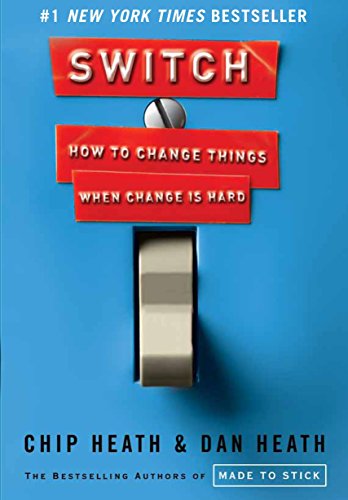
Inhaltsangabe
Why is it so hard to make lasting changes in our companies, in our communities, and in our own lives?
The primary obstacle is a conflict that's built into our brains, say Chip and Dan Heath, authors of the critically acclaimed bestseller Made to Stick. Psychologists have discovered that our minds are ruled by two different systems - the rational mind and the emotional mind—that compete for control. The rational mind wants a great beach body; the emotional mind wants that Oreo cookie. The rational mind wants to change something at work; the emotional mind loves the comfort of the existing routine. This tension can doom a change effort - but if it is overcome, change can come quickly.
In Switch, the Heaths show how everyday people - employees and managers, parents and nurses - have united both minds and, as a result, achieved dramatic results:
• The lowly medical interns who managed to defeat an entrenched, decades-old medical practice that was endangering patients
• The home-organizing guru who developed a simple technique for overcoming the dread of housekeeping
• The manager who transformed a lackadaisical customer-support team into service zealots by removing a standard tool of customer service
In a compelling, story-driven narrative, the Heaths bring together decades of counterintuitive research in psychology, sociology, and other fields to shed new light on how we can effect transformative change. Switch shows that successful changes follow a pattern, a pattern you can use to make the changes that matter to you, whether your interest is in changing the world or changing your waistline.
Die Inhaltsangabe kann sich auf eine andere Ausgabe dieses Titels beziehen.
Über die Autorin bzw. den Autor
CHIP HEATH is a professor at the Graduate School of Business at Stanford University. He lives in Los Gatos, California. DAN HEATH is a senior fellow at Duke University's Center for the Advancement of Social Entrepreneurship (CASE). He lives in Raleigh, North Carolina. The Heath brothers are the bestselling authors of Made to Stick and Switch. They write a regular column in Fast Company magazine, and have appeared on Today, NPR's Morning Edition, MSNBC, CNBC, and have been featured in Time, People and US News and World Report.
Auszug. © Genehmigter Nachdruck. Alle Rechte vorbehalten.
Chapter 1
The Three Surprises About Change
1.
One Saturday in 2000, some unsuspecting moviegoers showed up at a suburban theater in Chicago to catch a 1:05 P.M matinee of Mel Gibson's action flick Payback. They were handed a soft drink and a free bucket of popcorn and asked to stick around after the movie to answer a few questions about the concession stand. These movie fans had unwittingly entered a study of irrational eating behavior.1
There was something unusual about the popcorn they received. It was wretched. In fact, it had been carefully engineered to be wretched. It'd been popped five days earlier and was so stale that it squeaked when you ate it. One moviegoer later compared it to Styrofoam packing peanuts, and two others, forgetting that they'd received the popcorn for free, demanded their money back.
Some of them got their free popcorn in a medium-sized bucket, and others got a large bucket--the sort of huge tub that looks like it might once have been an above-ground swimming pool. Everybody got their own individual bucket so there'd be no need to share. The researchers responsible for the study were interested in a simple question: Would the people with bigger buckets eat more?
Both buckets were designed to be so big that no one could finish their portion. So the actual research question was a bit more specific: Would somebody with a larger inexhaustible supply of popcorn eat more than someone with a smaller inexhaustible supply?
The sneaky researchers weighed the buckets before and after the movie, so they were able to measure precisely how much popcorn each person ate. The results were stunning: People with the large buckets ate 53 percent more popcorn than people with the medium size. That's the equivalent of 173 more calories and approximately 21 extra hand-dips into the bucket.2
The author of the study, Brian Wansink, runs the Food and Brand Lab at Cornell University and he described the results in his book Mindless Eating: "We've run other popcorn studies, and the results were always the same, however we tweaked the details. It didn't matter if our moviegoers were in Pennsylvania, Illinois, or Iowa, and it didn't matter what kind of movie was showing; all of our popcorn studies led to the same conclusion. People eat more when you give them a bigger container. Period."
No other theory explains the behavior. These people weren't eating for pleasure. (The popcorn was so stale it squeaked!) They weren't driven by a desire to "finish their portion." (Both buckets were too big to finish.) It didn't matter whether they were hungry or full. The equation is unyielding: Bigger container = more eating.
Best of all, people refused to believe the results. After the movie, the researchers told the moviegoers about the two bucket sizes and the findings of their past research. The researchers asked, do you think you ate more because of the larger size? The vast majority scoffed at the idea, saying things like, "Things like that don't trick me," or "I'm pretty good at knowing when I'm full."
Whoops.
2.
Imagine that someone showed you the data from this study but didn't mention the bucket sizes. On your data summary, you'd see how much popcorn each person ate. You could quickly scan the results and see the differences--some people ate a little bit of popcorn, some ate a lot, and some seem determined to test the physical limits of the human stomach. Armed with a data set like that, you would have found it easy to jump to conclusions. Some people in the world are Reasonable Snackers and others are Big Gluttons.
A public health expert, studying that data alongside you, would likely get very worried about the Gluttons. We need to motivate these people to adopt healthier snacking behaviors! Let's find ways to show them the health hazards of eating so much! And maybe we should approach state legislators about a Big Bucket Ban!
But wait a second. If you want people to eat less popcorn, the solution is pretty simple: Just give them smaller buckets. You don't have to worry about their knowledge or their attitudes.
You can see how easy it would be to turn an easy change problem (shrinking people's buckets) into a hard change problem (influencing people's motivation or understanding, or changing the law). And that's the first surprise about change: What looks like a people problem is often a situation problem.
3.
This is a book to help you change things when change is hard. We'll consider change at every level--individual, organizational, and societal. Maybe you want to help your brother beat his gambling addiction. Maybe you need your team at work to act more frugally because of market conditions. Maybe you wish more of your neighbors would bike to work.
Usually these topics are treated separately--there is "change management" advice for executives and "self-help advice" for individuals and "change the world" advice for activists. That's a shame, because all change efforts have something in common: For anything to change, someone has to start acting differently. Your brother has got to stay out of the casino; your employees have got to start booking coach fares. Ultimately, all change efforts boil down to the same mission: Can you get people to start behaving in a new way?
We know what you're thinking--people resist change. But it's not quite that easy. Babies are born every day to parents who, inexplicably, welcomed the change. Think about the sheer magnitude of that change! Such an idea would never fly in the work world: Would anyone agree to work for a boss who'd wake you up twice a night, screaming, for trivial administrative duties? And what if, every time you wore a new piece of clothing, the boss spit up on it? Yet people don't resist this massive change--they volunteer for it.
Enormous changes are all around us, and they often come voluntarily--not just babies, but marriages and new homes and new technologies and new job duties. Meanwhile, other behaviors are maddeningly intractable. Smokers keep smoking and kids grow fatter and your husband can't ever seem to get his dirty shirts into a hamper.
So there are hard changes and easy changes. What distinguishes one from the other? In this book, we'll argue that successful changes share a common pattern--they require the leader of the change to do three things at once. We've already seen the first of those three things: To change someone's behavior, you've got to change their situation.
The situation isn't the whole game, of course. An alcoholic might go dry in rehab, but what happens when they leave? Your sales reps might be hyper-productive when the sales manager shadows them, but what happens afterward? For someone's behavior to change, you've got to influence not just their environment but their hearts and minds. The trick is this: Often the heart and mind disagree. Fervently.
4.
Consider the Clocky. It's an alarm clock invited by an MIT student and now manufactured by Nanda Home. It's no ordinary alarm clock--it has wheels. You set it at night and in the morning when the alarm goes off, it rolls off your nightstand and scurries around the room, forcing you to chase it down. Picture the scene: You're crawling around the bedroom in your underwear, stalking and cursing a runaway clock.
Clocky ensures that you won't snooze-button your way to disaster. And apparently that's a common fear, since about 35,000 Clockys have sold, at $50 each, in its first 2 years on the market.
The success of this invention reveals a lot about our psychology. What it means, fundamentally, is that we are schizophrenic. Part of us--our rational side--wants to get up at 5:45 a.m., allowing plenty of time for a quick jog before we leave for the office. The other part of us--the emotional side--wakes up in the darkness of the early...
„Über diesen Titel“ kann sich auf eine andere Ausgabe dieses Titels beziehen.
Suchergebnisse für Switch: How to Change Things When Change Is Hard

Beispielbild für diese ISBN
Switch: How to Change Things When Change Is Hard
Verlag:
Bantam Doubleday Dell Publishing Group Inc, 2010
ISBN 10: 0385528752
ISBN 13: 9780385528757
Gebraucht
Hardcover
Anbieter: World of Books (was SecondSale), Montgomery, IL, USA
Verkäuferbewertung 5 von 5 Sternen

Hardback. Zustand: Fair. #1 NEW YORK TIMES BESTSELLER * ONE MILLION COPIES SOLD! The ultimate guide to making changes and following through, from the authors of Made to Stick and Decisive--hailed as "witty and instructive" (The Wall Street Journal), "packed with examples and hands-on tools that will get you moving right away" (BusinessWeek) Why is it so hard to make lasting changes in our companies, in our communities, and in our own lives? The primary obstacle is a conflict that's built into our brains, say Chip and Dan Heath. Psychologists have discovered that our minds are ruled by two different systems--the rational mind and the emotional mind--that compete for control. The rational mind wants a great beach body; the emotional mind wants that Oreo cookie. The rational mind wants to change something at work; the emotional mind loves the comfort of the existing routine. This tension can doom a change effort--but if it is overcome, change can come quickly. In Switch, the Heaths show how everyday people--employees and managers, parents and nurses--have united both minds and, as a result, achieved dramatic results: * the lowly medical interns who managed to defeat an entrenched, decades-old medical practice that was endangering patients * the home-organizing guru who developed a simple technique for overcoming the dread of housekeeping * the manager who transformed a lackadaisical customer-support team into service zealots by removing a standard tool of customer service In a compelling, story-driven narrative, the Heaths bring together decades of counterintuitive research in psychology, sociology, and other fields to shed new light on how we can effect transformative change. Switch shows that successful changes follow a pattern, a pattern you can use to make the changes that matter to you. Artikel-Nr. 00104932694
Gebraucht kaufen
EUR 3,79
Versand gratis
Versand innerhalb von USA
Versand innerhalb von USA
Anzahl: 15 verfügbar
Beispielbild für diese ISBN
Switch: How to Change Things When Change Is Hard
Verlag:
Bantam Doubleday Dell Publishing Group Inc, 2010
ISBN 10: 0385528752
ISBN 13: 9780385528757
Gebraucht
Hardcover
Anbieter: World of Books (was SecondSale), Montgomery, IL, USA
Verkäuferbewertung 5 von 5 Sternen
Hardback. Zustand: Very Good. #1 NEW YORK TIMES BESTSELLER * ONE MILLION COPIES SOLD! The ultimate guide to making changes and following through, from the authors of Made to Stick and Decisive--hailed as "witty and instructive" (The Wall Street Journal), "packed with examples and hands-on tools that will get you moving right away" (BusinessWeek) Why is it so hard to make lasting changes in our companies, in our communities, and in our own lives? The primary obstacle is a conflict that's built into our brains, say Chip and Dan Heath. Psychologists have discovered that our minds are ruled by two different systems--the rational mind and the emotional mind--that compete for control. The rational mind wants a great beach body; the emotional mind wants that Oreo cookie. The rational mind wants to change something at work; the emotional mind loves the comfort of the existing routine. This tension can doom a change effort--but if it is overcome, change can come quickly. In Switch, the Heaths show how everyday people--employees and managers, parents and nurses--have united both minds and, as a result, achieved dramatic results: * the lowly medical interns who managed to defeat an entrenched, decades-old medical practice that was endangering patients * the home-organizing guru who developed a simple technique for overcoming the dread of housekeeping * the manager who transformed a lackadaisical customer-support team into service zealots by removing a standard tool of customer service In a compelling, story-driven narrative, the Heaths bring together decades of counterintuitive research in psychology, sociology, and other fields to shed new light on how we can effect transformative change. Switch shows that successful changes follow a pattern, a pattern you can use to make the changes that matter to you. Artikel-Nr. 00110217702
Gebraucht kaufen
EUR 3,79
Versand gratis
Versand innerhalb von USA
Versand innerhalb von USA
Anzahl: 8 verfügbar
Beispielbild für diese ISBN
Switch: How to Change Things When Change Is Hard
Verlag:
Bantam Doubleday Dell Publishing Group Inc, 2010
ISBN 10: 0385528752
ISBN 13: 9780385528757
Gebraucht
Hardcover
Anbieter: World of Books (was SecondSale), Montgomery, IL, USA
Verkäuferbewertung 5 von 5 Sternen
Hardback. Zustand: Good. #1 NEW YORK TIMES BESTSELLER * ONE MILLION COPIES SOLD! The ultimate guide to making changes and following through, from the authors of Made to Stick and Decisive--hailed as "witty and instructive" (The Wall Street Journal), "packed with examples and hands-on tools that will get you moving right away" (BusinessWeek) Why is it so hard to make lasting changes in our companies, in our communities, and in our own lives? The primary obstacle is a conflict that's built into our brains, say Chip and Dan Heath. Psychologists have discovered that our minds are ruled by two different systems--the rational mind and the emotional mind--that compete for control. The rational mind wants a great beach body; the emotional mind wants that Oreo cookie. The rational mind wants to change something at work; the emotional mind loves the comfort of the existing routine. This tension can doom a change effort--but if it is overcome, change can come quickly. In Switch, the Heaths show how everyday people--employees and managers, parents and nurses--have united both minds and, as a result, achieved dramatic results: * the lowly medical interns who managed to defeat an entrenched, decades-old medical practice that was endangering patients * the home-organizing guru who developed a simple technique for overcoming the dread of housekeeping * the manager who transformed a lackadaisical customer-support team into service zealots by removing a standard tool of customer service In a compelling, story-driven narrative, the Heaths bring together decades of counterintuitive research in psychology, sociology, and other fields to shed new light on how we can effect transformative change. Switch shows that successful changes follow a pattern, a pattern you can use to make the changes that matter to you. Artikel-Nr. 00103752204
Gebraucht kaufen
EUR 3,79
Versand gratis
Versand innerhalb von USA
Versand innerhalb von USA
Anzahl: Mehr als 20 verfügbar
Foto des Verkäufers
Switch: How to Change Things When Change Is Hard
Anbieter: Dream Books Co., Denver, CO, USA
Verkäuferbewertung 5 von 5 Sternen
Zustand: good. Gently used with minimal wear on the corners and cover. A few pages may contain light highlighting or writing, but the text remains fully legible. Dust jacket may be missing, and supplemental materials like CDs or codes may not be included. May be ex-library with library markings. Ships promptly! Artikel-Nr. DBV.0385528752.G
Gebraucht kaufen
EUR 3,80
Versand gratis
Versand innerhalb von USA
Versand innerhalb von USA
Anzahl: 5 verfügbar
Foto des Verkäufers
Switch: How to Change Things When Change Is Hard
Anbieter: Dream Books Co., Denver, CO, USA
Verkäuferbewertung 5 von 5 Sternen
Zustand: acceptable. This copy has clearly been enjoyedâ"expect noticeable shelf wear and some minor creases to the cover. Binding is strong, and all pages are legible. May contain previous library markings or stamps. Artikel-Nr. DBV.0385528752.A
Gebraucht kaufen
EUR 3,99
Versand gratis
Versand innerhalb von USA
Versand innerhalb von USA
Anzahl: 1 verfügbar
Beispielbild für diese ISBN
Switch: How to Change Things When Change Is Hard
Verlag:
Crown Currency (edition 1), 2010
ISBN 10: 0385528752
ISBN 13: 9780385528757
Gebraucht
Hardcover
Anbieter: BooksRun, Philadelphia, PA, USA
Verkäuferbewertung 5 von 5 Sternen
Hardcover. Zustand: Very Good. 1. It's a well-cared-for item that has seen limited use. The item may show minor signs of wear. All the text is legible, with all pages included. It may have slight markings and/or highlighting. Artikel-Nr. 0385528752-11-1
Gebraucht kaufen
EUR 4,02
Versand gratis
Versand innerhalb von USA
Versand innerhalb von USA
Anzahl: 3 verfügbar
Beispielbild für diese ISBN
Switch: How to Change Things When Change Is Hard
Anbieter: ThriftBooks-Phoenix, Phoenix, AZ, USA
Verkäuferbewertung 5 von 5 Sternen
Hardcover. Zustand: Very Good. No Jacket. Former library book; May have limited writing in cover pages. Pages are unmarked. ~ ThriftBooks: Read More, Spend Less. Artikel-Nr. G0385528752I4N10
Gebraucht kaufen
EUR 5,96
Versand gratis
Versand innerhalb von USA
Versand innerhalb von USA
Anzahl: 2 verfügbar
Beispielbild für diese ISBN
Switch: How to Change Things When Change Is Hard
Anbieter: ThriftBooks-Reno, Reno, NV, USA
Verkäuferbewertung 5 von 5 Sternen
Hardcover. Zustand: Very Good. No Jacket. Missing dust jacket; May have limited writing in cover pages. Pages are unmarked. ~ ThriftBooks: Read More, Spend Less. Artikel-Nr. G0385528752I4N01
Gebraucht kaufen
EUR 5,96
Versand gratis
Versand innerhalb von USA
Versand innerhalb von USA
Anzahl: 1 verfügbar
Beispielbild für diese ISBN
Switch: How to Change Things When Change Is Hard
Anbieter: ThriftBooks-Atlanta, AUSTELL, GA, USA
Verkäuferbewertung 5 von 5 Sternen
Hardcover. Zustand: Very Good. No Jacket. Former library book; May have limited writing in cover pages. Pages are unmarked. ~ ThriftBooks: Read More, Spend Less. Artikel-Nr. G0385528752I4N10
Gebraucht kaufen
EUR 5,96
Versand gratis
Versand innerhalb von USA
Versand innerhalb von USA
Anzahl: 2 verfügbar
Beispielbild für diese ISBN
Switch: How to Change Things When Change Is Hard
Anbieter: ThriftBooks-Dallas, Dallas, TX, USA
Verkäuferbewertung 5 von 5 Sternen
Hardcover. Zustand: Very Good. No Jacket. Missing dust jacket; May have limited writing in cover pages. Pages are unmarked. ~ ThriftBooks: Read More, Spend Less. Artikel-Nr. G0385528752I4N01
Gebraucht kaufen
EUR 5,96
Versand gratis
Versand innerhalb von USA
Versand innerhalb von USA
Anzahl: 2 verfügbar