
Verwandte Artikel zu The State of Jones: The Small Southern County That...
Inhaltsangabe
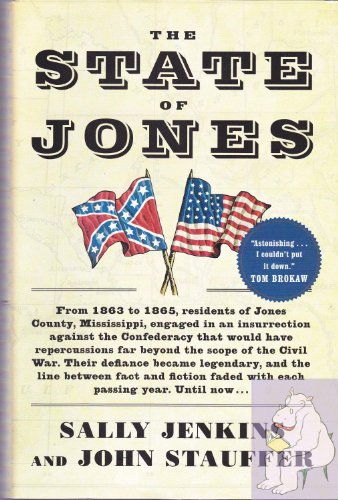
New York Times bestselling author Sally Jenkins and distinguished Harvard professor John Stauffer mine a nearly forgotten piece of Civil War history and strike gold in this surprising account of the only Southern county to secede from the Confederacy.
The State of Jones is a true story about the South during the Civil War—the real South. Not the South that has been mythologized in novels and movies, but an authentic, hardscrabble place where poor men were forced to fight a rich man’s war for slavery and cotton. In Jones County, Mississippi, a farmer named Newton Knight led his neighbors, white and black alike, in an insurrection against the Confederacy at the height of the Civil War. Knight’s life story mirrors the little-known story of class struggle in the South—and it shatters the image of the Confederacy as a unified front against the Union.
This riveting investigative account takes us inside the battle of Corinth, where thousands lost their lives over less than a quarter mile of land, and to the dreadful siege of Vicksburg, presenting a gritty picture of a war in which generals sacrificed thousands through their arrogance and ignorance. Off the battlefield, the Newton Knight story is rich in drama as well. He was a man with two loves: his wife, who was forced to flee her home simply to survive, and an ex-slave named Rachel, who, in effect, became his second wife. It was Rachel who cared for Knight during the war when he was hunted by the Confederates, and, later, when members of the Knight clan sought revenge for the disgrace he had brought upon the family name.
Working hand in hand with John Stauffer, distinguished chair and professor of the History of American Civilization at Harvard University, Sally Jenkins has made the leap from preeminent sportswriter to a historical writer endowed with the accuracy, drive, and passion of Doris Kearns Goodwin. The result is Civil War history at its finest.
Die Inhaltsangabe kann sich auf eine andere Ausgabe dieses Titels beziehen.
Über die Autorin bzw. den Autor
SALLY JENKINS is an award-winning journalist for The Washington Post and the author of The Real All Americans, as well as the legendary New York Times bestseller It's Not About the Bike with Lance Armstrong. She lives in New York City. JOHN STAUFFER is chair and professor of the History of American Civilization at Harvard University and the award-winning author of The Black Hearts of Men and other books on the Civil War era, including Giants: The Parallel Lives of Frederick Douglass and Abraham Lincoln. He lives in Cambridge, Massachusetts.
Auszug. © Genehmigter Nachdruck. Alle Rechte vorbehalten.
ONE
Corinth
May 1862, Corinth, Mississippi
As far as the foot soldiers were concerned, the other side could have the damned town. The generals might have gladly given it up too, if not for the railroad junction. Corinth was pestilential. Even the Union's pitiless William Tecumseh Sherman said the place made him feel "quite unwell." Sherman's superior, Henry Halleck, had such a low opinion of it that when he fell ill with a bowel ailment, he sourly named it "the evacuation of Corinth."
It was wretched ground for a fight, with boggy fields, swarms of bugs clouding the fetid air, and a chronic shortage of decent drinking water. A Confederate colonel called it a "sickly, malarial spot, fit only for alligators and snakes." It left no better impression on a Yankee lieutenant from Minnesota, who found the locals "ignorant" and the women "she vipers" with the figures of "shad bellied bean poles," he wrote. As far as he could tell, the chief local produce consisted of "wood ticks, chiggers, fleas, and niggers."
But men on both sides understood, if reluctantly, that Corinth was one of the most vital strategic points in the South. It was "the vertebrae of the Confederacy," as one rebel official put it. In the middle of town, two sets of railway tracks crossed each other in a broad X: the Memphis and Charleston ran -east--west, while the Mobile and Ohio ran -north--south. The intersection was a working hive: locomotives screeched and huffed, while men on platforms loaded and offloaded downy bales of cotton, stacks of lumber, crates, barrels, sacks of provisions like salt beef, and other vital war materiel. Trains were the reason for Corinth's existence: the village was just seven years old and the streets were still raw dirt. The largest hotel in town, the Tishomingo Hotel, was a broad -two--story affair with six chimneys that fronted directly on the tracks of the Memphis and Charleston, which ran just outside the front porch.
There were 80,000 Confederate troops under General Pierre G. T. Beauregard jammed into the brick and clapboard town, which normally housed just 2,800 inhabitants. Corinth was filled with rebel wounded from Beauregard's catastrophic encounter in April with U. S. Grant's Yankee troops at Shiloh, just a few miles away. The battle, so named for the log church where Grant's men had camped, was the worst bloodbath in the Western Hemisphere to date, with a toll of 20,000 in two days. "God grant that I may never be the partaker in such scenes again," one Confederate survivor wrote. "When released from this I shall ever be an advocate of peace."
Corinth was hardly an ideal place to recover. Contagion was inevitable with such a large army closely confined in pestiferous surroundings, the comings, goings, spewings, and brawlings of thousands of men, horses, mules, and oxen trod everything into mud, and their litter and foul runoff attracted hordes of fleas and mosquitoes. There were not enough rooms to accommodate the wounded, much less the sick. On the first floor of the Tishomingo, men lay on blood- and water-soaked carpets or blankets in the vestibule and hallways. On the second floor, the -charnel--house vapors caused some of the doctors and nurses to pass out.
One of the wounded was a rugged -thirty--year--old colonel in the 6th Mississippi Infantry, and a future governor of the state, named Robert Lowry. This peacetime lawyer had been raised in Smith County, one county over from Jones. He had taken wounds in the chest and another in the arm, as his company lost 310 men out of 425. The performance had earned his unit the nickname "The Bloody Sixth."
Those Confederates who survived Shiloh unharmed were as likely to get sick in Corinth. The rebels were preparing for a state of siege as a federal army of 120,000 under Union general Halleck encroached on the outskirts of town. Men labored constantly with shovels in the sweltering heat, as Beauregard ordered the defenses fortified with immense earthworks. The men dug until they were thirsty, then drank foul, swampy water. Diarrhea and dysentery became endemic. Soon, a quarter of the Southern troops were ill. "The water was bad enough to kill a dog much less a man," wrote a Mississippi cavalryman named William L. Nugent home to his wife.
Beauregard responded to the epidemic by trying to rally men with rhetoric: "We are about to meet in the shock of battle the invaders of our soil, the despoilers of our homes, the disturbers of our family ties," he wrote in a widely distributed letter. "Face to face, hand to hand, we are to decide whether we are to be freemen or the vile slaves of those who are free only in name . . . Let the impending battle decide our fate, and add one more illustrious page to the history of our Revolution, one to which our children will point with noble pride, saying, 'Our fathers were at the battle of Corinth.' "
But even as his letter circulated among the soldiers, Beauregard decided to evacuate the city. At the end of May, Beauregard hastily decamped his army and its provisions, mostly hunks of heavily salted meat, for the healthier environs of Tupelo to the west. Beauregard, too, had gotten sick. Suddenly, he did not feel his presence was required in such a swampland. He took an unauthorized leave to recuperate in comfort in Mobile.
With the Confederate withdrawal from Corinth, the Union forces moved in. They found the place a stinking pit. Abandoned foodstuffs and other detritus rotted on the roadsides. A soldier with the 81st Ohio, Joseph K. Nelson, noticed an odd glint in the earth that crunched under the soles of his boots. When he bent down to examine the dirt, he found it was literally moving with insects.
"The Johnnies left behind something for us to remember them by," he wrote in his diary. "The ground in places was alive with 'body guards'-lice-and was much littered in places with large chunks of very salt beef. The salt sparkled and glistened in it."
October 1862, Northern Mississippi, on the March
General Earl Van Dorn was a -ringlet--tossing little Mississippian in search of a big reputation. Profligate with the lives of men and impossibly conceited, as suggested by his extravagant twists of auburn hair, Van Dorn openly aspired to "a burning name," as he put it. He was continually conceiving of schemes that could win him the flaming renown he sought, and his latest was typical.
As an Indian summer fell over Mississippi, Van Dorn -about--faced the Confederate Army of the West and marched it back toward Corinth with the intention of retaking the town. His plan was a hurriedly drawn, surprise full frontal assault, and heedless of risk, but that only made it more infectious to some of his colleagues. He was after "great objects," and that justified the "unusual hazard" of the attack, according to his chief of staff, another overeager Mississippi cavalier general named Dabney H. Maury.
But Newton Knight, a young sergeant striding in Company F of the 7th Mississippi Battalion, felt none of the enthusiasm that the -glory--seeking Van Dorn and Maury tried to summon with such verbal flourishes. He was neither free nor proud to be a Confederate soldier.
Company F, made up of -sixty--nine men and four officers from Jones County, had been forcibly mustered into the ailing Confederate army after Beauregard's evacuation of Corinth in May. Now, just four months later, almost half the new men were ill. Fully -two--thirds were absent or on leave, and six had died. At the last roll call, only twenty men and two officers had answered present, Knight among them. Men were sick with yellow fever, dysentery, malaria, and influenza. Or they...
„Über diesen Titel“ kann sich auf eine andere Ausgabe dieses Titels beziehen.
Suchergebnisse für The State of Jones: The Small Southern County That...

Foto des Verkäufers
The State of Jones: The Small Southern County That Seceded from the Confederacy
Anbieter: Dream Books Co., Denver, CO, USA
Verkäuferbewertung 5 von 5 Sternen

Zustand: acceptable. This copy has clearly been enjoyedâ"expect noticeable shelf wear and some minor creases to the cover. Binding is strong, and all pages are legible. May contain previous library markings or stamps. Artikel-Nr. DBV.0385525931.A
Gebraucht kaufen
EUR 3,96
Versand gratis
Versand innerhalb von USA
Versand innerhalb von USA
Anzahl: 1 verfügbar
Foto des Verkäufers
The State of Jones: The Small Southern County That Seceded from the Confederacy
Anbieter: Dream Books Co., Denver, CO, USA
Verkäuferbewertung 5 von 5 Sternen
Zustand: very_good. Pages are clean with no markings. May show minor signs of wear or cosmetic defects marks, cuts, bends, or scuffs on the cover, spine, pages, or dust jacket. May have remainder marks on edges. Artikel-Nr. DBV.0385525931.VG
Gebraucht kaufen
EUR 4,14
Versand gratis
Versand innerhalb von USA
Versand innerhalb von USA
Anzahl: 1 verfügbar
Beispielbild für diese ISBN
The State of Jones: The Small Southern County That Seceded from the Confederacy
Anbieter: ThriftBooks-Dallas, Dallas, TX, USA
Verkäuferbewertung 5 von 5 Sternen
Hardcover. Zustand: Very Good. No Jacket. May have limited writing in cover pages. Pages are unmarked. ~ ThriftBooks: Read More, Spend Less. Artikel-Nr. G0385525931I4N00
Gebraucht kaufen
EUR 5,87
Versand gratis
Versand innerhalb von USA
Versand innerhalb von USA
Anzahl: 1 verfügbar
Beispielbild für diese ISBN
The State of Jones: The Small Southern County That Seceded from the Confederacy
Anbieter: ThriftBooks-Atlanta, AUSTELL, GA, USA
Verkäuferbewertung 5 von 5 Sternen
Hardcover. Zustand: Very Good. No Jacket. May have limited writing in cover pages. Pages are unmarked. ~ ThriftBooks: Read More, Spend Less. Artikel-Nr. G0385525931I4N00
Gebraucht kaufen
EUR 5,87
Versand gratis
Versand innerhalb von USA
Versand innerhalb von USA
Anzahl: 1 verfügbar
Beispielbild für diese ISBN
The State of Jones: The Small Southern County That Seceded from the Confederacy
Anbieter: World of Books (was SecondSale), Montgomery, IL, USA
Verkäuferbewertung 5 von 5 Sternen
Zustand: Good. Item in good condition. Textbooks may not include supplemental items i.e. CDs, access codes etc. Artikel-Nr. 00083070943
Gebraucht kaufen
EUR 6,59
Versand gratis
Versand innerhalb von USA
Versand innerhalb von USA
Anzahl: 2 verfügbar
Beispielbild für diese ISBN
The State of Jones: The Small Southern County That Seceded from the Confederacy
Anbieter: World of Books (was SecondSale), Montgomery, IL, USA
Verkäuferbewertung 5 von 5 Sternen
Zustand: Very Good. Item in very good condition! Textbooks may not include supplemental items i.e. CDs, access codes etc. Artikel-Nr. 00108261707
Gebraucht kaufen
EUR 6,59
Versand gratis
Versand innerhalb von USA
Versand innerhalb von USA
Anzahl: 1 verfügbar
Beispielbild für diese ISBN
The State of Jones : The Small Southern County That Seceded from the Confederacy
Verlag:
Knopf Doubleday Publishing Group, 2009
ISBN 10: 0385525931
ISBN 13: 9780385525930
Gebraucht
Hardcover
Erstausgabe
Anbieter: Better World Books, Mishawaka, IN, USA
Verkäuferbewertung 5 von 5 Sternen
Zustand: Good. First Edition. Former library copy. Pages intact with minimal writing/highlighting. The binding may be loose and creased. Dust jackets/supplements are not included. Includes library markings. Stock photo provided. Product includes identifying sticker. Better World Books: Buy Books. Do Good. Artikel-Nr. 2884525-6
Gebraucht kaufen
EUR 6,82
Versand gratis
Versand innerhalb von USA
Versand innerhalb von USA
Anzahl: 1 verfügbar
Beispielbild für diese ISBN
The State of Jones : The Small Southern County That Seceded from the Confederacy
Verlag:
Knopf Doubleday Publishing Group, 2009
ISBN 10: 0385525931
ISBN 13: 9780385525930
Gebraucht
Hardcover
Erstausgabe
Anbieter: Better World Books, Mishawaka, IN, USA
Verkäuferbewertung 5 von 5 Sternen
Zustand: Very Good. First Edition. Former library copy. Pages intact with possible writing/highlighting. Binding strong with minor wear. Dust jackets/supplements may not be included. Includes library markings. Stock photo provided. Product includes identifying sticker. Better World Books: Buy Books. Do Good. Artikel-Nr. GRP102422340
Gebraucht kaufen
EUR 6,82
Versand gratis
Versand innerhalb von USA
Versand innerhalb von USA
Anzahl: 1 verfügbar
Beispielbild für diese ISBN
The State of Jones : The Small Southern County That Seceded from the Confederacy
Verlag:
Knopf Doubleday Publishing Group, 2009
ISBN 10: 0385525931
ISBN 13: 9780385525930
Gebraucht
Hardcover
Erstausgabe
Anbieter: Better World Books, Mishawaka, IN, USA
Verkäuferbewertung 5 von 5 Sternen
Zustand: Good. First Edition. Pages intact with minimal writing/highlighting. The binding may be loose and creased. Dust jackets/supplements are not included. Stock photo provided. Product includes identifying sticker. Better World Books: Buy Books. Do Good. Artikel-Nr. 2884524-6
Gebraucht kaufen
EUR 6,82
Versand gratis
Versand innerhalb von USA
Versand innerhalb von USA
Anzahl: 1 verfügbar
Beispielbild für diese ISBN
The State of Jones: The Small Southern County That Seceded from the Confederacy
Verlag:
Doubleday (edition First Edition), 2009
ISBN 10: 0385525931
ISBN 13: 9780385525930
Gebraucht
Hardcover
Erstausgabe
Anbieter: BooksRun, Philadelphia, PA, USA
Verkäuferbewertung 5 von 5 Sternen
Hardcover. Zustand: Very Good. First Edition. With dust jacket. It's a well-cared-for item that has seen limited use. The item may show minor signs of wear. All the text is legible, with all pages included. It may have slight markings and/or highlighting. Artikel-Nr. 0385525931-8-1-29
Gebraucht kaufen
EUR 8,16
Versand gratis
Versand innerhalb von USA
Versand innerhalb von USA
Anzahl: 1 verfügbar