
Verwandte Artikel zu Say Yes to No: Using the Power of NO to Create the...
Inhaltsangabe
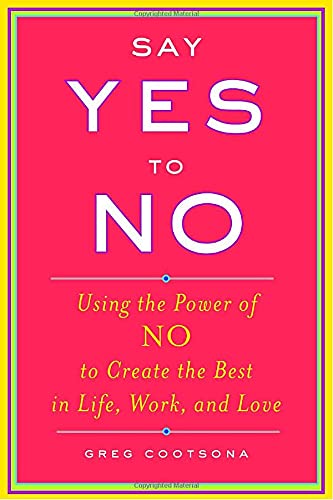
Greg Cootsona puts a spiritual spin on the classic business strategy for setting priorities in this valuable guide to finding personal fulfillment in an increasingly frantic world. At age thirty-eight, Cootsona, a physically fit minister busy with his growing congregation and his young family, had a scare with heart trouble. The unexpected and frightening news proved providential. Cootsona realized that he was juggling too many roles, saying yes to too many commitments.
In SAY YES TO NO, Cootsona blends personal experiences and deep reflection to show why learning to say no can transform our lives. He describes the choices he made as he set the priorities in his own life, and encourages readers to look within their hearts and focus on the values and the goals that promise them their greatest rewards. Filled with sound advice and profound insights, SAY YES TO NO provides a path to achieving physical, professional, emotional, and spiritual well-being that will appeal to Christian and mainstream audiences alike.
Die Inhaltsangabe kann sich auf eine andere Ausgabe dieses Titels beziehen.
Über die Autorin bzw. den Autor
GREG COOTSONA is a pastor at Bidwell Presbyterian Church in Chico, California. Formerly, he ministered at the Fifth Avenue Presbyterian Church in New York City, where he headed the Center for Christian Studies. Greg is married, with two young daughters.
Auszug. © Genehmigter Nachdruck. Alle Rechte vorbehalten.
CHAPTER ONE
Michelangelo and the Marble:
The Art of Negation
I saw the angel in the marble and carved until I set him free.
--MICHELANGELO BUONARROTI, sculptor, painter,
architect, and (in the eyes of many) creator of the Renaissance
The story goes something like this: An admirer ran up to Michelangelo and asked how he sculpted the famous statue of David that now sits in Accademia Gallery in the city of Florence. How did he craft this masterpiece of form and beauty? What was he thinking? How did he work with the rock so that he produced this exquisite human figure?
Michelangelo replied with this strikingly simple description: First, he said, I fixed my attention on the slab of raw marble. I studied it, sketched a few simple pencil drawings on it, and then
"chipped away all that wasn't David." The questioner was stunned. When pressed to go further, the artist offered an explanation: "In every block of marble I see a statue as though it stood before me, shaped and perfected in attitude and action. I have only to hew away the rough walls that imprison the lovely apparition to reveal it to the other eyes as mine see it." He discerned, imprisoned inside the crude block, a beauty that had to be released. And so he labored with all the genius and persistence he could muster. And what emerged from the rock has amazed and fascinated viewers ever since. Some even call it the greatest sculpture that ever existed.
Michelangelo unveiled beauty through what he removed. His was the art of negation. He created through the power of no.
I find that I'm often careless and haphazard at chipping away the excess in my life. I don't tap away in order to craft what's essential and crucial in myself. Instead, I add. And unlike with marble, humans have the choice to attach more and more blocks of unformed matter to our daily lives. Many times we become bored and abandon our project when just the hint of the beauty is peering out of the rock. Or we never get started. We stare at the raw, unformed marble and freeze before the tasks that stare back at us.
And then, to complicate matters, we live surrounded by a culture of almost countless possibilities. And so, paralyzed by choice, we can't decide what to cut out. To commit--to work on one's stone--means to say no to the overwhelming majority of these alluring possibilities. The options mock the hint of limits, and setting boundaries comes across as a mere suggestion. Consequently, many of us remain unformed. Many never find the life of beauty, excellence, and success that lies within.
Yet some do. Some of us do chip away with precise vision and durable resolve. What makes the difference? What's the secret? How do we move beyond good intentions to form habits that produce integrity and care for others, that craft goals and character in our lives, that make space for the relationships we crave, and that hone skills at work?
The Michelangelo story leads to some reflections on the power of no and how to sculpt our lives for true success. As the master artist phrased it, "The more the marble wastes, the more the statue grows."
How are we blocks of unchiseled marble? Have we succeeded in finding excellence and pursuing it with dogged perseverance? Is there a "you" and "me" hidden in a formless life, waiting to be released? Are we imprisoned in nos yet unstated? Are you letting God, the Creator and Re-creator, transform your life, craft and mold you?
These are some lessons I've learned by studying the great artist, organized into four large blocks: chiseling, creativity, grit, and God.
Chiseling
True success (that is, beauty and excellence) is found in chipping away.
Michelangelo found that he could create his sculpture only by removing what the figure didn't need until it achieved the beauty of its inherent form.
We need to say no to the things in our life that we don't want or need. This is most important when it comes to setting goals.
I've observed three major steps in setting goals. The first step in creating a successful life is to determine your key priorities. What do you really want? Here's the crux: Those goals and plans often lie dormant in the rock unless we start chiseling. Step two: outline your nos. In other words, what will you not pursue? It's finding what to say no to. And, finally, step three: sticking by those nos. This is where most people fall down in seeking what's best for their lives. Step three becomes really demanding when other good options present themselves. This is especially true of those things that seem like success: goals like wealth, fame, and position. But those things--as I'll describe in the next chapter--are not what really matters. They are secondary goals and can become significant distractions. Instead, true success is to discern the essence of what we're created to be and to follow it relentlessly.
Creativity
Break the mold or see something for the first time and replicate it . . . with variation.
Donatello had created a David sculpture (bronze, in this case) in the 1440s, some sixty years before Michelangelo's. That could have been the final artistic word on this biblical hero. But Michelangelo knew he had something original to offer. And so he took marble, started to sculpt, and took David in a new direction. Donatello crafted his slim, slightly effeminate David after the battle with Goliath, wearing just a hat and holding a sword, with his foot on the giant's head. Michelangelo discarded the silly hat and conferred a new power and vitality to the young warrior, who stands poised before battle, with veins bulging, to take on his gigantic foe.
Looking intently at the David's face, you can see an idealized projection of Michelangelo--not his actual visage, but his driving creativity. Just as he chose to portray David in the sculpture before the battle, looking out to face his enormous foe, this twenty-six-year-old artist seems to be scanning the horizon for his future projects.
Grit
The artist's vision directed his work and provided him with gritty resolve.
With precision of vision combined with incredible resolve, Michelangelo peered through the unformed shape into the figure it could become. This is the artistic concept of disegno, meaning "to sketch" or "to draw": The final product must first appear in the artist's imagination. Michelangelo simply knew David--his age, how he was positioned, the shape of his torso, and that beautiful curved left arm just below his chin. Through the amorphous mass of rock, a clear form sparkled in his imagination. The marble would only need chipping away. And so, gradually, tap by tap, David--or the Pieta, or Moses, or the Dying Slave--emerged. The glory of Michelangelo's sculpting was that he could see through the raw material, through all the chipping away, to its ultimate destiny. As Michelangelo believed: "The marble not yet carved can hold the form of every thought the greatest artist has."
To be clear: The yes will help guide the vision. And it needs to be decisive. We need to know the voice that guides us. Critical to the process of continuing is to know the direction you're going. To discern that vision, I draw inspiration from a quotation by the noted feminist Naomi Wolf:
"Excellence, to me, is the state of grace that can descend only when one tunes out all the world's clamor, listens to an inward voice one recognizes as wiser than one's own, and transcribes without fear." Where do you become quiet enough to hear that wiser voice? In Chapter Three, I have some directions for tuning out the technological static and listening. For now, I want to underline that the yes directs the nos. Our disegno directs the chiseling.
My reading of Michelangelo is that he felt that he was simply one of the...
„Über diesen Titel“ kann sich auf eine andere Ausgabe dieses Titels beziehen.
Suchergebnisse für Say Yes to No: Using the Power of NO to Create the...

Beispielbild für diese ISBN
Say Yes To No: Using The Power Of No To Create The Best In Life, Work, and Love
Anbieter: BooksRun, Philadelphia, PA, USA
Verkäuferbewertung 5 von 5 Sternen

Paperback. Zustand: Very Good. It's a well-cared-for item that has seen limited use. The item may show minor signs of wear. All the text is legible, with all pages included. It may have slight markings and/or highlighting. Artikel-Nr. 0385525737-11-1
Gebraucht kaufen
EUR 6,49
Versand gratis
Versand innerhalb von USA
Versand innerhalb von USA
Anzahl: 1 verfügbar
Beispielbild für diese ISBN
Say Yes to No: Using the Power of No to Create the Best in Life, Work, and Love
Anbieter: World of Books (was SecondSale), Montgomery, IL, USA
Verkäuferbewertung 5 von 5 Sternen
Paperback. Zustand: Fair. Artikel-Nr. 00094298493
Gebraucht kaufen
EUR 6,50
Versand gratis
Versand innerhalb von USA
Versand innerhalb von USA
Anzahl: 1 verfügbar
Beispielbild für diese ISBN
Say Yes to No: Using the Power of No to Create the Best in Life, Work, and Love
Anbieter: World of Books (was SecondSale), Montgomery, IL, USA
Verkäuferbewertung 5 von 5 Sternen
Paperback. Zustand: Very Good. Artikel-Nr. 00108635812
Gebraucht kaufen
EUR 6,50
Versand gratis
Versand innerhalb von USA
Versand innerhalb von USA
Anzahl: 1 verfügbar
Beispielbild für diese ISBN
Say Yes to No : Using the Power of No to Create the Best in Life, Work, and Love
Verlag:
Crown Publishing Group, The, 2009
ISBN 10: 0385525737
ISBN 13: 9780385525732
Gebraucht
Softcover
Anbieter: Better World Books: West, Reno, NV, USA
Verkäuferbewertung 5 von 5 Sternen
Zustand: Very Good. Former library copy. Pages intact with possible writing/highlighting. Binding strong with minor wear. Dust jackets/supplements may not be included. Includes library markings. Stock photo provided. Product includes identifying sticker. Better World Books: Buy Books. Do Good. Artikel-Nr. 485565-6
Gebraucht kaufen
EUR 8,31
Versand gratis
Versand innerhalb von USA
Versand innerhalb von USA
Anzahl: 1 verfügbar
Beispielbild für diese ISBN
Say Yes to No : Using the Power of No to Create the Best in Life, Work, and Love
Verlag:
Crown Publishing Group, The, 2009
ISBN 10: 0385525737
ISBN 13: 9780385525732
Gebraucht
Softcover
Anbieter: Better World Books: West, Reno, NV, USA
Verkäuferbewertung 5 von 5 Sternen
Zustand: Good. Pages intact with minimal writing/highlighting. The binding may be loose and creased. Dust jackets/supplements are not included. Stock photo provided. Product includes identifying sticker. Better World Books: Buy Books. Do Good. Artikel-Nr. 485562-6
Gebraucht kaufen
EUR 8,31
Versand gratis
Versand innerhalb von USA
Versand innerhalb von USA
Anzahl: 1 verfügbar
Beispielbild für diese ISBN
Say Yes to No : Using the Power of No to Create the Best in Life, Work, and Love
Verlag:
Crown Publishing Group, The, 2009
ISBN 10: 0385525737
ISBN 13: 9780385525732
Gebraucht
Softcover
Anbieter: Better World Books, Mishawaka, IN, USA
Verkäuferbewertung 5 von 5 Sternen
Zustand: Good. Former library copy. Pages intact with minimal writing/highlighting. The binding may be loose and creased. Dust jackets/supplements are not included. Includes library markings. Stock photo provided. Product includes identifying sticker. Better World Books: Buy Books. Do Good. Artikel-Nr. 485563-6
Gebraucht kaufen
EUR 8,31
Versand gratis
Versand innerhalb von USA
Versand innerhalb von USA
Anzahl: 1 verfügbar
Beispielbild für diese ISBN
Say Yes To No: Using The Power Of No To Create The Best In Life, Work, and Love
Anbieter: ThriftBooks-Atlanta, AUSTELL, GA, USA
Verkäuferbewertung 5 von 5 Sternen
Paperback. Zustand: Fair. No Jacket. Former library book; Readable copy. Pages may have considerable notes/highlighting. ~ ThriftBooks: Read More, Spend Less. Artikel-Nr. G0385525737I5N10
Gebraucht kaufen
EUR 8,48
Versand gratis
Versand innerhalb von USA
Versand innerhalb von USA
Anzahl: 1 verfügbar
Beispielbild für diese ISBN
Say Yes To No: Using The Power Of No To Create The Best In Life, Work, and Love
Anbieter: ThriftBooks-Dallas, Dallas, TX, USA
Verkäuferbewertung 5 von 5 Sternen
Paperback. Zustand: Very Good. No Jacket. May have limited writing in cover pages. Pages are unmarked. ~ ThriftBooks: Read More, Spend Less. Artikel-Nr. G0385525737I4N00
Gebraucht kaufen
EUR 8,48
Versand gratis
Versand innerhalb von USA
Versand innerhalb von USA
Anzahl: 1 verfügbar
Beispielbild für diese ISBN
Say Yes To No: Using The Power Of No To Create The Best In Life, Work, and Love
Anbieter: ThriftBooks-Reno, Reno, NV, USA
Verkäuferbewertung 5 von 5 Sternen
Paperback. Zustand: Good. No Jacket. Former library book; Pages can have notes/highlighting. Spine may show signs of wear. ~ ThriftBooks: Read More, Spend Less. Artikel-Nr. G0385525737I3N10
Gebraucht kaufen
EUR 8,48
Versand gratis
Versand innerhalb von USA
Versand innerhalb von USA
Anzahl: 1 verfügbar
Beispielbild für diese ISBN
Say Yes To No: Using The Power Of No To Create The Best In Life, Work, and Love
Anbieter: ThriftBooks-Dallas, Dallas, TX, USA
Verkäuferbewertung 5 von 5 Sternen
Paperback. Zustand: Good. No Jacket. Pages can have notes/highlighting. Spine may show signs of wear. ~ ThriftBooks: Read More, Spend Less. Artikel-Nr. G0385525737I3N00
Gebraucht kaufen
EUR 8,48
Versand gratis
Versand innerhalb von USA
Versand innerhalb von USA
Anzahl: 1 verfügbar