
Verwandte Artikel zu Days of Fire: Bush and Cheney in the White House
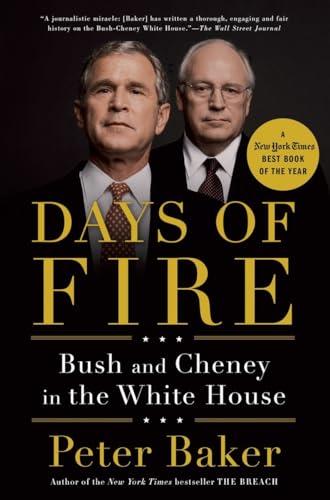
Inhaltsangabe
A New York Times Top 10 Best Book of the Year
A Washington Post Notable Book
Theirs was the most captivating American political partnership since Richard Nixon and Henry Kissinger: a bold and untested president and his seasoned, relentless vice president. Confronted by one crisis after another, they struggled to protect the country, remake the world, and define their own relationship along the way.
The real story of George W. Bush and Dick Cheney is far more fascinating than the familiar suspicion that Cheney was the power behind the throne. Drawing on hundreds of interviews with key players, and thousands of pages of private notes, memos, and other internal documents, Baker paints a riveting portrait of a partnership that evolved dramatically over time, during an era marked by devastating terror attacks, the Iraq War, Hurricane Katrina, and financial collapse. Peter Baker has produced a monumental and definitive work that ranks with the best of presidential histories.
Die Inhaltsangabe kann sich auf eine andere Ausgabe dieses Titels beziehen.
Über die Autorin bzw. den Autor
Peter Baker is the Chief White House Correspondent for The New York Times and a regular panelist on Washington Week on PBS. He is the author of the New York Times bestseller The Breach, about Bill Clinton’s impeachment, and, with his wife, Susan Glasser, of Kremlin Rising, about Vladimir Putin’s Russia.
Auszug. © Genehmigter Nachdruck. Alle Rechte vorbehalten.
Excerpted from the Hardcover Edition
Part one
1
“One of you could be president”
George W. Bush had already dropped by to see three congressmen when he strode down the high-ceilinged corridor of the Cannon House Office Building to find the fourth on his list. It was June 17, 1987, and the son of the vice president was making the rounds to gather support for his father’s presidential campaign, or at least build goodwill with Republicans on Capitol Hill. His 3:30 p.m. appointment was with a low-key congressman from Wyoming named Dick Cheney.
This next-generation Bush was a tall, rangy man, handsome with an easy smile and a face that bore a striking resemblance to that of his famous father. Just a couple weeks shy of his forty-first birthday, he had moved his wife and twin daughters to Washington for the campaign, appointing himself “loyalty enforcer” to ensure a growing staff of political operatives was laboring on behalf of George H. W. Bush’s interests rather than their own.
Along the way, he was becoming a surrogate for his father and was surprised how much he enjoyed his new role. This family business had gotten into his blood. He had none of his father’s smoothness, though, and none of those polished New England sensibilities. Junior, as some called him, although he was not technically a junior, lived closer to the edge, the “Roman candle of the family,” as the campaign chronicler Richard Ben Cramer would call him, “the biggest and most jagged chip off the old block.”
By temperament, the man he was visiting was quite the opposite. Cheney, a former White House chief of staff now in his fifth term in Congress, was as quiet as Bush was voluble, as stoic as the younger man was expressive. He would say what he had to and then stop, perfectly comfortable with the silences that disquieted others. “He’s not necessarily what you would call the life of the party,” observed Dennis Hastert, who served with him in the House and went on to become Speaker. Cheney’s wife, Lynne, thought the way to understand him was to remember how much he loved fly-fishing, standing without a sound for hours casting for a bite—”not a sport for the impatient,” as she put it, and “definitely not a sport for chatterboxes.” He refused to go fishing with his friend Kenneth Adelman because “he talks too much.” At forty-six, Cheney had just been promoted to chairman of the House Republican Conference, the number-three position in the party leadership. He had his eye on someday becoming Speaker.
Neither man in the years to come would remember the first time they met, but it was likely this encounter in the summer before the Republican primaries. Never mind that Cheney had no intention of taking sides in the Republican contest featuring Bush’s father. To a congressman eyeing further moves up the leadership ladder, becoming a partisan for a presidential candidate would be “asking for grief I didn’t need,” as Cheney later put it. Indeed, his neutrality would cause a years-long rift with his good friend and mentor, Donald Rumsfeld, who had been contemplating his own run for president. But Cheney got along well with his guest that day. “He and Bush hit it off,” recalled Wayne Berman, the campaign’s congressional relations director who organized the meeting.
Berman would go on to become one of Washington’s premier lobbyists and Republican fund-raisers, as well as one of the few men close to both Bush and Cheney. He raised millions of dollars for them, promoted their campaigns, and hosted dinners for them at his house. His wife, Lea Berman, would work in the White House first for Cheney’s wife and then for Bush’s wife. But even Wayne Berman never imagined what would eventually come of the acquaintance that began in that courtesy call one summer afternoon. “Bush in those days was a really interesting guy,” he observed years later. “A little insecure, had a bit of a chip on his shoulder. Very skeptical of everything in Washington, something I think he retained. Skeptical of a lot of people around his dad.” As for Cheney, he was more comfortable with Washington yet also kept his distance. The only ones he truly relaxed around were his wife and two daughters. “Cheney has three confidantes, and all their last names are Cheney,” Berman noted. “One is related by marriage and two by blood.” He could be unguarded with friends, “but if he told you something and it leaked and he suspected you leaked it, you didn’t get a second chance. Finished.”
Bush at that point had yet to win public office and was still evolving into the politician he would later become. When he visited the West Wing in those days, he would stop by offices of aides he knew, plop down on a couch, and put his cowboy boots on the coffee table. Ronald Reagan, who had met the Bush children, thought that if any of them had a bright political future, it would be George’s brother Jeb. Their brother Marvin once gave his assessment of each sibling. “George?” he said. “George is the family clown.”
Indeed, after their father won the presidency, the younger George attended a state dinner for Queen Elizabeth II, lifted his pant legs to show her his cowboy boots, and proudly declared that he was the black sheep in the family. “Do you have any in yours?” he asked. What was certainly a defense mechanism for a son and grandson of accomplished men also became a conscious strategy of lowering expectations. “It is always better to lowball these things,” he once told a general years later in a revealing moment during a conference call about Iraq. “If you perform, people are surprised.” He added, “I really enjoy it when somebody says, that son of a bitch just got out a coherent sentence.”
The day Bush met Cheney came less than a year after a radical midlife course correction. Although he never accepted the word “alcoholic,” Bush’s decision to quit drinking the day after his fortieth birthday reshaped his outlook on life, manifesting itself as both empathy and determination. The man who conquered his own weakness would stop whatever he was doing upon meeting an addict. “His cadence would change,” said David Kuo, a former aide. “He would put both of his hands on the man’s shoulders and look into his eyes. Any swagger disappeared. Something softer and perhaps more genuine took its place.” At the same time, the iron discipline it took to stop cold turkey would become a never-look-back approach to the Oval Office; he could be at once maddeningly stubborn about revisiting decisions and indefatigably upbeat in the face of crises that would leave other presidents talking to the paintings.
It may have also fueled an urgent idealism that would characterize his presidency for better or worse; on some level, he believed he had been saved to accomplish great things. His zeal inspired supporters with its promise of transformation while dismaying critics as dangerously messianic. Bush’s favorite book was The Raven, a Pulitzer Prize–winning biography that traced the life of Sam Houston from drunkard to president of the Republic of Texas. “His first thought, his constant thought, was to atone for the period of his delinquency,” the author, Marquis James, wrote of Houston. “He would do something grand. He would capture an empire.”
Grandiosity never defined Cheney. He was, as the writer Todd Purdum once observed, “a never-complain,...
„Über diesen Titel“ kann sich auf eine andere Ausgabe dieses Titels beziehen.
Suchergebnisse für Days of Fire: Bush and Cheney in the White House

Beispielbild für diese ISBN
Days of Fire: Bush and Cheney in the White House
Anbieter: World of Books (was SecondSale), Montgomery, IL, USA
Verkäuferbewertung 5 von 5 Sternen

Paperback. Zustand: Good. A New York Times Top 10 Best Book of the Year A Washington Post Notable Book Theirs was the most captivating American political partnership since Richard Nixon and Henry Kissinger: a bold and untested president and his seasoned, relentless vice president. Confronted by one crisis after another, they struggled to protect the country, remake the world, and define their own relationship along the way. The real story of George W. Bush and Dick Cheney is far more fascinating than the familiar suspicion that Cheney was the power behind the throne. Drawing on hundreds of interviews with key players, and thousands of pages of private notes, memos, and other internal documents, Baker paints a riveting portrait of a partnership that evolved dramatically over time, during an era marked by devastating terror attacks, the Iraq War, Hurricane Katrina, and financial collapse. Peter Baker has produced a monumental and definitive work that ranks with the best of presidential histories. Artikel-Nr. 00106082894
Gebraucht kaufen
EUR 4,04
Versand gratis
Versand innerhalb von USA
Versand innerhalb von USA
Anzahl: 8 verfügbar
Beispielbild für diese ISBN
Days of Fire: Bush and Cheney in the White House
Anbieter: World of Books (was SecondSale), Montgomery, IL, USA
Verkäuferbewertung 5 von 5 Sternen
Paperback. Zustand: Very Good. A New York Times Top 10 Best Book of the Year A Washington Post Notable Book Theirs was the most captivating American political partnership since Richard Nixon and Henry Kissinger: a bold and untested president and his seasoned, relentless vice president. Confronted by one crisis after another, they struggled to protect the country, remake the world, and define their own relationship along the way. The real story of George W. Bush and Dick Cheney is far more fascinating than the familiar suspicion that Cheney was the power behind the throne. Drawing on hundreds of interviews with key players, and thousands of pages of private notes, memos, and other internal documents, Baker paints a riveting portrait of a partnership that evolved dramatically over time, during an era marked by devastating terror attacks, the Iraq War, Hurricane Katrina, and financial collapse. Peter Baker has produced a monumental and definitive work that ranks with the best of presidential histories. Artikel-Nr. 00110298322
Gebraucht kaufen
EUR 4,04
Versand gratis
Versand innerhalb von USA
Versand innerhalb von USA
Anzahl: 3 verfügbar
Beispielbild für diese ISBN
Days of Fire: Bush and Cheney in the White House
Anbieter: World of Books (was SecondSale), Montgomery, IL, USA
Verkäuferbewertung 5 von 5 Sternen
Paperback. Zustand: Fair. A New York Times Top 10 Best Book of the Year A Washington Post Notable Book Theirs was the most captivating American political partnership since Richard Nixon and Henry Kissinger: a bold and untested president and his seasoned, relentless vice president. Confronted by one crisis after another, they struggled to protect the country, remake the world, and define their own relationship along the way. The real story of George W. Bush and Dick Cheney is far more fascinating than the familiar suspicion that Cheney was the power behind the throne. Drawing on hundreds of interviews with key players, and thousands of pages of private notes, memos, and other internal documents, Baker paints a riveting portrait of a partnership that evolved dramatically over time, during an era marked by devastating terror attacks, the Iraq War, Hurricane Katrina, and financial collapse. Peter Baker has produced a monumental and definitive work that ranks with the best of presidential histories. Artikel-Nr. 00107402488
Gebraucht kaufen
EUR 4,04
Versand gratis
Versand innerhalb von USA
Versand innerhalb von USA
Anzahl: 1 verfügbar
Foto des Verkäufers
Days of Fire: Bush and Cheney in the White House
Anbieter: Dream Books Co., Denver, CO, USA
Verkäuferbewertung 5 von 5 Sternen
Zustand: good. Gently used with minimal wear on the corners and cover. A few pages may contain light highlighting or writing, but the text remains fully legible. Dust jacket may be missing, and supplemental materials like CDs or codes may not be included. May be ex-library with library markings. Ships promptly! Artikel-Nr. DBV.0385525192.G
Gebraucht kaufen
EUR 4,19
Versand gratis
Versand innerhalb von USA
Versand innerhalb von USA
Anzahl: 1 verfügbar
Foto des Verkäufers
Days of Fire: Bush and Cheney in the White House
Anbieter: Dream Books Co., Denver, CO, USA
Verkäuferbewertung 5 von 5 Sternen
Zustand: acceptable. This copy has clearly been enjoyedâ"expect noticeable shelf wear and some minor creases to the cover. Binding is strong, and all pages are legible. May contain previous library markings or stamps. Artikel-Nr. DBV.0385525192.A
Gebraucht kaufen
EUR 4,92
Versand gratis
Versand innerhalb von USA
Versand innerhalb von USA
Anzahl: 1 verfügbar
Beispielbild für diese ISBN
Days of Fire: Bush and Cheney in the White House
Anbieter: ThriftBooks-Reno, Reno, NV, USA
Verkäuferbewertung 5 von 5 Sternen
Paperback. Zustand: Fair. No Jacket. Readable copy. Pages may have considerable notes/highlighting. ~ ThriftBooks: Read More, Spend Less. Artikel-Nr. G0385525192I5N00
Gebraucht kaufen
EUR 6,05
Versand gratis
Versand innerhalb von USA
Versand innerhalb von USA
Anzahl: 1 verfügbar
Beispielbild für diese ISBN
Days of Fire: Bush and Cheney in the White House
Anbieter: ThriftBooks-Dallas, Dallas, TX, USA
Verkäuferbewertung 5 von 5 Sternen
Paperback. Zustand: Very Good. No Jacket. May have limited writing in cover pages. Pages are unmarked. ~ ThriftBooks: Read More, Spend Less. Artikel-Nr. G0385525192I4N00
Gebraucht kaufen
EUR 6,07
Versand gratis
Versand innerhalb von USA
Versand innerhalb von USA
Anzahl: 1 verfügbar
Beispielbild für diese ISBN
Days of Fire: Bush and Cheney in the White House
Anbieter: ThriftBooks-Atlanta, AUSTELL, GA, USA
Verkäuferbewertung 5 von 5 Sternen
Paperback. Zustand: Good. No Jacket. Pages can have notes/highlighting. Spine may show signs of wear. ~ ThriftBooks: Read More, Spend Less. Artikel-Nr. G0385525192I3N00
Gebraucht kaufen
EUR 6,07
Versand gratis
Versand innerhalb von USA
Versand innerhalb von USA
Anzahl: 1 verfügbar
Beispielbild für diese ISBN
Days of Fire: Bush and Cheney in the White House
Anbieter: ThriftBooks-Dallas, Dallas, TX, USA
Verkäuferbewertung 5 von 5 Sternen
Paperback. Zustand: Good. No Jacket. Pages can have notes/highlighting. Spine may show signs of wear. ~ ThriftBooks: Read More, Spend Less. Artikel-Nr. G0385525192I3N00
Gebraucht kaufen
EUR 6,07
Versand gratis
Versand innerhalb von USA
Versand innerhalb von USA
Anzahl: 1 verfügbar
Beispielbild für diese ISBN
Days of Fire: Bush and Cheney in the White House
Anbieter: Wonder Book, Frederick, MD, USA
Verkäuferbewertung 5 von 5 Sternen
Zustand: Good. Good condition. A copy that has been read but remains intact. May contain markings such as bookplates, stamps, limited notes and highlighting, or a few light stains. Artikel-Nr. L01E-00753
Gebraucht kaufen
EUR 7,25
Versand gratis
Versand innerhalb von USA
Versand innerhalb von USA
Anzahl: 2 verfügbar