
Verwandte Artikel zu The Shadow Factory: The Ultra-Secret NSA from 9/11...
Inhaltsangabe
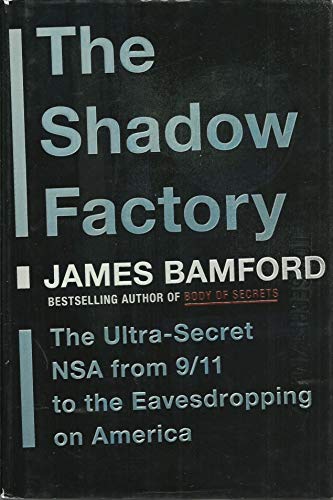
James Bamford exposed the existence of the top-secret National Security Agency in the bestselling The Puzzle Palace and continued to probe into its workings in his follow-up bestseller, Body of Secrets. Now Bamford discloses inside, often shocking information about the transformation of the NSA in the aftermath of the terrorist attacks of 2001.
In THE SHADOW FACTORY, Bamford shows how the NSA’s failure to detect the presence of two of the 9/11 hijackers inside the United States led the NSA to abandon its long-held policy of spying only on enemies outside the country. Instead, after 9/11 it turned its almost limitless ability to listen in on friend and foe alike over to the Bush Administration to use as a weapon in the war on terror. With unrivaled access to sources and documents, Bamford details how the agency has conducted domestic surveillance without court approval, and he frames it in the context of the NSA’s ongoing hunt for information about today’s elusive enemies.
THE SHADOW FACTORY is a riveting read for anyone concerned about civil liberties and America’s security in the post-9/11 world.
Die Inhaltsangabe kann sich auf eine andere Ausgabe dieses Titels beziehen.
Über die Autorin bzw. den Autor
JAMES BAMFORD is the author of Body of Secrets, The Puzzle Palace, and A Pretext for War, and has written on national security for The New York Times Magazine, The Washington Post Magazine, and the Los Angeles Times Magazine. His 2005 Rolling Stone article “The Man Who Sold the War” won a National Magazine Award for reporting. Formerly the Washington investigative producer for ABC’s World News Tonight with Peter Jennings and a distinguished visiting professor at the University of California, Berkeley, Bamford lives in Washington, D.C.
Auszug. © Genehmigter Nachdruck. Alle Rechte vorbehalten.
Sanaa
It was late December and Yemen's capital of Sanaa lay cool beneath the afternoon sun. A fine powder of reddish sand, blown southward from the vast Arabian Desert, coated the labyrinth of narrow alleyways that snake throughout the city. On crowded sidewalks, beneath high walls topped with shards of broken glass, women in black chadors paraded with men in drab suit coats and red-and-white checkered scarves that hung loose like long shawls. It is a city of -well--oiled Kalashnikovs and jewel-encrusted daggers known as jambiyahs; a place where former comrades from the once Marxist south sit on battered sidewalk chairs chewing qat and puffing from hookahs with wrinkled imams from the tribal north.
At the northwest edge of the city in Madbah, a cluttered neighborhood of cinder-block homes and yapping dogs, was a boxy, sand-swept house. Across the street sat a vacant lot littered with stones, bits of concrete, and tufts of greenish weeds. Made of cement and surrounded by a black iron fence, the house had a solid, fortresslike appearance. On the flat roof were three chimneys, one for each floor, and open balconies that were wide and square, like bull pens at a rodeo; glass arches topped the windows and doors.
It was the home of Ahmed -al-Hada, a middle-aged Yemeni who had become friends with Osama bin Laden while fighting alongside him against the Russians in Afghanistan. Hada came from a violent family tribe based for generations in Dhamar Province, about sixty miles south of Sanaa. In a valley of squat, mud-brick houses and green terraced farms, the region was sandwiched between two volcanic peaks in the Yemen Highlands. The area had achieved some fame as a center for the breeding of thoroughbred horses. It also gained fame for kidnappings.
A devoted follower of bin Laden, Hada offered to turn his house into a secret operations center for his friend in Afghanistan. While the rugged Afghan landscape provided bin Laden with security, it was too isolated and remote to manage the day-to-day logistics for his growing worldwide terrorist organization. His sole tool of communication was a gray, battery-powered $7,500 Compact-M satellite phone. About the size of a laptop computer, it could transmit and receive both voice phone calls and fax messages from virtually anywhere in the world over the Inmarsat satellite network. His phone number was 00-873-682505331; the 00 meant it was a satellite call, 873 indicated the phone was in the Indian Ocean area, and 682505331 was his personal number.
Bin Laden needed to set up a separate operations center somewhere outside Afghanistan, somewhere with access to regular telephone service and close to major air links. He took Hada up on his offer, and the house in Yemen quickly became the epicenter of bin Laden's war against America, a logistics base to coordinate his attacks, a switchboard to pass on orders, and a safe house where his field commanders could meet to discuss and carry out operations. Between 1996 and 1998, bin Laden and his top aides made a total of 221 calls to the ops center's phone number, 011-967-1-200-578, using the house to coordinate the 1998 bombings of the U.S. embassies in East Africa and to plan the attack of the USS Cole in the port of Aden in 2000.
Also living in the house was Hada's daughter, Hoda, along with her husband, Khalid al-Mihdhar. Standing 5'6" and weighing 142 pounds, Mihdhar had an intelligent face, with a soft, unblemished complexion and a neatly trimmed mustache. Wearing glasses, he had the appearance of a young university instructor. But it was war, not tenure, that interested Mihdhar. He had been training in secret for months to lead a massive airborne terrorist attack against the U.S. Now he was just waiting for the phone call to begin the operation.
Khalid al-Mihdhar began life atop Yemen's searing sandscape on May 16, 1975. Shortly thereafter, he and his family moved to the Kingdom of Saudi Arabia. It was the beginning of the oil boom and the Mihdhars, like thousands of others in the poverty-racked country, hoped to take advantage of the rivers of petrodollars then flowing into the Kingdom. They settled in the holy city of Mecca, Khalid's father was successful, and the family became Saudi citizens.
For centuries the Mihdhar tribe was prominent in the remote Yemen provinces that merge invisibly into Saudi Arabia across an endless expanse of drifting sand dunes. Known as the Empty Quarter, the provinces are a geographical twilight zone, a void on the map where governments, borders, and lines of demarcation have scarcely intruded. Horizon to horizon, there are only the occasional Bedouins who pass like a convoy of ships on a sea of sand. In the city of Tarim is the al-Mihdhar mosque, with its strikingly beautiful minaret reaching more than seventeen stories into the sky, the tallest such structure in southern Arabia. It was built in honor of the -fifteenth--century religious leader Omar-al-Mihdhar, the grand patriarch of the tribe.
When Mihdhar was growing up, one of his neighborhood friends was Nawaf al-Hazmi, whose father owned a supermarket and a building in the Nawariya district in northwest Mecca and whose older brother was a police chief in Jizan, a city in southwest Saudi Arabia across the border from Yemen. Darker, more muscular, and a year younger than Khalid, he came from a prominent and financially well-off family of nine sons. His father, Muhammad Salem al-Hazmi, described both Nawaf and his younger brother, Salem, as "well-behaved, nice young men who have been brought up in a family atmosphere free from any social or psychological problems." Nevertheless, Nawaf would later complain that his father once cut him with a knife that left a long scar on his forearm.
Soon after turning eighteen, Hazmi packed a duffel bag and left for Afghanistan to learn the art of warfare. But by 1993 the war against the Soviet occupiers was long over and Osama bin Laden had returned to his contracting business in Sudan. Undeterred, Hazmi called his family from Peshawar, Pakistan, near the Afghan border, and told them he was going to fight in Chechnya. Very concerned, Muhammad al-Hazmi went to Peshawar to bring his son home. "I went to Peshawar," he recalled. "I found him there. He said he was staying in Pakistan as a trader of frankincense and we returned home together. I asked him to help me in my commercial ventures, including shops and hotels." Speaking of his sons, he added, "In fact, I planned to open branches for them and to find brides for them. But they did not stay for long."
Returning to Mecca with his father, Hazmi met with a key al-Qaeda member and in 1996, bubbling with enthusiasm, convinced Mihdhar to join him in a new war, this one in Bosnia defending fellow Muslims from attacks by the Serbs.
What drove Mihdhar, Hazmi, and thousands of others was a burning need to defend Muslim lands from the West, which had a long history, as they saw it, of invading and occupying their territory, killing and humiliating their families, and supporting their corrupt rulers. The victory in Afghanistan over the Soviets, a superpower, was their first real win and gave many Muslims across the region a sense of unity, fueling an ideology that viewed their separate countries as a single Muslim nation--what they called the "ulema." An occupation or invasion of one Muslim state was therefore an aggression against all Muslim states.
Now with the taste of victory over Russia still sweet in their mouths, adrenaline still pumping through their veins, and a new sense of Muslim nationalism, many were no longer willing to sit and wait for the next encroachment on their lands. The West had long waged war on Islam, they believed; now it was Islam's time to defend itself and fight back. The time had come to go on the offensive.
On August 23,...
„Über diesen Titel“ kann sich auf eine andere Ausgabe dieses Titels beziehen.
Suchergebnisse für The Shadow Factory: The Ultra-Secret NSA from 9/11...

Beispielbild für diese ISBN
The Shadow Factory: the Ultra-secret NSA from 9/11 to the Eavesdropping on America
Anbieter: World of Books (was SecondSale), Montgomery, IL, USA
Verkäuferbewertung 5 von 5 Sternen

Hardback. Zustand: Good. James Bamford has been the preeminent expert on the National Security Agency since his reporting revealed the agency's existence in the 1980s. Now Bamford describes the transformation of the NSA since 9/11, as the agency increasingly turns its high-tech ears on the American public. The Shadow Factory reconstructs how the NSA missed a chance to thwart the 9/11 hijackers and details how this mistake has led to a heightening of domestic surveillance. In disturbing detail, Bamford describes exactly how every American's data is being mined and what is being done with it. Any reader who thinks America's liberties are being protected by Congress will be shocked and appalled at what is revealed here. Artikel-Nr. 00109400580
Gebraucht kaufen
EUR 4,07
Versand gratis
Versand innerhalb von USA
Versand innerhalb von USA
Anzahl: 5 verfügbar
Beispielbild für diese ISBN
The Shadow Factory: The Ultra-Secret NSA from 9/11 to the Eavesdropping on America
Anbieter: ThriftBooks-Reno, Reno, NV, USA
Verkäuferbewertung 5 von 5 Sternen
Hardcover. Zustand: Fair. No Jacket. Missing dust jacket; Readable copy. Pages may have considerable notes/highlighting. ~ ThriftBooks: Read More, Spend Less. Artikel-Nr. G0385521324I5N01
Gebraucht kaufen
EUR 5,99
Versand gratis
Versand innerhalb von USA
Versand innerhalb von USA
Anzahl: 1 verfügbar
Beispielbild für diese ISBN
The Shadow Factory: The Ultra-Secret NSA from 9/11 to the Eavesdropping on America
Anbieter: ThriftBooks-Phoenix, Phoenix, AZ, USA
Verkäuferbewertung 5 von 5 Sternen
Hardcover. Zustand: Good. No Jacket. Pages can have notes/highlighting. Spine may show signs of wear. ~ ThriftBooks: Read More, Spend Less. Artikel-Nr. G0385521324I3N00
Gebraucht kaufen
EUR 5,99
Versand gratis
Versand innerhalb von USA
Versand innerhalb von USA
Anzahl: 1 verfügbar
Beispielbild für diese ISBN
The Shadow Factory: The Ultra-Secret NSA from 9/11 to the Eavesdropping on America
Anbieter: ThriftBooks-Phoenix, Phoenix, AZ, USA
Verkäuferbewertung 5 von 5 Sternen
Hardcover. Zustand: Fair. No Jacket. Missing dust jacket; Readable copy. Pages may have considerable notes/highlighting. ~ ThriftBooks: Read More, Spend Less. Artikel-Nr. G0385521324I5N01
Gebraucht kaufen
EUR 5,99
Versand gratis
Versand innerhalb von USA
Versand innerhalb von USA
Anzahl: 1 verfügbar
Beispielbild für diese ISBN
The Shadow Factory: The Ultra-Secret NSA from 9/11 to the Eavesdropping on America
Anbieter: ThriftBooks-Dallas, Dallas, TX, USA
Verkäuferbewertung 5 von 5 Sternen
Hardcover. Zustand: Good. No Jacket. Missing dust jacket; Pages can have notes/highlighting. Spine may show signs of wear. ~ ThriftBooks: Read More, Spend Less. Artikel-Nr. G0385521324I3N01
Gebraucht kaufen
EUR 5,99
Versand gratis
Versand innerhalb von USA
Versand innerhalb von USA
Anzahl: 1 verfügbar
Beispielbild für diese ISBN
The Shadow Factory: The Ultra-Secret NSA from 9/11 to the Eavesdropping on America
Anbieter: ThriftBooks-Atlanta, AUSTELL, GA, USA
Verkäuferbewertung 5 von 5 Sternen
Hardcover. Zustand: Good. No Jacket. Missing dust jacket; Pages can have notes/highlighting. Spine may show signs of wear. ~ ThriftBooks: Read More, Spend Less. Artikel-Nr. G0385521324I3N01
Gebraucht kaufen
EUR 5,99
Versand gratis
Versand innerhalb von USA
Versand innerhalb von USA
Anzahl: 1 verfügbar
Beispielbild für diese ISBN
The Shadow Factory: The Ultra-Secret NSA from 9/11 to the Eavesdropping on America
Anbieter: ThriftBooks-Reno, Reno, NV, USA
Verkäuferbewertung 5 von 5 Sternen
Hardcover. Zustand: Fair. No Jacket. Former library book; Readable copy. Pages may have considerable notes/highlighting. ~ ThriftBooks: Read More, Spend Less. Artikel-Nr. G0385521324I5N10
Gebraucht kaufen
EUR 5,99
Versand gratis
Versand innerhalb von USA
Versand innerhalb von USA
Anzahl: 1 verfügbar
Beispielbild für diese ISBN
The Shadow Factory: The Ultra-Secret NSA from 9/11 to the Eavesdropping on America
Anbieter: ThriftBooks-Atlanta, AUSTELL, GA, USA
Verkäuferbewertung 5 von 5 Sternen
Hardcover. Zustand: Good. No Jacket. Pages can have notes/highlighting. Spine may show signs of wear. ~ ThriftBooks: Read More, Spend Less. Artikel-Nr. G0385521324I3N00
Gebraucht kaufen
EUR 5,99
Versand gratis
Versand innerhalb von USA
Versand innerhalb von USA
Anzahl: 2 verfügbar
Beispielbild für diese ISBN
The Shadow Factory: The Ultra-Secret NSA from 9/11 to the Eavesdropping on America
Anbieter: ThriftBooks-Reno, Reno, NV, USA
Verkäuferbewertung 5 von 5 Sternen
Hardcover. Zustand: Good. No Jacket. Pages can have notes/highlighting. Spine may show signs of wear. ~ ThriftBooks: Read More, Spend Less. Artikel-Nr. G0385521324I3N00
Gebraucht kaufen
EUR 5,99
Versand gratis
Versand innerhalb von USA
Versand innerhalb von USA
Anzahl: 1 verfügbar
Beispielbild für diese ISBN
The Shadow Factory: The Ultra-Secret NSA from 9/11 to the Eavesdropping on America
Anbieter: ThriftBooks-Phoenix, Phoenix, AZ, USA
Verkäuferbewertung 5 von 5 Sternen
Hardcover. Zustand: Good. No Jacket. Former library book; Pages can have notes/highlighting. Spine may show signs of wear. ~ ThriftBooks: Read More, Spend Less. Artikel-Nr. G0385521324I3N10
Gebraucht kaufen
EUR 5,99
Versand gratis
Versand innerhalb von USA
Versand innerhalb von USA
Anzahl: 1 verfügbar