
Verwandte Artikel zu The Long March: The True History of Communist China's...
Inhaltsangabe
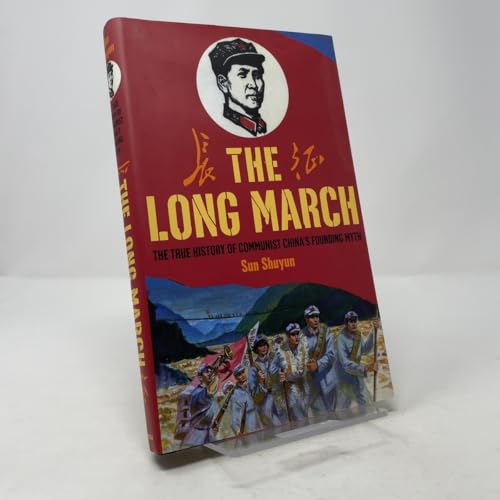
The Long March is Communist China’s founding myth, the heroic tale that every Chinese child learns in school. Seventy years after the historical march took place, Sun Shuyun set out to retrace the Marchers’ steps and unexpectedly discovered the true history behind the legend. The Long March is the stunning narrative of her extraordinary expedition.
The facts are these: in 1934, in the midst of a brutal civil war, the Communist party and its 200,000 soldiers were forced from their bases by Chiang Kaishek and his Nationalist troops. After that, truth and legend begin to blur: led by Mao Zedong, the Communists set off on a strategic retreat to the distant barren north of China, thousands of miles away. Only one in five Marchers reached their destination, where, the legend goes, they gathered strength and returned to launch the new China in the heat of revolution.
As Sun Shuyun journeys to remote villages along the Marchers’ route, she interviews the aged survivors and visits little-known local archives. She uncovers shocking stories of starvation, disease, and desertion, of ruthless purges ordered by party leaders, of the mistreatment of women, and of thousands of futile deaths. Many who survived the March report that their suffering continued long after the “triumph” of the revolution, recounting tales of persecution and ostracism that culminated in the horrific years of the Cultural Revolution.
What emerges from Sun’s research, her interviews, and her own memories of growing up in China is a moving portrait of China past and present. Sun finds that the forces at work during the days of the revolution—the barren, unforgiving landscape; the unifying power of outside threats from foreign countries; Mao’s brilliant political instincts and his use of terror, propaganda, and ruthless purges to consolidate power and control the population—are the very forces that made China what it is today.
The Long March is a gripping retelling of an amazing historical adventure, an eye-opening account of how Mao manipulated the event for his own purposes, and a beautiful document of a country balanced between legend and the truth.
Die Inhaltsangabe kann sich auf eine andere Ausgabe dieses Titels beziehen.
Über die Autorin bzw. den Autor
SUN SHUYUN was born in China in the 1960s. She graduated from Beijing University and won a scholarship to Oxford. A filmmaker and television producer, she has made documentaries for the BBC, Channel 4, and international broadcasters. For the past decade, she has divided her time between London and Beijing.
Auszug. © Genehmigter Nachdruck. Alle Rechte vorbehalten.
1 * DRAIN THE POND TO CATCH THE FISH
I’m sending you to the Army my man,
You must see the reason why
The Revolution is for us.
I’m sending you to do or die.
Here’s a towel I've embroidered
With all my love to say:
Revolution for ever!
The Party you must not betray!
The song pierced the silence of Shi Village, which nestled at the foot of a hill covered in thick bamboo groves. It was mid–October, 1935, in Jiangxi Province, southern China. The autumn harvest was already in and the land surrounding the village was yellow with the stubble of rice stalks, but some fields stood as if wasted, with grass sprouting in the dried–out paddy, already turning brown. A few water buffalo were plodding home, only stopping when they came to their favorite place, the village pond, where they drank, ducks and geese swam, children bathed, women washed their clothes, and men asked one another about their day. Nearby stood the giant camphor tree, whose overhanging branches gave ample shelter from the rain and intense heat of the South.
Today the water buffalo had the pond to themselves, and only the village ancestor shrine opposite showed signs of life, but not with pious prayers and hypnotic chants offered to the ancestors: only the revolutionary song calling on young men to join the Red Army. Through the imposing entrance topped by grey–tiled eaves, boys carrying spears rushed in and out, looking solemn, as if they had been entrusted with the most important task of their lives. Two young women were putting a table and some benches outside the gate. As the song died away, more women came out, clutching shoes they were making out of cloth, calling their children, while others gathered up firewood from outside the gate, and went home to cook.
“Nobody is too tired to sing! Keep up the good work!” called Wang Quanyuan, the young woman who had just emerged from a house nearby. She had on a grey cotton jacket, the kind every soldier wore, tied with a rope round her waist, but its simplicity made her beauty stand out even more. She asked one woman to bring more benches, and then stopped one of the boys who was running by, and whispered something in his ear; nodding eagerly, he took to his heels.
Wang noticed the slogans on the white wall of the shrine, written in black ink but slightly washed out by the summer rain. “Down with the Landlords and Evil Gentry!” “Long Live the Communists!” “Long Live the Soviet!” “I mustn’t forget to tell them to repaint the slogans,” she murmured to herself, remembering that until four years ago she had no idea what Soviet was. Someone had told her that it was a foreign shop, and others said he was the brother of a famous Communist labor organizer. A warlord definitely thought so: he had posted a notice throughout the villages, offering a reward for the capture, dead or alive, of Mr. Soviet. In the local dialect, Soviet was pronounced Su–wei–ai, which meant “we,” so perhaps the Soviet was our government, she once thought. Now she was actually working for the youth and women's departments of the Soviet, a government of workers and peasants that had been set up by Mao and his Red Army in southern Jiangxi in 1931. Small as it was, with barely three million people in half a dozen counties, hemmed in on all sides by Chiang Kaishek's Nationalist troops, the Jiangxi Soviet had all the functions of a state. Wang was told that the Communist Party was working to turn the whole of China into a Soviet. That would be the day, Wang smiled, but then became very solemn. “Everything hangs on tonight,” she muttered to herself.
As darkness fell, the bell hanging from the camphor tree rang out. Four giant bamboo torches lit up the pond and the gate of the shrine hall. Women, and a few men, old and young, gathered with several hundred people from nearby villages, summoned by Wang’s Red Pioneers. She had also sent for half a dozen militiamen from the county Party headquarters; when they finally arrived, Wang stood up and delivered her speech:
“Sisters and brothers, grandfathers and grandmothers, the Red Army is at its most critical time now, with many wounded every day. But in a war, there is always winning and losing. If we stop fighting just because we have lost a few battles, our Revolution will never succeed and we will always be exploited by the rich. You are strong. Do you want to be trampled on for the rest of your lives? If not, join the Red Army now!”
There was no reply.
Wang nodded to the militiamen who were standing close by, and continued: “Don’t be afraid. We will win. Use your brain. This village has hundreds of poor people, and only one or two landlords. Aren’t we more powerful than them? All we need to do is to unite, but there is a traitor who does not want this to happen. He seems to care about you, telling you to keep your men at home, but if we all stay at home, our enemy will come, taking our land and raping our women. Is that what you want?”
“Of course not!” shouted the militiamen.
“Then let’s bring the traitor out.” Wang waved her hand. Two militiamen appeared from behind the shrine gate, each holding the arm of a man, followed by a third with a pistol in his hand. Silence fell and the villagers looked at each other speechless. The accused was none other than the Party secretary of their district, Mr. Liu. Suddenly, a Red Pioneer raised his arm, shouting, “Down with the traitor! Kill the traitor!”
“Tell me, what do you want done with him?” Wang asked several times.
“Kill him,” yelled a militiaman.
“Kill him now!” a chorus of voices followed.
Two shots at point–blank range and Liu fell to the ground. Wang announced grimly: “This will be the fate of anyone who dares to sabotage the Revolution.”
It was hard to believe, when I met Woman Wang, that she had ever done such things, or suffered more than I could bear to think about. She had started as the quintessential supporter of the Revolution. Poverty had made her family sell her into a marriage which she did not want; joining the Communists represented hope. Chosen as one of only 30 women to go with the 1st Army among 86,000 men, she survived and rose to head the Red Army’s only women’s regiment. A year later, she was captured, raped, and given to a Nationalist officer as a concubine—a “crime” for which she was denounced by the Party, remaining under a cloud for the next fifty years. Still, she remained loyal to the Party, which she regarded as dearer to her than her parents. I remember thinking to myself after reading her biography: if there was ever a true Communist faithful, it must be Wang.
What better way to start my journey than by talking to her? I set out in October 2004, exactly seventy years after the Chinese Communist Party and the 1st Army abandoned their base in Jiangxi and began their escape from the Nationalists—the Long March as it became known. From Beijing I took the train, eighteen hours due south, and then after two hours more by bus through green-clad mountains and hills I found myself in Taihe in southern Jiangxi. It was a big town, with a grand new avenue, beautifully surfaced and complete with modern lighting—not many buildings yet, but looking for twenty–first–century growth. I wondered if I would have trouble finding Wang—after all, Taihe had a population of half a million people and all I had was her biography, which I had been rereading on the train. I took a rickshaw from the long–distance bus stop and mentioned Wang’s name hesitantly; I was relieved when the driver...
„Über diesen Titel“ kann sich auf eine andere Ausgabe dieses Titels beziehen.
Suchergebnisse für The Long March: The True History of Communist China's...

Beispielbild für diese ISBN
The Long March: The True History of Communist China's Founding Myth
Anbieter: ThriftBooks-Atlanta, AUSTELL, GA, USA
Verkäuferbewertung 5 von 5 Sternen

Hardcover. Zustand: Good. No Jacket. Pages can have notes/highlighting. Spine may show signs of wear. ~ ThriftBooks: Read More, Spend Less. Artikel-Nr. G0385520247I3N00
Gebraucht kaufen
EUR 6,51
Versand gratis
Versand innerhalb von USA
Versand innerhalb von USA
Anzahl: 1 verfügbar
Beispielbild für diese ISBN
The Long March: The True History of Communist China's Founding Myth
Anbieter: ThriftBooks-Atlanta, AUSTELL, GA, USA
Verkäuferbewertung 5 von 5 Sternen
Hardcover. Zustand: Very Good. No Jacket. Former library book; May have limited writing in cover pages. Pages are unmarked. ~ ThriftBooks: Read More, Spend Less. Artikel-Nr. G0385520247I4N10
Gebraucht kaufen
EUR 6,51
Versand gratis
Versand innerhalb von USA
Versand innerhalb von USA
Anzahl: 1 verfügbar
Beispielbild für diese ISBN
The Long March: The True History of Communist China's Founding Myth
Anbieter: ThriftBooks-Dallas, Dallas, TX, USA
Verkäuferbewertung 5 von 5 Sternen
Hardcover. Zustand: Very Good. No Jacket. Missing dust jacket; May have limited writing in cover pages. Pages are unmarked. ~ ThriftBooks: Read More, Spend Less. Artikel-Nr. G0385520247I4N01
Gebraucht kaufen
EUR 6,51
Versand gratis
Versand innerhalb von USA
Versand innerhalb von USA
Anzahl: 1 verfügbar
Beispielbild für diese ISBN
The Long March : The True History of Communist China's Founding Myth
Verlag:
Doubleday Religious Publishing Group, The, 2007
ISBN 10: 0385520247
ISBN 13: 9780385520249
Gebraucht
Hardcover
Anbieter: Better World Books: West, Reno, NV, USA
Verkäuferbewertung 5 von 5 Sternen
Zustand: Good. Pages intact with minimal writing/highlighting. The binding may be loose and creased. Dust jackets/supplements are not included. Stock photo provided. Product includes identifying sticker. Better World Books: Buy Books. Do Good. Artikel-Nr. 4798330-6
Gebraucht kaufen
EUR 7,11
Versand gratis
Versand innerhalb von USA
Versand innerhalb von USA
Anzahl: 1 verfügbar
Beispielbild für diese ISBN
The Long March : The True History of Communist China's Founding Myth
Verlag:
Doubleday Religious Publishing Group, The, 2007
ISBN 10: 0385520247
ISBN 13: 9780385520249
Gebraucht
Hardcover
Anbieter: Better World Books, Mishawaka, IN, USA
Verkäuferbewertung 5 von 5 Sternen
Zustand: Good. Former library copy. Pages intact with minimal writing/highlighting. The binding may be loose and creased. Dust jackets/supplements are not included. Includes library markings. Stock photo provided. Product includes identifying sticker. Better World Books: Buy Books. Do Good. Artikel-Nr. 485548-75
Gebraucht kaufen
EUR 7,11
Versand gratis
Versand innerhalb von USA
Versand innerhalb von USA
Anzahl: 1 verfügbar
Beispielbild für diese ISBN
The Long March : The True History of Communist China's Founding Myth
Verlag:
Doubleday Religious Publishing Group, The, 2007
ISBN 10: 0385520247
ISBN 13: 9780385520249
Gebraucht
Hardcover
Anbieter: Better World Books: West, Reno, NV, USA
Verkäuferbewertung 5 von 5 Sternen
Zustand: Very Good. Former library copy. Pages intact with possible writing/highlighting. Binding strong with minor wear. Dust jackets/supplements may not be included. Includes library markings. Stock photo provided. Product includes identifying sticker. Better World Books: Buy Books. Do Good. Artikel-Nr. 6274841-6
Gebraucht kaufen
EUR 7,11
Versand gratis
Versand innerhalb von USA
Versand innerhalb von USA
Anzahl: 1 verfügbar
Beispielbild für diese ISBN
The Long March: The True History of Communist China's Founding Myth
Anbieter: Books From California, Simi Valley, CA, USA
Verkäuferbewertung 4 von 5 Sternen

hardcover. Zustand: Good. Zustand des Schutzumschlags: Includes dust jacket. Dust jacket shows minimal shelf wear. Pages are clean, text and pictures are intact and unmarred. Artikel-Nr. mon0003642924
Gebraucht kaufen
EUR 3,61
EUR 4,39 Versand
Versand innerhalb von USA
Versand innerhalb von USA
Anzahl: 1 verfügbar
Beispielbild für diese ISBN
The Long March: The True History of Communist China's Founding Myth
Anbieter: AwesomeBooks, Wallingford, Vereinigtes Königreich
Verkäuferbewertung 5 von 5 Sternen
Hardcover. Zustand: Very Good. The Long March: The True History of Communist China's Founding Myth This book is in very good condition and will be shipped within 24 hours of ordering. The cover may have some limited signs of wear but the pages are clean, intact and the spine remains undamaged. This book has clearly been well maintained and looked after thus far. Money back guarantee if you are not satisfied. See all our books here, order more than 1 book and get discounted shipping. Artikel-Nr. 7719-9780385520249
Gebraucht kaufen
EUR 7,94
EUR 4,79 Versand
Versand von Vereinigtes Königreich nach USA
Versand von Vereinigtes Königreich nach USA
Anzahl: 2 verfügbar
Beispielbild für diese ISBN
The Long March: The True History of Communist China's Founding Myth
Anbieter: Bahamut Media, Reading, Vereinigtes Königreich
Verkäuferbewertung 5 von 5 Sternen
Hardcover. Zustand: Very Good. This book is in very good condition and will be shipped within 24 hours of ordering. The cover may have some limited signs of wear but the pages are clean, intact and the spine remains undamaged. This book has clearly been well maintained and looked after thus far. Money back guarantee if you are not satisfied. See all our books here, order more than 1 book and get discounted shipping. Artikel-Nr. 6545-9780385520249
Gebraucht kaufen
EUR 7,82
EUR 8,12 Versand
Versand von Vereinigtes Königreich nach USA
Versand von Vereinigtes Königreich nach USA
Anzahl: 2 verfügbar
Foto des Verkäufers
The Long March: The True History of Communist China's Founding Myth
Anbieter: Southampton Books, Sag Harbor, NY, USA
Verkäuferbewertung 5 von 5 Sternen
Hardcover. Zustand: Like New. First Edition. First Edition, First Printing. Not price-clipped. Published by Doubleday, 2007. Octavo. Hardcover. Book is like new. Dust jacket is like new.100% positive feedback. 30 day money back guarantee. NEXT DAY SHIPPING! Excellent customer service. Please email with any questions. All books packed carefully and ship with free delivery confirmation/tracking. All books come with free bookmarks. Ships from Sag Harbor, New York. Artikel-Nr. 371992
Gebraucht kaufen
EUR 18,10
EUR 4,39 Versand
Versand innerhalb von USA
Versand innerhalb von USA
Anzahl: 1 verfügbar