
Verwandte Artikel zu On-the-Fly Guide to Balancing Work and Life
Inhaltsangabe
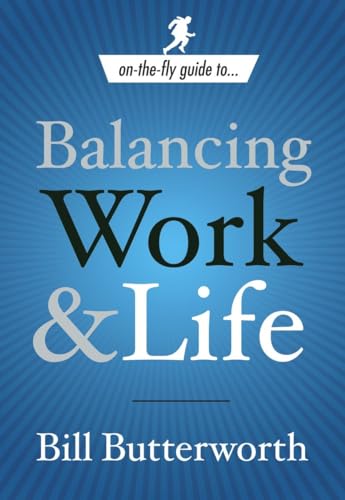
In the On-the-Fly Guide to Balancing Work and Life, Bill Butterworth brings his trusted brand of motivation to an issue that affects us all, no matter what our jobs or where we stand on the corporate ladder.
As this charming little book makes clear, it is possible to have it all: success at work and a fulfilling life outside the office. Designed to be read in one short plane ride—or over a hot cup of coffee or two—this book is the “Cliff’s Notes” for a happier, more well-rounded life. Filled with stories about how successful people from all walks of life have integrated their work and home lives and packed with advice on how you can learn to do the same, the On-the-Fly Guide to Balancing Work and Life will change the way you work—and, more importantly, the way you live.
There’s no telling what you’ll learn when you read on the fly.
Die Inhaltsangabe kann sich auf eine andere Ausgabe dieses Titels beziehen.
Über die Autorin bzw. den Autor
bill butterworth’s blend of humor, storytelling, wisdom, and practical advice has made him one of the most sought-after speakers in North America. A highly regarded author, Bill has written on topics ranging from sports to psychology and self-help issues and has been a columnist, editor, and scriptwriter. Bill lives with his wife, Kathi, in Newport Beach, California.
Auszug. © Genehmigter Nachdruck. Alle Rechte vorbehalten.
One
What I Know About Balance I Learned on the Track Team
I can describe my entire childhood in one run-on sentence: I weighed back then what I weigh now and I was four feet shorter and my last name was Butterworth.
Can you visualize it? It’s not a very pretty picture.
Like everyone else, I quickly observed that our school had a group of kids who really ran the place. They were the cool ones. In the school I went to, just outside Philadelphia, the cool kids were the athletes. I naively grew up thinking all athletes were cool, but that is not necessarily so. It could be that you went to a school where the band was tough or the chess club ruled. But in my hometown it was the jocks, and I wanted to be just like them. Yet there weren’t many coaches anxious for me to join their team.
I can remember, however, the first time the football coach laid eyes on me. He took one look at my size and began to drool with animal anticipation. “Butterworth,” he barked, “if I could just get you on my offensive line, my strategy would be simple. I’d have you hike the ball and roll over. The defensive line would be lost for hours. They wouldn’t even know what field they were playing on! We could score at will.”
Naturally excited at the prospect, I went home to tell my parents the good news that the football coach not only wanted me, but he wanted me badly. I recall being heartbroken when my folks said I couldn’t play football. “I don’t want to see my ‘little Billy’ [my first oxymoron] getting hurt,” my overprotective mother said.
I was no medical doctor, but I honestly believed that, because of the way I was built, it was physically impossible for me to get hurt. There was so much padding on my body, it would have been a miracle if someone could have found something hard enough to break–unless there is an ailment known as strained cellulite.
But football was out of the question.
I was crushed.
So, in a complete admission of failure, I joined the marching band. It was a Fat Kid Fraternity, where the common bond was the pain of rejection. There I was, taking up the entire back three rows of the marching band, watching the cool kids instead of being one.
But that all changed one day after a social studies class. “Butterworth, I want to see you after class,” my teacher announced as the bell was about to ring. I slowly walked to the front of the room like a man being led to the gallows, wondering what I possibly could have done. I was stumped, for I worked hard to keep my nose clean at school.
Mr. Warren greeted me warmly. “Butterworth, have you ever considered going out for the school’s track team?” he inquired.
I was stunned. Gee, kids make fun of me all the time, I thought. Now teachers are asking me to stay after class for a little one-on-one heckling. But I maintained a positive demeanor. After all, this man was responsible for my grade in social studies, so I didn’t dare come off disrespectful in any way. I swallowed hard and squeaked out the only response I could think of:
“Sir, I don’t think I’m very fast.”
Mr. Warren held back a chuckle. “Son, I wasn’t thinking of having you run.” He paused while I let out a sigh of relief. “There are other parts to a track team,” he continued.
“There are the field events. I think you’d be very effective in the weightman events.”
“Weightman events?”
“The shot put, Butterworth. The big steel ball that you place under your chin. You don’t throw it; you put it.” He illustrated the motion by bringing his hand from his chin out to its full extension.
“I see.”
“And then there’s the discus, Butterworth. You know–the plate- or saucer-looking thing that you throw. Surely you’ve seen the famous statue of the discus thrower, haven’t you, Butterworth?”
My face turned ashen.
“Relax, Butterworth, relax. They wear clothes now when they throw it.”
“Oh.”
“Ask your mom and dad if you can come out for the team,” Mr. Warren suggested. “We’ve got a place waiting for you.”
I went home that evening with absolutely no expectation of a positive response. I felt that my parents were anti-sports and track would be treated no differently than football. I was braced for more despair. It was painful enough being a fat kid, but add to it parents who protest the coolest activity in school, and you’ve got all the ingredients of a defeated childhood. So imagine my complete surprise when I threw the question out and was met with encouragement.
“That sounds like a great idea!” my parents replied. They liked the idea of a noncontact sport. I could throw the shot put and the discus to my heart’s content. (Although I do remember having to sign a form promising my parents I would not try to catch these implements after they were thrown.)
Overnight I was transformed from a member of the marching band to BILL BUTTERWORTH–ATHLETE. I liked the way that looked and sounded. I finally felt cool.
In the northeastern part of the country, where I grew up, track is a two-season sport. Winter track takes place indoors, and spring track is outside. I quickly discovered that if you are a weightman, winter track means going into a tiny–and smelly–room off the boys’ gym and lifting weights. This continues until spring, when you are finally allowed to go outside. Weightmen love the spring.
All humility aside, there were certain parts of this weightman scene in which I excelled. Mainly, I had great form. I knew how to slide across the circle, crouched low, and then, at just the precise moment, explode with great intensity (and a primitive grunt) in order to throw the shot put a mile. In the same way, I knew how to spin around through the circle for the discus throw, like a spring unwinding. I knew how to uncoil and, once again, explode at the optimum moment of release.
Yes, my form was outstanding…especially without the implements.
It was when I actually had to throw the darn things that it all unraveled. You see, I had no strength. Even with my perfect form, great slides and spins, and intense explosion, neither the shot put nor the discus went any distance when I threw it.
I was the only guy they measured with a ruler.
But I refused to become discouraged. I was one of the cool guys, and that’s what mattered most. I even remember the day I discovered how they keep score in a track meet. Points are awarded to those who come in first, second, or third. I did a little mental math and realized that I was the fifth man on my own team. That meant I would never score any points unless the opposition forfeited and malaria worked its way through our squad. But a chance to score points came up in a rather unusual circumstance.
As I was growing up, my parents saw to it that I was in church every Sunday. At the time, we went to a church that I would describe as “socially active.” By that I mean they had sporting events for every taste. They had church flag football in the fall, church basketball in the winter, and church softball in the spring. But they went far beyond those conventional contests. We had all-church boccie ball, all-church canasta, all-church darts–we had all the bases covered, so to speak.
One spring the question was raised: “There’s a certain sport in which we’ve never participated. How about an all-church track meet?”
I...
„Über diesen Titel“ kann sich auf eine andere Ausgabe dieses Titels beziehen.
Suchergebnisse für On-the-Fly Guide to Balancing Work and Life

Beispielbild für diese ISBN
On-the-Fly Guide to Balancing Work and Life
Anbieter: World of Books (was SecondSale), Montgomery, IL, USA
Verkäuferbewertung 5 von 5 Sternen

Paperback. Zustand: Fair. Life is more like a marathon than a sprint. Here's how to stay well conditioned.Bill Butterworth will make you laugh-and learn while you're doing it In the opening chapter of this powerful little book, Bill shares with you how, while running his rotund body in a nightmarish 440-yard dash, he learned a great lesson: Life is much more like a marathon than a sprint.The attitudes and actions that result in steady success over the long haul are what make for long-term satisfaction and achievement. To experience this for yourself, you need to understand how to deal with life's inevitable challenges: -The Hazies-losing sight of long-term goals-The Lazies-lacking the self-discipline to bring life back into focus-The Crazies-allowing life to run out of control Each of these can be conquered by three clarifying triangles: setting clear priorities, learning the discipline of endurance, and reaching the finish line through skillful pacing. It all adds up to a succinct and inspiring guide to balancing excellence at work with fulfillment in all of life. Also look for the On-the-Fly-Guide to Building Successful Teams. Artikel-Nr. 00104773421
Gebraucht kaufen
EUR 4,43
Versand gratis
Versand innerhalb von USA
Versand innerhalb von USA
Anzahl: 1 verfügbar
Beispielbild für diese ISBN
On-the-Fly Guide to Balancing Work and Life
Anbieter: World of Books (was SecondSale), Montgomery, IL, USA
Verkäuferbewertung 5 von 5 Sternen
Paperback. Zustand: Good. Life is more like a marathon than a sprint. Here's how to stay well conditioned.Bill Butterworth will make you laugh-and learn while you're doing it In the opening chapter of this powerful little book, Bill shares with you how, while running his rotund body in a nightmarish 440-yard dash, he learned a great lesson: Life is much more like a marathon than a sprint.The attitudes and actions that result in steady success over the long haul are what make for long-term satisfaction and achievement. To experience this for yourself, you need to understand how to deal with life's inevitable challenges: -The Hazies-losing sight of long-term goals-The Lazies-lacking the self-discipline to bring life back into focus-The Crazies-allowing life to run out of control Each of these can be conquered by three clarifying triangles: setting clear priorities, learning the discipline of endurance, and reaching the finish line through skillful pacing. It all adds up to a succinct and inspiring guide to balancing excellence at work with fulfillment in all of life. Also look for the On-the-Fly-Guide to Building Successful Teams. Artikel-Nr. 00071336320
Gebraucht kaufen
EUR 4,43
Versand gratis
Versand innerhalb von USA
Versand innerhalb von USA
Anzahl: 3 verfügbar
Beispielbild für diese ISBN
On-the-Fly Guide to Balancing Work and Life
Anbieter: World of Books (was SecondSale), Montgomery, IL, USA
Verkäuferbewertung 5 von 5 Sternen
Paperback. Zustand: Very Good. Life is more like a marathon than a sprint. Here's how to stay well conditioned.Bill Butterworth will make you laugh-and learn while you're doing it In the opening chapter of this powerful little book, Bill shares with you how, while running his rotund body in a nightmarish 440-yard dash, he learned a great lesson: Life is much more like a marathon than a sprint.The attitudes and actions that result in steady success over the long haul are what make for long-term satisfaction and achievement. To experience this for yourself, you need to understand how to deal with life's inevitable challenges: -The Hazies-losing sight of long-term goals-The Lazies-lacking the self-discipline to bring life back into focus-The Crazies-allowing life to run out of control Each of these can be conquered by three clarifying triangles: setting clear priorities, learning the discipline of endurance, and reaching the finish line through skillful pacing. It all adds up to a succinct and inspiring guide to balancing excellence at work with fulfillment in all of life. Also look for the On-the-Fly-Guide to Building Successful Teams. Artikel-Nr. 00073014072
Gebraucht kaufen
EUR 4,43
Versand gratis
Versand innerhalb von USA
Versand innerhalb von USA
Anzahl: 2 verfügbar
Beispielbild für diese ISBN
On-the-Fly Guide to Balancing Work and Life
Verlag:
Crown Currency (edition First Edition), 2006
ISBN 10: 0385519680
ISBN 13: 9780385519687
Gebraucht
Paperback
Erstausgabe
Anbieter: BooksRun, Philadelphia, PA, USA
Verkäuferbewertung 5 von 5 Sternen
Paperback. Zustand: Very Good. First Edition. It's a well-cared-for item that has seen limited use. The item may show minor signs of wear. All the text is legible, with all pages included. It may have slight markings and/or highlighting. Artikel-Nr. 0385519680-11-6
Gebraucht kaufen
EUR 4,44
Versand gratis
Versand innerhalb von USA
Versand innerhalb von USA
Anzahl: 1 verfügbar
Beispielbild für diese ISBN
On-The-Fly Guide to Balancing Work and Life
Anbieter: ThriftBooks-Dallas, Dallas, TX, USA
Verkäuferbewertung 5 von 5 Sternen
Paperback. Zustand: Very Good. No Jacket. May have limited writing in cover pages. Pages are unmarked. ~ ThriftBooks: Read More, Spend Less. Artikel-Nr. G0385519680I4N00
Gebraucht kaufen
EUR 5,96
Versand gratis
Versand innerhalb von USA
Versand innerhalb von USA
Anzahl: 1 verfügbar
Beispielbild für diese ISBN
On-the-Fly Guide to Balancing Work and Life
Anbieter: Wonder Book, Frederick, MD, USA
Verkäuferbewertung 5 von 5 Sternen
Zustand: Very Good. Very Good condition. A copy that may have a few cosmetic defects. May also contain light spine creasing or a few markings such as an owner's name, short gifter's inscription or light stamp. Artikel-Nr. H15C-00398
Gebraucht kaufen
EUR 6,43
Versand gratis
Versand innerhalb von USA
Versand innerhalb von USA
Anzahl: 2 verfügbar
Beispielbild für diese ISBN
On-The-Fly Guide to Balancing Work and Life
Verlag:
Crown Publishing Group, The, 2006
ISBN 10: 0385519680
ISBN 13: 9780385519687
Gebraucht
Softcover
Anbieter: Better World Books: West, Reno, NV, USA
Verkäuferbewertung 5 von 5 Sternen
Zustand: Very Good. Pages intact with possible writing/highlighting. Binding strong with minor wear. Dust jackets/supplements may not be included. Stock photo provided. Product includes identifying sticker. Better World Books: Buy Books. Do Good. Artikel-Nr. 56163948-75
Gebraucht kaufen
EUR 7,21
Versand gratis
Versand innerhalb von USA
Versand innerhalb von USA
Anzahl: 1 verfügbar
Beispielbild für diese ISBN
On-the-Fly Guide to . . . Balancing Work & Life: 2
Anbieter: AwesomeBooks, Wallingford, Vereinigtes Königreich
Verkäuferbewertung 5 von 5 Sternen
Paperback. Zustand: Very Good. On-the-Fly Guide to . . . Balancing Work & Life: 2 This book is in very good condition and will be shipped within 24 hours of ordering. The cover may have some limited signs of wear but the pages are clean, intact and the spine remains undamaged. This book has clearly been well maintained and looked after thus far. Money back guarantee if you are not satisfied. See all our books here, order more than 1 book and get discounted shipping. Artikel-Nr. 7719-9780385519687
Gebraucht kaufen
EUR 14,45
EUR 4,92 Versand
Versand von Vereinigtes Königreich nach USA
Versand von Vereinigtes Königreich nach USA
Anzahl: 2 verfügbar
Beispielbild für diese ISBN
On-the-Fly Guide to . . . Balancing Work & Life: 2
Anbieter: Bahamut Media, Reading, Vereinigtes Königreich
Verkäuferbewertung 4 von 5 Sternen

Paperback. Zustand: Very Good. This book is in very good condition and will be shipped within 24 hours of ordering. The cover may have some limited signs of wear but the pages are clean, intact and the spine remains undamaged. This book has clearly been well maintained and looked after thus far. Money back guarantee if you are not satisfied. See all our books here, order more than 1 book and get discounted shipping. Artikel-Nr. 6545-9780385519687
Gebraucht kaufen
EUR 14,20
EUR 8,33 Versand
Versand von Vereinigtes Königreich nach USA
Versand von Vereinigtes Königreich nach USA
Anzahl: 2 verfügbar
Beispielbild für diese ISBN
On-the-Fly Guide to Balancing Work and Life
Anbieter: Ria Christie Collections, Uxbridge, Vereinigtes Königreich
Verkäuferbewertung 5 von 5 Sternen
Zustand: New. In English. Artikel-Nr. ria9780385519687_new
Neu kaufen
EUR 16,80
EUR 11,19 Versand
Versand von Vereinigtes Königreich nach USA
Versand von Vereinigtes Königreich nach USA
Anzahl: Mehr als 20 verfügbar