
Verwandte Artikel zu The Strategy Paradox: Why Committing to Success Leads...
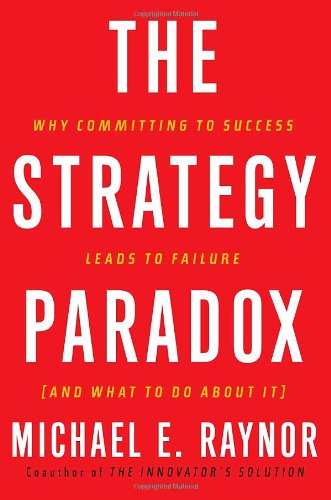
The Strategy Paradox: Why Committing to Success Leads to Failure and What to Do About It - Hardcover
Inhaltsangabe
A business consultant and co-author of The Innovator's Solution describes how companies can achieve successful results while minimizing their risk, drawing on cutting-edge research and firsthand experience to introduce his innovative principle of requisite uncertainty and detail a framework for strategic action in today's marketplace. 25,000 first printing.
Die Inhaltsangabe kann sich auf eine andere Ausgabe dieses Titels beziehen.
Über die Autorin bzw. den Autor
Michael E. Raynor, of Deloitte Consulting LLP, is a Distinguished Fellow with Deloitte Research in Boston and works extensively with clients worldwide. He is the coauthor, with Clayton M. Christensen, of the best-sellingThe Innovator’s Solution. Raynor has a doctorate from the Harvard Business School, and is an Adjunct Professor at the Richard Ivey School of Business in London, Canada. He lives in Mississauga, Canada.
Auszug. © Genehmigter Nachdruck. Alle Rechte vorbehalten.
Chapter One
WHAT STRATEGY PARADOX?
Most strategies are built on specific beliefs about the future. Unfortunately, the future is deeply unpredictable. Worse, the requirements of breakthrough success demand implementing strategy in ways that make it impossible to adapt should the future not turn out as expected. The result is the Strategy Paradox: strategies with the greatest possibility of success also have the greatest possibility of failure. Resolving this paradox requires a new way of thinking about strategy and uncertainty.
Here is a puzzling fact: the best–performing firms often have more in common with humiliated bankrupts than with companies that have managed merely to survive. In fact, the very traits we have come to identify as determinants of high achievement are also the ingredients of total collapse. And so it turns out that, behaviorally at least, the opposite of success is not failure, but mediocrity.
There is more at stake here than simply observing that accomplishing anything worthwhile requires at least making the attempt, while those who venture nothing can only ever avoid disappointment. Theodore Roosevelt, the twenty–sixth president of the United States, explained this much to us when he argued that the credit belongs to those actually “in the arena,” whose faces are marred by “dust and sweat and blood.”(1) His point was that victory demands valiant action, and that valiant action necessarily brings with it the risk of defeat.
In business, the kinship between these antipodes runs far deeper, to the nature of the actions one must take in order to prevail. Therein lies the strategy paradox: the same behaviors and characteristics that maximize a firm’s probability of notable success also maximize its probability of total failure.
THE SIMILARITY OF OPPOSITES
Many opposites are not nearly as different as they first appear. For example, as Nobel Peace Prize winner Elie Wiesel observed, the opposite of love is not hate, but indifference; for at a minimum, to love or hate someone is to have intense emotions toward them.(2) We see how the similarities between love and hate often outweigh the differences when one is transformed into the other, a phenomenon that literature—from Gilgamesh to Shakespeare to Harlequin Romances—has exploited and explored for millennia.
The psychological proximity of love and hate is part of the hard–wiring of the human psyche. Dan Gilbert explains, in his book Stumbling on Happiness, that the same neurocircuitry and neurochemistry triggered in response to stressful events (“flight or fight”) are also triggered in response to sexual arousal.(3) As a result, when we are stressed in the presence of a person we find sexually attractive, we have a tough time telling what we are responding to: are our passions inflamed (hate) because of a stressor, or are we aroused (love) because of the attractive person?
In the 1994 movie Speed starring Keanu Reeves and Sandra Bullock, Bullock’s character, Annie Porter, appeals to this possible confusion when she notes, upon finding herself in the hero’s arms after several near–death experiences, that “relationships that start under intense circumstances, they never last .”
Call it an “emotional paradox”: two very different dispositions—loving and hating—can have far more in common with each other than a seemingly intermediate state.
The strategy paradox is visible only when we can put under the microscope strategies whose only flaw was that they flopped. Chapter 2 explores two such strategies: Sony’s Betamax VCR and its MiniDisc music player. In both cases, the company never set a foot wrong by the lights of how one is supposed to build a successful strategy: it understood its customers, identified viable market segments, developed cutting–edge products, executed flawlessly, and monitored and responded to its competitors’ countermoves. Yet, in both cases, Sony came up short because the commitments the company had to make in the pursuit of greatness were undermined when the perfectly reasonable assumptions behind those commitments turned out to be wrong. Sony’s failures were not a consequence of bad strategy, but of great strategy coupled with bad luck. Sony did everything necessary to maximize its chances of success, yet those same actions exposed it to the possibility of near–total defeat. In other words, when key uncertainties broke against it, Sony became a victim of the strategy paradox.
The purpose of this book is to describe how the strategy paradox can be resolved. In what follows, a new principle I call Requisite Uncertainty and a new management tool I call Strategic Flexibility provide a way for managers to implement the kinds of strategies that can deliver outstanding results while minimizing exposure to the vagaries of fate.
1.1 HIDDEN IN PLAIN SIGHT
Why is this the first you have heard of the strategy paradox? After all, there is no shortage of well–designed and well–executed studies offering useful insights into the defining characteristics of successful firms. Similarities to failed firms and the importance of luck have not featured prominently.
The reason most business research misses the strategy paradox is that few studies ever examine failure. In some cases, this is because pursuing the secrets of success seems more rewarding than picking through the wreckage of failure. In other cases, it is simply a flawed method: researchers embrace the idea that by studying winners they can discern their defining characteristics, forgetting that the factors differentiating winners from losers can be identified only by analyzing both. Finally, there is the reality that failures are often harder to document because failed companies are typically no longer available for study.
In light of these difficulties, researchers often compromise, comparing companies that have been very successful over ten or fifteen years (focal companies) with companies that have been less successful over that same time period (comparison companies). Some studies look for firms that have done very poorly over that time, and others look for comparison companies that have actually done pretty well—just not nearly as well as their focal companies. Either way, however, comparison companies have at least survived for the period in question, and over a ten–year period, mere survival is actually a pretty high bar.(4)
What this means is that most studies of the determinants of success have based their conclusions upon comparisons of the exceptional with the mediocre. Studies that systematically seek out successful companies will necessarily find those that in the past made the right commitments. And because the comparison companies are always firms that have performed less well, but not failed completely, they will tend to be firms that have avoided high–risk, high–return strategies. A review of more than thirty empirical studies, published in academic journals over the past twenty years, exploring the relationship between strategy and performance found none that had accounted for this bias.(5)
By examining primarily those companies that have guessed right and comparing them with those that have avoided guessing, what has been largely missed is the critical importance of managing uncertainty. The gallant charge and the cowardly retreat are not the only alternatives to catastrophic defeat. There is a way to boldly go, yet mitigate risk without compromising performance. Describing that solution is the promise of this book.
Accepting the strategy paradox forces us to accept mediocrity,...
„Über diesen Titel“ kann sich auf eine andere Ausgabe dieses Titels beziehen.
Suchergebnisse für The Strategy Paradox: Why Committing to Success Leads...

Foto des Verkäufers
The Strategy Paradox: Why Committing to Success Leads to Failure (And What to do About It)
Anbieter: Dream Books Co., Denver, CO, USA
Verkäuferbewertung 5 von 5 Sternen

Zustand: acceptable. This copy has clearly been enjoyedâ"expect noticeable shelf wear and some minor creases to the cover. Binding is strong, and all pages are legible. May contain previous library markings or stamps. Artikel-Nr. DBV.0385516223.A
Gebraucht kaufen
EUR 4,06
Versand gratis
Versand innerhalb von USA
Versand innerhalb von USA
Anzahl: 1 verfügbar
Beispielbild für diese ISBN
The Strategy Paradox Why Commi
Anbieter: World of Books (was SecondSale), Montgomery, IL, USA
Verkäuferbewertung 5 von 5 Sternen
Zustand: Good. Item in good condition. Textbooks may not include supplemental items i.e. CDs, access codes etc. Artikel-Nr. 00103208564
Gebraucht kaufen
EUR 4,25
Versand gratis
Versand innerhalb von USA
Versand innerhalb von USA
Anzahl: 3 verfügbar
Beispielbild für diese ISBN
The Strategy Paradox Why Commi
Anbieter: World of Books (was SecondSale), Montgomery, IL, USA
Verkäuferbewertung 5 von 5 Sternen
Zustand: Very Good. Item in very good condition! Textbooks may not include supplemental items i.e. CDs, access codes etc. Artikel-Nr. 00110390087
Gebraucht kaufen
EUR 4,25
Versand gratis
Versand innerhalb von USA
Versand innerhalb von USA
Anzahl: 1 verfügbar
Beispielbild für diese ISBN
The Strategy Paradox: Why Committing to Success Leads to Failure (And What to do About It)
Verlag:
Crown Business (edition 1), 2007
ISBN 10: 0385516223
ISBN 13: 9780385516228
Gebraucht
Hardcover
Anbieter: BooksRun, Philadelphia, PA, USA
Verkäuferbewertung 5 von 5 Sternen
Hardcover. Zustand: Very Good. 1. With dust jacket. It's a well-cared-for item that has seen limited use. The item may show minor signs of wear. All the text is legible, with all pages included. It may have slight markings and/or highlighting. Artikel-Nr. 0385516223-11-1-29
Gebraucht kaufen
EUR 5,37
Versand gratis
Versand innerhalb von USA
Versand innerhalb von USA
Anzahl: 1 verfügbar
Beispielbild für diese ISBN
The Strategy Paradox: Why Committing to Success Leads to Failure (And What to do About It)
Anbieter: ThriftBooks-Phoenix, Phoenix, AZ, USA
Verkäuferbewertung 5 von 5 Sternen
Hardcover. Zustand: Good. No Jacket. Missing dust jacket; Pages can have notes/highlighting. Spine may show signs of wear. ~ ThriftBooks: Read More, Spend Less. Artikel-Nr. G0385516223I3N01
Gebraucht kaufen
EUR 6,03
Versand gratis
Versand innerhalb von USA
Versand innerhalb von USA
Anzahl: 1 verfügbar
Beispielbild für diese ISBN
The Strategy Paradox: Why Committing to Success Leads to Failure (And What to do About It)
Anbieter: ThriftBooks-Reno, Reno, NV, USA
Verkäuferbewertung 5 von 5 Sternen
Hardcover. Zustand: Good. No Jacket. Former library book; Pages can have notes/highlighting. Spine may show signs of wear. ~ ThriftBooks: Read More, Spend Less. Artikel-Nr. G0385516223I3N10
Gebraucht kaufen
EUR 6,03
Versand gratis
Versand innerhalb von USA
Versand innerhalb von USA
Anzahl: 1 verfügbar
Beispielbild für diese ISBN
The Strategy Paradox: Why Committing to Success Leads to Failure (And What to do About It)
Anbieter: ThriftBooks-Reno, Reno, NV, USA
Verkäuferbewertung 5 von 5 Sternen
Hardcover. Zustand: As New. No Jacket. Pages are clean and are not marred by notes or folds of any kind. ~ ThriftBooks: Read More, Spend Less. Artikel-Nr. G0385516223I2N00
Gebraucht kaufen
EUR 6,03
Versand gratis
Versand innerhalb von USA
Versand innerhalb von USA
Anzahl: 1 verfügbar
Beispielbild für diese ISBN
The Strategy Paradox: Why Committing to Success Leads to Failure (And What to do About It)
Anbieter: ThriftBooks-Phoenix, Phoenix, AZ, USA
Verkäuferbewertung 5 von 5 Sternen
Hardcover. Zustand: Very Good. No Jacket. Former library book; May have limited writing in cover pages. Pages are unmarked. ~ ThriftBooks: Read More, Spend Less. Artikel-Nr. G0385516223I4N10
Gebraucht kaufen
EUR 6,03
Versand gratis
Versand innerhalb von USA
Versand innerhalb von USA
Anzahl: 1 verfügbar
Beispielbild für diese ISBN
The Strategy Paradox: Why Committing to Success Leads to Failure (And What to do About It)
Anbieter: ThriftBooks-Reno, Reno, NV, USA
Verkäuferbewertung 5 von 5 Sternen
Hardcover. Zustand: Very Good. No Jacket. May have limited writing in cover pages. Pages are unmarked. ~ ThriftBooks: Read More, Spend Less. Artikel-Nr. G0385516223I4N00
Gebraucht kaufen
EUR 6,03
Versand gratis
Versand innerhalb von USA
Versand innerhalb von USA
Anzahl: 1 verfügbar
Beispielbild für diese ISBN
The Strategy Paradox: Why Committing to Success Leads to Failure (And What to do About It)
Anbieter: ThriftBooks-Dallas, Dallas, TX, USA
Verkäuferbewertung 5 von 5 Sternen
Hardcover. Zustand: Good. No Jacket. Pages can have notes/highlighting. Spine may show signs of wear. ~ ThriftBooks: Read More, Spend Less. Artikel-Nr. G0385516223I3N00
Gebraucht kaufen
EUR 6,07
Versand gratis
Versand innerhalb von USA
Versand innerhalb von USA
Anzahl: 1 verfügbar