
Verwandte Artikel zu Uncertainty: Einstein, Heisenberg, Bohr, and the Struggle...
Inhaltsangabe
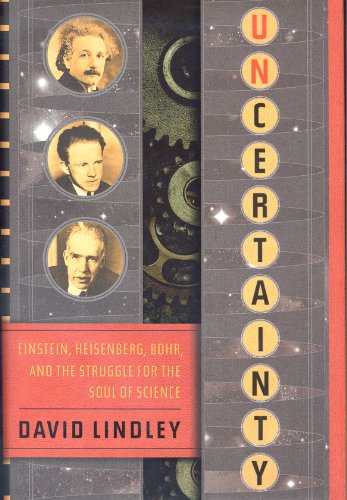
An in-depth analysis of the uncertainty principle, first introduced by German physicist Werner Heisenberg in 1927, discusses the birth, evolution, and impact of this important idea, as well as the clash in personalities and ideas that it provoked between Einstein's theories and the new generations of physicists who espoused quantum theory. 35,000 first printing.
Die Inhaltsangabe kann sich auf eine andere Ausgabe dieses Titels beziehen.
Über die Autorin bzw. den Autor
DAVID LINDLEY holds a Ph.D. in astrophysics and has been an editor at Nature, Science, and Science News. He is the author of The End of Physics, Degrees Kelvin, Where Does the Weirdness Go?, and Boltzmann’s Atom. He lives in Alexandria, Virginia.
Auszug. © Genehmigter Nachdruck. Alle Rechte vorbehalten.
Chapter 1
IRRITABLE PARTICLES
Robert Brown, son of a Scottish clergyman, was the archetypal self–made scholar, sober, diligent, and careful to the point of fanaticism. Born in 1773, he trained in medicine at Edinburgh, then served for some years as a surgeon’s assistant in a Fifeshire regiment. There he put his spare time to worthy use. Rising early, he taught himself German (nouns and their declensions before breakfast, his diary records, conjugation of auxiliary verbs afterward) so that he could master the considerable German literature on botany, his chosen subject. On a visit to London in 1798, the young Scotsman met and so impressed the great botanist Sir Joseph Banks, president of the Royal Society, that on Banks’s recommendation he sailed three years later on a long voyage to Australia, returning in 1805 with close to four thousand exotic plant specimens neatly stowed on his ship. These he spent the next several years assiduously describing, classifying, and cataloging, serving meanwhile as Banks’s librarian and personal assistant. Brown’s remarkable Australian trove, along with Banks’s own equally notable collection, became the heart of the botanical department of the British Museum, of which Brown became the first professional curator. He was, said a visitor to Banks’s London house, “a walking catalogue of every book in the world.”
Charles Darwin, before he was married, passed many a Sunday with the learned Robert Brown. In his autobiography Darwin describes a contradictory man, vastly knowledgeable but powerfully inclined to pedantry, generous in some ways, crabbed and suspicious in others. “He seemed to me to be chiefly remarkable for the minuteness of his observations and their perfect accuracy. He never propounded to me any large scientific views in biology,” Darwin writes. “He poured out his knowledge to me in the most unreserved manner, yet was strangely jealous on some points.” Brown was notorious, Darwin adds, for refusing to lend out specimens from his vast collection, even specimens that no one else possessed and which he knew he would never make any use of himself.
It is ironic, then, that this dry, cautious man should be commemorated now mainly as the observer of a curious phenomenon, Brownian motion, that represented the capricious intrusion of randomness and unpredictability into the elegant mansion of Victorian science. It was indeed the very scrupulousness of Brown’s observations that made the implications of Brownian motion so grave.
In June 1827, Brown began a study of pollen grains from Clarkia pulchella, a wildflower, popular today with gardeners, that had been discovered in Idaho in 1806 by Meriwether Lewis but named by him for his co–explorer William Clark. Characteristically, he intended to scrutinize minutely the shape and size of pollen particles, hoping that this would shed light on their function and on the way they interacted with other parts of the plant to fulfill their reproductive role.
Brown had acquired a microscope of recent and improved design. Its compound lenses largely banished the rainbow–hued fringes of color that afflicted the borders of objects seen in more primitive instruments. Under Brown’s eye the ghostly shapes of the pollen grains sprang clearly into view, their edges neatly delineated. Even so, the images were not perfect. The pollen grains wouldn’t stay still. They moved about, jiggled endlessly this way and that; they shimmered and stuttered; they drifted with strange erratic grace across the microscope’s field of view.
This incessant motion complicated Brown’s planned investigations, but it was not so very surprising. More than a century and a half earlier Antony van Leeuwenhoek, a draper from Delft, Holland, had astonished and delighted the scientific world when he described tiny “animalcules” of strange and myriad form that his crude microscope revealed in droplets of pond water, in scrapings from the unbrushed teeth of old men, and even in a suspension of ordinary household pepper crushed into plain water. “The motion of most of these animalcules in the water was so swift, and so various, upwards, downwards, and round about, that ’twas wonderful to see,” the entranced Leeuwenhoek wrote. His discovery not only spurred further scientific investigation but also led well–to–do citizens to purchase microscopes for their parlors and drawing rooms, where they could amaze their guests with this new wonder of nature.
Some animalcules had tiny hairs or finny extensions that enabled them to swim about. Others wriggled like little eels. It was easy to imagine that their meanderings were purposeful in some rudimentary way. Pollen grains, on the other hand, were simple in shape and had no moving parts. Still, they were undeniably organic. It seemed to Brown not unreasonable to suppose that pollen grains—especially as they were the male parts of a plant’s reproductive equipment—might possess some vital spirit that impelled them to move in their amusing but inscrutable fashion.
But Brown distrusted vague hypotheses of this sort. Observation, not speculation, was his forte. Testing pollen from other plants, he found that those grains danced about too. But then he examined minute fragments of leaves and stems and saw that those also jogged perplexingly about under his microscope’s gaze.
His attention caught by this “very unexpected fact of seeming vitality,” Brown could not help but probe the matter further. He obtained dust from dried plant samples, some more than a century old. He scraped tiny fragments from a piece of petrified wood. All these tiny grains had once been living but were now long dead, any vital spark extinguished. Examined under a microscope, they also shimmied. He moved on to truly inorganic material, knocking tiny shards from a variety of rocks and a piece of ordinary window glass. They too jiggled about. To put the case to the ultimate test, he scratched powder from a piece of the Sphinx, to which, as a curator of the British Museum, he had easy access and which he presumably regarded as certifiably, unarguably dead, on account of its provenance.
Placed in a drop of water under his microscope lens, ancient dust from the Sphinx danced about like everything else.
Brown acknowledged that he was not the first to see things jiggling about under the microscope. A certain Mr. Bywater of Liverpool, he noted, had a few years earlier looked at fragments of both organic and inorganic materials and observed “the animated and irritable particles” that they all shed. But Brown, through a variety of ingenious and careful experiments, established that the ceaseless motion of all these tiny fragments was neither the “animalcular motion” Leeuwenhoek and others had seen nor movement produced by vibration or turbulence of the fluid suspensions, by the action of heat, or through electric or magnetic influences.
This was contradictory and baffling. Dead particles of dust clearly couldn’t move of their own volition, nor was any external influence pushing them around. Yet move they all too plainly did. Brown himself made no attempt at an explanation. He was a careful descriptive botanist, not a philosopher of nature, and as Charles Darwin said, “much died with him, owing to his excessive fear of never making a mistake.”
Faced with this impossible dilemma, science took the prudent course and ignored Brownian motion for decades. Its deep significance went unnoticed because the phenomenon was so far beyond scientific apprehension. There was no way even to begin to grasp what it meant. Anyone who used a microscope knew about Brownian motion, at least as...
„Über diesen Titel“ kann sich auf eine andere Ausgabe dieses Titels beziehen.
Suchergebnisse für Uncertainty: Einstein, Heisenberg, Bohr, and the Struggle...

Beispielbild für diese ISBN
Uncertainty
Verlag:
Bantam Doubleday Dell Publishing Group Inc, 2007
ISBN 10: 0385515065
ISBN 13: 9780385515061
Gebraucht
Hardcover
Anbieter: World of Books (was SecondSale), Montgomery, IL, USA
Verkäuferbewertung 5 von 5 Sternen

Hardback. Zustand: Fair. The gripping, entertaining, and vividly-told narrative of a radical discovery that sent shockwaves through the scientific community and forever changed the way we understand the world. Werner Heisenberg's uncertainty principle challenged centuries of scientific understanding, placed him in direct opposition to Albert Einstein, and put Niels Bohr in the middle of one of the most heated debates in scientific history. Heisenberg's theorem stated that there were physical limits to what we could know about sub-atomic particles; this uncertainty would have shocking implications. In a riveting and lively account, David Lindley captures this critical episode and explains one of the most important scientific discoveries in history, which has since transcended the boundaries of science and influenced everything from literary theory to television. Artikel-Nr. 00102910356
Gebraucht kaufen
EUR 5,80
Versand gratis
Versand innerhalb von USA
Versand innerhalb von USA
Anzahl: 1 verfügbar
Beispielbild für diese ISBN
Uncertainty
Verlag:
Bantam Doubleday Dell Publishing Group Inc, 2007
ISBN 10: 0385515065
ISBN 13: 9780385515061
Gebraucht
Hardcover
Anbieter: World of Books (was SecondSale), Montgomery, IL, USA
Verkäuferbewertung 5 von 5 Sternen
Hardback. Zustand: Very Good. The gripping, entertaining, and vividly-told narrative of a radical discovery that sent shockwaves through the scientific community and forever changed the way we understand the world. Werner Heisenberg's uncertainty principle challenged centuries of scientific understanding, placed him in direct opposition to Albert Einstein, and put Niels Bohr in the middle of one of the most heated debates in scientific history. Heisenberg's theorem stated that there were physical limits to what we could know about sub-atomic particles; this uncertainty would have shocking implications. In a riveting and lively account, David Lindley captures this critical episode and explains one of the most important scientific discoveries in history, which has since transcended the boundaries of science and influenced everything from literary theory to television. Artikel-Nr. 00104515322
Gebraucht kaufen
EUR 5,80
Versand gratis
Versand innerhalb von USA
Versand innerhalb von USA
Anzahl: 2 verfügbar
Beispielbild für diese ISBN
Uncertainty: Einstein, Heisenberg, Bohr, and the Struggle for the Soul of Science
Anbieter: ThriftBooks-Dallas, Dallas, TX, USA
Verkäuferbewertung 5 von 5 Sternen
Hardcover. Zustand: Very Good. No Jacket. May have limited writing in cover pages. Pages are unmarked. ~ ThriftBooks: Read More, Spend Less. Artikel-Nr. G0385515065I4N00
Gebraucht kaufen
EUR 5,94
Versand gratis
Versand innerhalb von USA
Versand innerhalb von USA
Anzahl: 2 verfügbar
Beispielbild für diese ISBN
Uncertainty: Einstein, Heisenberg, Bohr, and the Struggle for the Soul of Science
Anbieter: ThriftBooks-Reno, Reno, NV, USA
Verkäuferbewertung 5 von 5 Sternen
Hardcover. Zustand: Fair. No Jacket. Readable copy. Pages may have considerable notes/highlighting. ~ ThriftBooks: Read More, Spend Less. Artikel-Nr. G0385515065I5N00
Gebraucht kaufen
EUR 5,94
Versand gratis
Versand innerhalb von USA
Versand innerhalb von USA
Anzahl: 1 verfügbar
Beispielbild für diese ISBN
Uncertainty: Einstein, Heisenberg, Bohr, and the Struggle for the Soul of Science
Anbieter: ThriftBooks-Reno, Reno, NV, USA
Verkäuferbewertung 5 von 5 Sternen
Hardcover. Zustand: Very Good. No Jacket. Former library book; May have limited writing in cover pages. Pages are unmarked. ~ ThriftBooks: Read More, Spend Less. Artikel-Nr. G0385515065I4N10
Gebraucht kaufen
EUR 5,94
Versand gratis
Versand innerhalb von USA
Versand innerhalb von USA
Anzahl: 1 verfügbar
Beispielbild für diese ISBN
Uncertainty: Einstein, Heisenberg, Bohr, and the Struggle for the Soul of Science
Anbieter: ThriftBooks-Phoenix, Phoenix, AZ, USA
Verkäuferbewertung 5 von 5 Sternen
Hardcover. Zustand: Very Good. No Jacket. May have limited writing in cover pages. Pages are unmarked. ~ ThriftBooks: Read More, Spend Less. Artikel-Nr. G0385515065I4N00
Gebraucht kaufen
EUR 5,94
Versand gratis
Versand innerhalb von USA
Versand innerhalb von USA
Anzahl: 1 verfügbar
Beispielbild für diese ISBN
Uncertainty: Einstein, Heisenberg, Bohr, and the Struggle for the Soul of Science
Anbieter: ThriftBooks-Phoenix, Phoenix, AZ, USA
Verkäuferbewertung 5 von 5 Sternen
Hardcover. Zustand: Good. No Jacket. Former library book; Pages can have notes/highlighting. Spine may show signs of wear. ~ ThriftBooks: Read More, Spend Less. Artikel-Nr. G0385515065I3N10
Gebraucht kaufen
EUR 5,94
Versand gratis
Versand innerhalb von USA
Versand innerhalb von USA
Anzahl: 1 verfügbar
Beispielbild für diese ISBN
Uncertainty: Einstein, Heisenberg, Bohr, and the Struggle for the Soul of Science
Anbieter: ThriftBooks-Dallas, Dallas, TX, USA
Verkäuferbewertung 5 von 5 Sternen
Hardcover. Zustand: Fair. No Jacket. Readable copy. Pages may have considerable notes/highlighting. ~ ThriftBooks: Read More, Spend Less. Artikel-Nr. G0385515065I5N00
Gebraucht kaufen
EUR 5,94
Versand gratis
Versand innerhalb von USA
Versand innerhalb von USA
Anzahl: 1 verfügbar
Beispielbild für diese ISBN
Uncertainty: Einstein, Heisenberg, Bohr, and the Struggle for the Soul of Science
Anbieter: ThriftBooks-Reno, Reno, NV, USA
Verkäuferbewertung 5 von 5 Sternen
Hardcover. Zustand: Very Good. No Jacket. May have limited writing in cover pages. Pages are unmarked. ~ ThriftBooks: Read More, Spend Less. Artikel-Nr. G0385515065I4N00
Gebraucht kaufen
EUR 5,94
Versand gratis
Versand innerhalb von USA
Versand innerhalb von USA
Anzahl: 1 verfügbar
Beispielbild für diese ISBN
Uncertainty: Einstein, Heisenberg, Bohr, and the Struggle for the Soul of Science
Anbieter: ThriftBooks-Atlanta, AUSTELL, GA, USA
Verkäuferbewertung 5 von 5 Sternen
Hardcover. Zustand: Very Good. No Jacket. May have limited writing in cover pages. Pages are unmarked. ~ ThriftBooks: Read More, Spend Less. Artikel-Nr. G0385515065I4N00
Gebraucht kaufen
EUR 5,94
Versand gratis
Versand innerhalb von USA
Versand innerhalb von USA
Anzahl: 2 verfügbar