
Verwandte Artikel zu In Spite of the Gods: The Strange Rise of Modern India
Inhaltsangabe
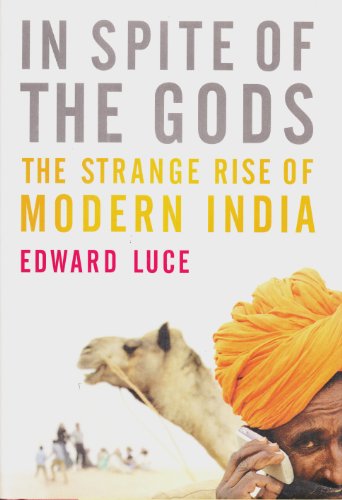
India remains a mystery to many Americans, even as it is poised to become the world’s third largest economy within a generation, outstripping Japan. It will surpass China in population by 2032 and will have more English speakers than the United States by 2050. In In Spite of the Gods, Edward Luce, a journalist who covered India for many years, makes brilliant sense of India and its rise to global power. Already a number-one bestseller in India, his book is sure to be acknowledged for years as the definitive introduction to modern India.
In Spite of the Gods illuminates a land of many contradictions. The booming tech sector we read so much about in the West, Luce points out, employs no more than one million of India’s 1.1 billion people. Only 35 million people, in fact, have formal enough jobs to pay taxes, while three-quarters of the country lives in extreme deprivation in India’s 600,000 villages. Yet amid all these extremes exists the world’s largest experiment in representative democracy—and a largely successful one, despite bureaucracies riddled with horrifying corruption.
Luce shows that India is an economic rival to the U.S. in an entirely different sense than China is. There is nothing in India like the manufacturing capacity of China, despite the huge potential labor force. An inept system of public education leaves most Indians illiterate and unskilled. Yet at the other extreme, the middle class produces ten times as many engineering students a year as the United States. Notwithstanding its future as a major competitor in a globalized economy, American. leaders have been encouraging India’s rise, even welcoming it into the nuclear energy club, hoping to balance China’s influence in Asia.
Above all, In Spite of the Gods is an enlightening study of the forces shaping India as it tries to balance the stubborn traditions of the past with an unevenly modernizing present. Deeply informed by scholarship and history, leavened by humor and rich in anecdote, it shows that India has huge opportunities as well as tremendous challenges that make the future “hers to lose.”
Die Inhaltsangabe kann sich auf eine andere Ausgabe dieses Titels beziehen.
Über die Autorin bzw. den Autor
EDWARD LUCE is the Washington commentator for the Financial Times. He was the paper’s South Asia bureau chief, based in New Delhi, between 2001 and 2006. From 1999–2000, Luce worked in the Clinton administration as the speechwriter to Treasury secretary Larry Summers. Oxford educated and married into an Indian family, he now lives in Washington, D.C.
Auszug. © Genehmigter Nachdruck. Alle Rechte vorbehalten.
1. GLOBAL AND MEDIEVAL
India’s Schizophrenic Economy
Its stupendous population consists of farm laborers. India is one vast farm—one almost interminable stretch of fields with mud fences between. Think of the above facts: and consider what an incredible aggregate of poverty they place before you.
— Mark Twain, Following the Equator, 1897 (1)
It took a long time. But finally in the late 1990s India started to build roads that could get you from A to B at something better than a canter. Until then, India’s most significant highway was the Grand Trunk Road that bisects the country from north to south. Laid at various stages by the late medieval Mughal dynasty, then upgraded and extended by the British in the nineteenth century and popularized by Rudyard Kipling in his novel Kim, most of the “GT Road,” as it is known, got acquainted with asphalt only after independence. But it is a single lane and one can rarely exceed an average of thirty miles an hour. So the relative novelty of India’s double–lane expressways still generates a buzz. By 2006, India had all but completed the 3,000-mile “Golden Quadrilateral” expressway linking the country’s four largest cities: Delhi to Mumbai (formerly known as Bombay) to Chennai (formerly known as Madras) to Kolkata (formerly known as Calcutta) (*) to Delhi. Average speeds on the better stretches are closer to sixty miles an hour.
For some, the expressways have heralded a modern era of speed, punctuality, and hygienic roadside bathrooms. For others, they represent a brash intrusion on the more lackadaisical world they cut through. To me, the new expressways provide an intriguing juxtaposition of India’s multispeed economics. Curiosity—and an instinct of self-preservation—means I occasionally move into the slow lane. One of the best ways of observing India’s galloping new economy is to count the number of car brands that whir past you in the fast lane. You tend to lose count at thirty or forty. In the early 1990s, as India was starting to relax import and investment restrictions on foreign manufacturers, you would at best have counted six or seven makes of car. More than 90 percent of them would have been Ambassadors, the stately but desperately uncomfortable colonial–era vehicles that are still used by VIPs, and Marutis, the cramped family passenger car, still manufactured under a joint venture between Suzuki of Japan and the Indian government. Nowadays you have little time to register the tinted and reflector windows of the Toyotas, Fiats, Hondas, Tatas, Fords, Volkswagens, and Mercedes–Benz, as they flash past.
But your speed is never quite what it should be. Coming far too frequently from the opposite direction, but on your side of the road, you encounter decrepit scooters, bicycles, and even camel–drawn carts, whose drivers appear blissfully unfazed by the fact that they are breaking all known rules of traffic and common sense. Once or twice, on the two–hundred–mile Delhi expressway to Jaipur, a city in the neighboring state of Rajasthan, my journey has been brought to a halt by a herd of goats. Even without the local fauna, the absence of lane discipline means you are mostly on the edge of your seat.
But it is at the side of the expressways in the glaring billboards advertising cell phones, iPods, and holiday villas and the shiny gas stations with their air–conditioned mini–supermarkets that India’s schizophrenic economy reveals itself. Behind them, around them, and beyond them is the unending vista of rural India, of yoked bullocks plowing the fields in the same manner they have for three thousand years and the primitive brick kilns that dot the endless patchwork of fields of rice, wheat, pulse, and oilseed. There are growing pockets of rural India that are mechanizing and becoming more prosperous. But they are still islands. It is in this almost continuous contrast that you observe the two most striking features of India’s early–twenty–first–century economy: its modern and booming service sector in a sea of indifferent farmland. It would be tempting, as you cruise happily toward your destination with a reasonable chance of being on time, to believe these features are from different worlds. Along the way, you might also glimpse an occasional factory and an assembly plant or two for vehicles or washing machines. But evidence of manufacturing in India is far thinner on the ground than it is in neighboring China.
* * *
By the time of independence, Nehru had already helped to forge a consensus in which the country would aim for complete economic self–sufficiency and the state would lead the effort by building up heavy industry, with an emphasis on steel plants and large dams. It has become fashionable since 1991 to write off Nehru as a hopeless idealist who tied the country up in socialist red tape for forty years. Much of the criticism is fair,(*) since India failed to achieve the high economic growth rates that were seen at the time in Japan and later in South Korea, Taiwan, Thailand, and Malaysia. But in the late 1940s and 1950s Nehru’s economic strategy was perfectly in step with worldwide economic fashion. It came with the blessings of a team from the Massachusetts Institute of Technology in Cambridge, which advised New Delhi on the country's early five–year development plans. India was also advised by Gosplan, the Soviet Union’s economic planning agency.
The idea, which combined India’s critique of the imperial economic system with a widespread global distrust of free trade following the disasters that had resulted in Europe and elsewhere during the “hungry thirties,” was to give the state a primary role in an economy aiming for self–reliance, or swadeshi—the second most important rallying cry of India’s freedom movement after swaraj, or self–rule. Of great importance in kick–starting this model were a series of large projects that stimulated further economic activity—much as the widely admired Tennessee Valley Authority had in the United States. Nehru liked to call such projects “temples of concrete.”
Nehru’s plans for a closed economy dominated by the state also came with the blessings of Britain’s postwar Labour government, which had agreed to Indian independence, and which carried out its own nationalization of private sector industries to a far greater degree than did Nehru’s India. Many of the Labour government’s Fabian advisers were accorded a warm welcome in Nehru’s New Delhi. Indeed, it was not until fifteen to twenty years after India’s independence that international praise of the country’s economic model was outweighed by rising concerns about its effectiveness. Until then India’s trajectory was uncontroversial and relatively unexceptional.
Yet, in retrospect and in comparison to other developing economies in Asia, Nehru’s economic policies served India poorly. In 1950 South Korea, which was yet to emerge from its war with Communist North Korea, had the same living standards as India (roughly $50 annually per capita in 2005 prices). Fifty years later, South Korea’s per capita income was above $10,000, which was more than ten times higher than that of India. More or less similar contrasts can be found between India and most of the countries of east and Southeast Asia. Even China, which devoted much of the first thirty years of its revolution to countrywide terror, now has double India’s per capita income, having started at about the same level at the time of its revolution in 1949.
Why did Nehru’s approach...
„Über diesen Titel“ kann sich auf eine andere Ausgabe dieses Titels beziehen.
Suchergebnisse für In Spite of the Gods: The Strange Rise of Modern India

Beispielbild für diese ISBN
In Spite of the Gods: The Strange Rise of Modern India
Anbieter: World of Books (was SecondSale), Montgomery, IL, USA
Verkäuferbewertung 5 von 5 Sternen

Hardback. Zustand: Good. Artikel-Nr. 00095539096
Gebraucht kaufen
EUR 3,97
Versand gratis
Versand innerhalb von USA
Versand innerhalb von USA
Anzahl: 8 verfügbar
Beispielbild für diese ISBN
In Spite of the Gods: The Strange Rise of Modern India
Anbieter: BooksRun, Philadelphia, PA, USA
Verkäuferbewertung 5 von 5 Sternen
Hardcover. Zustand: Very Good. 1. It's a well-cared-for item that has seen limited use. The item may show minor signs of wear. All the text is legible, with all pages included. It may have slight markings and/or highlighting. Artikel-Nr. 0385514743-8-1
Gebraucht kaufen
EUR 6,76
Versand gratis
Versand innerhalb von USA
Versand innerhalb von USA
Anzahl: 1 verfügbar
Beispielbild für diese ISBN
In Spite of the Gods: The Strange Rise of Modern India
Anbieter: ThriftBooks-Dallas, Dallas, TX, USA
Verkäuferbewertung 5 von 5 Sternen
Hardcover. Zustand: Very Good. No Jacket. May have limited writing in cover pages. Pages are unmarked. ~ ThriftBooks: Read More, Spend Less. Artikel-Nr. G0385514743I4N00
Gebraucht kaufen
EUR 6,86
Versand gratis
Versand innerhalb von USA
Versand innerhalb von USA
Anzahl: 1 verfügbar
Beispielbild für diese ISBN
In Spite of the Gods: The Strange Rise of Modern India
Anbieter: ThriftBooks-Dallas, Dallas, TX, USA
Verkäuferbewertung 5 von 5 Sternen
Hardcover. Zustand: Very Good. No Jacket. Former library book; May have limited writing in cover pages. Pages are unmarked. ~ ThriftBooks: Read More, Spend Less. Artikel-Nr. G0385514743I4N10
Gebraucht kaufen
EUR 6,86
Versand gratis
Versand innerhalb von USA
Versand innerhalb von USA
Anzahl: 1 verfügbar
Beispielbild für diese ISBN
In Spite of the Gods: The Strange Rise of Modern India
Anbieter: ThriftBooks-Atlanta, AUSTELL, GA, USA
Verkäuferbewertung 5 von 5 Sternen
Hardcover. Zustand: Very Good. No Jacket. May have limited writing in cover pages. Pages are unmarked. ~ ThriftBooks: Read More, Spend Less. Artikel-Nr. G0385514743I4N00
Gebraucht kaufen
EUR 6,86
Versand gratis
Versand innerhalb von USA
Versand innerhalb von USA
Anzahl: 1 verfügbar
Beispielbild für diese ISBN
In Spite of the Gods: The Strange Rise of Modern India
Anbieter: ThriftBooks-Phoenix, Phoenix, AZ, USA
Verkäuferbewertung 5 von 5 Sternen
Hardcover. Zustand: Very Good. No Jacket. May have limited writing in cover pages. Pages are unmarked. ~ ThriftBooks: Read More, Spend Less. Artikel-Nr. G0385514743I4N00
Gebraucht kaufen
EUR 6,86
Versand gratis
Versand innerhalb von USA
Versand innerhalb von USA
Anzahl: 1 verfügbar
Beispielbild für diese ISBN
In Spite of the Gods: The Strange Rise of Modern India
Anbieter: Wonder Book, Frederick, MD, USA
Verkäuferbewertung 5 von 5 Sternen
Zustand: Very Good. Very Good condition. Good dust jacket. A copy that may have a few cosmetic defects. May also contain light spine creasing or a few markings such as an owner's name, short gifter's inscription or light stamp. Artikel-Nr. K05P-01961
Gebraucht kaufen
EUR 6,93
Versand gratis
Versand innerhalb von USA
Versand innerhalb von USA
Anzahl: 4 verfügbar
Beispielbild für diese ISBN
In Spite of the Gods: The Strange Rise of Modern India
Anbieter: Wonder Book, Frederick, MD, USA
Verkäuferbewertung 5 von 5 Sternen
Zustand: As New. Like New condition. Like New dust jacket. A near perfect copy that may have very minor cosmetic defects. Artikel-Nr. Q05O-00712
Gebraucht kaufen
EUR 6,93
Versand gratis
Versand innerhalb von USA
Versand innerhalb von USA
Anzahl: 1 verfügbar
Beispielbild für diese ISBN
In Spite of the Gods : The Strange Rise of Modern India
Verlag:
Doubleday Religious Publishing Group, The, 2007
ISBN 10: 0385514743
ISBN 13: 9780385514743
Gebraucht
Hardcover
Erstausgabe
Anbieter: Better World Books, Mishawaka, IN, USA
Verkäuferbewertung 5 von 5 Sternen
Zustand: Very Good. 1st Edition. Pages intact with possible writing/highlighting. Binding strong with minor wear. Dust jackets/supplements may not be included. Stock photo provided. Product includes identifying sticker. Better World Books: Buy Books. Do Good. Artikel-Nr. GRP76410187
Gebraucht kaufen
EUR 7,58
Versand gratis
Versand innerhalb von USA
Versand innerhalb von USA
Anzahl: 1 verfügbar
Beispielbild für diese ISBN
In Spite of the Gods : The Strange Rise of Modern India
Verlag:
Doubleday Religious Publishing Group, The, 2007
ISBN 10: 0385514743
ISBN 13: 9780385514743
Gebraucht
Hardcover
Erstausgabe
Anbieter: Better World Books: West, Reno, NV, USA
Verkäuferbewertung 5 von 5 Sternen
Zustand: Very Good. 1st Edition. Pages intact with possible writing/highlighting. Binding strong with minor wear. Dust jackets/supplements may not be included. Stock photo provided. Product includes identifying sticker. Better World Books: Buy Books. Do Good. Artikel-Nr. GRP76410187
Gebraucht kaufen
EUR 7,58
Versand gratis
Versand innerhalb von USA
Versand innerhalb von USA
Anzahl: 1 verfügbar