
Verwandte Artikel zu How We Compete: What Companies Around The World Are...
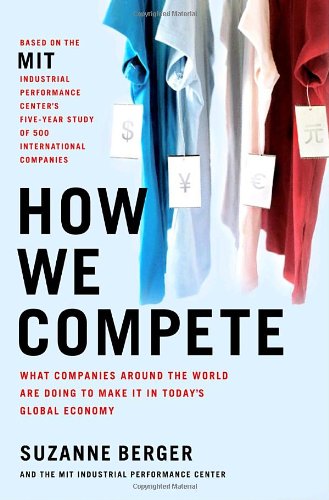
How We Compete: What Companies Around The World Are Doing To Make It In Today's Global Economy - Hardcover
Inhaltsangabe
"Impressive... This is an evidence-based bottom-up account of the realities of globalisation. It is more varied, more subtle, and more substantial than many of the popular works available on the subject." --Financial Times
Based on a five-year study by the MIT Industrial Performance Center, How We Compete goes into the trenches of over 500 international companies to discover which practices are succeeding in today’s global economy, which are failing –and why.
There is a rising fear in America that no job is safe. In industry after industry, jobs seem to be moving to low-wage countries in Asia, Central America, and Eastern Europe. Production once handled entirely in U.S. factories is now broken into pieces and farmed out to locations around the world. To discover whether our current fears about globalization are justified, Suzanne Berger and a group of MIT researchers went to the front lines, visiting workplaces and factories around the world. They conducted interviews with managers at more than 500 companies, asking questions about which parts of the manufacturing process are carried out in their own plants and which are outsourced, who their biggest competitors are, and how they plan to grow their businesses.How We Compete presents their fascinating, and often surprising, conclusions.
Berger and her team examined businesses where technology changes rapidly–such as electronics and software–as well as more traditional sectors, like the automobile industry, clothing, and textile industries. They compared the strategies and success of high-tech companies like Intel and Sony, who manufacture their products in their own plants, and Cisco and Dell, who rely primarily on outsourcing. They looked closely at textile and clothing to uncover why some companies, including the Gap and Liz Claiborne, choose to outsource production to foreign countries, while others, such as Zara and Benetton, base most operations at home.
What emerged was far more complicated than the black-and-white picture presented by promoters and opponents of globalization. Contrary to popular belief, cheap labor isnot the answer, and the world is not flat, as Thomas Friedman would have it.How We Compete shows that there are many different ways to win in the global economy, and that the avenues open to American companies are much wider than we ever imagined.
SUZANNE BERGER is the Raphael Dorman and Helen Starbuck Professor of Political Science at MIT and director of the MIT International Science and Technology Initiative. She was a member of the MIT Commission on Industrial Productivity, whose reportMade in America analyzed weaknesses and strengths in U.S. industry in the 1980s.She lives in Boston , Massachusetts.
Die Inhaltsangabe kann sich auf eine andere Ausgabe dieses Titels beziehen.
Über die Autorin bzw. den Autor
SUZANNE BERGER is the Raphael Dorman and Helen Starbuck Professor of Political Science at MIT and director of the MIT International Science and Technology Initiative. She was a member of the MIT Commission on Industrial Productivity, whose report,Made in America, analyzed weaknesses and strengths in U.S. industry in the 1980s.She lives in Boston, Massachusetts.
Auszug. © Genehmigter Nachdruck. Alle Rechte vorbehalten.
CHAPTER 1
Who’s Afraid of Globalization?
Globalization means a world of opportunity and a world of danger. We rush to Wal-Mart for the basics, but we know that many of them are made in China or some other low-wage country. We want low prices at Best Buy and Circuit City on digital cameras and ?at-panel TVs, but we fear that our good fortune as consumers costs jobs at home. We like to be able to place orders on the telephone twenty-four hours a day, but when we hear strange accents on the other end of the line, we wonder where on earth the operator sits. We realize when we think about it that the rise out of poverty of more than 2 billion Chinese and Indians must be good for the world; we question whether it’s good for us.
We celebrate the fact that American success is built on innovation and rising productivity, but we wonder whether the new technologies and products will create enough jobs and if our children will live as well as we do. Surveys in the United States and Europe ?nd very mixed opinions about globalization, often re?ecting these con?icting feelings within individuals themselves, rather than simply the rifts between supporters and opponents of globalization. A majority of Americans and Europeans think globalization raises their standard of living; a majority also believe that it is bad for employment and job security.(1)
For the questions about who wins and who loses in the new global economy and the uncertainties about whether the opportunities are worth the risks, there is no one right answer. People disagree about de?nitions of globalization, its causes, and its consequences. Many simply wonder whether any job in America is safe. By mid-2004, about 1,000 stories a month on outsourcing and offshoring were appearing in the U.S. print media, with such titles as “Is Your Job Going Abroad?”(Time, March 1, 2004), “Is Your Job Next?”(BusinessWeek, February 3, 2003), and “Is Your Job Coming to India? Get Used to It” (William Pesek Jr., Bloomberg.com, October 5, 2004).(2) One consulting ?rm predicted in September 2003 that 1.4 million American jobs would move overseas over the next twelve years, and that the real wages of 80 percent of the population would fall.(3) But a McKinsey study conducted a month earlier concluded that offshoring jobs was a “win-win” for both the United States and developing countries like India, as many low-skilled jobs would move overseas, raising incomes there, and U.S. ?rms would become more productive and pro?table and better able to expand higher value-added operations at home.(4) Despite their optimism, however, McKinsey researchers did acknowledge that 55 percent of those reemployed after losing a job because of import competition or offshoring end up earning less than 85 percent of their old wages in the new job. Many take even bigger pay and bene?t cuts.
Other studies claim that outsourcing low-end jobs leads to more job creation at home. Matthew Slaughter, an economist at Dartmouth, analyzed government data on U.S. multinational corporations and found that for every job offshored, a company created almost two in the United States.(5) Catherine Mann at The Brookings Institution showed that by lowering the cost of information hardware, production abroad has raised
U.S. productivity and generated $230 billion of additional GDP between 1995 and 2002. Furthermore, an open economy in which U.S. companies can create jobs abroad is also one in which foreign companies can create jobs in the United States. Between 1986 and 2001, the number of jobs that foreign businesses established in the United States actually
doubled, while the number that moved offshore grew only by 56 percent. The private services work (like legal services, programming, banking, and consulting) that the United States sells to foreigners exceeds by over $50 billion the services Americans buy from foreign companies.(6) Similar ?ndings are reported for Europe. Oxford University researchers found that while U.K. companies are buying more services from ?rms abroad, U.K. exports of business services have grown even faster.(7)
Mainstream economists like Alan Greenspan, the chairman of the Federal Reserve Board, and N. Gregory Mankiw, former chairman of the Council of Economic Advisors, assure the public that outsourcing work raises productivity and the standard of living in the United States. Free trade, they argue, ultimately creates more and better jobs in the United States than it destroys. Historically, Mankiw explained, innovation has always generated good new employment opportunities:
It is hard to predict what changes American ingenuity will bring to the
U.S. economy. For example, over the past half century, new technology has led to great advances in farm productivity. As a result, the number of Americans working on farms has declined from almost 20 percent of the workforce in 1940 to about 2 percent today. In 1940, no one could have predicted that some of the grandchildren of farmers would become website designers and CAT scan operators. But they did, and at much higher wages and incomes.(8)
The economists base their optimism about globalization and jobs on standard trade theories of comparative advantage. These theories predict that as developing countries with large populations move into activities that use a lot of unskilled and semiskilled labor, the United States and other advanced countries will gain advantage in activities requiring more intensive use of capital and well-educated workers. Some of these neoclassical economists now, however, are having second thoughts. Paul Samuelson, Nobel Prize-winning economist at MIT known for his contributions to modern trade theory, published an article in fall 2004 in which he shows how even skilled workers in the advanced countries could lose out as China upgrades its economy.(9) Globalization should increase the world’s total income and its average standard of living, but there’s no reason to think that any particular country or region’s advances will outweigh its losses. As Samuelson points out, worldwide gains will only be “cold comfort” for losers.
Some think that in an open global economy, government can no longer regulate or buffer citizens against strong economic tides of change. In The Borderless World (1990), one of the ?rst books on globalization, Kenichi Ohmae, a well-known management consultant, claimed that “[the global economy] is becoming so powerful that it has swallowed most consumers and corporations, made traditional national borders almost disappear, and pushed bureaucrats, politicians, and the military toward the status of declining industries.”(10) Thomas Friedman, the New York Times op-ed writer, describes globalization as a race of Formula One cars.(11) If you’re worried about drivers smashing into the walls, you can give them driving lessons and improve the skills of the ambulance technicians. But, says Friedman, you can’t put bales of straw around the walls of the racetrack to buffer the accidents without ruining the race. “If you don’t want to do all these things, then you should forget about Formula One racing and become a jogger. But be careful, because as a jogger in this world you will be run over by a Formula One Car.”
Ohmae and Friedman are enthusiastic about globalization’s impact in shrinking the role of government in the economy, thereby allowing people to develop their talents without hindrance from the bureaucracy. Critics of globalization, though, see a world “running out of control toward some sort of abyss.”(12) They regard the World Trade Organization, the International Monetary Fund, the World Bank, the G8 summits, and the Davos World Economic Forum as arms of multinational...
„Über diesen Titel“ kann sich auf eine andere Ausgabe dieses Titels beziehen.
Suchergebnisse für How We Compete: What Companies Around The World Are...

Beispielbild für diese ISBN
How We Compete: What Companies Around the World Are Doing to Make it in Today's Global Economy
Verlag:
Crown Business (edition ), 2005
ISBN 10: 0385513593
ISBN 13: 9780385513593
Gebraucht
Hardcover
Anbieter: BooksRun, Philadelphia, PA, USA
Verkäuferbewertung 5 von 5 Sternen

Hardcover. Zustand: Very Good. With dust jacket. It's a well-cared-for item that has seen limited use. The item may show minor signs of wear. All the text is legible, with all pages included. It may have slight markings and/or highlighting. Artikel-Nr. 0385513593-11-1-29
Gebraucht kaufen
EUR 4,82
Versand gratis
Versand innerhalb von USA
Versand innerhalb von USA
Anzahl: 1 verfügbar
Beispielbild für diese ISBN
How We Compete: What Companies Around the World Are Doing to Make it in Today's Global Economy
Anbieter: Wonder Book, Frederick, MD, USA
Verkäuferbewertung 5 von 5 Sternen
Zustand: As New. Like New condition. Like New dust jacket. A near perfect copy that may have very minor cosmetic defects. Artikel-Nr. R05A-02502
Gebraucht kaufen
EUR 6,40
Versand gratis
Versand innerhalb von USA
Versand innerhalb von USA
Anzahl: 1 verfügbar
Beispielbild für diese ISBN
How We Compete: What Companies Around the World Are Doing to Make it in Today's Global Economy
Anbieter: ThriftBooks-Atlanta, AUSTELL, GA, USA
Verkäuferbewertung 5 von 5 Sternen
Hardcover. Zustand: Very Good. No Jacket. Missing dust jacket; May have limited writing in cover pages. Pages are unmarked. ~ ThriftBooks: Read More, Spend Less. Artikel-Nr. G0385513593I4N01
Gebraucht kaufen
EUR 6,67
Versand gratis
Versand innerhalb von USA
Versand innerhalb von USA
Anzahl: 1 verfügbar
Beispielbild für diese ISBN
How We Compete : What Companies Around the World Are Doing to Make It in Today's Global Economy
Verlag:
Crown Publishing Group, The, 2005
ISBN 10: 0385513593
ISBN 13: 9780385513593
Gebraucht
Hardcover
Anbieter: Better World Books, Mishawaka, IN, USA
Verkäuferbewertung 5 von 5 Sternen
Zustand: Very Good. Pages intact with possible writing/highlighting. Binding strong with minor wear. Dust jackets/supplements may not be included. Stock photo provided. Product includes identifying sticker. Better World Books: Buy Books. Do Good. Artikel-Nr. GRP102707435
Gebraucht kaufen
EUR 6,72
Versand gratis
Versand innerhalb von USA
Versand innerhalb von USA
Anzahl: 1 verfügbar
Beispielbild für diese ISBN
How We Compete : What Companies Around the World Are Doing to Make It in Today's Global Economy
Verlag:
Crown Publishing Group, The, 2005
ISBN 10: 0385513593
ISBN 13: 9780385513593
Gebraucht
Hardcover
Anbieter: Better World Books, Mishawaka, IN, USA
Verkäuferbewertung 5 von 5 Sternen
Zustand: Very Good. Former library copy. Pages intact with possible writing/highlighting. Binding strong with minor wear. Dust jackets/supplements may not be included. Includes library markings. Stock photo provided. Product includes identifying sticker. Better World Books: Buy Books. Do Good. Artikel-Nr. 4567675-6
Gebraucht kaufen
EUR 6,72
Versand gratis
Versand innerhalb von USA
Versand innerhalb von USA
Anzahl: 1 verfügbar
Foto des Verkäufers
How We Compete
Anbieter: Hamelyn, Madrid, M, Spanien
Verkäuferbewertung 5 von 5 Sternen
Zustand: Very Good. : En este libro, Suzanne Berger explora cómo las empresas de todo el mundo están adaptándose para tener éxito en la economía global actual. Basado en un estudio de cinco años del MIT Industrial Performance Center, Berger analiza las estrategias que están funcionando y las que están fracasando, ofreciendo una visión valiosa para las empresas que buscan prosperar en un mercado globalizado. El libro examina diversos sectores, desde la tecnología hasta la industria textil, comparando el éxito de empresas que optan por la fabricación interna con aquellas que prefieren la externalización. EAN: 9780385513593 Tipo: Libros Categoría: Negocios y Economía Título: How We Compete Autor: Suzanne Berger Editorial: Crown Business Idioma: en Páginas: 352 Formato: tapa dura. Artikel-Nr. Happ-2025-05-27-7974b6be
Gebraucht kaufen
EUR 5,99
EUR 11,99 Versand
Versand von Spanien nach USA
Versand von Spanien nach USA
Anzahl: 1 verfügbar
Beispielbild für diese ISBN
How We Compete: What Companies Around the World Are Doing to Make It in Today's Global Economy
Anbieter: Anybook.com, Lincoln, Vereinigtes Königreich
Verkäuferbewertung 5 von 5 Sternen
Zustand: Fair. This is an ex-library book and may have the usual library/used-book markings inside.This book has hardback covers. In fair condition, suitable as a study copy. Dust jacket in fair condition. Please note the Image in this listing is a stock photo and may not match the covers of the actual item,700grams, ISBN:9780385513593. Artikel-Nr. 9418841
Gebraucht kaufen
EUR 3,04
EUR 15,34 Versand
Versand von Vereinigtes Königreich nach USA
Versand von Vereinigtes Königreich nach USA
Anzahl: 1 verfügbar
Beispielbild für diese ISBN
How We Compete: What Companies Around the World Are Doing to Make it in Today's Global Economy
Anbieter: Ammareal, Morangis, Frankreich
Verkäuferbewertung 5 von 5 Sternen
Hardcover. Zustand: Très bon. Edition 2005. Ammareal reverse jusqu'à 15% du prix net de cet article à des organisations caritatives. ENGLISH DESCRIPTION Book Condition: Used, Very good. Edition 2005. Ammareal gives back up to 15% of this item's net price to charity organizations. Artikel-Nr. F-378-777
Gebraucht kaufen
EUR 3,50
EUR 16,50 Versand
Versand von Frankreich nach USA
Versand von Frankreich nach USA
Anzahl: 1 verfügbar
Foto des Verkäufers
How we compete
Anbieter: Bookbot, Prague, Tschechien
Verkäuferbewertung 5 von 5 Sternen
Hardcover. Zustand: Fine. Leichte Kratzer / Abnutzungen / Druckstellen; Leichte Verformung / umgeknickte Seiten. "There is a rising fear in America that no job is safe. In industry after industry, jobs seem to be moving to low-wage countries in Asia, Central America, and Eastern Europe. Production once handled entirely in U.S. factories is now broken into pieces and farmed out to locations around the world. To discover whether our current fears about globalization are justified, Suzanne Berger and a group of MIT researchers visited workplaces and factories around the world. They conducted interviews with managers at more than 500 companies, asking questions about which parts of the manufacturing process are carried out in their own plants and which are outsourced, who their biggest competitors are, and how they plan to grow their businesses. How We Compete presents their fascinating, and often surprising, conclusions." "Contrary to popular belief, cheap labor is not the answer. How We Compete shows that there are many different ways to win in the global economy, and that the avenues open to American companies are much wider than we ever imagined."--BOOK JACKET. Artikel-Nr. b003693d-657d-4e3d-bd28-e17f35a7e707
Gebraucht kaufen
EUR 9,28
EUR 20,99 Versand
Versand von Tschechien nach USA
Versand von Tschechien nach USA
Anzahl: 1 verfügbar