
Verwandte Artikel zu Freedom Of Expression: Overzealous Copyright Bozos...
Inhaltsangabe
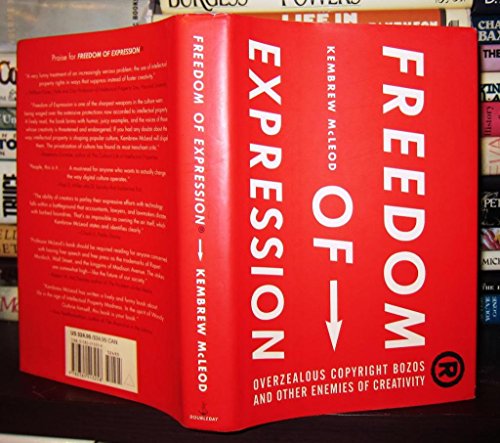
Drop that quotation/sample/collage, sir! An enlightening, amusing, and frightening look at how the growth of intellectual property law is making us all less free to say and think what we want.
In 1998 university professor and professional art prankster Kembrew McLeod trademarked the phrase "freedom of expression" as a joke, an amusing if dark way to comment on how intellectual property law is increasingly being used to fence off the culture and restrict the way we're allowed to express ideas. But what's happened in recent years to intellectual property law is no joke and has had repercussions on our culture and our everyday lives. The trend toward privatization of―melodies, genes, public space, the English language―means an inevitable clash of economic values against the value of free speech, creativity, and shared resources. Our irreplaceable cultural commons is being sectioned up and sold off to the highest bidders and the most aggressive litigators.
In Freedom of Expression®, Kembrew McLeod gathers topics as diverse as hip-hop music and digital sampling, the patenting of seeds and human genes, folk and blues music, visual collage art, electronic voting, the Internet and computer software. In doing so, he connects this rapidly accelerating push to pin down everything as a piece of private property to its effects on music, art and science.
In much the same way Eric Schlosser's Fast Food Nation tied together disparate topics to paint an alarming picture of the food industry, and written in a witty style that brings to mind media pranksters like Al Franken, Ken Kesey, and Abbie Hoffman, Freedom of Expression® uses intellectual property law as the focal point to show how economic concerns are seriously eroding creativity and free speech. It’s later than we know.
Die Inhaltsangabe kann sich auf eine andere Ausgabe dieses Titels beziehen.
Über die Autorin bzw. den Autor
<p>A journalist, activist, artist and professor in the department of communication studies at the University of Iowa, <b>KEMBREW McLEOD</b> is the author of <i>Owning Culture: Authorship, Ownership, and Intellectual Property Law</i> (Peter Lang, 2001), and has written music criticism for <i>Rolling Stone</i>, <i>The Village Voice</i>, <i>Spin</i>, and <i>Mojo</i>. He is also the coproducer of a 2001 documentary on the music industry, <i>Money for Nothing: Behind the Business of Pop Music</i>, and a documentary on intellectual property law, <i>Copyright Criminals</i>, which will be completed in 2005.</p>
Auszug. © Genehmigter Nachdruck. Alle Rechte vorbehalten.
CHAPTER ONE
THIS GENE IS YOUR GENE
fencing off the folk and genetic commons
This gene is your gene," sang Francis Collins, playfully reworking an old Woody Guthrie song, with electric guitar in hand. "This gene is my gene," he continued, backed up by the lumbering roar of a middle-aged rock band. This was no ordinary club gig; he was singing at a post-press conference party for scientists. Collins was the man who headed up the Human Genome Project (HGP), funded by the National Institutes of Health, and he was trying to make an ethical and political point. Since the mid-1990s, Collins's HGP had raced against a private effort to map the human genome in order to make our genetic information freely accessible, not privately owned and patented by a handful of corporations. Any scientist could examine HGP's genome map for free--unlike the Celera Genomics' privately owned draft, which was published with strings attached.(1) Over the din, Collins chided his competitors in song by genetically modifying Guthrie's lyrics:
This draft is your draft, this draft is my draft,
And it's a free draft, no charge to see draft.
It's our instruction book, so come on, have a look,
This draft was made for you and me.
Dr. Francis Collins reworked "This Land Is Your Land" to argue that genetic information should be freely available to the scientific community. However, his use of that Woody Guthrie song was sadly ironic, on multiple levels. "This Land Is Your Land" is a song written by an unabashed socialist as a paean to communal property: "This land was made for you and me." Another key lyric goes, "A sign was painted 'Private Property' but on the backside it didn't say nothin'." The folk-song tradition from which Guthrie emerged valued the open borrowing of lyrics and melodies; culture was meant to be freely created and re-created in a democratic, participatory way.
If this was so, then why was Collins's use of "This Land Is Your Land" painfully ironic? Even though it was written over sixty years ago, the song is, to quote Woody Guthrie himself, still "private property." Guthrie based the melody of "This Land Is Your Land" on the Carter Family's 1928 recording "Little Darlin' Pal of Mine," which in turn was derived from a nineteenth-century gospel song, "Oh, My Loving Brother."(2) This means that, in the twenty-first century, the publishing company that owns the late Guthrie's music can earn money from a song about communal property, which was itself based on a tune that is over a century old. Far more disturbing, Guthrie's publishing company prevents musicians from releasing altered, updated lyrical versions of that song. We won't be hearing Collins's mutated "This Gene Is Your Gene" anytime soon.
What's the connection, you might be wondering, between folk music and genetic research? Although obviously very different endeavors, the practitioners of both used to value the open sharing of information (i.e., melodies or scientific data). In these communities, "texts" were often considered common property, but today this concept has been fundamentally altered by the process of privatization, that is, the belief that shared public resources—sometimes referred to by economists and social scientists as the commons—can be better managed by private industries. And in recent years, there's been a significant erosion of both the cultural commons and the genetic commons, resulting in a shrinking of the public domain. The fact that folk melodies and lyrics are now privately owned rather than shared resources is a depressing example of how our cultural commons is being fenced off. As for the genetic commons, the patenting of human and plant genes is but the furthest logical extension of privatization—taken at times to illogical lengths.
HAPPY BIRTHDAY, SCREW YOU
Like with many things relating to copyright, the story of how Time-Warner's music-publishing division came to own "Happy Birthday to You" is long, convoluted, and absurd. It's also a telling narrative about folk music—how it evolved from a living, breathing part of culture to little more than one musical genre among many, a mere section of a record store. When I first began cobbling together a legal and social history of "Happy Birthday to You," I was surprised to discover that there was virtually nothing published on the subject. Unearthing the song's genealogy was difficult because Warner-Chappell Music, then a subsidiary of TimeWarner, ignored my repeated requests for internal documents that might shed light on the song's origins. Finally, Don Biederman—an executive vice president at the company—informed me in a faxed letter that the company does in fact maintain "files concerning HBTY in various departments of our company." However, he could not provide me with any information on "Happy Birthday to You" because "we regard this information as proprietary and confidential."
Despite the "owner's" lack of cooperation, I can now tell the story—after nearly ten years of digging through journals, books, music-trade papers, old master's theses, and other dusty sources. It goes like this: Schoolteacher Mildred J. Hill and her sister Patty published the song's melody in 1893 in their book Song Stories for the Kindergarten, calling it "Good Morning to All." However, the Hill sisters didn't compose the melody all on their own. There were numerous popular nineteenth-century songs that were substantially similar, including Horace Waters's "Happy Greetings to All," published in 1858. The Hill sisters' tune is nearly identical to other songs, such as "Good Night to You All," also from 1858; "A Happy New Year to All," from 1875; and "A Happy Greeting to All," published 1885. This commonality clearly suggests a freely borrowed melody (and title, and lyrics) that had been used and reworked throughout the century. Children liked the Hill sisters' song so much that they began singing it at birthday parties, changing the words to "Happy Birthday to You" in a spontaneous form of lyrical parody that's common in folk music.(3)
It wasn't until 1935 that the Hill sisters finally got around to registering a copyright on the melody and the new birthday lyrics, claiming both as their own. The years rolled on, and so did the lawsuits, of which there were many. Then, in 1988, Birch Tree Group, Ltd., sold "Happy Birthday to You" and its other assets to Warner Communications (which begat TimeWarner, which will one day give birth to OmniCorp, or a similarly named entity). The owners of Birch Tree told the Chicago Tribune that it was too time-consuming for a smaller company to monitor the usage of "Happy Birthday to You" and that "a major music firm could better protect the copyright during its final 22 years."(4) It turns out TimeWarner hit the jackpot when the U.S. Congress added twenty more years of protection to existing copyrights. As a result, "Happy Birthday to You" won't go into the public domain until 2030.
How better to protect an investment than to aggressively police the song's use? The current owner does this job quite well, much like the song's previous stewards. One person who was very well acquainted with royalty payments and copyright law was Irving Berlin, the famous American popular-music composer. His 1934 Broadway play As Thousands Cheer included a scene where actors sang the litigation-prone birthday song. Although the lyrics of "Happy Birthday to You" had not yet been copyrighted—that wouldn't happen for...
„Über diesen Titel“ kann sich auf eine andere Ausgabe dieses Titels beziehen.
Suchergebnisse für Freedom Of Expression: Overzealous Copyright Bozos...

Beispielbild für diese ISBN
Freedom Of Expression: Overzea
Anbieter: World of Books (was SecondSale), Montgomery, IL, USA
Verkäuferbewertung 5 von 5 Sternen

Zustand: Good. Item in good condition. Textbooks may not include supplemental items i.e. CDs, access codes etc. Artikel-Nr. 00106535216
Gebraucht kaufen
EUR 4,43
Versand gratis
Versand innerhalb von USA
Versand innerhalb von USA
Anzahl: 1 verfügbar
Beispielbild für diese ISBN
Freedom of Expression (R): Overzealous Copyright Bozos and Other Enemies of Creativity
Anbieter: Wonder Book, Frederick, MD, USA
Verkäuferbewertung 5 von 5 Sternen
Zustand: Very Good. Very Good condition. Very Good dust jacket. A copy that may have a few cosmetic defects. May also contain light spine creasing or a few markings such as an owner's name, short gifter's inscription or light stamp. Bundled media such as CDs, DVDs, floppy disks or access codes may not be included. Artikel-Nr. X11B-00863
Gebraucht kaufen
EUR 6,20
Versand gratis
Versand innerhalb von USA
Versand innerhalb von USA
Anzahl: 1 verfügbar
Beispielbild für diese ISBN
Freedom of Expression® : Overzealous Copyright Bozos and Other Enemies of Creativity
Verlag:
Doubleday Religious Publishing Group, The, 2005
ISBN 10: 0385513259
ISBN 13: 9780385513258
Gebraucht
Hardcover
Anbieter: Better World Books, Mishawaka, IN, USA
Verkäuferbewertung 5 von 5 Sternen
Zustand: Fine. Used book that is in almost brand-new condition. May contain a remainder mark. Better World Books: Buy Books. Do Good. Artikel-Nr. 51479855-6
Gebraucht kaufen
EUR 6,51
Versand gratis
Versand innerhalb von USA
Versand innerhalb von USA
Anzahl: 1 verfügbar
Beispielbild für diese ISBN
Freedom of Expression® : Overzealous Copyright Bozos and Other Enemies of Creativity
Verlag:
Doubleday Religious Publishing Group, The, 2005
ISBN 10: 0385513259
ISBN 13: 9780385513258
Gebraucht
Hardcover
Anbieter: Better World Books, Mishawaka, IN, USA
Verkäuferbewertung 5 von 5 Sternen
Zustand: Very Good. Pages intact with possible writing/highlighting. Binding strong with minor wear. Dust jackets/supplements may not be included. Stock photo provided. Product includes identifying sticker. Better World Books: Buy Books. Do Good. Artikel-Nr. 51474188-6
Gebraucht kaufen
EUR 6,51
Versand gratis
Versand innerhalb von USA
Versand innerhalb von USA
Anzahl: 1 verfügbar
Beispielbild für diese ISBN
Freedom of Expression (R): Overzealous Copyright Bozos and Other Enemies of Creativity
Anbieter: ThriftBooks-Dallas, Dallas, TX, USA
Verkäuferbewertung 5 von 5 Sternen
Hardcover. Zustand: Very Good. No Jacket. May have limited writing in cover pages. Pages are unmarked. ~ ThriftBooks: Read More, Spend Less. Artikel-Nr. G0385513259I4N00
Gebraucht kaufen
EUR 6,90
Versand gratis
Versand innerhalb von USA
Versand innerhalb von USA
Anzahl: 1 verfügbar
Beispielbild für diese ISBN
Freedom of Expression (R): Overzealous Copyright Bozos and Other Enemies of Creativity
Anbieter: ThriftBooks-Dallas, Dallas, TX, USA
Verkäuferbewertung 5 von 5 Sternen
Hardcover. Zustand: Very Good. No Jacket. Former library book; May have limited writing in cover pages. Pages are unmarked. ~ ThriftBooks: Read More, Spend Less. Artikel-Nr. G0385513259I4N10
Gebraucht kaufen
EUR 6,90
Versand gratis
Versand innerhalb von USA
Versand innerhalb von USA
Anzahl: 1 verfügbar
Foto des Verkäufers
Freedom of Expression (R): Overzealous Copyright Bozos and Other Enemies of Creativity
Anbieter: The Haunted Bookshop, LLC, Iowa City, IA, USA
Verkäuferbewertung 5 von 5 Sternen
Hardcover. Zustand: Very Good. Zustand des Schutzumschlags: Very Good. Artikel-Nr. 045343
Gebraucht kaufen
EUR 8,87
EUR 4,74 Versand
Versand innerhalb von USA
Versand innerhalb von USA
Anzahl: 1 verfügbar
Foto des Verkäufers
Freedom of Expression: Overzealous Copyright Bozos and Other Enemies of Creativity
Verlag:
Doubleday, New York, 2005
ISBN 10: 0385513259
ISBN 13: 9780385513258
Gebraucht
Softcover
Erstausgabe
Anbieter: Between the Covers-Rare Books, Inc. ABAA, Gloucester City, NJ, USA
Verkäuferbewertung 5 von 5 Sternen
Softcover. Zustand: Fine. First edition. Advance reading copy. Wrappers. Fine. Artikel-Nr. 379879
Gebraucht kaufen
EUR 17,74
EUR 4,74 Versand
Versand innerhalb von USA
Versand innerhalb von USA
Anzahl: 1 verfügbar
Beispielbild für diese ISBN
Freedom of Expression® : Overzealous Copyright Bozos and Other Enemies of Creativity
Anbieter: Librairie Sheehy (Theologia Books), La Charite sur Loire, Frankreich
Verkäuferbewertung 4 von 5 Sternen

Cloth. Zustand: Like New. Zustand des Schutzumschlags: Like New. Like new hardback copy in like new dustjacket. 375pp. Book. Artikel-Nr. 017479
Gebraucht kaufen
EUR 10,00
EUR 32,00 Versand
Versand von Frankreich nach USA
Versand von Frankreich nach USA
Anzahl: 1 verfügbar