
Verwandte Artikel zu The Rebels of Ireland: The Dublin Saga
Inhaltsangabe
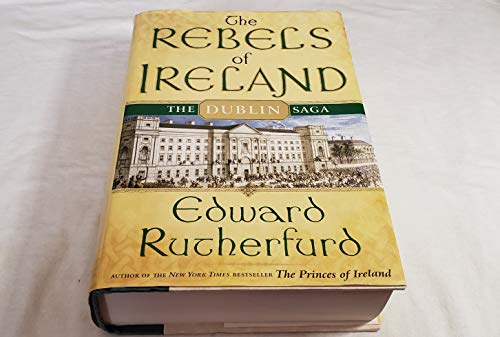
The sequel to The Princes of Ireland follows the lives and destinies of several Dublin families, both Catholic and Protestant, from all strata of society, from the sixteenth-century colonization of Ireland by the English under Elizabeth I to the founding of the Irish free state in 1922. 200,000 first printing.
Die Inhaltsangabe kann sich auf eine andere Ausgabe dieses Titels beziehen.
Über die Autorin bzw. den Autor
EDWARD RUTHERFURD was born in Salisbury, England, and educated at Cambridge University and Stanford University in California. His bestselling novel Sarum is based on the history of Salisbury and Stonehenge. Russka, his second novel, recounts the sweeping history of Russia. London tells the two-thousand-year story of the great city, bringing all of the richness of London’s past unforgettably to life. His novel The Forest is set in England’s ancient New Forest. His last novel, The Princes of Ireland is the companion to The Rebels of Ireland covering the first eleven centuries of Ireland’s history. Edward Rutherfurd divides his time between Dublin and New York.
Auszug. © Genehmigter Nachdruck. Alle Rechte vorbehalten.
PLANTATION
1597
Octor Simeon Pincher knew all about Ireland. Doctor Simeon Pincher was a tall, thin, balding man, still in his twenties, with a sallow complexion and stern black eyes that belonged in a pulpit. He was a learned man, a graduate and fellow of Emmanuel College, at Cambridge University. When he had been offered a position at the new foundation of Trinity College in Dublin, however, he had come thither with such alacrity that his new hosts were quite surprised.
“I shall come at once,” he had written to them, “to do God’s work.” With which reply, no one could argue.
Not only did he come with the stated zeal of a missionary. Even before his arrival in Ireland, Doctor Pincher had informed himself thoroughly about its inhabitants. He knew, for instance, that the mere Irish, as the original native Irish were now termed in England, were worse than animals, and that, as Catholics, they could not be trusted.
But the special gift that Doctor Pincher brought to Ireland was his belief that the mere Irish were not only an inferior people, but that God had deliberately marked them out–along with others, too, of course–since the beginning of time, to be cast into eternal hellfire. For Doctor Simeon Pincher was a follower of Calvin.
To understand Doctor Pincher’s version of the subtle teachings of the great Protestant reformer, it was only necessary to listen to one of his sermons–for he was already accounted a fine preacher, greatly praised for his clarity.
“The logic of the Lord,” he would declare, “like His love, is perfect. And since we are endowed with the faculty of reason, with which God in His infinite goodness has bestowed upon us, we may see His purpose as it is.” Leaning forward slightly towards his audience to ensure their concentration, Doctor Pincher would then explain.
“Consider. It is undeniable that God, the fount of all knowl-edge–to whom all ages are but as the blinking of an eye–must in His infinite wisdom know all things, past, present, and to come. And therefore it must be that even now, He knows full well who upon the Day of Judgement is to be saved, and who shall be cast down into the pit of Hell. He has established all things from the beginning. It cannot be otherwise. Even though, in His mercy, He has left us ignorant of our fate, some have already been chosen for Heaven and others for Hell. The divine logic is absolute, and all who believe must tremble before it. Those who are chosen, those who shall be saved, we call the Elect. All other, damned from the first, shall perish. And so,” he would fix his audience with a terrible stare, “well may you ask: ‘Which am I?’”
The grim logic of John Calvin’s doctrine of predestination was hard to refute. That Calvin was a deeply religious and well-meaning man could not be doubted. His followers strove to follow the loving teachings of the gospels, and to live lives that were honest, hardworking, and charitable. But for some critics, his form of religion ran a risk: its practice could become unduly harsh. Moving from France to Switzerland, Calvin had set up his church in Geneva. The rules governing his community were sterner than those of the Lutheran Protestants, and he believed that the state should enforce them by law. Following their strict moral regime–and reporting their neighbours to the authorities for any failure to live according to God’s law–his congregation did not only seek to earn a place in Heaven, but also to prove to themselves and to the world that they were indeed the predestined Elect who had already been chosen to go there.
Soon Calvinist communities had sprung up in other parts of Europe. If the Scottish Presbyterians were known for their somewhat dour adherence to the doctrines of predestination, the Church of England and its sister Church of Ireland had nowadays a Calvinistic air. “Only the Godly are part of the Church,” its congregations would declare.
But could it be that certain among the community might in fact not be chosen to go to Heaven at all? Most certainly, the Calvinists would concede. Any moral backsliding might be an indication of it. And even then, as Doctor Pincher put it in one of his finest sermons, there remained a great uncertainty.
“No man knows his fate. We are like men walking across a frozen river, foolishly unmindful that, at any time, the ice may crack, and buckle, and drop us down into the frozen waters–below which, hidden deeper yet, burn the fiery furnaces of Hell. Be not puffed up with pride, therefore, as you follow the law of the scriptures, but remember that we are all miserable sinners and be humble. For this is the divine trap, and from it there is no escape. All is foretold, and the mind of God, being perfect, will not be changed.” Then, looking round at his disconsolate congregation, Doctor Pincher would cry out: “And even though, if God has so ordained, you may be doomed, yet I beseech you, be of good cheer. For remember, no matter how hard the way, we are commanded, always, to hope.”
Might there, perhaps, be hope for some of those not in the Calvinist congregation? Perhaps. No man could know the mind of God. But it seemed doubtful. In particular, for those in the Catholic Church, the future looked bleak. Did they not indulge in popish superstitions and worship the saints as idols–things specifically prohibited in the scriptures? Hadn’t they had opportunity to turn away from their errors? To Doctor Pincher it seemed that all followers of the Pope in Rome must surely be on their way to perdition, and that the natives of Ireland, whose bad character was so well-known, were probably in the devil’s clutch already. And might they not yet be saved if they converted? Could not their case be remedied? No. Their sin, to Doctor Pincher, was a clear sign that they had been selected to be damned from the first. They belonged, like the pagan spirits that infested the place, deep underground. Such were the thoughts that had strengthened the keen resolve of Doctor Pincher as he crossed the sea to Dublin.
Yet what of his own fate? Was Simeon Pincher sure, in the secret places of his heart, that he himself was one of the Elect? He had to hope so. If there had been certain sins, indiscretions at least, in his own life, might they be signs that his own nature was corrupt? He turned his face from the thought. To sin, of course, was the lot of every man. Those who repented might indeed be saved. If sins there had been in his life, therefore, he repented most earnestly. And his daily conduct, and his zeal for the Lord, proved, he hoped and believed, that he was, indeed, not the least amongst God’s chosen.
It was a quiet day, with a light breeze, when he arrived at Dublin. His ship had anchored out in the Liffey. A waterman rowed him to the Wood Quay.
And he had just clambered onto the terra firma of Ireland represented by the old quay when, quite suddenly, something happened and the world turned upside down.
The next thing he remembered, he was lying facedown, conscious of a great roar, and that something had given him a huge blow in the stomach so that he could hardly breathe. He looked up, blinked, and saw the face of a man, a gentleman by his clothes, dusting himself off and gazing down at him with concern.
“You are not hurt?”
“I do not think so,” Pincher answered. “What has happened?”
“An explosion.” The stranger pointed, and, twisting round, Pincher saw that, in...
„Über diesen Titel“ kann sich auf eine andere Ausgabe dieses Titels beziehen.
Suchergebnisse für The Rebels of Ireland: The Dublin Saga

Beispielbild für diese ISBN
The Rebels of Ireland: The Dublin Saga
Anbieter: World of Books (was SecondSale), Montgomery, IL, USA
Verkäuferbewertung 5 von 5 Sternen

Zustand: Good. Item in good condition. Textbooks may not include supplemental items i.e. CDs, access codes etc. Artikel-Nr. 00090789735
Gebraucht kaufen
EUR 4,78
Versand gratis
Versand innerhalb von USA
Versand innerhalb von USA
Anzahl: 18 verfügbar
Beispielbild für diese ISBN
The Rebels of Ireland: The Dublin Saga
Anbieter: World of Books (was SecondSale), Montgomery, IL, USA
Verkäuferbewertung 5 von 5 Sternen
Zustand: Acceptable. Item in acceptable condition! Textbooks may not include supplemental items i.e. CDs, access codes etc. Artikel-Nr. 00105490878
Gebraucht kaufen
EUR 4,78
Versand gratis
Versand innerhalb von USA
Versand innerhalb von USA
Anzahl: 1 verfügbar
Beispielbild für diese ISBN
The Rebels of Ireland: The Dublin Saga
Anbieter: World of Books (was SecondSale), Montgomery, IL, USA
Verkäuferbewertung 5 von 5 Sternen
Zustand: Good. Item in good condition and has highlighting/writing on text. Used texts may not contain supplemental items such as CDs, info-trac etc. Artikel-Nr. 00101176524
Gebraucht kaufen
EUR 4,93
Versand gratis
Versand innerhalb von USA
Versand innerhalb von USA
Anzahl: 1 verfügbar
Beispielbild für diese ISBN
The Rebels of Ireland: The Dublin Saga
Anbieter: ThriftBooks-Reno, Reno, NV, USA
Verkäuferbewertung 5 von 5 Sternen
Hardcover. Zustand: Good. No Jacket. Missing dust jacket; Pages can have notes/highlighting. Spine may show signs of wear. ~ ThriftBooks: Read More, Spend Less. Artikel-Nr. G0385512899I3N01
Gebraucht kaufen
EUR 5,87
Versand gratis
Versand innerhalb von USA
Versand innerhalb von USA
Anzahl: 1 verfügbar
Beispielbild für diese ISBN
The Rebels of Ireland: The Dublin Saga
Anbieter: ThriftBooks-Phoenix, Phoenix, AZ, USA
Verkäuferbewertung 5 von 5 Sternen
Hardcover. Zustand: Good. No Jacket. Former library book; Pages can have notes/highlighting. Spine may show signs of wear. ~ ThriftBooks: Read More, Spend Less. Artikel-Nr. G0385512899I3N10
Gebraucht kaufen
EUR 5,87
Versand gratis
Versand innerhalb von USA
Versand innerhalb von USA
Anzahl: 1 verfügbar
Beispielbild für diese ISBN
The Rebels of Ireland: The Dublin Saga
Anbieter: ThriftBooks-Phoenix, Phoenix, AZ, USA
Verkäuferbewertung 5 von 5 Sternen
Hardcover. Zustand: Good. No Jacket. Missing dust jacket; Pages can have notes/highlighting. Spine may show signs of wear. ~ ThriftBooks: Read More, Spend Less. Artikel-Nr. G0385512899I3N01
Gebraucht kaufen
EUR 5,87
Versand gratis
Versand innerhalb von USA
Versand innerhalb von USA
Anzahl: 1 verfügbar
Beispielbild für diese ISBN
The Rebels of Ireland: The Dublin Saga
Anbieter: ThriftBooks-Phoenix, Phoenix, AZ, USA
Verkäuferbewertung 5 von 5 Sternen
Hardcover. Zustand: Good. No Jacket. Pages can have notes/highlighting. Spine may show signs of wear. ~ ThriftBooks: Read More, Spend Less. Artikel-Nr. G0385512899I3N00
Gebraucht kaufen
EUR 5,87
Versand gratis
Versand innerhalb von USA
Versand innerhalb von USA
Anzahl: 1 verfügbar
Beispielbild für diese ISBN
The Rebels of Ireland: The Dublin Saga
Anbieter: ThriftBooks-Reno, Reno, NV, USA
Verkäuferbewertung 5 von 5 Sternen
Hardcover. Zustand: Good. No Jacket. Pages can have notes/highlighting. Spine may show signs of wear. ~ ThriftBooks: Read More, Spend Less. Artikel-Nr. G0385512899I3N00
Gebraucht kaufen
EUR 5,87
Versand gratis
Versand innerhalb von USA
Versand innerhalb von USA
Anzahl: 2 verfügbar
Beispielbild für diese ISBN
The Rebels of Ireland: The Dublin Saga
Anbieter: ThriftBooks-Atlanta, AUSTELL, GA, USA
Verkäuferbewertung 5 von 5 Sternen
Hardcover. Zustand: Good. No Jacket. Pages can have notes/highlighting. Spine may show signs of wear. ~ ThriftBooks: Read More, Spend Less. Artikel-Nr. G0385512899I3N00
Gebraucht kaufen
EUR 5,90
Versand gratis
Versand innerhalb von USA
Versand innerhalb von USA
Anzahl: 2 verfügbar
Beispielbild für diese ISBN
The Rebels of Ireland: The Dublin Saga
Anbieter: ThriftBooks-Dallas, Dallas, TX, USA
Verkäuferbewertung 5 von 5 Sternen
Hardcover. Zustand: Good. No Jacket. Former library book; Pages can have notes/highlighting. Spine may show signs of wear. ~ ThriftBooks: Read More, Spend Less. Artikel-Nr. G0385512899I3N10
Gebraucht kaufen
EUR 5,90
Versand gratis
Versand innerhalb von USA
Versand innerhalb von USA
Anzahl: 1 verfügbar