
Verwandte Artikel zu Beating the Business Cycle: How to Predict and Profit...
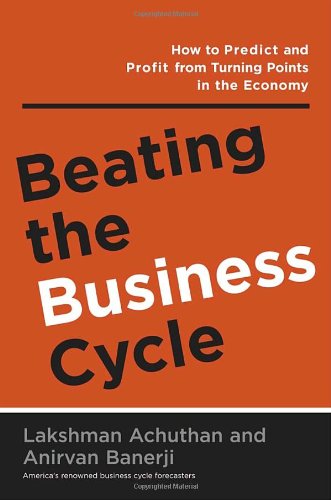
Beating the Business Cycle: How to Predict and Profit from Turning Points in the Economy - Hardcover
Inhaltsangabe
The directors of the Economic Cycle Research Institute explain how to utilize the leading econcomic indicators to predict--and profit from--the ups and downs of the economy, as well as how to use one's knowledge of economic trends to make sound business or major life decisions.
Die Inhaltsangabe kann sich auf eine andere Ausgabe dieses Titels beziehen.
Über die Autorin bzw. den Autor
<p>LAKSHMAN ACHUTHAN and ANIRVAN BANERJI are the managing director and director of research at the famed Economic Cycle Research Institute. They are the trusted advisors of Fortune 500 companies, major fund managers, and government agencies throughout the world. They appear regularly on CNN’s <i>Moneyline</i>, CNBC, and NPR, and have been featured in <i>Money</i> magazine and <i>The Economist</i>.</p>
Aus dem Klappentext
<p>How can you make wise decisions about your company and your personal future when you have no idea where the economy is headed?<br><br>The answer is, you can’t. But you <i>can </i>learn how to accurately predict turns in the economy so that you can see the road ahead. And <i>Beating The Business Cycle</i> shows you how.<br><br>In <i>Beating the Business Cycle</i>, Lakshman Achuthan and Anirvan Banerji, the directors of the renowned Economic Cycle Research Institute (ECRI) show how anyone can predict and profit from the inevitable booms and busts of the economy. <br><br>Why should we believe them? Because while so many economists and financial gurus have failed to predict recessions in the past, ECRI’s forecasts are known for being uncannily accurate. The institute successfully predicted the U.S. recession of 2001 many months before the economists did; the 1990 recession and later recovery; and most recently, the weak U.S. recovery in 2002. ECRI is in constant demand by corporate America and the media. It is the “secret weapon” of companies from Disney to DuPont, the major fund managers, and many central banks. <br><br><i>Beating the Business Cycle</i> is the first book to reveal how decision makers at all levels—managers, small business owners, and individuals—can see into the economy’s future when making key decisions. Should a large company search out new clients and build new factories or stores, or should it consider cost cutting and layoffs? Is it the right time for you to splurge on that luxury vacation or addition to your house, or would it be more prudent to cut back on big expenditures and save money for a rainy day? <br><br>Written in an easy-to-understand, accessible style, <i>Beating the Business Cycle</i> takes the guesswork out of deciding which of the hundreds of economic indicators to trust and which ones to trash. It will give you the tools and confidence you need to make the right decisions at the right times—even when the rest of the investing and business world would persuade you otherwise. Whether you are a corporate manager or the owner of a small business, whether you have your money invested in stocks or in your home, <i>Beating the Business Cycle</i> will give you the edge you need to trump the competition and stay ahead of the crowd.</p>
Auszug. © Genehmigter Nachdruck. Alle Rechte vorbehalten.
Chapter 1
The Resurrection of Risk
In the Road Runner cartoon the joke is always the same. Wile E. Coyote chases the Road Runner, misses a sharp turn, and runs right over the edge of the cliff. He looks down and, realizing too late that he is in midair, plunges into the chasm below.
This may seem uncomfortably familiar to those who found themselves carried away by the excitement of the 1990s economic boom. Too late they realized that profits, jobs, or stock prices were already in a free fall. But, unlike the cartoon, it was not funny. A shift from boom to bust, from economic expansion to recession, like the one we experienced in 2001, can be painful, even tragic, for those blindsided by the downturn. That is why it is so critical to be forewarned of turning points in the economy.
Is that even possible? Many would say "no." It is true that economic forecasters rarely get recession calls right. In fact, as a recent study concluded, "The [worldwide] record of failure to predict recessions is virtually unblemished."1
But we are here to tell you a different story. It really is possible to predict recessions. And we will show you how, so that you will no longer be at the mercy of economic cycles. Whether you are an employee or a student, a business manager or a policy maker, you can learn to navigate the economy's ups and downs.
We will describe a cyclical framework for viewing the economy that relies on an array of objective indicators that, if used properly, warn of turning points before they happen. We will also tell you why many of the commonly followed economic indicators can be misleading. You'll discover you don't need a Ph.D. in economics or even a full-time focus on the economy to use our techniques.
But if recessions have historically been so hard to predict, why should you listen to us? Because we have accurately predicted recessions and recoveries when others have failed.2
We were able to do this not because we are smarter than other forecasters, or because we have some secret formula, but because at the Economic Cycle Research Institute (ECRI) an eighty-year tradition of business cycle research gives us a unique vantage point. By standing on the shoulders of the giants of business cycle research who pioneered our approach, we have, over time, designed objective tools that accurately predict turning points in the economy. In Beating the Business Cycle, we share this information so that you, too, can create your own customized "economic dashboard" that will help steer your future financial decisions in the right direction before you find yourself plunging into the abyss.
Our research tradition was handed down to us by Geoffrey H. Moore, the legendary business cycle scholar whom The Wall Street Journal called "the father of leading indicators." Moore
was the protege of Wesley C. Mitchell and Arthur F. Burns, who, early in the twentieth century, pioneered modern business cycle research. Moore's career spanned six decades and focused on the development of practical tools to monitor and predict economic cycles. His approach stands in stark contrast to the views of a generation of economic researchers who shrugged their shoulders long ago, resigned to the belief that forecasting turns in the cycle was impossible and therefore irrelevant. Moore founded the independent Economic Cycle Research Institute to advance the tradition of cyclical research, as well as to refine its predictive tools and make those results available to as many people as possible.
We believe these tools are invaluable in helping you make decisions about your business and your personal life. Why? Because there are both opportunities and dangers linked to the ups and downs of the business cycle that you need to know. When will the next turning point in the economy arrive? How can you avoid getting hurt in a bust? When can you capitalize on the opportunities a boom will offer? This book will give you those answers. It will help you to reduce the risk of being blindsided by an economic downturn and allow you to take full advantage of the good times. So while most economic books are liable to put you to sleep, this book should help you to sleep better.
Wile E. Coyote, after scraping himself off the canyon floor, again gives chase, heedless of the dangers ahead, oblivious to any lessons he might learn. Because he is only a cartoon character, no matter how many times he gets splattered, he never really gets hurt. But life is not a cartoon. And if you are the one to take a nosedive when the economy makes an unexpected turn, the pain is real. It may not be so easy to peel yourself off the canyon floor.
A Different Perspective
The 2001 recession was the first time many of us experienced what it feels like to go from a boom to a bust. The fact is, with forewarning, the pain could have been considerably less. But
the din of the late-1990s euphoria was simply too loud for most people to hear any voice not in harmony with the boom-market revelry.
In September 2000, ECRI warned of a recession ahead3 to our clients, and later on the evening news shows. Few listened. Most kept upping the ante, convincing themselves and one another that any economic rough spots were only minor speed bumps. It was easy to be swept along by the enthusiasm of the New Economy.
For much of the 1990s, it was worth joining in on the fun. Contrarians missed out on the longest expansion in U.S. history, as the stock market climbed from well below 4,000 to over 11,000. Clearly, during the boom, the important question was "When is it the right time to break away from the bulls?" And in the wake of a bust, it is just as important to know when to part company with the pessimists. The bottom of an economic cycle is the perfect time to ask, "Is now the time to add to my business by buying out competitors while prices are low?"
These questions are answerable. You need not live in a constant state of fear, wondering where the economy is headed. The tools we employ to forecast recessions and recoveries for our major clients can be used by any business or individual. The objective indicators we have developed will tell you when we are approaching a turning point in the economy. We will show you how to read them and use them when making different kinds of financial decisions. But you must be strong enough to trust them--especially when they cut against the grain of popular opinion. And believe us--at the most critical times, they will.
The research that gave rise to these indicators has too long been hidden from public view. Back in the 1920s and 1930s, there was a great deal of interest in business cycles as a result of the boom of the 1920s and the Great Depression that followed. But memories fade. Most forecasters have forgotten the work of Mitchell, Burns, and Moore. This is part of the reason so many economists and financial experts were blindsided by the 2001 recession, and why much of what you read here will seem new.
In March 2001, six months after we issued our initial warning of a recession, it became clear to us that a recession was unavoidable. We were not shy about saying so. The New York Times published our call on its front page.4 In hindsight, it is agreed that was precisely when the recession began.5
We do not want to suggest that it was easy to make the call. Far from it. Over a decade had passed since our last recession call in February 1990, five months before the previous recession started. Because we are experts in business cycle forecasting and had the record to prove it, we were under enormous pressure. To make things even more stressful, this was the first recession forecast we would make without the help of Moore, who had passed away a year earlier. (Some...
„Über diesen Titel“ kann sich auf eine andere Ausgabe dieses Titels beziehen.
Suchergebnisse für Beating the Business Cycle: How to Predict and Profit...

Beispielbild für diese ISBN
Beating the Business Cycle: How to Predict and Profit From Turning Points in the Economy
Verlag:
Crown Business (edition ), 2004
ISBN 10: 0385509537
ISBN 13: 9780385509534
Gebraucht
Hardcover
Anbieter: BooksRun, Philadelphia, PA, USA
Verkäuferbewertung 5 von 5 Sternen

Hardcover. Zustand: Very Good. It's a well-cared-for item that has seen limited use. The item may show minor signs of wear. All the text is legible, with all pages included. It may have slight markings and/or highlighting. Artikel-Nr. 0385509537-11-6
Gebraucht kaufen
EUR 4,89
Versand gratis
Versand innerhalb von USA
Versand innerhalb von USA
Anzahl: 1 verfügbar
Beispielbild für diese ISBN
Beating the Business Cycle: How to Predict and Profit From Turning Points in the Economy
Anbieter: ThriftBooks-Atlanta, AUSTELL, GA, USA
Verkäuferbewertung 5 von 5 Sternen
Hardcover. Zustand: Very Good. No Jacket. May have limited writing in cover pages. Pages are unmarked. ~ ThriftBooks: Read More, Spend Less. Artikel-Nr. G0385509537I4N00
Gebraucht kaufen
EUR 6,05
Versand gratis
Versand innerhalb von USA
Versand innerhalb von USA
Anzahl: 1 verfügbar
Beispielbild für diese ISBN
Beating the Business Cycle: How to Predict and Profit From Turning Points in the Economy
Anbieter: ThriftBooks-Reno, Reno, NV, USA
Verkäuferbewertung 5 von 5 Sternen
Hardcover. Zustand: Very Good. No Jacket. May have limited writing in cover pages. Pages are unmarked. ~ ThriftBooks: Read More, Spend Less. Artikel-Nr. G0385509537I4N00
Gebraucht kaufen
EUR 6,05
Versand gratis
Versand innerhalb von USA
Versand innerhalb von USA
Anzahl: 1 verfügbar
Beispielbild für diese ISBN
Beating the Business Cycle: How to Predict and Profit From Turning Points in the Economy
Anbieter: ThriftBooks-Dallas, Dallas, TX, USA
Verkäuferbewertung 5 von 5 Sternen
Hardcover. Zustand: Very Good. No Jacket. May have limited writing in cover pages. Pages are unmarked. ~ ThriftBooks: Read More, Spend Less. Artikel-Nr. G0385509537I4N00
Gebraucht kaufen
EUR 6,05
Versand gratis
Versand innerhalb von USA
Versand innerhalb von USA
Anzahl: 1 verfügbar
Beispielbild für diese ISBN
Beating the Business Cycle : How to Predict and Profit from Turning Points in the Economy
Verlag:
Bantam Doubleday Dell Publishing Group, 2004
ISBN 10: 0385509537
ISBN 13: 9780385509534
Gebraucht
Hardcover
Erstausgabe
Anbieter: Better World Books, Mishawaka, IN, USA
Verkäuferbewertung 5 von 5 Sternen
Zustand: Very Good. 1st. Former library copy. Pages intact with possible writing/highlighting. Binding strong with minor wear. Dust jackets/supplements may not be included. Includes library markings. Stock photo provided. Product includes identifying sticker. Better World Books: Buy Books. Do Good. Artikel-Nr. 5756911-6
Gebraucht kaufen
EUR 6,56
Versand gratis
Versand innerhalb von USA
Versand innerhalb von USA
Anzahl: 1 verfügbar
Beispielbild für diese ISBN
Beating the Business Cycle : How to Predict and Profit from Turning Points in the Economy
Verlag:
Bantam Doubleday Dell Publishing Group, 2004
ISBN 10: 0385509537
ISBN 13: 9780385509534
Gebraucht
Hardcover
Erstausgabe
Anbieter: Better World Books, Mishawaka, IN, USA
Verkäuferbewertung 5 von 5 Sternen
Zustand: Good. 1st. Pages intact with minimal writing/highlighting. The binding may be loose and creased. Dust jackets/supplements are not included. Stock photo provided. Product includes identifying sticker. Better World Books: Buy Books. Do Good. Artikel-Nr. 4448714-75
Gebraucht kaufen
EUR 6,56
Versand gratis
Versand innerhalb von USA
Versand innerhalb von USA
Anzahl: 2 verfügbar
Beispielbild für diese ISBN
Beating the Business Cycle : How to Predict and Profit from Turning Points in the Economy
Verlag:
Bantam Doubleday Dell Publishing Group, 2004
ISBN 10: 0385509537
ISBN 13: 9780385509534
Gebraucht
Hardcover
Erstausgabe
Anbieter: Better World Books, Mishawaka, IN, USA
Verkäuferbewertung 5 von 5 Sternen
Zustand: Fine. 1st. Used book that is in almost brand-new condition. May contain a remainder mark. Better World Books: Buy Books. Do Good. Artikel-Nr. 14929858-6
Gebraucht kaufen
EUR 6,56
Versand gratis
Versand innerhalb von USA
Versand innerhalb von USA
Anzahl: 1 verfügbar
Beispielbild für diese ISBN
Beating the Business Cycle: How to Predict and Profit From Turning Points in the Economy
Anbieter: medimops, Berlin, Deutschland
Verkäuferbewertung 5 von 5 Sternen
Zustand: good. Befriedigend/Good: Durchschnittlich erhaltenes Buch bzw. Schutzumschlag mit Gebrauchsspuren, aber vollständigen Seiten. / Describes the average WORN book or dust jacket that has all the pages present. Artikel-Nr. M00385509537-G
Gebraucht kaufen
EUR 8,38
EUR 10,00 Versand
Versand von Deutschland nach USA
Versand von Deutschland nach USA
Anzahl: 1 verfügbar
Foto des Verkäufers
Beating the Business Cycle: How to Predict and Profit From Turning Points in the Economy
Verlag:
Currency Doubleday, 2004
ISBN 10: 0385509537
ISBN 13: 9780385509534
Gebraucht
Hardcover
Erstausgabe
Anbieter: Southampton Books, Sag Harbor, NY, USA
Verkäuferbewertung 5 von 5 Sternen
Hardcover. Zustand: Like New. First Edition. First Edition, First Printing. Not price-clipped. Published by Currency Doubleday, 2004. Octavo. Hardcover. Book is like new. Dust jacket is like new.100% positive feedback. 30 day money back guarantee. NEXT DAY SHIPPING! Excellent customer service. Please email with any questions. All books packed carefully and ship with free delivery confirmation/tracking. All books come with free bookmarks. Ships from Sag Harbor, New York. Artikel-Nr. 342584
Gebraucht kaufen
EUR 18,35
EUR 4,44 Versand
Versand innerhalb von USA
Versand innerhalb von USA
Anzahl: 1 verfügbar
Beispielbild für diese ISBN
Beating the Business Cycle: How to Predict and Profit from Turning Points in the Economy
Anbieter: Revaluation Books, Exeter, Vereinigtes Königreich
Verkäuferbewertung 5 von 5 Sternen
Hardcover. Zustand: Brand New. 208 pages. 8.50x5.50x0.25 inches. In Stock. Artikel-Nr. 0385509537
Neu kaufen
EUR 70,12
EUR 11,88 Versand
Versand von Vereinigtes Königreich nach USA
Versand von Vereinigtes Königreich nach USA
Anzahl: 1 verfügbar