
Verwandte Artikel zu I Like Being Catholic: Treasured Traditions, Rituals,...
Inhaltsangabe
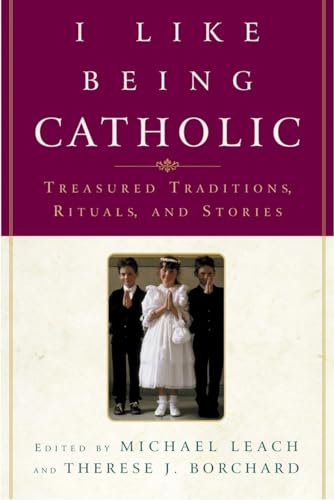
A celebration of the treasured traditions, rituals, and stories that run through the bloodstream of American Catholics
For Andrew Greeley, it is the reverence of Christmas night and the exultation of Easter morn. Martin Scorsese, like many others, remains grateful for the nuns who rapped his knuckles but built his self-esteem. Mary Gordon recalls the sense of lightness that follows confession; Vince Lombardi, the strength he derived from Mass; and Christopher Buckley, the role St. Thomas More plays in his writing.
I Like Being Catholic brings together the memories, thought, and hopes of famous Catholics and ordinary parishioners, lapsed and "good-enough" Catholics, and those who have devoted their lives to the faith. It captures their abiding ties to and deep affection for the Church and offers the wide-ranging, sometimes surprising views on the good things that come with being Catholic.
This is not a book of theology. It is about the beauty at the heart of Catholicism. It is about what Teilhard de Chardin called "the chosen part of things." It is about family and community, the value of Catholic education, the significance of sacraments and milestones, and the cultural impact of Catholicism—there are lists of the ten best Catholic novels, the ten best Catholic movies, ten Catholic heroes of the twentieth century, ten good reasons to raise your kids Catholic, fifty things Catholics like best about being Catholic, and much more ...
I Like Being Catholic is a book for all those who have ever called themselves Catholic. It is a book of warmth, affection, humor, and love.
Die Inhaltsangabe kann sich auf eine andere Ausgabe dieses Titels beziehen.
Über die Autorin bzw. den Autor
Michael Leach has been a leading figure in Catholic book publishing for three decades. A past president and publisher of the Crossroad/Continuum Publishing Group and president of the Catholic Book Publishers Association, he is currently executive director of Orbis Books. He lives in Greenwich, Connecticut. Therese J. Borchard has an M.A. in theology from the University of Notre Dame and is the author of fifteen books, including The Emerald Bible Collection for young readers. She lives in Annapolis, Maryland.
Von der hinteren Coverseite
A celebration of the treasured traditions, rituals, and stories that run through the bloodstream of American Catholics
For Andrew Greeley, it is the reverence of Christmas night and the exultation of Easter morn. Martin Scorsese, like many others, remains grateful for the nuns who rapped his knuckles but built his self-esteem. Mary Gordon recalls the sense of lightness that follows confession; Vince Lombardi, the strength he derived from Mass; and Christopher Buckley, the role St. Thomas More plays in his writing. This is not a book of theology. It is about the beauty at the heart of Catholicism. It is about what Teilhard de Chardin called "the chosen part of things." It is about family and community, the value of Catholic education, the significance of sacraments and milestones, and the cultural impact of Catholicism--there are lists of the ten best Catholic novels, the ten best Catholic movies, ten Catholic heroes of the twentieth century, ten good reasons to raise your kids Catholic, fifty things Catholics like best about being Catholic, and much more ... "From the Hardcover edition.
Aus dem Klappentext
A celebration of the treasured traditions, rituals, and stories that run through the bloodstream of American Catholics
For Andrew Greeley, it is the reverence of Christmas night and the exultation of Easter morn. Martin Scorsese, like many others, remains grateful for the nuns who rapped his knuckles but built his self-esteem. Mary Gordon recalls the sense of lightness that follows confession; Vince Lombardi, the strength he derived from Mass; and Christopher Buckley, the role St. Thomas More plays in his writing.
I Like Being Catholic brings together the memories, thought, and hopes of famous Catholics and ordinary parishioners, lapsed and "good-enough" Catholics, and those who have devoted their lives to the faith. It captures their abiding ties to and deep affection for the Church and offers the wide-ranging, sometimes surprising views on the good things that come with being Catholic.
This is not a book of theology. It is about the beauty at the heart of Catholicism. It is about what Teilhard de Chardin called "the chosen part of things." It is about family and community, the value of Catholic education, the significance of sacraments and milestones, and the cultural impact of Catholicism there are lists of the ten best Catholic novels, the ten best Catholic movies, ten Catholic heroes of the twentieth century, ten good reasons to raise your kids Catholic, fifty things Catholics like best about being Catholic, and much more ...
I Like Being Catholic is a book for all those who have ever called themselves Catholic. It is a book of warmth, affection, humor, and love.
From the Hardcover edition.
Auszug. © Genehmigter Nachdruck. Alle Rechte vorbehalten.
Chapter One
It's Fun to be Catholic
By Andrew M. Greeley
In its best moments Catholicism is the happiest of the major world religions. It is permeated by the reverent joy of Christmas night, the exultant joy of Easter morn, the gentle joy of First Communion, the satisfied joy of grammar school graduation, the hopeful joy of a funeral mass, the confident joy of a May crowning. Catholicism is shaped by the happiness of hymns like O Come Emmanuel, Adeste Fideles, the Exultet, and Bring Flowers of the Rarest.
Catholicism is an old, variegated, complex religious heritage. Many different cultural streams have emptied into its vast rivers. New ones still pour into it today. One can find in its history almost anything one wants--superstition, ignorance, bigotry, cruelty, arrogance, pride. One can easily find such realities today, too. Our ancestors have tortured and burned heretics and witches. They have murdered pagans, Muslims, Jews, Greeks, Protestants, and other Catholics. Anyone who has been raised Catholic has had experience with the harsh, negative, dour, repressive components of our heritage. Yet at its best--and all religions should be judged by their best--Catholicism is essentially a religion of sacramentality and community, a religion which believes that God is everywhere in our daily life and world and that we honor God as part of a community of believers. Anglican historian Owen Chadwick, in his book The Popes and European Revolution, comments, "The religious world of Haydn and Mozart had this characteristic of the Catholic eighteenth century, that it was a world of happy religion. . . . Like rococo architects, these were not men of an otherworldly religion, or (if they were) the other world was close to this world and permeated all its being."
Precisely. Perhaps without realizing it Professor Chadwick put his finger on the essence, the genius, the fundamental orientation of Catholicism, that aspect of our heritage which distinguishes us from all the other great world religions. We believe that the sacred is everywhere, that it lurks among us, sanctifying everything. We live in haunted houses, enchanted by the Holy Spirit. God is not (only) distant. God is among us in the water, the bread and the wine, the oil, the body of the beloved. And in the sun and the moon and the stars, in reconciliation after quarrels, in the touch of a friendly hand, in a glorious summer sunrise, in a chill winter sunset behind a frozen lake, in a familiar face seen in a crowd after many years of absence, in the cool waters of summer and the blazing fire of winter, in chocolate ice cream (with raspberry sauce!), in a joyous romp with our lover. Grace is everywhere. All is grace!
Alone of the major world religions, Catholicism affirms life, affirms flesh, affirms pleasure, affirms art and music, affirms a God who is present in the objects and events and persons of daily life. Hence we have angels and saints and souls in purgatory and stained glass and statues and Mary the Mother of Jesus. They all remind us of the presence of God in the Sacraments as well as in all the sacraments of our world.
Sure, Catholicism can easily slip over into superstition, folk religion, and a syncretistic blend with paganism. But other world religions that emphasize the distance of God and the god-forsaken nature of our world risk reducing the world to an empty and almost meaningless place. God is both present and absent, of course, both near and far, both immanent and transcendent. Catholicism bets that its emphasis on his presence, his nearness, his immanence, is legitimated by the mystery of the incarnation, that the word became flesh and dwelt among us (literally pitched his tent among us).
This appeal, this attractiveness, this charm of Catholicism is the reason why we remain Catholic, no matter the sins of the past or the foolishness of the present. Once a Catholic, it is said, always a Catholic. If Catholicism can enchant and enthrall your imagination in the early years of your life, you will always be haunted by it. As novelist Alice McDermott said, with considerable pride, we are forever doomed to be Catholic. There's no turning back.
Somehow too many of our teachers and our leaders don't seem to understand that we remain Catholic and always will be Catholic because of stories of the presence of grace in the world, stories of God's love all around us. Most Catholics know better. They know with St. Therese of the Infant Jesus (and the Holy Face) that God is nothing but mercy and love. They know with the Irish Dominican poet Paul Murray that God loves us so much that if any one of us should cease to exist He would die of sadness. They know with the American (and Chicago) theologian Robert Barron that God cannot help but love us with all the tender love of a mother.
There is a distinctively Catholic imagination--sacramental, liturgical, analogical, call it what you wish--which enables Catholics to see the world through a different set of lenses. That is the first reason it is fun to be Catholic.
Catholicism is thus a religion of festivity and celebration, of holidays and parties, of a sacred calendar, of Christmas cribs and Easter lilies, of processions and pilgrimages, of seasons and colors, of special prayers and special patrons. They are all part of the explanation of why Catholicism is a happy religion and why it is fun to be Catholic.
The other dimension of Catholicism which is so attractive to Catholics is its emphasis on community--an emphasis which is diametrically opposed to the emphasis on the individual which is so much part of American culture. Catholicism teaches and Catholics believe in their bones that we relate to God as part of a network of family, friends, and neighbors. We feel all other human behavior intuitively involves us as members of groups. Why should religion be any different? Why should we, when it comes to religion, go off into the desert by ourselves? Why desert our lovers, our neighbors, our friends, when it comes to God?
So we express our intense communal relations at every level of our lives and most particularly in the neighborhood parish which is the church for us. Catholics cluster, they bond, they converge, they swarm. Catholicism in James Joyce's happy phrase means "Here comes everybody!" We draw our boundaries out as wide as we can and, in our better moments, include within the boundaries even those who think they are outside. It's hard to stop being a Catholic. Those rigid people who try to draw the boundaries tightly (so as to exclude the ones with whom they disagree) misunderstand what Catholicism is about. We are not a religion for only the saved, much less for those who think that they are saved. We are a religion for everyone. Even those who have been excommunicated are still Catholics. The only way one can get out is by formally and explicitly announcing that they have renounced the faith or by joining another denomination. Even then neither the church nor your own imagination gives up on you. Never!
It's more fun being Catholic because it's more fun to belong to something than to be a religious lone wolf. Do I have evidence for my claim that Catholics are (on the average) more communal than others? Does one really need evidence? I wonder. However, in a multination study of family life, my colleagues in the International Social Survey Program discovered that in virtually every country Catholics are more likely to live with their parents or to live close to them, to visit them often, and to talk to them often on the phone. The same things are true of relationships with children and siblings and even with other relatives. Catholics, as I say, tend to swarm.
I administer this questionnaire to my students at both the University of Arizona and the University of Chicago on the first day of my class in the sociology of religion. The young people...
„Über diesen Titel“ kann sich auf eine andere Ausgabe dieses Titels beziehen.
Suchergebnisse für I Like Being Catholic: Treasured Traditions, Rituals,...

Beispielbild für diese ISBN
I Like Being Catholic: Treasur
Verlag:
PRH Christian Publishing, 2005
ISBN 10: 0385508069
ISBN 13: 9780385508063
Gebraucht
Softcover
Anbieter: World of Books (was SecondSale), Montgomery, IL, USA
Verkäuferbewertung 5 von 5 Sternen

Zustand: Very Good. Item in very good condition! Textbooks may not include supplemental items i.e. CDs, access codes etc. Artikel-Nr. 00102349404
Gebraucht kaufen
EUR 3,97
Versand gratis
Versand innerhalb von USA
Versand innerhalb von USA
Anzahl: 2 verfügbar
Beispielbild für diese ISBN
I Like Being Catholic: Treasur
Verlag:
PRH Christian Publishing, 2005
ISBN 10: 0385508069
ISBN 13: 9780385508063
Gebraucht
Softcover
Anbieter: World of Books (was SecondSale), Montgomery, IL, USA
Verkäuferbewertung 5 von 5 Sternen
Zustand: Acceptable. Item in acceptable condition! Textbooks may not include supplemental items i.e. CDs, access codes etc. Artikel-Nr. 00101675118
Gebraucht kaufen
EUR 3,97
Versand gratis
Versand innerhalb von USA
Versand innerhalb von USA
Anzahl: 1 verfügbar
Beispielbild für diese ISBN
I Like Being Catholic: Treasur
Verlag:
PRH Christian Publishing, 2005
ISBN 10: 0385508069
ISBN 13: 9780385508063
Gebraucht
Softcover
Anbieter: World of Books (was SecondSale), Montgomery, IL, USA
Verkäuferbewertung 5 von 5 Sternen
Zustand: Good. Item in good condition. Textbooks may not include supplemental items i.e. CDs, access codes etc. Artikel-Nr. 00100695053
Gebraucht kaufen
EUR 3,97
Versand gratis
Versand innerhalb von USA
Versand innerhalb von USA
Anzahl: 2 verfügbar
Beispielbild für diese ISBN
I Like Being Catholic: Treasured Traditions, Rituals, and Stories
Verlag:
PRH Christian Publishing (edition ), 2005
ISBN 10: 0385508069
ISBN 13: 9780385508063
Gebraucht
Paperback
Anbieter: BooksRun, Philadelphia, PA, USA
Verkäuferbewertung 5 von 5 Sternen
Paperback. Zustand: Very Good. It's a well-cared-for item that has seen limited use. The item may show minor signs of wear. All the text is legible, with all pages included. It may have slight markings and/or highlighting. Artikel-Nr. 0385508069-11-1
Gebraucht kaufen
EUR 4,41
Versand gratis
Versand innerhalb von USA
Versand innerhalb von USA
Anzahl: 1 verfügbar
Beispielbild für diese ISBN
I Like Being Catholic: Treasured Traditions, Rituals, and Stories
Verlag:
PRH Christian Publishing, 2005
ISBN 10: 0385508069
ISBN 13: 9780385508063
Gebraucht
Softcover
Anbieter: Wonder Book, Frederick, MD, USA
Verkäuferbewertung 5 von 5 Sternen
Zustand: Good. Good condition. A copy that has been read but remains intact. May contain markings such as bookplates, stamps, limited notes and highlighting, or a few light stains. Bundled media such as CDs, DVDs, floppy disks or access codes may not be included. Artikel-Nr. Y01A-01118
Gebraucht kaufen
EUR 6,29
Versand gratis
Versand innerhalb von USA
Versand innerhalb von USA
Anzahl: 1 verfügbar
Beispielbild für diese ISBN
I Like Being Catholic: Treasured Traditions, Rituals, and Stories
Verlag:
PRH Christian Publishing, 2005
ISBN 10: 0385508069
ISBN 13: 9780385508063
Gebraucht
Softcover
Anbieter: Wonder Book, Frederick, MD, USA
Verkäuferbewertung 5 von 5 Sternen
Zustand: Very Good. Very Good condition. A copy that may have a few cosmetic defects. May also contain light spine creasing or a few markings such as an owner's name, short gifter's inscription or light stamp. Artikel-Nr. T08B-05132
Gebraucht kaufen
EUR 6,29
Versand gratis
Versand innerhalb von USA
Versand innerhalb von USA
Anzahl: 2 verfügbar
Beispielbild für diese ISBN
I Like Being Catholic: Treasured Traditions, Rituals, and Stories
Verlag:
Prh Christian Publishing, 2005
ISBN 10: 0385508069
ISBN 13: 9780385508063
Gebraucht
Paperback
Anbieter: ThriftBooks-Atlanta, AUSTELL, GA, USA
Verkäuferbewertung 5 von 5 Sternen
Paperback. Zustand: Good. No Jacket. Pages can have notes/highlighting. Spine may show signs of wear. ~ ThriftBooks: Read More, Spend Less. Artikel-Nr. G0385508069I3N00
Gebraucht kaufen
EUR 6,35
Versand gratis
Versand innerhalb von USA
Versand innerhalb von USA
Anzahl: 1 verfügbar
Beispielbild für diese ISBN
I Like Being Catholic: Treasured Traditions, Rituals, and Stories
Verlag:
Prh Christian Publishing, 2005
ISBN 10: 0385508069
ISBN 13: 9780385508063
Gebraucht
Paperback
Anbieter: ThriftBooks-Atlanta, AUSTELL, GA, USA
Verkäuferbewertung 5 von 5 Sternen
Paperback. Zustand: Fair. No Jacket. Readable copy. Pages may have considerable notes/highlighting. ~ ThriftBooks: Read More, Spend Less. Artikel-Nr. G0385508069I5N00
Gebraucht kaufen
EUR 6,35
Versand gratis
Versand innerhalb von USA
Versand innerhalb von USA
Anzahl: 1 verfügbar
Beispielbild für diese ISBN
I Like Being Catholic : Treasured Traditions, Rituals, and Stories
Verlag:
Doubleday Religious Publishing Group, The, 2005
ISBN 10: 0385508069
ISBN 13: 9780385508063
Gebraucht
Softcover
Anbieter: Better World Books, Mishawaka, IN, USA
Verkäuferbewertung 5 von 5 Sternen
Zustand: Very Good. Pages intact with possible writing/highlighting. Binding strong with minor wear. Dust jackets/supplements may not be included. Stock photo provided. Product includes identifying sticker. Better World Books: Buy Books. Do Good. Artikel-Nr. 54558648-6
Gebraucht kaufen
EUR 6,87
Versand gratis
Versand innerhalb von USA
Versand innerhalb von USA
Anzahl: 1 verfügbar
Beispielbild für diese ISBN
I Like Being Catholic: Treasured Traditions, Rituals, and Stories
Verlag:
PRH Christian Publishing, 2005
ISBN 10: 0385508069
ISBN 13: 9780385508063
Gebraucht
Paperback
Anbieter: WorldofBooks, Goring-By-Sea, WS, Vereinigtes Königreich
Verkäuferbewertung 5 von 5 Sternen
Paperback. Zustand: Very Good. The book has been read, but is in excellent condition. Pages are intact and not marred by notes or highlighting. The spine remains undamaged. Artikel-Nr. GOR009537536
Gebraucht kaufen
EUR 6,73
EUR 6,53 Versand
Versand von Vereinigtes Königreich nach USA
Versand von Vereinigtes Königreich nach USA
Anzahl: 1 verfügbar