
Verwandte Artikel zu Shameless Exploitation in Pursuit of the Common Good
Inhaltsangabe
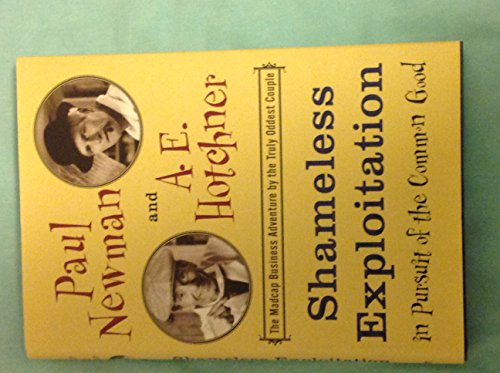
Describes how the authors conceived a venture to promote a brand of all-natural foods as a way to poke fun at traditional marketing, the surprise success of their endeavor and its offbeat growth into a full-fledged enterprise, and the decision to use the company's profits to promote philanthropic causes.
Die Inhaltsangabe kann sich auf eine andere Ausgabe dieses Titels beziehen.
Über die Autorin bzw. den Autor
<p><b>PAUL NEWMAN</b> (known as ol’ PL to both friends and enemies.)<br>The <i>L</i> stands for “Leonard” or “Lunkhead.” He answers to both. He is probably best known for his spectacularly successful food conglomerate. In addition to giving the profits to charity, he also ran Frank Sinatra out of the spaghetti sauce business. On the downside, the spaghetti sauce is out-grossing his films. He did graduate from Kenyon College magna cum lager and in the process begat a laundry business which was the only student-run enterprise on Main Street. Yale University later awarded him an honorary Doctorate of Humane Letters for unknown reasons. He has won four Sports Car Club of America National Championships and is listed in the <i>Guinness Book of World Records</i> as the oldest driver (70) to win a professionally sanctioned race (24 Hours of Daytona, 1995). He is married to the best actress on the planet, was number 19 on Nixon’s enemy list, and purely by accident has 51 films and four Broadway plays. He is generally considered by professionals to be the worst fisherman on the East Coast.<br><br><b>A. E. HOTCHNER</b><br>fully intended to be a career lawyer but after two stultifying years practicing with a St. Louis law firm, he escaped into the wild blue yonder of the Air Force, vowing never to look at another Corpus Juris Secundum. After the war, Hotch became a literary bounty hunter, and in the process met Ernest Hemingway, with whom he buddied around for fourteen years, an adventurous period that Hotch chronicled in <i>Papa Hemingway</i>, which was published in 34 countries in 28 different languages. In between selling salad dressing, Hotch has written fifteen books, a dozen plays and musicals, and scores of television dramas. In 1999, Washington University conferred on him an honorary Doctor of Letters to go along with his doctor of law degree, but he is proudest of the fact that he was crowned marbles champion of St. Louis when he was in the sixth grade.</p>
Auszug. © Genehmigter Nachdruck. Alle Rechte vorbehalten.
Chapter 1
It is December 1980, a week before Christmas, Westport, Connecticut, a blanket of snow on the ground, wood smoke from fireplaces redolent in the air, tree lights festooning the houses, a pervasive Yuletide lilt, but we are laboring in the subterranean space beneath Paul's converted barn, an area that had once been a stable for farm horses. There is a bucket filled with ice-blanketed Budweisers and an array of bottles of olive oil, vinegar, mustard, condiments, and so forth. There is also an empty tub and a collection of old bottles dating back to Revolutionary times by their appearance, bottles of various shapes and sizes that had been somewhat sanitized for this occasion.
Paul Newman, known to his friends as ol' PL or Calezzo de Wesso (Bonehead), had asked his buddy A. E. Hotchner (Hotch), sometimes called Sawtooth, to help him with a Christmas project that he was assembling in this basement, which wasn't a basement in the usual sense. There were crusty stones, a dirt floor, crumbling cement, and overhead timbers covered with active cobwebs. Also three long since vacated horse stalls, but the unmistakable aroma of horses remained. There were desiccated manure fragments here and there, and there was evidence that certain field animals were still occupying the premises. A very picturesque place in which to mix salad dressing.
The project was to mix up a batch of PL's salad dressing in the washtub and fill all those old wine bottles using the assembled funnels and corks and labels, and on Christmas Eve our collective families would go around the neighborhood singing carols and distributing these gift bottles of PL's dressing.
PL was very proud of his salad dressing, and this was the apotheosis of his salad days. Over the years, even in four-star restaurants, PL had been rejecting the house dressings and concocting his own. Captains, ma"tre D's, and sometimes the restaurant owner would scurry around to assemble Paul's ingredients while neighboring diners gawked in disbelief. When we first ate at Elaine's, one of New York's popular restaurants, several waiters and Elaine herself gathered round as Paul blended and tasted the brew he made from the ingredients brought to him from the kitchen. This scene had been repeated in such varied eateries as a Greek diner, at a wedding party, in an outdoor restaurant, on the island of Eleuthera, and in snazzy restaurants from coast to coast. When his kids went off to school, Paul would fill a couple of bottles of dressing for them to take along. On one occasion, when the restaurant mistakenly served the salad with its own dressing, Paul took the salad to the men's room, washed off the dressing, dried it with paper towels, and, after returning to the table, anointed it with his own, which he concocted with ingredients brought to him from the kitchen.
At that time, almost all dressings, especially the mass-market ones, contained sugar, artificial coloring, chemical preservatives, gums, and God knows what. So Paul really started to make his own dressing not just as a taste preference, but also as a defense against those insufferable artificial additives.
That evening the basement operation seemed to go on forever. We had never tried to mix a vat of salad dressing, let alone pound a 1925 syrup cork into an 1895 vinegar bottle, especially after a few beers. Sometimes the mallet would smack the cork, and sometimes it nailed our thumbs. Paul carefully measured amounts of olive oil and vinegar, for he had no feel yet for dealing with a quantity like this, which, he decided, required six boxes of black pepper.
He was almost crazed as he stirred the dressing with the wooden paddle. There's a river that runs alongside his house, and the paddle most certainly came from his canoe. It was his notion that the olive oil and vinegar had a sort of hygienic effect so that one didn't have to wash anything thoroughly. That aside, he was highly critical of Hotch's paddle technique. The motion, he insisted, had to have an even, smooth rhythm that would not create frothing. But Hotch couldn't get the hang of it. "You've got to go with the paddle," Paul said. "Don't pull it straight toward you, waffle it, gyrate it, go with the paddle." Hotch said he was going with the paddle, but, having had four beers, if he went with the paddle too much, he was going to fall facedown in the tub. Paul said as long as it wasn't butt first, not to worry about it.
Occasionally, during the hours we labored, somebody would show up--Caroline, the housekeeper, or Joanne or one of Paul's kids. But they had the good sense to stop at the door. The smell of vintage horse piss and mold had now commingled with the aroma of Budweiser and the salad dressing ingredients, a combination that did not exactly beckon. So they stood near the door and announced that dinner was ready, or Aunt Margaret was here, or the police wanted to invalidate Paul's driver's license, but Paul said we still had work to do, whereupon everyone seemed to scatter in a hurry. No one dared venture into that place. It was forbidding, or sanctified, maybe.
The precise number of giveaway bottles were lined up on the dirt floor like a battalion of infantry soldiers, but there was still a quantity of dressing left in the tub. That's when it occurred to Paul that we could bottle the rest, hustle them into some upscale local food stores, make a buck, and go fishing. But Hotch, a refugee from law school, put on the brakes: "It's against the law," he shouted. "Look at this place! The bugs can't even stay alive here! If somebody croaks from ingesting this stuff, you'll be in court, with no liability insurance. You could wind up without your basement and everything above it. There are certain rules and regulations to be followed--hygienic, first and foremost, proper labeling, government stuff!"
With his barn at stake, Paul agreed that they'd have to take out insurance, create a proper label, and get a bona fide bottler and see if it would sell.
And that is how our baby got started--not in a manger, but in a tub--not a wise man in sight--a fading movie star and a cantankerous writer, but that was it.
"You can get straight A's in marketing and still flunk ordinary life."
--Newman to Lee Iacocca, after Iacocca's Pinto caught fire
Chapter 2
It is 1982, and we are sitting in the conference room of the largest marketing company in America. A long, burnished table is presided over by its president, with five of his department heads in attendance, all experts in how to market new products in the United States. Very imposing. On the table in front of us we have a bottle, once filled with Chianti, now containing an olive oil and vinegar salad dressing, which is the object of this meeting.
"You gentlemen have come to the right place," the president tells us. "We launch new products for some of the biggest brands in America--Libby's, Heinz, Del Monte, Campbell's, Kraft--so we can give you an exponential trajectory on the welter of details that have to be accomplished to launch your salad dressing.
"It's essential to know in advance how the public will react to your product. So we would dispatch people across the country to gather together focus groups of varied ethnicity, financial strata, age groups, sexual preference, fast-food habits, footwear use or nonuse, deodorants, the whole load. We would go around the country, asking folks in shopping malls and such places how they like the bottle, the name, the taste--we'd have them sample it on lettuce, tomatoes, onions, cabbage, sausage. Then the price--you have to set a price for us--questions like that, and then in maybe seven or eight sections of the country we'd correlate the results and study them to let you know how to adjust all those...
„Über diesen Titel“ kann sich auf eine andere Ausgabe dieses Titels beziehen.
Suchergebnisse für Shameless Exploitation in Pursuit of the Common Good

Beispielbild für diese ISBN
Shameless Exploitation in Pursuit O
Verlag:
Bantam Doubleday Dell Publishing Group Inc, 2003
ISBN 10: 0385508026
ISBN 13: 9780385508025
Gebraucht
Hardcover
Anbieter: World of Books (was SecondSale), Montgomery, IL, USA
Verkäuferbewertung 5 von 5 Sternen

Hardback. Zustand: Fair. Artikel-Nr. 00109561032
Gebraucht kaufen
EUR 5,20
Versand gratis
Versand innerhalb von USA
Versand innerhalb von USA
Anzahl: 1 verfügbar
Beispielbild für diese ISBN
Shameless Exploitation in Pursuit O
Verlag:
Bantam Doubleday Dell Publishing Group Inc, 2003
ISBN 10: 0385508026
ISBN 13: 9780385508025
Gebraucht
Hardcover
Anbieter: World of Books (was SecondSale), Montgomery, IL, USA
Verkäuferbewertung 5 von 5 Sternen
Hardback. Zustand: Good. Artikel-Nr. 00108337659
Gebraucht kaufen
EUR 5,20
Versand gratis
Versand innerhalb von USA
Versand innerhalb von USA
Anzahl: 5 verfügbar
Beispielbild für diese ISBN
Shameless Exploitation in Pursuit of the Common Good: The Madcap Business Adventure by the Truly Oddest Couple
Verlag:
Nan A. Talese (edition 1), 2003
ISBN 10: 0385508026
ISBN 13: 9780385508025
Gebraucht
Hardcover
Anbieter: BooksRun, Philadelphia, PA, USA
Verkäuferbewertung 5 von 5 Sternen
Hardcover. Zustand: Very Good. 1. With dust jacket. It's a well-cared-for item that has seen limited use. The item may show minor signs of wear. All the text is legible, with all pages included. It may have slight markings and/or highlighting. Artikel-Nr. 0385508026-11-1-29
Gebraucht kaufen
EUR 5,20
Versand gratis
Versand innerhalb von USA
Versand innerhalb von USA
Anzahl: 1 verfügbar
Beispielbild für diese ISBN
Shameless Exploitation in Pursuit of the Common Good : The Madcap Business Adventure by the Truly Oddest Couple
Verlag:
Knopf Doubleday Publishing Group, 2003
ISBN 10: 0385508026
ISBN 13: 9780385508025
Gebraucht
Hardcover
Erstausgabe
Anbieter: Better World Books, Mishawaka, IN, USA
Verkäuferbewertung 5 von 5 Sternen
Zustand: Good. 1st Edition. Pages intact with minimal writing/highlighting. The binding may be loose and creased. Dust jackets/supplements are not included. Stock photo provided. Product includes identifying sticker. Better World Books: Buy Books. Do Good. Artikel-Nr. GRP73130442
Gebraucht kaufen
EUR 6,19
Versand gratis
Versand innerhalb von USA
Versand innerhalb von USA
Anzahl: 2 verfügbar
Beispielbild für diese ISBN
Shameless Exploitation in Pursuit of the Common Good: The Madcap Business Adventure by the Truly Oddest Couple
Anbieter: Wonder Book, Frederick, MD, USA
Verkäuferbewertung 5 von 5 Sternen
Zustand: Very Good. Very Good condition. Good dust jacket. A copy that may have a few cosmetic defects. May also contain light spine creasing or a few markings such as an owner's name, short gifter's inscription or light stamp. Artikel-Nr. Q17T-00942
Gebraucht kaufen
EUR 6,43
Versand gratis
Versand innerhalb von USA
Versand innerhalb von USA
Anzahl: 1 verfügbar
Beispielbild für diese ISBN
Shameless Exploitation in Pursuit of the Common Good: The Madcap Business Adventure by the Truly Oddest Couple
Anbieter: Wonder Book, Frederick, MD, USA
Verkäuferbewertung 5 von 5 Sternen
Zustand: As New. Like New condition. Like New dust jacket. A near perfect copy that may have very minor cosmetic defects. Artikel-Nr. F30A-07149
Gebraucht kaufen
EUR 6,43
Versand gratis
Versand innerhalb von USA
Versand innerhalb von USA
Anzahl: 3 verfügbar
Beispielbild für diese ISBN
Shameless Exploitation in Pursuit of the Common Good: The Madcap Business Adventure by the Truly Oddest Couple
Anbieter: ThriftBooks-Atlanta, AUSTELL, GA, USA
Verkäuferbewertung 5 von 5 Sternen
Hardcover. Zustand: Very Good. No Jacket. Missing dust jacket; May have limited writing in cover pages. Pages are unmarked. ~ ThriftBooks: Read More, Spend Less. Artikel-Nr. G0385508026I4N01
Gebraucht kaufen
EUR 6,67
Versand gratis
Versand innerhalb von USA
Versand innerhalb von USA
Anzahl: 1 verfügbar
Beispielbild für diese ISBN
Shameless Exploitation in Pursuit of the Common Good: The Madcap Business Adventure by the Truly Oddest Couple
Anbieter: ThriftBooks-Dallas, Dallas, TX, USA
Verkäuferbewertung 5 von 5 Sternen
Hardcover. Zustand: Very Good. No Jacket. May have limited writing in cover pages. Pages are unmarked. ~ ThriftBooks: Read More, Spend Less. Artikel-Nr. G0385508026I4N00
Gebraucht kaufen
EUR 6,67
Versand gratis
Versand innerhalb von USA
Versand innerhalb von USA
Anzahl: 1 verfügbar
Beispielbild für diese ISBN
Shameless Exploitation in Pursuit of the Common Good: The Madcap Business Adventure by the Truly Oddest Couple
Anbieter: ThriftBooks-Atlanta, AUSTELL, GA, USA
Verkäuferbewertung 5 von 5 Sternen
Hardcover. Zustand: Very Good. No Jacket. May have limited writing in cover pages. Pages are unmarked. ~ ThriftBooks: Read More, Spend Less. Artikel-Nr. G0385508026I4N00
Gebraucht kaufen
EUR 6,67
Versand gratis
Versand innerhalb von USA
Versand innerhalb von USA
Anzahl: 1 verfügbar
Foto des Verkäufers
Shameless Exploitation
Verlag:
Doubleday & Company, Inc., 2003
ISBN 10: 0385508026
ISBN 13: 9780385508025
Gebraucht
Hardcover
Anbieter: Dolly's Bookstore, Cedaredge, CO, USA
Verkäuferbewertung 4 von 5 Sternen

Hardcover. Zustand: As New. Zustand des Schutzumschlags: As New. in Pursuit of the Common Good. Artikel-Nr. DBS119
Gebraucht kaufen
EUR 1,84
EUR 9,37 Versand
Versand innerhalb von USA
Versand innerhalb von USA
Anzahl: 1 verfügbar