
Verwandte Artikel zu Office of Innocence
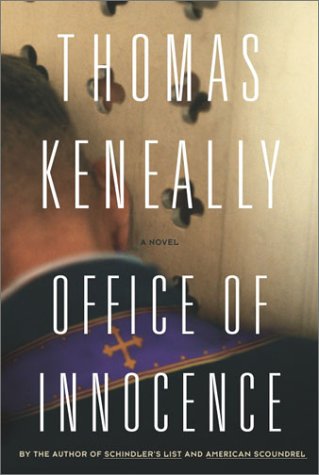
Inhaltsangabe
On the outskirts of Sydney, Father Frank Darragh is embarking on his new life of priesthood just as war erupts in the Pacific theater. American GIs pour into Father Darragh's neighborhood, and with them comes a reminder of the atrocities abounding nearby. Determined to shun hypocrisy, the earnest priest finds himself constantly at odds with his superiors, who frown on his efforts to rescue an errant black soldier and pay deathbed visits to the wayward. But Frank Darragh persists, becoming his parish's most popular confessor, particularly among wives of Australian servicemen who confront an array of temptations while their husbands are away.
One such parishioner, Kate Heggarty, turns the tables of temptation on young Darragh, challenging his spiritual beliefs and stirring a vulnerable place in his heart. When Kate is found murdered, his anguish is only compounded by accusations that he caused her death. Poignantly depicting the conflicts between the secular and the holy and between the family of Darragh's birth and the brotherhood of priests, Office of Innocence is a tale set in the most compelling of circumstances. Drawing on his own experience studying for the priesthood in his youth, Thomas Keneally has created a protagonist who speaks to the conundrums of our age while paying tribute to quiet heroes of the past.
Die Inhaltsangabe kann sich auf eine andere Ausgabe dieses Titels beziehen.
Über die Autorin bzw. den Autor
THOMAS KENEALLY is the acclaimed author of more than two dozen books, including Schindler’s List, which won the Booker Prize and inspired the film; The Great Shame: The Triumph of the Irish in the English-Speaking World; and most recently American Scoundrel, a biography of Civil War general Dan Sickles. He lives in Sydney, Australia.
Von der hinteren Coverseite
lly is a writer of extraordinary range: from Schindler’s List to The Great Shame his storytelling has engaged millions of readers. Now, after a brief departure into non-fiction, he is back with a novel as timely as it is enduring.
On the outskirts of Sydney, Father Frank Darragh is embarking on his new life of priesthood just as war erupts in the Pacific theater. American GIs pour into Father Darragh’s neighborhood, and with them comes a reminder of the atrocities abounding nearby. Determined to shun hypocrisy, the earnest priest finds himself constantly at odds with his superiors, who frown on his efforts to rescue an errant black soldier and pay deathbed visits to the wayward. But Frank Darragh persists, becoming his parish’s most popular confessor, particularly among wives of Australian servicemen who confront an array of temptations while their husbands are away.
One such parishioner, Kate Heggarty, turns the tables of temptat
Aus dem Klappentext
lly is a writer of extraordinary range: from Schindler s List to The Great Shame his storytelling has engaged millions of readers. Now, after a brief departure into non-fiction, he is back with a novel as timely as it is enduring.
On the outskirts of Sydney, Father Frank Darragh is embarking on his new life of priesthood just as war erupts in the Pacific theater. American GIs pour into Father Darragh s neighborhood, and with them comes a reminder of the atrocities abounding nearby. Determined to shun hypocrisy, the earnest priest finds himself constantly at odds with his superiors, who frown on his efforts to rescue an errant black soldier and pay deathbed visits to the wayward. But Frank Darragh persists, becoming his parish s most popular confessor, particularly among wives of Australian servicemen who confront an array of temptations while their husbands are away.
One such parishioner, Kate Heggarty, turns the tables of temptat
Auszug. © Genehmigter Nachdruck. Alle Rechte vorbehalten.
I
Penitents, kneeling in the confessional, can be divided into predictable categories. The tennis-playing young priests at White City on Mondays, drinking beer supplied, despite war rationing, by a Knight of the Southern Cross who owned a hotel at Edgecliff, often did so. They spoke only of generalized types of sin and sinner, being careful not to violate the strict seal of the sacrament of penance. So there were, for instance, the self-congratulators, muttering minor sins; the shame-hot boy masturbators; the guilt-obsessed, so hungry for pardon that they would confess, if given a chance, many times a day.
Amongst priests, as amongst the laity, the confessional was a focus of humor, just as, privately, it was a focus of dread and hope. The curates sitting by the tennis courts all agreed that hearing the utterly predictable confessions was an ordeal, and boring. Young priests groaned through their Saturday afternoons, leaving their radios, the staccato of horse races, the reports of Sheffield Shield or rugby league at the Sydney Cricket Ground, to do their personal penance in confessional boxes too hot in summer, too cold in winter. Then a quick meal and their Saturday-evening stints in the box began, with all the banal confessions of disobedience, small theft, secret desire, shifty touches, and self-soiling.
Frank Darragh, a young man of quieter disposition than the other curates, had had an early experience which caused him not to think so cynically, either of the boxes or of those who entered them in piety or desperate guilt. It had occurred on St. Patrick's Day 1939, a few days after Hitler invaded Czechoslovakia. It was, insofar as any day ever was in the seminary, a day of special meals in the refectory, and a day of remission from the Lenten fast which had recently made the seminary bill of fare more frugal than ever. But with an abscessed tooth, he had not been able to do much feasting and was walking down the long driveway towards Darley Road, with a pass from the rector, to go to the dentist. Because he was a pale, lean-faced young man close to being ordained a priest, he would be treated free and for God's love by either of the chatty Cusack brothers, who had a dentistry practice down the hill in Manly.
His naive soul was in some turmoil that day, and it was not to do with missing what passed in the seminary's dour cuisine as a special meal. It was this: should there be a war, he would feel he was being tested to become a volunteer, as his father, Sergeant Darragh, had been in 1915. That which in him made him relish the communal life of the seminary would dispose him, he believed, to enjoy the ordered fraternity of the army. He could tell this from the demeanor of his recently deceased father, who had had a lung condition as a result of both a shrapnel wound and gas intake, but whose eyes had gleamed beneath his freckled dome whenever visitors mentioned the life they had shared in Great War rest camps, after having come alive out of the line. At other times, Darragh's father was politely secretive, yet then uttered unexpected war tales, stories in which Darragh thought absurdity and savagery swamped the humor his father thought to be the real point. From all this, the child Darragh supposed the Great War to have been the most exalting, horrifying, humbling, and valid stage of his father's life. In both darkness and light, it was the measure of who he was. And thus, Darragh's mother said once, there were dead men in France and Flanders who knew his father best, better than she and Frank did. The truth of his father was dug down with the bones of valiant fallen into the soil of unreachable places with names like Bullecourt, Hamel, Albert, Mont St. Quentin.
And now that war asserted itself again, thought Darragh the student, how can I be measured? Within a year he would be a priest. He feared that those who did not understand would consider him an evader of warrior duties, of the duty of being measured. As silly as such a feeling might have seemed to worldlier men, on the way to the dentist it rankled within his innocent chest and ate his virgin heart.
Before he had traversed the long driveway with its deep-green sentries of Norfolk pine, and as he approached the iron gates with their wrought designs of harps, miters, and Celtic crosses, from the archbishop's house on the far side of the road emerged an arduously creeping old priest. He was a familiar sight on the bitumen surface between the archbishop's house and the seminary driveway, and local trucks had been known to steer around him considerately as he stood, contemplatively catatonic, in the midst of the road. It always seemed as if, in walking, the old man was held back by a gravity greater than that of earth. The story was that he had flung incarnate evil, the Devil, out of souls in China when he was a young missionary. Now, in vengeance, the Devil and his minions fiercely delayed the old fellow as he crossed Darley Road on his way to the St. Patrick's Day feast. It had been known for him to take three hours to pass four hundred yards up the driveway, and students who encountered him knew better than to extend a hand to him and thus enroll themselves in the close combat between him and the Evil One. All Darragh, with a dental appointment in the temporal world at two o'clock, said was "Hello, Monsignor, Happy St. Patrick's," to the old man, who was at this time as at most inhabiting another scale of time and place, and passed on.
Darragh accepted that, though many inches taller--indeed, nearly six feet--he was an insignificant figure in the exorcist's landscape. But before he had gone five paces past the barely moving old fellow, he heard a thunderous voice emerge. "Wait!"
Darragh turned and the old man had him fixed with two blazing eyes set in his blocklike Irish head, a skull which seemed to come from another age, from the thirteenth century--reputedly the greatest of centuries, Darragh knew, apart from the diseases people had, of course. The old man's eyes were exactly the sort of eyes which, seconds before or eons ago, had transfixed the Evil One himself.
"You, son!" the old priest further roared. Darragh stopped, and his callow, student soul blazed in his face. He was not ready yet for such an august summons.
"Monsignor?" he pleaded. He could not tell what would be demanded of him, but his pre-dentist nervousness was gone, replaced by a terror more absolute and transcendent.
"You must be a merciful confessor!" It sounded as if the old man had been struck by a message from another sphere, a suggestion that Darragh, unless warned, would not be at all merciful.
Darragh took his black hat off and straightened the black tie he hoped soon to exchange for a clerical collar. "I pray I will be, Monsignor," he assured the old man.
But the exorcist waved his hands in a cut-out-the-claptrap way. "You must be a merciful confessor!" he insisted.
"Yes," said a terrified Darragh. He knew this answer had no chance of satisfying the terrifying old exorcist. "Help me," he heard himself bleat like a despicable creature, a coward, a sinner, a silly boy as well.
Though the monsignor did not answer, the fury went out of his eyes, and he seemed content that an essential message had been passed. Turning back to apply himself again to the driveway, and advancing by millimeters, he might make the main building by pudding.
This was the most exalted message Darragh had received in all his preparation for the priesthood. As a revelation, it suited him. He'd carried from childhood a sense of the augustness and aura of the sacrament of penance. He was aware of how the penitent, having been absolved, emerged into a new and better light. A trivial Saturday afternoon in a remote place called New South...
„Über diesen Titel“ kann sich auf eine andere Ausgabe dieses Titels beziehen.
Suchergebnisse für Office of Innocence

Beispielbild für diese ISBN
Office of Innocence: A Novel
Anbieter: World of Books (was SecondSale), Montgomery, IL, USA
Verkäuferbewertung 5 von 5 Sternen

Zustand: Good. Item in good condition. Textbooks may not include supplemental items i.e. CDs, access codes etc. Artikel-Nr. 00095570835
Gebraucht kaufen
EUR 3,10
Versand gratis
Versand innerhalb von USA
Versand innerhalb von USA
Anzahl: 1 verfügbar
Beispielbild für diese ISBN
Office of Innocence: A Novel
Anbieter: World of Books (was SecondSale), Montgomery, IL, USA
Verkäuferbewertung 5 von 5 Sternen
Zustand: Acceptable. Item in acceptable condition! Textbooks may not include supplemental items i.e. CDs, access codes etc. Artikel-Nr. 00109049386
Gebraucht kaufen
EUR 3,90
Versand gratis
Versand innerhalb von USA
Versand innerhalb von USA
Anzahl: 1 verfügbar
Beispielbild für diese ISBN
Office of Innocence: A Novel
Anbieter: World of Books (was SecondSale), Montgomery, IL, USA
Verkäuferbewertung 5 von 5 Sternen
Zustand: Very Good. Item in very good condition! Textbooks may not include supplemental items i.e. CDs, access codes etc. Artikel-Nr. 00085698731
Gebraucht kaufen
EUR 3,90
Versand gratis
Versand innerhalb von USA
Versand innerhalb von USA
Anzahl: 4 verfügbar
Beispielbild für diese ISBN
Office of Innocence: A Novel
Verlag:
Nan A. Talese (edition ), 2003
ISBN 10: 0385507631
ISBN 13: 9780385507639
Gebraucht
Hardcover
Anbieter: BooksRun, Philadelphia, PA, USA
Verkäuferbewertung 5 von 5 Sternen
Hardcover. Zustand: Very Good. With dust jacket. It's a well-cared-for item that has seen limited use. The item may show minor signs of wear. All the text is legible, with all pages included. It may have slight markings and/or highlighting. Artikel-Nr. 0385507631-11-1-29
Gebraucht kaufen
EUR 5,49
Versand gratis
Versand innerhalb von USA
Versand innerhalb von USA
Anzahl: 1 verfügbar
Beispielbild für diese ISBN
Office of Innocence: A Novel
Verlag:
Nan A. Talese (edition ), 2003
ISBN 10: 0385507631
ISBN 13: 9780385507639
Gebraucht
Hardcover
Anbieter: BooksRun, Philadelphia, PA, USA
Verkäuferbewertung 5 von 5 Sternen
Hardcover. Zustand: Very Good. It's a well-cared-for item that has seen limited use. The item may show minor signs of wear. All the text is legible, with all pages included. It may have slight markings and/or highlighting. Artikel-Nr. 0385507631-11-1
Gebraucht kaufen
EUR 5,96
Versand gratis
Versand innerhalb von USA
Versand innerhalb von USA
Anzahl: 1 verfügbar
Beispielbild für diese ISBN
Office of Innocence: A Novel (Keneally, Thomas)
Anbieter: Wonder Book, Frederick, MD, USA
Verkäuferbewertung 5 von 5 Sternen
Zustand: Very Good. Very Good condition. Good dust jacket. A copy that may have a few cosmetic defects. May also contain light spine creasing or a few markings such as an owner's name, short gifter's inscription or light stamp. Artikel-Nr. Q12H-00725
Gebraucht kaufen
EUR 6,19
Versand gratis
Versand innerhalb von USA
Versand innerhalb von USA
Anzahl: 1 verfügbar
Beispielbild für diese ISBN
The Office of Innocence
Verlag:
Knopf Doubleday Publishing Group, 2003
ISBN 10: 0385507631
ISBN 13: 9780385507639
Gebraucht
Hardcover
Anbieter: Better World Books: West, Reno, NV, USA
Verkäuferbewertung 5 von 5 Sternen
Zustand: Good. Former library copy. Pages intact with minimal writing/highlighting. The binding may be loose and creased. Dust jackets/supplements are not included. Includes library markings. Stock photo provided. Product includes identifying sticker. Better World Books: Buy Books. Do Good. Artikel-Nr. GRP89785321
Gebraucht kaufen
EUR 6,50
Versand gratis
Versand innerhalb von USA
Versand innerhalb von USA
Anzahl: 1 verfügbar
Beispielbild für diese ISBN
The Office of Innocence
Verlag:
Knopf Doubleday Publishing Group, 2003
ISBN 10: 0385507631
ISBN 13: 9780385507639
Gebraucht
Hardcover
Anbieter: Better World Books, Mishawaka, IN, USA
Verkäuferbewertung 5 von 5 Sternen
Zustand: Good. Pages intact with minimal writing/highlighting. The binding may be loose and creased. Dust jackets/supplements are not included. Stock photo provided. Product includes identifying sticker. Better World Books: Buy Books. Do Good. Artikel-Nr. 51958712-6
Gebraucht kaufen
EUR 6,50
Versand gratis
Versand innerhalb von USA
Versand innerhalb von USA
Anzahl: 1 verfügbar
Beispielbild für diese ISBN
Office of Innocence: A Novel
Anbieter: ThriftBooks-Dallas, Dallas, TX, USA
Verkäuferbewertung 5 von 5 Sternen
Hardcover. Zustand: Good. No Jacket. Pages can have notes/highlighting. Spine may show signs of wear. ~ ThriftBooks: Read More, Spend Less. Artikel-Nr. G0385507631I3N00
Gebraucht kaufen
EUR 6,56
Versand gratis
Versand innerhalb von USA
Versand innerhalb von USA
Anzahl: 1 verfügbar
Beispielbild für diese ISBN
Office of Innocence: A Novel
Verlag:
Nan A. Talese, 2003
ISBN 10: 0385507631
ISBN 13: 9780385507639
Gebraucht
Hardcover
Erstausgabe
Anbieter: Books End Bookshop, Syracuse, NY, USA
Verkäuferbewertung 4 von 5 Sternen

Hardcover. Zustand: Very Good+. Zustand des Schutzumschlags: Very Good+. First Edition; First Printing. fmc2%262D. Artikel-Nr. 17213
Gebraucht kaufen
EUR 4,88
EUR 5,16 Versand
Versand innerhalb von USA
Versand innerhalb von USA
Anzahl: 1 verfügbar