
Verwandte Artikel zu Creative Destruction: Why Companies That Are Built...
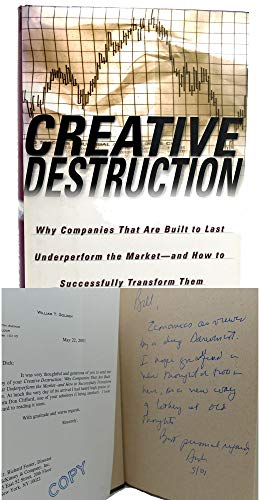
Creative Destruction: Why Companies That Are Built to Last Underperform the Market--And How to Successfully Transform Them - Hardcover
Inhaltsangabe
Argues that "built-to-last" companies weigh down the market, presents a plan for transforming business practices, and explains how formerly successful companies fall into habits that compromise future productivity.
Die Inhaltsangabe kann sich auf eine andere Ausgabe dieses Titels beziehen.
Über die Autorin bzw. den Autor
Richard Foster is a senior partner and director at McKinsey & Company and the author of the bestselling <i>Innovation: </i><b>The Attacker's Advantage</b>, named one of the best business books of the year by <i>The Wall Street Journal</i>. <br><br>Sarah Kaplan worked at McKinsey & Company for many years, specializing in innovation and technology management. Foster lives in New York City, and Kaplan in Boston.
Aus dem Klappentext
entional wisdom on its head, a Senior Partner and an Innovation Specialist from McKinsey & Company debunk the myth that high-octane, built-to-last companies can continue to excel year after year and reveal the dynamic strategies of <i>discontinuity </i>and creative destruction these corporations <i>must</i> adopt in order to maintain excellence and remain competitive.<br><br>In striking contrast to such bibles of business literature as <b>In Search of Excellence</b><i> </i>and <b>Built to Las</b><i>t, </i>Richard N. Foster and Sarah Kaplan draw on research they conducted at McKinsey & Company of more than one thousand corporations in fifteen industries over a thirty-six-year period. The industries they examined included old-economy industries such as pulp and paper and chemicals, and new-economy industries like semiconductors and software. Using this enormous fact base, Foster and Kaplan show that even the best-run and most widely admired companies inc
Auszug. © Genehmigter Nachdruck. Alle Rechte vorbehalten.
Survival and Performance in the Era of Discontinuity
This company will be going strong one hundred and even five hundred years from now.
- C. Jay Parkinson, President of Anaconda Mines, statement made three years in advance of Anaconda's bankruptcy
In 1917, shortly before the end of World War I, Bertie Charles (or B.C., as he was known) Forbes formed his first list of the one hundred largest American companies. The firms were ranked by assets, since sales data were not accurately compiled in those days. In 1987, Forbes republished its original "Forbes 100" list and compared it to its 1987 list of top companies. Of the original group, 61 had ceased to exist.
Of the remaining thirty-nine, eighteen had managed to stay in the top one hundred. These eighteen companies--which included Kodak, DuPont, General Electric, Ford, General Motors, Procter & Gamble, and a dozen other corporations--had clearly earned the nation's respect. Skilled in the arts of survival, these enterprises had weathered the Great Depression, the Second World War, the Korean conflict, the roaring '60s, the oil and inflation shocks of the '70s, and unprecedented technological change in the chemicals, pharmaceuticals, computers, software, radio and television, and global telecommunications industries.
They survived. But they did not perform. As a group these great companies earned a long-term return for their investors during the 1917-1987 period 20% less than that of the overall market. Only two of them, General Electric and Eastman Kodak, performed better than the averages, and Kodak has since fallen on harder times.
One reaches the same conclusion from an examination of the S&P 500. Of the five hundred companies originally making up the S&P 500 in 1957, only seventy-four remained on the list through 1997. And of these seventy-four, only twelve outperformed the S&P 500 index itself over the 1957-1998 period. Moreover, the list included companies from two industries, pharmaceuticals and food, that were strong performers during this period. If today's S&P 500 today were made up of only those companies that were on the list when it was formed in 1957, the overall performance of the S&P 500 would have been about 20% less per year than it actually has been.
For the last several decades we have celebrated the big corporate survivors, praising their "excellence" and their longevity, their ability to last. These, we have assumed, are the bedrock companies of the American economy. These are the companies that "patient" investors pour their money into--investments that would certainly reward richly at the end of a lifetime. But our findings--based on the thirty-eight years of data compiled in the McKinsey Corporate Performance Database, discussed in the Introduction--have shown that they do not perform as we might suspect. An investor following the logic of patiently investing money in these survivors will do substantially less well than an investor who merely invests in market index funds.
McKinsey's long-term studies of corporate birth, survival, and death in America clearly show that the corporate equivalent of El Dorado, the golden company that continually performs better than the markets, has never existed. It is a myth. Managing for survival, even among the best and most revered corporations, does not guarantee strong long-term performance for shareholders. In fact, just the opposite is true. In the long run, markets always win.
The Assumption of Continuity
How could this be? How could a stock market index such as the Dow Jones Industrial average or the S&P 500 average--which, unlike companies, lack skilled managers, boards of experienced directors, carefully crafted organizational structures, the most advanced management methods, privileged assets, and special relationships with anyone of their choosing--perform better, over the long haul, than all but two of Forbes's strongest survivors, General Electric and Eastman Kodak? Are the capital markets, as represented by the stock market averages, "wiser" than managers who think about performance all the time?
The answer is that the capital markets, and the indices that reflect them, encourage the creation of corporations, permit their efficient operations (as long as they remain competitive), and then rapidly--and remorselessly--remove them when they lose their ability to perform. Corporations, which operate with management philosophies based on the assumption of continuity, are not able to change at the pace and scale of the markets. As a result, in the long term, they do not create value at the pace and scale of the markets.
It is among the relatively new entrants to the economy--for example, Intel, Amgen, and Cisco--where one finds superior performance, at least for a time. The structure and mechanisms of the capital markets enable these companies to produce results superior to even the best surviving corporations. Moreover, it is the corporations that have lost their ability to meet investor expectations (no matter how unreasonable these expectations might be) that consume the wealth of the economy. The capital markets remove these weaker performers at a greater rate than even the best-performing companies. Joseph Alois Schumpeter, the great Austrian-American economist of the 1930s and '40s, called this process of creation and removal "the gales of creative destruction." So great is the challenge of running the operations of a corporation today that few corporate leaders have the energy or time to manage the processes of creative destruction, especially at the pace and scale necessary to compete with the market. Yet that is precisely what is required to sustain market levels of long-term performance.
The essential difference between corporations and capital markets is in the way they enable, manage, and control the processes of creative destruction. Corporations are built on the assumption of continuity; their focus is on operations. Capital markets are built on the assumption of discontinuity; their focus is on creation and destruction. The market encourages rapid and extensive creation, and hence greater wealth-building. It is less tolerant than the corporation is of long-term underperformance. Outstanding corporations do win the right to survive, but not the ability to earn above-average or even average shareholder returns over the long term. Why? Because their control processes--the very processes that help them to survive over the long haul--deaden them to the need for change.
The Reality of Discontinuity
This distinction between the way corporations and markets approach the processes of creative destruction is not an artifact of our times or an outgrowth of the "dot.com" generation. It has been smoldering for decades, like a fire in a wall, ready to erupt at any moment. The market turmoil we see today is a logical extension of trends that began decades ago.
The origins of modern managerial philosophy can be traced to the eighteenth century, when Adam Smith argued for specialization of tasks and division of labor in order to cut waste. By the late nineteenth century these ideas had culminated in an age of American trusts, European holding companies, and Japanese zaibatsus. These complex giants were designed to convert natural resources into food, energy, clothing, and shelter in the most asset-efficient way--to maximize output and to minimize waste.
By the 1920s, Smith's simple idea had enabled huge enterprises, exploiting the potential of mass production, to flourish. Peter Drucker wrote the seminal guidebook for these corporations in 1946, The Concept of the Corporation. The book laid out the precepts of the then-modern corporation, based on the specialization of labor, mass production,...
„Über diesen Titel“ kann sich auf eine andere Ausgabe dieses Titels beziehen.
Suchergebnisse für Creative Destruction: Why Companies That Are Built...

Beispielbild für diese ISBN
Creative Destruction: Why Companies That Are Built to Last Underperform the Market--And How to Successfully Transform Them
Anbieter: World of Books (was SecondSale), Montgomery, IL, USA
Verkäuferbewertung 5 von 5 Sternen

Hardback. Zustand: Very Good. Turning conventional wisdom on its head, a Senior Partner and an Innovation Specialist from McKinsey & Company debunk the myth that high-octane, built-to-last companies can continue to excel year after year and reveal the dynamic strategies of discontinuity and creative destruction these corporations must adopt in order to maintain excellence and remain competitive. In striking contrast to such bibles of business literature as In Search of Excellence and Built to Last, Richard N. Foster and Sarah Kaplan draw on research they conducted at McKinsey & Company of more than one thousand corporations in fifteen industries over a thirty-six-year period. The industries they examined included old-economy industries such as pulp and paper and chemicals, and new-economy industries like semiconductors and software. Using this enormous fact base, Foster and Kaplan show that even the best-run and most widely admired companies included in their sample are unable to sustain their market-beating levels of performance for more than ten to fifteen years. Foster and Kaplan's long-term studies of corporate birth, survival, and death in America show that the corporate equivalent of El Dorado, the golden company that continually outperforms the market, has never existed. It is a myth. Corporations operate with management philosophies based on the assumption of continuity; as a result, in the long term, they cannot change or create value at the pace and scale of the markets. Their control processes, the very processes that enable them to survive over the long haul, deaden them to the vital and constant need for change. Proposing a radical new business paradigm, Foster and Kaplan argue that redesigning the corporation to change at the pace and scale of the capital markets rather than merely operate well will require more than simple adjustments. They explain how companies like Johnson and Johnson, Enron, Corning, and GE are overcoming cultural lock-in by transforming rather than incrementally improving their companies. They are doing this by creating new businesses, selling off or closing down businesses or divisions whose growth is slowing down, as well as abandoning outdated, ingrown structures and rules and adopting new decision-making processes, control systems, and mental models. Corporations, they argue, must learn to be as dynamic and responsive as the market itself if they are to sustain superior returns and thrive over the long term. In a book that is sure to shake the business world to its foundations, Creative Destruction, like Re-Engineering the Corporation before it, offers a new paradigm that will change the way we think about business. From the Hardcover edition. Artikel-Nr. 00096498195
Gebraucht kaufen
EUR 3,82
Versand gratis
Versand innerhalb von USA
Versand innerhalb von USA
Anzahl: 1 verfügbar
Beispielbild für diese ISBN
Creative Destruction: Why Companies That Are Built to Last Underperform the Market--And How to Successfully Transform Them
Anbieter: World of Books (was SecondSale), Montgomery, IL, USA
Verkäuferbewertung 5 von 5 Sternen
Hardback. Zustand: Good. Turning conventional wisdom on its head, a Senior Partner and an Innovation Specialist from McKinsey & Company debunk the myth that high-octane, built-to-last companies can continue to excel year after year and reveal the dynamic strategies of discontinuity and creative destruction these corporations must adopt in order to maintain excellence and remain competitive. In striking contrast to such bibles of business literature as In Search of Excellence and Built to Last, Richard N. Foster and Sarah Kaplan draw on research they conducted at McKinsey & Company of more than one thousand corporations in fifteen industries over a thirty-six-year period. The industries they examined included old-economy industries such as pulp and paper and chemicals, and new-economy industries like semiconductors and software. Using this enormous fact base, Foster and Kaplan show that even the best-run and most widely admired companies included in their sample are unable to sustain their market-beating levels of performance for more than ten to fifteen years. Foster and Kaplan's long-term studies of corporate birth, survival, and death in America show that the corporate equivalent of El Dorado, the golden company that continually outperforms the market, has never existed. It is a myth. Corporations operate with management philosophies based on the assumption of continuity; as a result, in the long term, they cannot change or create value at the pace and scale of the markets. Their control processes, the very processes that enable them to survive over the long haul, deaden them to the vital and constant need for change. Proposing a radical new business paradigm, Foster and Kaplan argue that redesigning the corporation to change at the pace and scale of the capital markets rather than merely operate well will require more than simple adjustments. They explain how companies like Johnson and Johnson, Enron, Corning, and GE are overcoming cultural lock-in by transforming rather than incrementally improving their companies. They are doing this by creating new businesses, selling off or closing down businesses or divisions whose growth is slowing down, as well as abandoning outdated, ingrown structures and rules and adopting new decision-making processes, control systems, and mental models. Corporations, they argue, must learn to be as dynamic and responsive as the market itself if they are to sustain superior returns and thrive over the long term. In a book that is sure to shake the business world to its foundations, Creative Destruction, like Re-Engineering the Corporation before it, offers a new paradigm that will change the way we think about business. From the Hardcover edition. Artikel-Nr. 00097059894
Gebraucht kaufen
EUR 3,82
Versand gratis
Versand innerhalb von USA
Versand innerhalb von USA
Anzahl: 6 verfügbar
Beispielbild für diese ISBN
Creative Destruction: Why Companies That Are Built to Last Underperform the Market--And How to Successfully Transform Them
Verlag:
Broadway Business (edition 1), 2001
ISBN 10: 0385501331
ISBN 13: 9780385501330
Gebraucht
Hardcover
Anbieter: BooksRun, Philadelphia, PA, USA
Verkäuferbewertung 5 von 5 Sternen
Hardcover. Zustand: Fair. 1. The item might be beaten up but readable. May contain markings or highlighting, as well as stains, bent corners, or any other major defect, but the text is not obscured in any way. Artikel-Nr. 0385501331-7-1
Gebraucht kaufen
EUR 5,52
Versand gratis
Versand innerhalb von USA
Versand innerhalb von USA
Anzahl: 1 verfügbar
Beispielbild für diese ISBN
Creative Destruction: Why Companies That Are Built to Last Underperform the Market--And How to Successfully Transform Them
Anbieter: ThriftBooks-Atlanta, AUSTELL, GA, USA
Verkäuferbewertung 5 von 5 Sternen
Hardcover. Zustand: Very Good. No Jacket. May have limited writing in cover pages. Pages are unmarked. ~ ThriftBooks: Read More, Spend Less. Artikel-Nr. G0385501331I4N00
Gebraucht kaufen
EUR 5,94
Versand gratis
Versand innerhalb von USA
Versand innerhalb von USA
Anzahl: 1 verfügbar
Beispielbild für diese ISBN
Creative Destruction : Why Companies That Are Built to Last Underperform the Market--and How to Successfully Transform Them
Verlag:
Knopf Doubleday Publishing Group, 2001
ISBN 10: 0385501331
ISBN 13: 9780385501330
Gebraucht
Hardcover
Erstausgabe
Anbieter: Better World Books, Mishawaka, IN, USA
Verkäuferbewertung 5 von 5 Sternen
Zustand: Very Good. 1st Edition. Former library copy. Pages intact with possible writing/highlighting. Binding strong with minor wear. Dust jackets/supplements may not be included. Includes library markings. Stock photo provided. Product includes identifying sticker. Better World Books: Buy Books. Do Good. Artikel-Nr. 11301360-6
Gebraucht kaufen
EUR 6,33
Versand gratis
Versand innerhalb von USA
Versand innerhalb von USA
Anzahl: 1 verfügbar
Beispielbild für diese ISBN
Creative Destruction : Why Companies That Are Built to Last Underperform the Market--and How to Successfully Transform Them
Verlag:
Knopf Doubleday Publishing Group, 2001
ISBN 10: 0385501331
ISBN 13: 9780385501330
Gebraucht
Hardcover
Erstausgabe
Anbieter: Better World Books, Mishawaka, IN, USA
Verkäuferbewertung 5 von 5 Sternen
Zustand: Good. 1st Edition. Former library copy. Pages intact with minimal writing/highlighting. The binding may be loose and creased. Dust jackets/supplements are not included. Includes library markings. Stock photo provided. Product includes identifying sticker. Better World Books: Buy Books. Do Good. Artikel-Nr. 3235730-6
Gebraucht kaufen
EUR 6,33
Versand gratis
Versand innerhalb von USA
Versand innerhalb von USA
Anzahl: 1 verfügbar
Beispielbild für diese ISBN
Creative Destruction: Why Companies That Are Built to Last Underperform the Market--And How to Successfully Transform Them
Anbieter: Wonder Book, Frederick, MD, USA
Verkäuferbewertung 5 von 5 Sternen
Zustand: Very Good. Very Good condition. Good dust jacket. A copy that may have a few cosmetic defects. May also contain light spine creasing or a few markings such as an owner's name, short gifter's inscription or light stamp. Artikel-Nr. H02A-03739
Gebraucht kaufen
EUR 6,40
Versand gratis
Versand innerhalb von USA
Versand innerhalb von USA
Anzahl: 1 verfügbar
Beispielbild für diese ISBN
Creative Destruction: Why Companies That Are Built to Last Underperform the Market--And How to Successfully Transform Them
Anbieter: WorldofBooks, Goring-By-Sea, WS, Vereinigtes Königreich
Verkäuferbewertung 5 von 5 Sternen
Paperback. Zustand: Very Good. The book has been read, but is in excellent condition. Pages are intact and not marred by notes or highlighting. The spine remains undamaged. Artikel-Nr. GOR002693582
Gebraucht kaufen
EUR 3,04
EUR 6,59 Versand
Versand von Vereinigtes Königreich nach USA
Versand von Vereinigtes Königreich nach USA
Anzahl: 5 verfügbar
Foto des Verkäufers
Creative Destruction: Why Companies That Are Built to Last Underperform the Market--And How to Successfully Transform Them
Anbieter: WeBuyBooks, Rossendale, LANCS, Vereinigtes Königreich
Verkäuferbewertung 5 von 5 Sternen
hardcover. Zustand: Very Good. Most items will be dispatched the same or the next working day. A copy that has been read, but is in excellent condition. Pages are intact and not marred by notes or highlighting. The spine remains undamaged. Artikel-Nr. rev1818540117
Gebraucht kaufen
EUR 2,39
EUR 9,14 Versand
Versand von Vereinigtes Königreich nach USA
Versand von Vereinigtes Königreich nach USA
Anzahl: 2 verfügbar
Foto des Verkäufers
Creative Destruction: Why Companies That Are Built to Last Underperform the Market--And How to Successfully Transform Them
Anbieter: WeBuyBooks, Rossendale, LANCS, Vereinigtes Königreich
Verkäuferbewertung 5 von 5 Sternen
hardcover. Zustand: Like New. Most items will be dispatched the same or the next working day. An apparently unread copy in perfect condition. Dust cover is intact with no nicks or tears. Spine has no signs of creasing. Pages are clean and not marred by notes or folds of any kind. Artikel-Nr. rev7364090861
Gebraucht kaufen
EUR 2,39
EUR 9,14 Versand
Versand von Vereinigtes Königreich nach USA
Versand von Vereinigtes Königreich nach USA
Anzahl: 1 verfügbar