
Verwandte Artikel zu Postcards from the Brain Museum: The Improbable Search...
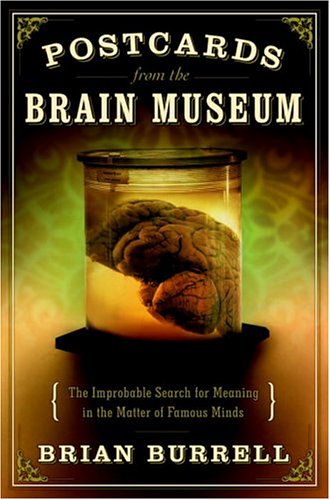
Postcards from the Brain Museum: The Improbable Search for Meaning in the Matter of Famous Minds - Hardcover
Inhaltsangabe
Traces the near-obsessive nineteenth-century research of top scientific minds to locate possible anatomical signs of genius, criminal behavior, and insanity, discussing the posthumous brain examinations of such figures as Albert Einstein, Walt Whitman, and Vladimir Lenin. 30,000 first printing.
Die Inhaltsangabe kann sich auf eine andere Ausgabe dieses Titels beziehen.
Über die Autorin bzw. den Autor
<p><b>BRIAN BURRELL </b>teaches mathematics at the University of Massachusetts at Amherst. The author of <i>The Words We Live By</i> and <i>Damn the Torpedoes</i>, he has appeared on C-SPAN's <i>Booknotes with Brian Lamb</i> and the<i> Today </i>show. He makes his home in Northampton, Massachusetts.</p>
Auszug. © Genehmigter Nachdruck. Alle Rechte vorbehalten.
Chapter 1
The Most Complex Object in the Universe
As neuroscientists never tire of pointing out, the adult human brain is the single most complex object in the universe, and one of the least understood. On average, it weighs about three and a half pounds, most of which is fragile, malleable tissue—so fragile that the brain is the most difficult part of the body to access, remove, handle, and study. A Soviet neuroscientist once likened its consistency to the insides of a watermelon, but even that overstates its structural integrity. If placed on a table, a fresh brain will quickly surrender to gravity and collapse into a heap (more like gelatin than watermelon). Within eight hours, it will begin to decompose, the first part of a dead body to do so. There may indeed be nothing so complex in the universe, nor anything quite as delicate.
The familiar shape of the human brain is somewhat misleading. As a ubiquitous graphic symbol, its most prominent feature, the massive, fissured cerebrum, has come to symbolize the unlimited potential of human thought, if not the very means of man's dominion over the planet. Yet it also bears an unmistakable resemblance to a comical turban, and for most of recorded history it was treated that way.
Until the 1600s, anatomists drew the brain's tortuous surface as a mass of undifferentiated folds, which they likened in their randomness to the folds of the small intestine.1 After puzzling over its purpose, they concluded that the folds were nothing more than an apparatus for the manufacture of phlegm, which the brain squeezed out through the sinuses, and for producing tears, which it squeezed out through the eyes. Only in the last 150 years have scientists come to appreciate what really goes on in those folds, and that their rapid evolution, seemingly accomplished over the last million years, is easily the most impressive achievement in Darwin's universe. In hindsight, the human brain is a triumph of adaptation, so impressive both in size and reputation that until recently it has succeeded in hiding what has in common with the brains of all mammals, which turns out to be quite a bit.
The principal parts of the mammalian brain are the brain stem, the cerebellum, and the forebrain. The stem houses the physical plant. It monitors and regulates unconscious physical processes such as breathing, blood flow, digestion, and glandular secretion. It consists of the medulla, an extension of the spinal cord, a nodule called the pons, and a short connector called the midbrain. The cerebellum, or little brain, lies behind this assembly, and it is aptly named. With its striated exterior and dual hemispheres (at least in primates), it hangs behind the cantilevered back porch of the forebrain like a wasp's nest. Although its role is still not completely understood, the cerebellum is believed to act as a kind of automatic pilot for fine muscle control. If recent studies are correct, it also plays a role in short-term memory, attention, impulse control, emotion, cognition, and future planning. Researchers suspect that it might be a kind of backup unit, an auxiliary brain. Its loss, while far from desirable, is not fatal. The rest of the brain seems to be able to compensate. The forebrain, on the other hand, is indispensable. It is what makes humans human, and, as a result, the search for the anatomical locus of genius, criminality, or insanity begins there.
Neurologists tend to be of two minds about the forebrain. Some see it as two complementary but sometimes competing hemispheres, an uneasy coalition of rationality and impulse. Others attribute the same inner struggle to a cold brain and a hot brain, the entire cerebrum being the source of cool calculation, and a set of nested organs called the limbic system giving rise to hot instincts and urges. The left brain-right brain dichotomy originated in the 1960s when neurosurgeons intervened in acute cases of epilepsy by severing the corpus callosum, the fiber bundle that allows the two hemispheres to communicate with each other. In most cases the seizures went away, leaving patients with a curious split personality. The notion of a hot brain and a cold brain is somewhat older, and reflects a belief that higher functions, specifically the intellect, are situated literally and figuratively above the lower functions. Just as the intellect is supposed to keep the passions in check, the massive cerebrum envelops the limbic organs—the thalamus, hypothalamus, hippocampus, and amygdala—and, on good days, dominates them. Some psychologists like to refer to the embedded limbic system as the reptile brain, a term they invented as a way to market themselves to Madison Avenue and Hollywood. The impulsive animal brain, they say, seeks dominance, safety, or sustenance, and it wants everything NOW—everything from an ice cream sundae to a sport utility vehicle, with little concern for practicality or consequence. Without the intervention of the cold, rational brain, the reptile brain can act quite unreasonably in getting what it craves.
Whether we really are of two minds in a literal sense is far from proven. Yet there is no denying that every mind undergoes a constant struggle between reason and emotion, between impulse and hesitation, between short-term strategies and long-term planning. The conscious brain struggles to rein in the unconscious, to calm nameless fears and anxieties. But if human beings, which is to say the human brain, hot or cold, can be characterized by one driving force, it would have to be curiosity, which has allowed it to explain just about everything in the universe, with two notable exceptions—the universe and itself.
What distinguishes a human brain from an animal brain, from an actual reptile brain? The size of the cerebrum, for one thing, and thus its surface area. But size, it turns out, isn't everything. The brain of an elephant, for example, is about four times as large as a man's, a blue whale's almost six times as large. Neither, of course, can match the forty-to-one body-to-brain-weight ratio in humans, but if ratios were all that mattered, the lowly field mouse, with a body-to-brain ratio of eight-to-one, would sit at the head of the class. Although the thinking part of the cerebrum, its outer shell, is four times thicker in humans than in rats, and four hundred times greater in surface area, the difference between men and mice is several orders of magnitude larger than dimensions alone can explain. It is not so much a matter of size, as of cerebral specialization. As the Alexandrian physician Erasistratus guessed in the fourth century b.c., the advantage lies in the folds, which are more developed in man than in any of the beasts.(2)
Are the folds in the brains of geniuses different from the folds of ordinary folk? The possibility has haunted investigators for a century and a half, and still has its supporters. Although not the only candidate for the anatomical substrate of genius, the folds are easily the front-runner because, contrary to the writings of the ancient anatomists, they are not entirely random. And where there is a pattern, there is assumed to be a meaning. In order to appreciate these patterns, you will not need a medical degree and a copy of Gray's Anatomy. To navigate the brain's tortuous surface, a thumbnail sketch should suffice.
To appreciate the rudimentary topology of the folds of the brain, place your right hand on the table and make a loose fist, relaxing the index finger so that the tip of the thumb rests inside the crux of the first knuckle. In other words, turn your hand into a talking clam, a puppet. Now shut the clam's mouth and imagine the hand enclosed in a mitten. What you are looking at, roughly speaking, is the left cerebral hemisphere of a primate brain. To turn it into a human brain, exchange for the mitten a boxing...
„Über diesen Titel“ kann sich auf eine andere Ausgabe dieses Titels beziehen.
Suchergebnisse für Postcards from the Brain Museum: The Improbable Search...

Beispielbild für diese ISBN
Postcards from Brain Museum
ISBN 10: 0385501285
ISBN 13: 9780385501286
Gebraucht
Hardcover
Anbieter: World of Books (was SecondSale), Montgomery, IL, USA
Verkäuferbewertung 5 von 5 Sternen

Hardback. Zustand: Good. Artikel-Nr. 00088025268
Gebraucht kaufen
EUR 4,61
Versand gratis
Versand innerhalb von USA
Versand innerhalb von USA
Anzahl: 2 verfügbar
Beispielbild für diese ISBN
Postcards from the Brain Museum: The Improbable Search for Meaning in the Matter of Famous Minds
Anbieter: BooksRun, Philadelphia, PA, USA
Verkäuferbewertung 5 von 5 Sternen
Hardcover. Zustand: Very Good. With dust jacket. It's a well-cared-for item that has seen limited use. The item may show minor signs of wear. All the text is legible, with all pages included. It may have slight markings and/or highlighting. Artikel-Nr. 0385501285-11-1-29
Gebraucht kaufen
EUR 5,85
Versand gratis
Versand innerhalb von USA
Versand innerhalb von USA
Anzahl: 1 verfügbar
Beispielbild für diese ISBN
Postcards from the Brain Museum : The Improbable Search for Meaning in the Matter of Famous Minds
Anbieter: Better World Books, Mishawaka, IN, USA
Verkäuferbewertung 5 von 5 Sternen
Zustand: Fine. Used book that is in almost brand-new condition. May contain a remainder mark. Better World Books: Buy Books. Do Good. Artikel-Nr. 56502712-6
Gebraucht kaufen
EUR 6,25
Versand gratis
Versand innerhalb von USA
Versand innerhalb von USA
Anzahl: 1 verfügbar
Beispielbild für diese ISBN
Postcards from the Brain Museum : The Improbable Search for Meaning in the Matter of Famous Minds
Anbieter: Better World Books, Mishawaka, IN, USA
Verkäuferbewertung 5 von 5 Sternen
Zustand: Good. Pages intact with minimal writing/highlighting. The binding may be loose and creased. Dust jackets/supplements are not included. Stock photo provided. Product includes identifying sticker. Better World Books: Buy Books. Do Good. Artikel-Nr. 4294249-75
Gebraucht kaufen
EUR 6,25
Versand gratis
Versand innerhalb von USA
Versand innerhalb von USA
Anzahl: 1 verfügbar
Beispielbild für diese ISBN
Postcards from the Brain Museum : The Improbable Search for Meaning in the Matter of Famous Minds
Anbieter: Better World Books, Mishawaka, IN, USA
Verkäuferbewertung 5 von 5 Sternen
Zustand: Very Good. Former library copy. Pages intact with possible writing/highlighting. Binding strong with minor wear. Dust jackets/supplements may not be included. Includes library markings. Stock photo provided. Product includes identifying sticker. Better World Books: Buy Books. Do Good. Artikel-Nr. 5012788-6
Gebraucht kaufen
EUR 6,25
Versand gratis
Versand innerhalb von USA
Versand innerhalb von USA
Anzahl: 1 verfügbar
Beispielbild für diese ISBN
Postcards from the Brain Museum: The Improbable Search for Meaning in the Matter of Famous Minds
Anbieter: ThriftBooks-Atlanta, AUSTELL, GA, USA
Verkäuferbewertung 5 von 5 Sternen
Hardcover. Zustand: Very Good. No Jacket. May have limited writing in cover pages. Pages are unmarked. ~ ThriftBooks: Read More, Spend Less. Artikel-Nr. G0385501285I4N00
Gebraucht kaufen
EUR 7,82
Versand gratis
Versand innerhalb von USA
Versand innerhalb von USA
Anzahl: 1 verfügbar
Beispielbild für diese ISBN
Postcards from the Brain Museum: The Improbable Search for Meaning in the Matter of Famous Minds
Verlag:
Broadway Books, New York, 2004
ISBN 10: 0385501285
ISBN 13: 9780385501286
Gebraucht
Hardcover
Erstausgabe
Anbieter: Abacus Bookshop, Pittsford, NY, USA
Verkäuferbewertung 5 von 5 Sternen
hardcover. Zustand: Fine copy in fine dust jacket. Well-illustrated (illustrator). 1st. 8vo, 356 pp. Artikel-Nr. 055874
Gebraucht kaufen
EUR 9,04
EUR 3,51 Versand
Versand innerhalb von USA
Versand innerhalb von USA
Anzahl: 1 verfügbar
Foto des Verkäufers
Postcards from the Brain Museum: The Improbable Search for Meaning in the Matter of Famous Minds
Anbieter: WeBuyBooks, Rossendale, LANCS, Vereinigtes Königreich
Verkäuferbewertung 5 von 5 Sternen
hardcover. Zustand: Good. Most items will be dispatched the same or the next working day. A copy that has been read but remains in clean condition. All of the pages are intact and the cover is intact and the spine may show signs of wear. The book may have minor markings which are not specifically mentioned. Ex library copy with usual stamps & stickers. Artikel-Nr. rev8332816847
Gebraucht kaufen
EUR 17,17
EUR 9,10 Versand
Versand von Vereinigtes Königreich nach USA
Versand von Vereinigtes Königreich nach USA
Anzahl: 1 verfügbar
Beispielbild für diese ISBN
Postcards from the Brain Museum : The Improbable Search for Meaning in the Matter of Famous Minds
Anbieter: Librería Pérez Galdós, Madrid, M, Spanien
Verkäuferbewertung 5 von 5 Sternen
Zustand: leido. cartone con sobrecubierta BUEN ESTADO 356. Artikel-Nr. 00061029R
Gebraucht kaufen
EUR 15,00
EUR 45,00 Versand
Versand von Spanien nach USA
Versand von Spanien nach USA
Anzahl: 1 verfügbar
Beispielbild für diese ISBN
Postcards from the Brain Museum: The Improbable Search for Meaning in the Matter of Famous Minds
Anbieter: Revaluation Books, Exeter, Vereinigtes Königreich
Verkäuferbewertung 5 von 5 Sternen
Hardcover. Zustand: Brand New. 356 pages. 9.75x6.50x1.25 inches. In Stock. Artikel-Nr. 0385501285
Neu kaufen
EUR 54,54
EUR 14,53 Versand
Versand von Vereinigtes Königreich nach USA
Versand von Vereinigtes Königreich nach USA
Anzahl: 1 verfügbar