
Verwandte Artikel zu The Wealth of Knowledge: Intellectual Capital and the...
Inhaltsangabe
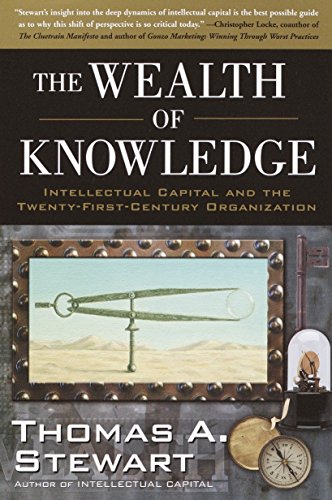
In Thomas A. Stewart’s bestselling first book, Intellectual Capital, he redefined the priorities of businesses around the world, demonstrating that the most important assets companies own today are often not tangible goods, equipment, financial capital, or market share, but the intangibles: patents, the knowledge of workers, and the information about customers and channels and past experience that a company has in its institutional memory. Now in his new book, The Wealth of Knowledge, Stewart--widely acknowledged as the world’s leading expert on working with intellectual capital in today’s knowledge economy--reveals how today’s companies are applying the concept of intellectual capital into day-to-day operations to dramatically increase their success in the marketplace.
Arguing that companies can make untold millions of dollars by managing knowledge more effectively--and save millions more--Stewart offers executives and managers compelling accounts of how leading companies around the world are successfully tackling the practical issues involved in today’s knowledge economy. The heart of the book is a revolutionary 4-step preocess that shows how to put intellectual capital to work to improve performance and profitablity, as well as manage knowledge processes. He goes on to discuss how companies can better utilize their current assets and enhance their knowledge resources for the future. Questioning many of the assumptions that have ruled business in the twentieth century, he addresses such critical and fundamental issues as why companies exist, how they should be organized and how people should be compensated. With his customary fearlessness and foresight, he plunges into the thick of the controversial arena of measuring and accounting, as well-an increasingly difficult task when a corporation’s assets are intangible.
The Wealth of Knowledge not only sets out the latest thinking in creating and managing knowledge assets, but provides a detailed course of action for corporations trying to navigate their way in the world of knowledge economy.
Die Inhaltsangabe kann sich auf eine andere Ausgabe dieses Titels beziehen.
Über die Autorin bzw. den Autor
THOMAS A. STEWART is a member of the Board of Editors of Fortune Magazine and a senior writer for Business 2.0. For the past six years, his column, "The Leading Edge" in Fortune was the most important forum about intellectual capital and knowledge management. His articles appear regularly in Fortune and Business 2.0. A fellow of the World Economic Forum, he is the author of the bestselling book Intellectual Capital (Currency), which was named one of the most important business books of the year by the Financial Times, and has been translated into seventeen languages. He lives in New York City.
Von der hinteren Coverseite
In Thomas A. Stewart's bestselling first book, "Intellectual Capital, he redefined the priorities of businesses around the world, demonstrating that the most important assets companies own today are often not tangible goods, equipment, financial capital, or market share, but the intangibles: patents, the knowledge of workers, and the information about customers and channels and past experience that a company has in its institutional memory. Now in his new book, "The Wealth of Knowledge, Stewart--widely acknowledged as the world's leading expert on working with intellectual capital in today's knowledge economy--reveals how today's companies are applying the concept of intellectual capital into day-to-day operations to dramatically increase their success in the marketplace.
Arguing that companies can make untold millions of dollars by managing knowledge more effectively--and save millions more--Stewart offers executives and managers compelling accounts of how leading companies around the world are successfully tackling the practical issues involved in today's knowledge economy. The heart of the book is a revolutionary 4-step preocess that shows how to put intellectual capital to work to improve performance and profitablity, as well as manage knowledge processes. He goes on to discuss how companies can better utilize their current assets and enhance their knowledge resources for the future. Questioning many of the assumptions that have ruled business in the twentieth century, he addresses such critical and fundamental issues as why companies exist, how they should be organized and how people should be compensated. With his customary fearlessness and foresight, he plunges into the thickof the controversial arena of measuring and accounting, as well-an increasingly difficult task when a corporation's assets are intangible.
"The Wealth of Knowledge not only sets out the latest thinking in creating and managing knowledge assets, but provides a detailed course of action for corporations trying to navigate their way in the world of knowledge economy.
"From the Hardcover edition.
Aus dem Klappentext
In Thomas A. Stewarts bestselling first book, Intellectual Capital, he redefined the priorities of businesses around the world, demonstrating that the most important assets companies own today are often not tangible goods, equipment, financial capital, or market share, but the intangibles: patents, the knowledge of workers, and the information about customers and channels and past experience that a company has in its institutional memory. Now in his new book, The Wealth of Knowledge, Stewart--widely acknowledged as the worlds leading expert on working with intellectual capital in todays knowledge economy--reveals how todays companies are applying the concept of intellectual capital into day-to-day operations to dramatically increase their success in the marketplace.
Arguing that companies can make untold millions of dollars by managing knowledge more effectively--and save millions more--Stewart offers executives and managers compelling accounts of how leading companies around the world are successfully tackling the practical issues involved in todays knowledge economy. The heart of the book is a revolutionary 4-step preocess that shows how to put intellectual capital to work to improve performance and profitablity, as well as manage knowledge processes. He goes on to discuss how companies can better utilize their current assets and enhance their knowledge resources for the future. Questioning many of the assumptions that have ruled business in the twentieth century, he addresses such critical and fundamental issues as why companies exist, how they should be organized and how people should be compensated. With his customary fearlessness and foresight, he plunges into the thick of the controversial arena of measuring and accounting, as well-an increasingly difficult task when a corporations assets are intangible.
The Wealth of Knowledge not only sets out the latest thinking in creating and managing knowledge assets, but provides a detailed course of action for corporations trying to navigate their way in the world of knowledge economy.
From the Hardcover edition.
Auszug. © Genehmigter Nachdruck. Alle Rechte vorbehalten.
Chapter 1
The Pillars of the Knowledge Economy
We are confronted with insurmountable opportunities. Walt Kelly
Consider a key. Dig into your pocket or purse, pull out your key ring, and examine one of the keys--car key, house key, office, mailbox, trunk-in-the-basement key. I'm looking at the key to the door of my office, a piece of silverish metal about two and a quarter inches long; the name of the manufacturer, Corbin, is stamped on the end where my fingers grip it. A key is a physical object. It has size, mass, specific gravity. It can be dropped, lost, bent, hung on a hook.
A key contains information as well as molecules. The serrations along the top of the business end of the key--if you traced them onto a sheet of graph paper, they would resemble the electrocardiogram of a man with not long to live--are a code. They instruct one lock, and only one lock, to open; the lock has a matching set of cuts and ridges that order it to yield to one key, and only one key.
Keys used to be heavier and less intricate than the one in your hand (You can put it away now). That is, they were more massive and less knowledge-intensive; my father-in-law owns a large, rusty, old iron key, about eight inches long, that he uses as a doorstop. The oldest known key is a big wooden bar from which pins stick up like the bristles of a sparse brush. The pins match holes on a wooden bolt that secured a door in the ancient Assyrian city of Nineveh some 4,000 years ago. The fancy, gorgeous locks and keys of the Middle Ages and Renaissance were more show than security; their ingenious metalwork elegantly obscured the fact that picking them was child's play. That changed in the late eighteenth century, when an Englishman, Joseph Bramah, revolutionized locksmithing by manufacturing devices of unprecedented intricacy--that is, by increasing their information intensity. More than half a century passed before anyone managed to pick a Bramah lock.
If you're traveling as you read this, you might have in your pocket a little plastic card that is also a key, the key to your hotel room. The code, the instructions--the knowledge content--of this key reside in the magnetic stripe on one side. When you checked in, the clerk at the front desk stuck the card into a small device and typed in a code matching one that had been set for the lock in the door of your room. You can't see the code; if you compare two card keys, you can't tell if they are for the same or different locks. These keys can also hold a lot more information. They can tell time; if you ask for a late checkout, you might need to present your key to have an extra hour or two added to its clock--alternatively, the clerk might reset the clock in the lock on the door. Similar keys can carry money: The MetroCard in my wallet, which unlocks the turnstiles of New York City's subway, contains $13.50 as I write this, I believe, but no one can tell how much value is stored in it just by looking, any more than you can see the code on a hotel-room key. Before MetroCards, I filled my pocket with subway tokens; I could feel their weight and hear their jingle. If I put more money in my MetroCard, I notice nothing.
In mechanical keys, the physical object and the information are one and the same. The code is literally cut into the metal, visibly and inseparably. If you skip town with a metal hotel-room key in your pocket and the lock is not changed, you could return and unlock the door. That's not so with card keys. Signs outside aluminum smelters warn visitors to remove their credit cards and hotel keys: The magnetic field created by the electricity that pulses through these factories will wipe the cards clean. The hotel-room card will no longer open the door after you check out: The lock will have been changed--physically it will be untouched, but its information component will be new.
Keys are a metaphor that helps to describe how the so-called new economy--the Information Age, the knowledge economy--differs from the old one. Fundamentally, the twenty-first-century economy is one of ever-increasing information intensity. Like keys, the economy is packed with more and more knowledge--data, interpretation, ideas. As with keys, it's the knowledge itself that is valuable--value resides in the code in the magnetic strip, not the plastic. And this valuable knowledge exists independently of whatever physical carrier it's in at the moment: key, Web site, Palm Pilot.
The Information Age isn't just a slogan but a fact; the knowledge-based economy is, indeed, a new economy, with new rules, requiring new ways of doing business. The case for the existence of a new economy has been made and proven beyond the doubt of all but an unreasoning few; I don't propose to remake it here.
The knowledge economy stands on three pillars. The first: Knowledge has become what we buy, sell, and do. It is the most important factor of production. The second pillar is a mate, a corollary to the first: Knowledge assets--that is, intellectual capital--have become more important to companies than financial and physical assets. The third pillar is this: To prosper in this new economy and exploit these newly vital assets, we need new vocabularies, new management techniques, new technologies, and new strategies. On these three pillars rest all the new economy's laws and its profits.
KNOWLEDGE IS WHAT WE BUY, SELL, AND DO
You awaken in the morning when the clock radio turns on, giving you the news and your morning's share of $73 billion in annual advertising spending. Your toothpaste, the product of millions of dollars of research and development and further billions of marketing expenditure, is, on a cost basis, more than 50 percent knowledge. The newspaper on your doorstep, if it is this morning's New York Times, contains about 150,000 words, about as many as a fat book. The microwave oven in which you heat your coffee contains a microprocessor.
Drink your coffee, eat something, get dressed. The car you are about to enter, which uses more computing power than it took to put a man on the moon, is an infotainment pod. Automobile companies are stuffing as much intelligence into their machines as they can. Cars now know how much fuel you have and calculate how far you can drive before sputtering to an ignominious halt. They know where you are, and can give you directions and a map to where you want to go. The information-infused car, with voice-activated Internet access, real-time traffic information, and the ability to diagnose breakdowns and notify emergency services automatically in case of accident, will offer a new income stream to automakers and their suppliers. Stuffing cars with smarts, says Ford's CEO, Jacques Nasser, "is about shifting competitive advantage from hard assets to intangible assets."
Knowledge and information are embedded in every product we use, more and more. Your telephone stores dozens of phone numbers, remembers the last one you dialed, records messages from people who called when you were out, and reveals the phone numbers of people who called and did not leave a message. Today's jetliner contains, in addition to sophisticated computers and communication systems in the cockpit, more than a thousand microprocessor chips. What used to be an almost entirely physical experience--the transport of your molecules from here to there in the company of a stewardess whose own molecules were attractively arranged, and with passably edible food--has become e-mail and news and movies and phone calls and computer games and cuisine that resembles nothing found in nature. Airlines' spending on in-flight entertainment and communications septupled from 1992 to 2000 and now totals about $2.25 billion a year.
It has become traditional in books about knowledge and knowledge management to spend several pages defining knowledge and distinguishing it...
„Über diesen Titel“ kann sich auf eine andere Ausgabe dieses Titels beziehen.
Suchergebnisse für The Wealth of Knowledge: Intellectual Capital and the...

Beispielbild für diese ISBN
The Wealth of Knowledge: Intellectual Capital and the Twenty-first Century Organization
Anbieter: World of Books (was SecondSale), Montgomery, IL, USA
Verkäuferbewertung 5 von 5 Sternen

Zustand: Good. Item in good condition. Textbooks may not include supplemental items i.e. CDs, access codes etc. Artikel-Nr. 00110499167
Gebraucht kaufen
EUR 5,50
Versand gratis
Versand innerhalb von USA
Versand innerhalb von USA
Anzahl: 1 verfügbar
Beispielbild für diese ISBN
The Wealth of Knowledge: Intellectual Capital and the Twenty-First Century Organization
Anbieter: ThriftBooks-Atlanta, AUSTELL, GA, USA
Verkäuferbewertung 5 von 5 Sternen
Paperback. Zustand: Very Good. No Jacket. May have limited writing in cover pages. Pages are unmarked. ~ ThriftBooks: Read More, Spend Less. Artikel-Nr. G0385500726I4N00
Gebraucht kaufen
EUR 6,12
Versand gratis
Versand innerhalb von USA
Versand innerhalb von USA
Anzahl: 1 verfügbar
Beispielbild für diese ISBN
The Wealth of Knowledge : Intellectual Capital and the Twenty-First Century Organization
Verlag:
Crown Publishing Group, The, 2003
ISBN 10: 0385500726
ISBN 13: 9780385500722
Gebraucht
Softcover
Anbieter: Better World Books, Mishawaka, IN, USA
Verkäuferbewertung 5 von 5 Sternen
Zustand: Good. Pages intact with minimal writing/highlighting. The binding may be loose and creased. Dust jackets/supplements are not included. Stock photo provided. Product includes identifying sticker. Better World Books: Buy Books. Do Good. Artikel-Nr. 4799001-6
Gebraucht kaufen
EUR 8,56
Versand gratis
Versand innerhalb von USA
Versand innerhalb von USA
Anzahl: 1 verfügbar
Beispielbild für diese ISBN
The Wealth of Knowledge : Intellectual Capital and the Twenty-First Century Organization
Verlag:
Crown Publishing Group, The, 2003
ISBN 10: 0385500726
ISBN 13: 9780385500722
Gebraucht
Softcover
Anbieter: Better World Books, Mishawaka, IN, USA
Verkäuferbewertung 5 von 5 Sternen
Zustand: Very Good. Pages intact with possible writing/highlighting. Binding strong with minor wear. Dust jackets/supplements may not be included. Stock photo provided. Product includes identifying sticker. Better World Books: Buy Books. Do Good. Artikel-Nr. 13654910-6
Gebraucht kaufen
EUR 8,56
Versand gratis
Versand innerhalb von USA
Versand innerhalb von USA
Anzahl: 1 verfügbar
Beispielbild für diese ISBN
The Wealth of Knowledge: Intellectual Capital and the Twenty-first Century Organization
Anbieter: Revaluation Books, Exeter, Vereinigtes Königreich
Verkäuferbewertung 5 von 5 Sternen
Paperback. Zustand: Brand New. 400 pages. 5.50x8.50x0.75 inches. In Stock. Artikel-Nr. x-0385500726
Neu kaufen
EUR 26,53
EUR 11,93 Versand
Versand von Vereinigtes Königreich nach USA
Versand von Vereinigtes Königreich nach USA
Anzahl: 2 verfügbar
Beispielbild für diese ISBN
The Wealth of Knowledge. Intellectual Capital and the Twenty-first Century Organization
Anbieter: Sigrun Wuertele buchgenie_de, Altenburg, Deutschland
Verkäuferbewertung 5 von 5 Sternen
Zustand: Wie neu - gebraucht. Paperback 400 S. Sehr guter Zustand, ohne Namenseintrag Zustand: 1, Wie neu - gebraucht, Paperback Currency , 2003 400 S. , The Wealth of Knowledge. Intellectual Capital and the Twenty-first Century Organization, Thomas A. A. Stewart. Artikel-Nr. BU359030
Gebraucht kaufen
EUR 16,85
EUR 37,99 Versand
Versand von Deutschland nach USA
Versand von Deutschland nach USA
Anzahl: 1 verfügbar