
Verwandte Artikel zu Maximum Success: Changing the 12 Behavior Patterns...
Inhaltsangabe
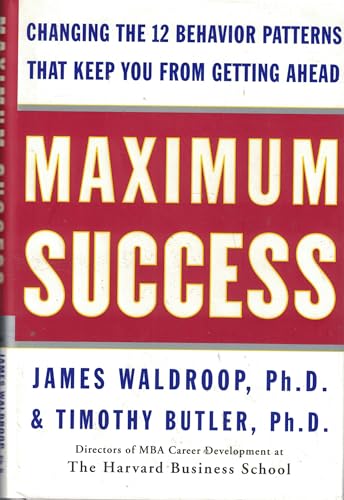
Identifies twelve behaviors that can undermine a career, explaining how to break patterns that limit advancement for any job and outlining the stories of executives from such companies as GTE, Sony, GE, and McKinsey & Co.
Die Inhaltsangabe kann sich auf eine andere Ausgabe dieses Titels beziehen.
Über die Autorin bzw. den Autor
James Waldroop, Ph.D., and Timothy Butler, Ph.D., are directors of MBA career development at the Harvard Business School, as well as the creators of the Internet-based interactive career-assessment program CareerLeader, currently used by over 100 corporations and MBA programs worldwide. Leaders in the area of executive coaching and intervention, they have consulted with many of the top corporations in the country. They are the authors of Discovering Your Career in Business, as well as articles that have appeared in the Harvard Business Review and Fortune. They live in the Boston metropolitan area.
Aus dem Klappentext
m Success is a compelling exploration of the behavior patterns that cause people to undermine their careers-as well as specific advice on how to overcome them. Have you ever wondered why some people seem to rise effortlessly to the top, while others are stuck in the same job year after year? Have you ever felt you are falling short of your career potential? Have you wondered if some of the things you do-or don't do-at work might be hamstringing your ambitions?
In Maximum Success, James Waldroop and Timothy Butler, directors of MBA career development at the Harvard Business School, identify the twelve habits that over and over again-whether you are a retail clerk or a partner in a law firm, whether you work in technology or in a factory-are almost guaranteed to hold you back.
While an examination of the habits of highly effective people has made Stephen Covey's book The Seven Habits of Highly Effective People a self-help classic, the fact is th
Auszug. © Genehmigter Nachdruck. Alle Rechte vorbehalten.
Never Feeling Good Enough
IN A WORLD OVERPOPULATED WITH OUTSIZE EGOS, PAUL seemed to be an anomaly. He had an ego that was too small for his considerable abilities and his position. A big international bank in New York had hired him away from a smaller bank in Texas for a high-profile job taking charge of a group of loan officers who, after some heady early successes, had involved the bank in several dangerous arrangements in Latin America. When the Mexican peso collapsed, the bank had taken a financial bath, suffering tens of millions of dollars in losses. Paul's assignment was to rein in the lending group, to ensure that the necessary "due diligence" had been done on major loans before any further commitments were made.
Paul, who was in his early forties at the time, clearly had both the intellect and the experience to handle the job. Although he had never been a manager, he had considerable know-how as a banker, and Latin America was his specialty. Moreover, Paul had succeeded at everything he had ever done. He had been a top student in both college and graduate business school, and he was promoted quickly through the bank he joined in Dallas after getting his MBA at the University of Texas.
But in his new position Paul was suddenly a misfit--or so it appeared, and so he felt. He was self-conscious and awkward, unable to speak with authority, and unable to command the respect that he needed to excel. He felt like a little fish tossed into a very big pond, a small-town kid from fly-over country way out of place among East Coast elites. Sure, he had been at the top of his class in school, but in schools without prestigious names. Now he had to take charge of a herd of headstrong and arrogant deal makers with degrees from Harvard, Columbia, and Wharton.
The coterie of loan officers who had been operating on their own before Paul arrived understandably were not delighted to welcome an outsider charged with keeping them under control. Still, if Paul had presented himself as a confident manager, he might have been able to defuse their resentment quickly enough and establish himself as their skillful leader.
But he never demonstrated that confidence and as a result never took command in the fullest sense. He had a look of intensity and concern that sometimes seemed to approach panic. He worked long hours, much too long--and work that he should have been delegating, he took upon himself. His superior, who had hired him, was afraid that Paul was going to burn out. In the eyes of the lenders Paul supervised, he was respected as a hard worker and a technical specialist, but not really admired and certainly not looked up to as a commander.
Troops want a leader who exudes self-assurance. In a battle at sea, sailors want to look up at the bridge and see "the old man" calmly overseeing the battle--not struggling nervously into his life jacket! But everything about Paul said worry. He had no stature in the lending group; people avoided him.
But at his new job, instead of strolling through offices in comfortable command Paul scurried down the halls with an intense, inner--directed gaze on his face that signaled to everyone that he was in trouble. His body language broadcast concern, discomfort, and isolation. When he stopped to talk to people he was all business, almost curt. There was never any small talk.
Paul was telling people, without knowing or intending to, that he couldn't get away from them fast enough. It was as though if he lingered too long, people would see through him and would recognize that he didn't belong, would know that he was in over his head--and the fact was, he did feel in over his head. Instead of looking upward and contemplating whether he might be CEO someday, or at least head of all of International, he was frightened that he had already risen too high. He wondered whether he didn't really belong a peg or two below where he was.
Those in the department followed his instructions when necessary, but they didn't seek out his advice. Nobody invited him to lunch. Meetings were held without Paul being aware of them. One of his colleagues said of Paul, "He's a hard worker . . . and it shows." Another said, "He's very smart, and everybody respects him--but no one wants to be him." When Paul stepped outside himself and took a close look, he didn't want to be himself, either! That was the point at which he came to us.
„Über diesen Titel“ kann sich auf eine andere Ausgabe dieses Titels beziehen.
Suchergebnisse für Maximum Success: Changing the 12 Behavior Patterns...

Beispielbild für diese ISBN
Maximum Success: Changing the 12 Behavior Patterns That Keep You From Getting Ahead
Anbieter: World of Books (was SecondSale), Montgomery, IL, USA
Verkäuferbewertung 5 von 5 Sternen

Zustand: Good. Item in good condition. Textbooks may not include supplemental items i.e. CDs, access codes etc. Artikel-Nr. 00089311868
Gebraucht kaufen
EUR 5,09
Versand gratis
Versand innerhalb von USA
Versand innerhalb von USA
Anzahl: 2 verfügbar
Beispielbild für diese ISBN
Maximum Success: Changing the 12 Behavior Patterns That Keep You From Getting Ahead
Anbieter: World of Books (was SecondSale), Montgomery, IL, USA
Verkäuferbewertung 5 von 5 Sternen
Zustand: Very Good. Item in very good condition! Textbooks may not include supplemental items i.e. CDs, access codes etc. Artikel-Nr. 00082929374
Gebraucht kaufen
EUR 5,09
Versand gratis
Versand innerhalb von USA
Versand innerhalb von USA
Anzahl: 2 verfügbar
Beispielbild für diese ISBN
Maximum Success: Changing the 12 Behavior Patterns That Keep You From Getting Ahead
Anbieter: ThriftBooks-Dallas, Dallas, TX, USA
Verkäuferbewertung 5 von 5 Sternen
Hardcover. Zustand: As New. No Jacket. Pages are clean and are not marred by notes or folds of any kind. ~ ThriftBooks: Read More, Spend Less. Artikel-Nr. G0385498497I2N00
Gebraucht kaufen
EUR 8,38
Versand gratis
Versand innerhalb von USA
Versand innerhalb von USA
Anzahl: 1 verfügbar
Beispielbild für diese ISBN
Maximum Success: Changing the 12 Behavior Patterns That Keep You From Getting Ahead
Anbieter: ThriftBooks-Dallas, Dallas, TX, USA
Verkäuferbewertung 5 von 5 Sternen
Hardcover. Zustand: Very Good. No Jacket. May have limited writing in cover pages. Pages are unmarked. ~ ThriftBooks: Read More, Spend Less. Artikel-Nr. G0385498497I4N00
Gebraucht kaufen
EUR 8,38
Versand gratis
Versand innerhalb von USA
Versand innerhalb von USA
Anzahl: 1 verfügbar
Beispielbild für diese ISBN
Maximum Success : Changing the 12 Behavior Patterns That Keep You from Getting Ahead
Verlag:
Knopf Doubleday Publishing Group, 2000
ISBN 10: 0385498497
ISBN 13: 9780385498494
Gebraucht
Hardcover
Anbieter: Better World Books, Mishawaka, IN, USA
Verkäuferbewertung 5 von 5 Sternen
Zustand: Very Good. Pages intact with possible writing/highlighting. Binding strong with minor wear. Dust jackets/supplements may not be included. Stock photo provided. Product includes identifying sticker. Better World Books: Buy Books. Do Good. Artikel-Nr. 9127721-6
Gebraucht kaufen
EUR 8,48
Versand gratis
Versand innerhalb von USA
Versand innerhalb von USA
Anzahl: 1 verfügbar
Beispielbild für diese ISBN
Maximum Success: Changing the 12 Behavior Patterns That Keep You From Getting Ahead
Anbieter: Wonder Book, Frederick, MD, USA
Verkäuferbewertung 5 von 5 Sternen
Zustand: Good. Good condition. Very Good dust jacket. A copy that has been read but remains intact. May contain markings such as bookplates, stamps, limited notes and highlighting, or a few light stains. Artikel-Nr. A10A-02612
Gebraucht kaufen
EUR 10,89
Versand gratis
Versand innerhalb von USA
Versand innerhalb von USA
Anzahl: 1 verfügbar
Beispielbild für diese ISBN
Maximum Success : Changing the 12 Behavior Patterns That Keep You from Getting Ahead
Verlag:
Knopf Doubleday Publishing Group, 2000
ISBN 10: 0385498497
ISBN 13: 9780385498494
Gebraucht
Hardcover
Anbieter: Better World Books Ltd, Dunfermline, Vereinigtes Königreich
Verkäuferbewertung 5 von 5 Sternen
Zustand: Good. Former library copy. Pages intact with minimal writing/highlighting. The binding may be loose and creased. Dust jackets/supplements are not included. Includes library markings. Stock photo provided. Product includes identifying sticker. Better World Books: Buy Books. Do Good. Artikel-Nr. GRP9406706
Gebraucht kaufen
EUR 5,69
EUR 5,86 Versand
Versand von Vereinigtes Königreich nach USA
Versand von Vereinigtes Königreich nach USA
Anzahl: 1 verfügbar
Beispielbild für diese ISBN
Maximum Success: Changing the 12 Behavior Patterns That Keep You From Getting Ahead
Anbieter: Robinson Street Books, IOBA, Binghamton, NY, USA
Verkäuferbewertung 4 von 5 Sternen

Hardcover. Zustand: As New. Prompt Shipment, shipped in Boxes, Tracking PROVIDEDFine in Fine dust jacket. First edition.*. Artikel-Nr. lower50rm6060
Gebraucht kaufen
EUR 12,28
EUR 8,39 Versand
Versand innerhalb von USA
Versand innerhalb von USA
Anzahl: 1 verfügbar
Foto des Verkäufers
Maximum Success
Verlag:
Broadway Business, 2000
ISBN 10: 0385498497
ISBN 13: 9780385498494
Gebraucht
Hardcover
Erstausgabe
Signiert
Anbieter: Southampton Books, Sag Harbor, NY, USA
Verkäuferbewertung 5 von 5 Sternen
Hardcover. Zustand: Like New. First Edition. First Edition, First Printing. Not price-clipped. Published by Broadway Business, 2000. Octavo. Hardcover. Book is like new. Dust jacket is like new. Signed by the author on the half title page.100% positive feedback. 30 day money back guarantee. NEXT DAY SHIPPING! Excellent customer service. Please email with any questions. All books packed carefully and ship with free delivery confirmation/tracking. All books come with free bookmarks. Ships from Sag Harbor, New York. Artikel-Nr. 428693
Gebraucht kaufen
EUR 18,19
EUR 4,41 Versand
Versand innerhalb von USA
Versand innerhalb von USA
Anzahl: 1 verfügbar
Beispielbild für diese ISBN
Maximum Success. Changing the 12 Behavior Patterns That Keep You from Getting Ahead
Verlag:
Broadway Business, 2000
ISBN 10: 0385498497
ISBN 13: 9780385498494
Gebraucht
Hardcover
Erstausgabe
Anbieter: Sigrun Wuertele buchgenie_de, Altenburg, Deutschland
Verkäuferbewertung 5 von 5 Sternen
Zustand: Wie neu - gebraucht. 1st ed. Gebundene Ausgabe Sehr guter Zustand, ohne Namenseintrag, Original-Schutzumschlag Zustand: 1, Wie neu - gebraucht, Gebundene Ausgabe Broadway Business 1st ed, 2000 , Maximum Success. Changing the 12 Behavior Patterns That Keep You from Getting Ahead, Ph. D. Waldroop, James. Artikel-Nr. BU359653
Gebraucht kaufen
EUR 19,99
EUR 37,99 Versand
Versand von Deutschland nach USA
Versand von Deutschland nach USA
Anzahl: 1 verfügbar