
Verwandte Artikel zu The Shaping of a Life: A Spiritual Landscape
Inhaltsangabe
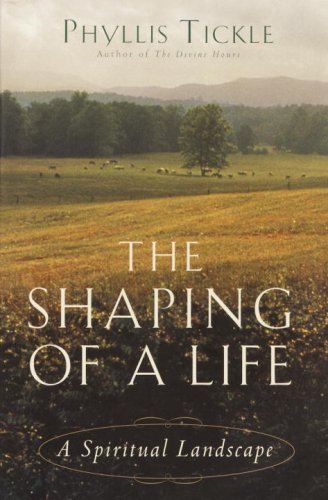
A leading authority on modern religion chronicles her own personal journey of spiritual discovery, growth, and transformation , detailing her childhood in Tennessee, her discovery of the power and comfort of prayer, and her recognition that prayer requires a disciplined routine. Reprint.
Die Inhaltsangabe kann sich auf eine andere Ausgabe dieses Titels beziehen.
Über die Autorin bzw. den Autor
PHYLLIS TICKLE is Contributing Editor in Religion for Publishers Weekly. One of America's most respected authorities on religion, she is frequently interviewed for both print and electronic media, and is a regular guest on PBS's "Religion and Ethics NewsWeekly." The author of more than a dozen books, including the recently published The Divine Hours, she lives in Lucy, Tennessee.
Aus dem Klappentext
Shaping of a Life, Phyllis Tickle recounts her life with honesty and humor, richly conveying both the external events and the internal insights and emotions. As Tickle chronicles her deepening understanding of prayer and the rewards of marriage, family, and spiritual life, she reaches across the boundaries that separate one denomination from another and presents a portrait of spiritual growth and transformation that will appeal to devout practitioners and their less religious neighbors as well. Within a very personal story, Tickle reveals the keys that will help readers of all faiths find the path that leads from the everyday world of doing to the special place of simply being.
Auszug. © Genehmigter Nachdruck. Alle Rechte vorbehalten.
1.
My father taught me to love words, and my mother taught me to pray. In his case, it was patient and intentional. In hers, quite the opposite.
The house in which I grew up and in which my first subjective instruction was played out was a determinant in those lessons. Or if not a determinant, then at least a kind of text upon which my memory and understanding have recorded them and to which I have attached their intricacies. This is not to say that the old house was in any way a thing of beauty or even that it could lay claim to any pretensions. It most assuredly was not that kind of house.
Built in the 1920s just before the Great Depression wrought havoc on everybody including the house's original owner/builder, the poor thing was still not entirely finished when my father bought it fifteen years later from the man's widow. The roughed-in, but unfinished, portions of the upstairs that looked out through broad dormer windows onto a line of silver maple trees and then to the street beyond became mine within a few days of our moving in.
"Phyllis's playroom" was the way my mother came to refer to that near-sixth of her new house that yawned, dusty and inviting, at the end of the upstairs hall and just beyond my bedroom door. It was a phrasing that, once she had invented it, allowed Mother to live more comfortably with the notion that her only child was setting up shop on a loose-planked floor and sitting on cross braces nailed to open studs. With or without such euphemisms, however, my mother and I both knew that that unfinished space was my soul's home, just as my father and I knew that so long as I lived as a child among them, the space was to remain unfinished except by my imagination or my own juvenile carpentry. It was a kind of gentlemen's agreement amongst the three of us.
Almost as a result of that agreement, I came in time, subtly but surely, to divide the old house into "theirs" (the downstairs) and "mine" (the upstairs.) I found theirs considerably less interesting than mine for adventures, but rivetingly more absorbing for its revelations about adults and adult ways of living. I spent whole afternoons, in fact, just sitting on the upstairs steps and contemplating the complexities of what was going on below me and what, presumably, I was to become in time. But the house was so laid out that no one seat, not even my favored one on the stairs, was totally satisfactory as an observatory. No, ours was a house that required an inquisitive child to move about a lot.
The floor plan of the downstairs was hardly more imaginative or less phlegmatic than was the house itself. A huge (the most odious chore of my late childhood was having to sweep the whole thing every Saturday morning for the perfectionist who masqueraded as my mother) . . . a huge porch ran the entire front of the house. At the porch's western end was the front door. Made of heavy oak, the door groaned its way into an entrance room the size of most people's bedrooms and that, as a result, no one could ever figure out how to either appoint or use. Ultimately it became a kind of parlor-anteroom that just sat there and, according to my father, used up space and heat. The unruly parlor did serve one good purpose, however; it opened into a living room that was almost the size of the porch and many times more pleasing to me.
The living room ran from east to west paralleling the porch. On its south wall, which it shared with the porch, a bank of broad-paned windows looked across the front yard to the maples trees that, when one was downstairs, totally obscured the street beyond. On its north wall, the room was interrupted in two places. At its western end was the door to the downstairs hall and at its eastern, the double french doors that led into the dining room. The hall, which was far and away the house's greatest impediment to easy living, was a long narrow affair whose only purpose was to connect other necessary spaces in as narrow and dark a manner as possible. It had, I always suspected, been the builder's attempt to conserve the heat and floor footage he had squandered in the entrance hall parlor.
But for whatever reason, the downstairs hall was and remained a domestic bottleneck that led, straight as an arrow, north from the living room to the back of the house. On the way, it opened first onto my father's study--onto that sunny, book-lined room where, as a college professor, he spent so many hours at his desk and where he taught me how poetry could give body to the soul and how the voice speaking words aloud could give life to the printed page.
Just beyond the study door, the hallway accessed on one's left what has to have been the world's largest linen closet and on one's right the landing of the steps to my upstairs world. Beyond the closet and landing, the hall squeezed past my parents' bedroom door, pretended to terminate in their bathroom, and then abruptly bent around the corner past the basement door to actually terminate in Mother's industrial-sized, white-and-red kitchen.
If one wished to come at the kitchen from the other direction, one had to pass through the living room and then through the dining room doors, or more correctly, through the open doorway where they were. (I never remember the doors themselves being shut except on Christmas Day when they hid the coming feast, the better to tease my excitement.) Directly across the dining room from the french doors, positioned in its own kind of arrow-straight alignment, was our breakfast room. While there was no door at all, only a doorway, between the kitchen and that breakfast room, there was most definitely a door between the breakfast and the dining rooms. It was one of those somewhat antique, heavy swinging doors that allow the cook to move easily from kitchen to table while carrying hot dishes and full trays. It was a rule of the house that this door, unlike the glass double ones across from it, was always closed. Always, that is, except from about three-thirty until about four-thirty in the afternoon. That was when my mother prayed.
If we had, as a family, early reached the accommodation of splitting the house by layers between parents and child, so likewise had my mother and father managed early to split it by rooms between his and hers. The study was his, the living room hers. This is not to say that their division was as complete as was theirs with me.
My mother rarely if ever came above stairs except to clean or to deliberately visit for a while. Visiting was a great skill with her, in fact. She was a brilliant and widely read woman as well as a gifted conversationalist, and I remember those times in her company with quiet pleasure to this day. But when Mother came up, it was always purposeful rather than coincidental; and her presence was never actively enough a part of my upstairs life for me to feel her rhythms after she had left or to discover the faint traces of her perfume in my quarters a day later.
My father came upstairs only by my insistent invitation, frequently because I lacked some skill of carpentry that I needed and he possessed or because, almost as often, I needed his sheer strength to accomplish some construction or other. Many of those command visits, of course, were also close to trumped-up excuses; all too frequently I just wanted to show off something I had done and had assumed, in my naivete, that my petite and very feminine mother could never fully appreciate.
In much the same way, below stairs there was a similar kind of arrangement. My mother cleaned and straightened the study very respectfully each morning, and every evening she sat in the rocker beside my father's desk and read or talked or listened as the case might be; but one never thought, even then, that the study was her room. It was his and, while she was clearly the life of his life and his most...
„Über diesen Titel“ kann sich auf eine andere Ausgabe dieses Titels beziehen.
Suchergebnisse für The Shaping of a Life: A Spiritual Landscape

Beispielbild für diese ISBN
The Shaping Of A Life
Verlag:
Bantam Doubleday Dell Publishing Group Inc, 2003
ISBN 10: 0385497563
ISBN 13: 9780385497565
Gebraucht
Paperback
Anbieter: World of Books (was SecondSale), Montgomery, IL, USA
Verkäuferbewertung 5 von 5 Sternen

Paperback. Zustand: Good. In The Shaping of a Life, Phyllis Tickle recounts her life with honesty and humor, richly conveying both the external events and the internal insights and emotions. As Tickle chronicles her deepening understanding of prayer and the rewards of marriage, family, and spiritual life, she reaches across the boundaries that separate one denomination from another and presents a portrait of spiritual growth and transformation that will appeal to devout practitioners and their less religious neighbors as well. Within a very personal story, Tickle reveals the keys that will help readers of all faiths find the path that leads from the everyday world of doing to the special place of simply being. Artikel-Nr. 00109411947
Gebraucht kaufen
EUR 4,67
Versand gratis
Versand innerhalb von USA
Versand innerhalb von USA
Anzahl: 2 verfügbar
Beispielbild für diese ISBN
The Shaping Of A Life
Verlag:
Bantam Doubleday Dell Publishing Group Inc, 2003
ISBN 10: 0385497563
ISBN 13: 9780385497565
Gebraucht
Paperback
Anbieter: World of Books (was SecondSale), Montgomery, IL, USA
Verkäuferbewertung 5 von 5 Sternen
Paperback. Zustand: Very Good. In The Shaping of a Life, Phyllis Tickle recounts her life with honesty and humor, richly conveying both the external events and the internal insights and emotions. As Tickle chronicles her deepening understanding of prayer and the rewards of marriage, family, and spiritual life, she reaches across the boundaries that separate one denomination from another and presents a portrait of spiritual growth and transformation that will appeal to devout practitioners and their less religious neighbors as well. Within a very personal story, Tickle reveals the keys that will help readers of all faiths find the path that leads from the everyday world of doing to the special place of simply being. Artikel-Nr. 00110401050
Gebraucht kaufen
EUR 4,67
Versand gratis
Versand innerhalb von USA
Versand innerhalb von USA
Anzahl: 1 verfügbar
Beispielbild für diese ISBN
The Shaping of a Life: A Spiritual Landscape
Anbieter: BooksRun, Philadelphia, PA, USA
Verkäuferbewertung 5 von 5 Sternen
Paperback. Zustand: Fair. The item might be beaten up but readable. May contain markings or highlighting, as well as stains, bent corners, or any other major defect, but the text is not obscured in any way. Artikel-Nr. 0385497563-7-1-13
Gebraucht kaufen
EUR 4,68
Versand gratis
Versand innerhalb von USA
Versand innerhalb von USA
Anzahl: 1 verfügbar
Beispielbild für diese ISBN
The Shaping of a Life: A Spiritual Landscape
Verlag:
Image (edition Reprint), 2003
ISBN 10: 0385497563
ISBN 13: 9780385497565
Gebraucht
Paperback
Anbieter: BooksRun, Philadelphia, PA, USA
Verkäuferbewertung 5 von 5 Sternen
Paperback. Zustand: Fair. Reprint. The item might be beaten up but readable. May contain markings or highlighting, as well as stains, bent corners, or any other major defect, but the text is not obscured in any way. Artikel-Nr. 0385497563-7-1
Gebraucht kaufen
EUR 4,73
Versand gratis
Versand innerhalb von USA
Versand innerhalb von USA
Anzahl: 1 verfügbar
Beispielbild für diese ISBN
The Shaping of a Life : A Spiritual Landscape
Verlag:
Crown Publishing Group, The, 2003
ISBN 10: 0385497563
ISBN 13: 9780385497565
Gebraucht
Softcover
Anbieter: Better World Books, Mishawaka, IN, USA
Verkäuferbewertung 5 von 5 Sternen
Zustand: Good. Pages intact with minimal writing/highlighting. The binding may be loose and creased. Dust jackets/supplements are not included. Stock photo provided. Product includes identifying sticker. Better World Books: Buy Books. Do Good. Artikel-Nr. 2304688-20
Gebraucht kaufen
EUR 6,30
Versand gratis
Versand innerhalb von USA
Versand innerhalb von USA
Anzahl: 1 verfügbar
Beispielbild für diese ISBN
The Shaping of a Life : A Spiritual Landscape
Verlag:
Crown Publishing Group, The, 2003
ISBN 10: 0385497563
ISBN 13: 9780385497565
Gebraucht
Softcover
Anbieter: Better World Books: West, Reno, NV, USA
Verkäuferbewertung 5 von 5 Sternen
Zustand: Good. Pages intact with minimal writing/highlighting. The binding may be loose and creased. Dust jackets/supplements are not included. Stock photo provided. Product includes identifying sticker. Better World Books: Buy Books. Do Good. Artikel-Nr. 2304688-20
Gebraucht kaufen
EUR 6,30
Versand gratis
Versand innerhalb von USA
Versand innerhalb von USA
Anzahl: 1 verfügbar
Beispielbild für diese ISBN
The Shaping of a Life : A Spiritual Landscape
Verlag:
Crown Publishing Group, The, 2003
ISBN 10: 0385497563
ISBN 13: 9780385497565
Gebraucht
Softcover
Anbieter: Better World Books, Mishawaka, IN, USA
Verkäuferbewertung 5 von 5 Sternen
Zustand: Good. Former library copy. Pages intact with minimal writing/highlighting. The binding may be loose and creased. Dust jackets/supplements are not included. Includes library markings. Stock photo provided. Product includes identifying sticker. Better World Books: Buy Books. Do Good. Artikel-Nr. 39221928-6
Gebraucht kaufen
EUR 6,30
Versand gratis
Versand innerhalb von USA
Versand innerhalb von USA
Anzahl: 1 verfügbar
Beispielbild für diese ISBN
The Shaping of a Life: A Spiritual Landscape
Anbieter: Wonder Book, Frederick, MD, USA
Verkäuferbewertung 5 von 5 Sternen
Zustand: Good. Good condition. A copy that has been read but remains intact. May contain markings such as bookplates, stamps, limited notes and highlighting, or a few light stains. Artikel-Nr. B03C-00049
Gebraucht kaufen
EUR 6,55
Versand gratis
Versand innerhalb von USA
Versand innerhalb von USA
Anzahl: 4 verfügbar
Beispielbild für diese ISBN
The Shaping of a Life: A Spiritual Landscape
Anbieter: ThriftBooks-Atlanta, AUSTELL, GA, USA
Verkäuferbewertung 5 von 5 Sternen
Paperback. Zustand: Fair. No Jacket. Readable copy. Pages may have considerable notes/highlighting. ~ ThriftBooks: Read More, Spend Less. Artikel-Nr. G0385497563I5N00
Gebraucht kaufen
EUR 6,72
Versand gratis
Versand innerhalb von USA
Versand innerhalb von USA
Anzahl: 1 verfügbar
Beispielbild für diese ISBN
The Shaping of a Life: A Spiritual Landscape
Anbieter: ThriftBooks-Dallas, Dallas, TX, USA
Verkäuferbewertung 5 von 5 Sternen
Paperback. Zustand: Fair. No Jacket. Readable copy. Pages may have considerable notes/highlighting. ~ ThriftBooks: Read More, Spend Less. Artikel-Nr. G0385497563I5N00
Gebraucht kaufen
EUR 6,72
Versand gratis
Versand innerhalb von USA
Versand innerhalb von USA
Anzahl: 1 verfügbar