
Verwandte Artikel zu Ghost Soldiers: The Forgotten Epic Story of World War...
Inhaltsangabe
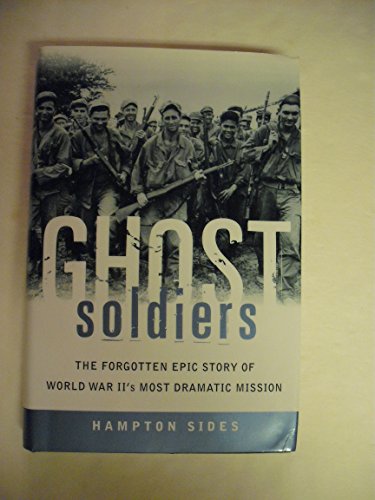
Chronicles the daring mission of the elite U.S. Army Sixth Ranger Battalion to slip behind enemy lines in the Phillipines and rescue the 513 American and British POWs who had spent over three years in a hellish, Japanese-run camp near Cabanatuan. 100,000 first printing.
Die Inhaltsangabe kann sich auf eine andere Ausgabe dieses Titels beziehen.
Über die Autorin bzw. den Autor
A native of Memphis, Tennessee, Hampton Sides is a contributing editor for Outside magazine, and the author of Stomping Grounds, a book of stories about American subcultures. His work has appeared in theNew York Times Magazine, DoubleTake, The New Republic, the Washington Post, and on NPR's "All Things Considered." He lives in Santa Fe, New Mexico.
Auszug. © Genehmigter Nachdruck. Alle Rechte vorbehalten.
Prologue
December 14, 1944
Puerto Princesa Prison Camp, Palawan, Philippines
All about them, their work lay in ruins. Their raison d'etre, the task their commandant had said would take them three months but had taken nearly three years. A thousand naked days of clearing, lifting, leveling, wheelbarrowing, hacking. Thirty-odd months in close heavy heat smashing rocks into smaller rocks, and smaller rocks into pebbles, hammering sad hunks of brain coral into bone-white flour with which to make concrete. Ripping out the black humus floor of the jungle, felling the gnarled beasts of mahogany or narra or kamagong that happened to be in the way. Above the bay, in a malarial forest skittering with monkeys and monitor lizards, they had built an airstrip where none should be, and now they were happy to see it in ruins, cratered by bombs.
One hundred and fifty slaves stood on a tarmac 2,200 meters long and 210 meters wide, straining with shovels and pickaxes and rakes. Ever since the air raids started two months earlier, Lieutenant Sato, the one they called "the Buzzard," had ordered them out each morning to fill the bomb pits, to make the runway usable again. This morning had been no different. The men had risen at dawn and eaten a breakfast of weevily rice, then climbed aboard the trucks for the short ride to the airstrip. As usual, they worked all morning and took a break for lunch around noon. But now the Buzzard said no lunch would be served on the strip, that instead the food would be prepared back at the barracks. The men were puzzled, because they'd never eaten lunch at their barracks before, not on a workday. It didn't make sense to drive back now, for they still had considerable repair work to do. Sato offered no explanation.
The prisoners crawled into their trucks again and took the bumpy serpentine road back to the prison. In the meager shade of spindly coconut palms, they ate their lunches squatting beside their quarters in an open-air stockade that was secured with two barbed-wire fences. The entire compound was built at the edge of a cliff that dropped fifty ragged feet to a coral beach splashed by the warm blue waters of Puerto Princesa Bay.
Around 1 p.m. the air-raid alarm sounded. It was nothing more than a soldier pounding on an old Catholic church bell splotched with verdigris. The men looked up and saw two American fighters, P-38s, streaking across the sky, but the planes were moving away from the island and were too high to pose a danger. Having become discriminating appraisers of aerial threat, the prisoners ignored the signal and resumed their lunches.
A few minutes later a second air-raid alarm sounded. The men consulted the skies and this time saw an American bomber flying far in the distance. They didn't take the alarm seriously and kept on eating. Presently a third air-raid alarm sounded, and this time Sato and a few of his men marched into the compound with sabers drawn and rifles fixed with bayonets. Sato insisted that everyone heed the signal and descend into the air-raid hovels. "They're coming!" he shrieked. "Planes–hundreds of planes!"
Again the men were puzzled, and this time suspicious. When planes had come before, Sato had never registered any particular concern for their safety. Many times they'd been working on the landing strip when American planes had menaced the site. The Japanese would leap into their slit trenches, but often made the prisoners work until the last possible minute. The Americans had to fend for themselves, out in the open, as aircraft piloted by their own countrymen dropped out of the sky to bomb and strafe the airstrip. Several weeks earlier an American from Kentucky named James Stidham had taken a piece of shrapnel from one of the American bombers, a B-24 Liberator, and was now paralyzed. During the lunch hour he lay on a stretcher in the compound, silent and listless, with a fellow prisoner spoon-feeding him his ration.
"Hundreds of planes!" Sato shouted again, with even more urgency. "Hurry."
The slaves moved toward the air-raid shelters. They were primitive, nothing more than narrow slits dug four feet deep and roofed with logs covered over with a few feet of dirt. There were three main trenches, each about a hundred feet long. On both ends, the structures had tiny crawl-space entrances that admitted one man at a time. Approximately fifty men could fit inside each one, but they had to pack themselves in with their knees tucked under their chins. The prisoners had constructed these crude shelters for their own safety after the American air raids started in October, to avoid more casualties like Stidham. With Sato's reluctant approval, they'd also painted "POW" on the galvanized-metal roof of their barracks.
Sato was behaving strangely today, the prisoners thought, but perhaps he knew something, perhaps a massive air attack was indeed close at hand. All the signs pointed to the imminent arrival of the American forces. The tide of the war was turning fast*#8212;everyone knew it. That very morning a Japanese seaplane had spotted a convoy of American destroyers and battleships churning through the Sulu Sea en route to Mindoro, the next large island north of Palawan. If not today, then someday soon Sato and his company of airfield engineers would have to reckon with the arrival of U.S. ground troops, and their work on Palawan would be finished.
Reluctantly, the American prisoners did as they were told, all 150 of them, crawling single file into the dark, poorly ventilated pits. Everyone but Stidham, whose stretcher was conveniently placed beside one of the trench entrances. If the planes came, his buddies would gather his limp form and tuck him into the shelter with everyone else.
They waited and waited but heard not a single American plane, let alone a hundred. They huddled in the stifling dankness of their collective body heat, sweat coursing down their bare chests. The air-raid bell continued to peal. A Navy signalman named C. C. Smith refused to go into his pit. Suddenly the Buzzard set upon him. He raised his saber high so that it gleamed in the midday sun, and with all his strength he brought it blade side down. Smith's head was cleaved in two, the sword finally stopping midway down the neck.
Then, peeking out the ends of the trenches, the men saw several soldiers bursting into the compound. They were carrying five-gallon buckets filled with a liquid. The buckets sloshed messily as the soldiers walked. With a quick jerk of the hands, they flung the contents into the openings of the trenches. By the smell of it on their skin, the Americans instantly recognized what it was–high-octane aviation fuel from the airstrip. Before they could apprehend the full significance of it, other soldiers tossed in lighted bamboo torches. Within seconds, the trenches exploded in flames. The men squirmed over each other and clawed at the dirt as they tried desperately to shrink from the intense heat. They choked back the smoke and the fumes, their nostrils assailed by the smell of singed hair and roasting flesh. They were trapped like termites in their own sealed nest.
Only a few managed to free themselves. Dr. Carl Mango, from Pennsylvania, sprang from his hole, his clothes smoldering. His arms were outstretched as he pleaded–"Show some reason, please God show reason"–but a machine gunner mowed him down.
Another prisoner crawled from his trench, wrested a rifle from the hands of a soldier, and shot him before receiving a mortal stab in the back. A number of men dashed toward the fence and tried to press through it but were quickly riddled with lead, leaving a row of corpses hung from the barbed strands like drying cuttlefish. A few men managed to slip through the razor ribbon and leap from...
„Über diesen Titel“ kann sich auf eine andere Ausgabe dieses Titels beziehen.
Suchergebnisse für Ghost Soldiers: The Forgotten Epic Story of World War...

Beispielbild für diese ISBN
Ghost Soldiers: The Forgotten
Anbieter: World of Books (was SecondSale), Montgomery, IL, USA
Verkäuferbewertung 5 von 5 Sternen

Zustand: Good. Item in good condition. Textbooks may not include supplemental items i.e. CDs, access codes etc. Artikel-Nr. 00085956433
Gebraucht kaufen
EUR 3,71
Versand gratis
Versand innerhalb von USA
Versand innerhalb von USA
Anzahl: 15 verfügbar
Beispielbild für diese ISBN
Ghost Soldiers: The Forgotten
Anbieter: World of Books (was SecondSale), Montgomery, IL, USA
Verkäuferbewertung 5 von 5 Sternen
Zustand: Good. Item in good condition. Textbooks may not include supplemental items i.e. CDs, access codes etc. Artikel-Nr. 00087213269
Gebraucht kaufen
EUR 3,78
Versand gratis
Versand innerhalb von USA
Versand innerhalb von USA
Anzahl: 12 verfügbar
Beispielbild für diese ISBN
Ghost Soldiers: The Forgotten
Anbieter: World of Books (was SecondSale), Montgomery, IL, USA
Verkäuferbewertung 5 von 5 Sternen
Zustand: Good. Item in good condition. Textbooks may not include supplemental items i.e. CDs, access codes etc. Artikel-Nr. 00087118428
Gebraucht kaufen
EUR 3,78
Versand gratis
Versand innerhalb von USA
Versand innerhalb von USA
Anzahl: 14 verfügbar
Beispielbild für diese ISBN
Ghost Soldiers The Forgotten E
Anbieter: World of Books (was SecondSale), Montgomery, IL, USA
Verkäuferbewertung 5 von 5 Sternen
Zustand: Good. Item in good condition and has highlighting/writing on text. Used texts may not contain supplemental items such as CDs, info-trac etc. Artikel-Nr. 00103759114
Gebraucht kaufen
EUR 4,44
Versand gratis
Versand innerhalb von USA
Versand innerhalb von USA
Anzahl: 1 verfügbar
Beispielbild für diese ISBN
Ghost Soldiers: The Forgotten
Anbieter: World of Books (was SecondSale), Montgomery, IL, USA
Verkäuferbewertung 5 von 5 Sternen
Zustand: Good. Item in good condition. Textbooks may not include supplemental items i.e. CDs, access codes etc. Artikel-Nr. 00106251720
Gebraucht kaufen
EUR 4,51
Versand gratis
Versand innerhalb von USA
Versand innerhalb von USA
Anzahl: 6 verfügbar
Beispielbild für diese ISBN
Ghost Soldiers: The Forgotten
Anbieter: World of Books (was SecondSale), Montgomery, IL, USA
Verkäuferbewertung 5 von 5 Sternen
Zustand: Acceptable. Item in acceptable condition! Textbooks may not include supplemental items i.e. CDs, access codes etc. Artikel-Nr. 00083280244
Gebraucht kaufen
EUR 4,51
Versand gratis
Versand innerhalb von USA
Versand innerhalb von USA
Anzahl: 20 verfügbar
Beispielbild für diese ISBN
Ghost Soldiers: The Forgotten Epic Story of World War II's Most Dramatic Mission
Verlag:
Doubleday (edition First Edition), 2001
ISBN 10: 0385495641
ISBN 13: 9780385495646
Gebraucht
Hardcover
Erstausgabe
Anbieter: BooksRun, Philadelphia, PA, USA
Verkäuferbewertung 5 von 5 Sternen
Hardcover. Zustand: Very Good. First Edition. With dust jacket. It's a well-cared-for item that has seen limited use. The item may show minor signs of wear. All the text is legible, with all pages included. It may have slight markings and/or highlighting. Artikel-Nr. 0385495641-11-1-29
Gebraucht kaufen
EUR 4,99
Versand gratis
Versand innerhalb von USA
Versand innerhalb von USA
Anzahl: 1 verfügbar
Beispielbild für diese ISBN
Ghost Soldiers: The Forgotten Epic Story of World War II's Most Dramatic Mission
Anbieter: ThriftBooks-Atlanta, AUSTELL, GA, USA
Verkäuferbewertung 5 von 5 Sternen
Hardcover. Zustand: Good. No Jacket. Former library book; Missing dust jacket; Pages can have notes/highlighting. Spine may show signs of wear. ~ ThriftBooks: Read More, Spend Less. Artikel-Nr. G0385495641I3N11
Gebraucht kaufen
EUR 5,74
Versand gratis
Versand innerhalb von USA
Versand innerhalb von USA
Anzahl: 1 verfügbar
Beispielbild für diese ISBN
Ghost Soldiers: The Forgotten Epic Story of World War II's Most Dramatic Mission
Anbieter: ThriftBooks-Reno, Reno, NV, USA
Verkäuferbewertung 5 von 5 Sternen
Hardcover. Zustand: Good. No Jacket. Missing dust jacket; Pages can have notes/highlighting. Spine may show signs of wear. ~ ThriftBooks: Read More, Spend Less. Artikel-Nr. G0385495641I3N01
Gebraucht kaufen
EUR 5,74
Versand gratis
Versand innerhalb von USA
Versand innerhalb von USA
Anzahl: 10 verfügbar
Beispielbild für diese ISBN
Ghost Soldiers: The Forgotten Epic Story of World War II's Most Dramatic Mission
Anbieter: ThriftBooks-Phoenix, Phoenix, AZ, USA
Verkäuferbewertung 5 von 5 Sternen
Hardcover. Zustand: Very Good. No Jacket. Missing dust jacket; May have limited writing in cover pages. Pages are unmarked. ~ ThriftBooks: Read More, Spend Less. Artikel-Nr. G0385495641I4N01
Gebraucht kaufen
EUR 5,74
Versand gratis
Versand innerhalb von USA
Versand innerhalb von USA
Anzahl: 1 verfügbar