
Verwandte Artikel zu Heretics and Heroes: How Renaissance Artists and Reformation...
Heretics and Heroes: How Renaissance Artists and Reformation Priests Created Our World (The Hinges of History, Band 6) - Softcover
Buch 6 von 6: The Hinges of History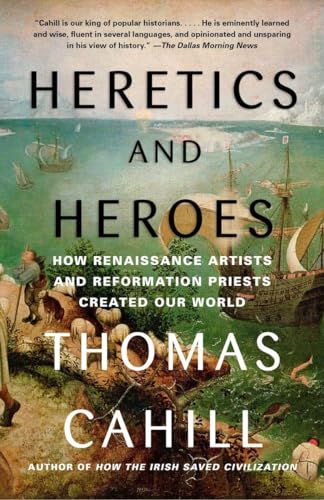
Inhaltsangabe
The New York Times bestselling author of How the Irish Saved Civilization reveals how the innovations of the Renaissance and the Reformation changed the Western world. • “Cahill is our king of popular historians.” —The Dallas Morning News
This was an age in which whole continents and peoples were discovered. It was an era of sublime artistic and scientific adventure, but also of newly powerful princes and armies—and of unprecedented courage, as thousands refused to bow their heads to the religious pieties of the past. In these exquisitely written and lavishly illustrated pages, Cahill illuminates, as no one else can, the great gift-givers who shaped our history—those who left us a world more varied and complex, more awesome and delightful, more beautiful and strong than the one they had found.
Die Inhaltsangabe kann sich auf eine andere Ausgabe dieses Titels beziehen.
Über die Autorin bzw. den Autor
THOMAS CAHILL’s appealing approach to distant history won the attention of millions of readers in North America and beyond. Cahill is the author of six volumes in the Hinges of History series: How the Irish Saved Civilization, The Gifts of the Jews, Desire of the Everlasting Hills, Sailing the Wine-Dark Sea, Mysteries of the Middle Ages, and Heretics and Heroes. They have been bestsellers not only in the United States but also in countries ranging from Italy to Brazil. He is also the author of A Saint on Death Row. He died in 2022.
Auszug. © Genehmigter Nachdruck. Alle Rechte vorbehalten.
Chapter I
NEW WORLDS FOR OLD
Innovation on Sea and Land
Winter completes an age
With its thorough levelling;
Heaven’s tourbillions of rage
Abolish the watchman’s tower
And delete the cedar grove.
As winter completes an age,
The eyes huddle like cattle, doubt
Seeps into the pores and power
Ebbs from the heavy signet ring;
The prophet’s lantern is out
And gone the boundary stone,
Cold the heart and cold the stove,
Ice condenses on the bone:
Winter completes an age.
Thus the perspicacious W. H. Auden in For the Time Being. Like seasons, ages are seldom so precise as to end abruptly, while allowing another age to commence. Few events of European history have been as final as the Black Death in bringing to an end one age (which we might call the Innocently Playful Medieval) and bringing into view another (which we might call the Colder Late Medieval–Early Renaissance). But even at this interstice, old forms and old mental states hang on, while new forms and new mental states peek uncertainly into view. Locality often determines how boldly or timidly the new will come to supplant the old; and localities can find their integrity, even their ancient right to existence, open to question. (“This village has always been crown territory.” “But which crown, England’s or France’s?” “Which religion, Christian or Muslim?” “Oh, and where, pray, is the boundary stone, the definitive separation between Us and Them?”)
At such a crossroads, it is difficult if not impossible to see much farther than one’s nose: the watchman’s tower is down and the prophet’s lantern out. Those who occupy traditional seats of power—those who use signet rings—may begin to find their perches less stable and secure, more open to question. The ordinary bloke, the commoner attempting to make his way in the world, is all too likely to experience a new if vague sense of unease, of doubt seeping into his pores like unhealthy air. It is not a time of dancing and embracing but of stepping back and taking stock. Yet life goes on: men travel and make deals, as they have always done; monarchs make decisions, as they have always done, with far-reaching and often unpredictable consequences.
1492: COLUMBUS DISCOVERS AMERICA
One such man was Christopher Columbus, born of undistinguished forebears near Genoa, long a shadowy petitioner at various European courts, now arrived at Córdoba to the new headquarters of Spanish royalty, the Alcázar, former stronghold of Muhammad XII, whom Spaniards called Boabdil; and two such monarchs were their Catholic Majesties Ferdinand and Isabella of Spain. The year was a fateful one, 1492. To it, historians, looking backwards, have assigned the final expiration of the Middle Ages and the (as yet unheralded) birth of a new age.
Many Americans will recall having suffered through a school pageant or two meant to dramatize the monumental encounter between the Genoese ship captain and the Spanish royal couple. And since such dramatizations invariably contain almost as much misinformation as they do historical fact, it is worth revisiting the great moment with a colder eye.
The ship captain was probably born in 1451 at or very near Genoa, the son of a weaver who also sold cheeses on the streets of Genoa, then of Savona, his son helping out at both locations (“Parmigiano! Mozzarella! Gorgonzola!!”). The boy would have been called Christoffa Corombo in his native Ligurian, later Cristóbal Colón by Spaniards. Since documents of any importance were written in Latin, his Latinized name, Christophorus Columbus, which appears in his own hand as well as in other records of the period, was easily Englished as Christopher Columbus. Though there have been numerous attempts to render Columbus as Jewish, or even Muslim, and to trace his origins to a European country other than Italy, there is no evidence to support such theories, but there is good evidence to support his birth as an Italian Catholic.
Genoa and Savona, ports on the Italian Riviera north of Corsica, offered adventurous boys many opportunities for seafaring apprenticeships. Columbus claimed to have first ventured to sea at the age of ten, and there is little reason to doubt him; surely by his late teens he was almost an old salt, and by his early twenties he had already docked as far away as the west coast of Africa, Chios in the Greek Aegean, Bristol on Britain’s west coast, Galway at the edge of the Atlantic, and probably Iceland. He also began to act as agent for a consortium of Genoese merchants, who traded far and wide. One of his voyages took him to Lisbon, where a brother, Bartolomeo, worked as a cartographer. In their collaboration we may glimpse the origin of Columbus’s great endeavor.
Thanks to the enormous expansion in world trade that had been booming for more than two centuries, Europeans of means had come to take for granted certain substances that did not originate in Europe, especially the spices, opiates, and silks of faraway Asia. No one (who was anyone) could any longer imagine doing without these things. But the fall of Greek Constantinople to the Ottoman Turks in 1453 had created a profound and permanent alteration in international affairs. It was of course still possible to extract the expected goodies from the Far East, but getting them past the Turks required both more cunning and more gold—and sometimes more blood—than had been previously required, considerably raising the price of the beloved commodities by the time they came to market. (Imagine if Americans could no longer afford chocolate, salt, or cocaine, or if most of the Wal-Marts closed down.) If Europeans could not dislodge the Turks—which they could not—what were they to do? At times, it seemed as if all the best practical minds of Europe were engaged in figuring out how to solve the problem. But think as much as they might, no one could come up with a solution. Except Columbus.
What he suggested made little sense. He proposed to sail around the world, heading west into the Ocean Sea (as it was then called) till he hit the Island of Cipangu (Japan, as identified in the writings of Marco Polo) or perhaps, if he was especially lucky, the fabulous coast of Cathay (China) itself. Maps of the period, inaccurate about many things, nonetheless show both the principal island of Japan (misshapen and lacking most of its fellow islands) and the coast of a strangely squeezed China. There are even attempts to sketch in the archipelagos of Malaysia and Indonesia.
The diameter of the spherical Earth had been calculated accurately by the Greek Eratosthenes in the second century BC, and his calculation was still widely known in the time of Columbus. Though no European foresaw what lay in wait for Columbus, since all thought mistakenly that the Ocean Sea, empty of land, was much larger than it was, almost all who could read and had looked into the subject understood that Columbus was seriously underestimating the overall size of the Earth.
Columbus, basing his calculations on inaccurate assumptions, theorized that the east coast of Asia could be reached by a European ship within a few weeks of its leaving port. The actual circumference of the Earth is about 40,000 kilometers, whereas Columbus assumed it to be closer to 25,000 kilometers. Compounding his mistake was his misreading—in a Latin translation—of a renowned ninth-century Persian astronomer, Ahmad ibn Muhammad ibn Kathir al-Farghani, known to the West as Alfraganus. The Persian’s correct measurements were...
„Über diesen Titel“ kann sich auf eine andere Ausgabe dieses Titels beziehen.
Suchergebnisse für Heretics and Heroes: How Renaissance Artists and Reformation...

Foto des Verkäufers
Heretics and Heroes: How Renaissance Artists and Reformation Priests Created Our World (The Hinges of History)
Anbieter: Dream Books Co., Denver, CO, USA
Verkäuferbewertung 5 von 5 Sternen

Zustand: acceptable. This copy has clearly been enjoyedâ"expect noticeable shelf wear and some minor creases to the cover. Binding is strong, and all pages are legible. May contain previous library markings or stamps. Artikel-Nr. DBV.0385495587.A
Gebraucht kaufen
EUR 3,66
Versand gratis
Versand innerhalb von USA
Versand innerhalb von USA
Anzahl: 2 verfügbar
Beispielbild für diese ISBN
Heretics and Heroes: How Renaissance Artists and Reformation Priests Created Our World (The Hinges of History)
Verlag:
Vintage (edition Illustrated), 2014
ISBN 10: 0385495587
ISBN 13: 9780385495585
Gebraucht
Paperback
Anbieter: BooksRun, Philadelphia, PA, USA
Verkäuferbewertung 5 von 5 Sternen
Paperback. Zustand: Fair. Illustrated. The item might be beaten up but readable. May contain markings or highlighting, as well as stains, bent corners, or any other major defect, but the text is not obscured in any way. Artikel-Nr. 0385495587-7-1
Gebraucht kaufen
EUR 4,93
Versand gratis
Versand innerhalb von USA
Versand innerhalb von USA
Anzahl: 1 verfügbar
Beispielbild für diese ISBN
Heretics and Heroes: How Renaissance Artists and Reformation Priests Created Our World
Anbieter: ThriftBooks-Dallas, Dallas, TX, USA
Verkäuferbewertung 5 von 5 Sternen
Paperback. Zustand: Good. No Jacket. Former library book; Pages can have notes/highlighting. Spine may show signs of wear. ~ ThriftBooks: Read More, Spend Less. Artikel-Nr. G0385495587I3N10
Gebraucht kaufen
EUR 5,73
Versand gratis
Versand innerhalb von USA
Versand innerhalb von USA
Anzahl: 1 verfügbar
Beispielbild für diese ISBN
Heretics and Heroes: How Renaissance Artists and Reformation Priests Created Our World
Anbieter: ThriftBooks-Dallas, Dallas, TX, USA
Verkäuferbewertung 5 von 5 Sternen
Paperback. Zustand: Fair. No Jacket. Readable copy. Pages may have considerable notes/highlighting. ~ ThriftBooks: Read More, Spend Less. Artikel-Nr. G0385495587I5N00
Gebraucht kaufen
EUR 5,73
Versand gratis
Versand innerhalb von USA
Versand innerhalb von USA
Anzahl: 1 verfügbar
Beispielbild für diese ISBN
Heretics and Heroes : How Renaissance Artists and Reformation Priests Created Our World
Verlag:
Knopf Doubleday Publishing Group, 2014
ISBN 10: 0385495587
ISBN 13: 9780385495585
Gebraucht
Softcover
Anbieter: Better World Books, Mishawaka, IN, USA
Verkäuferbewertung 5 von 5 Sternen
Zustand: Good. Former library copy. Pages intact with minimal writing/highlighting. The binding may be loose and creased. Dust jackets/supplements are not included. Includes library markings. Stock photo provided. Product includes identifying sticker. Better World Books: Buy Books. Do Good. Artikel-Nr. 8663474-6
Gebraucht kaufen
EUR 6,93
Versand gratis
Versand innerhalb von USA
Versand innerhalb von USA
Anzahl: 1 verfügbar
Beispielbild für diese ISBN
Heretics and Heroes : How Renaissance Artists and Reformation Priests Created Our World
Verlag:
Knopf Doubleday Publishing Group, 2014
ISBN 10: 0385495587
ISBN 13: 9780385495585
Gebraucht
Softcover
Anbieter: Better World Books, Mishawaka, IN, USA
Verkäuferbewertung 5 von 5 Sternen
Zustand: Good. Pages intact with minimal writing/highlighting. The binding may be loose and creased. Dust jackets/supplements are not included. Stock photo provided. Product includes identifying sticker. Better World Books: Buy Books. Do Good. Artikel-Nr. 484764-6
Gebraucht kaufen
EUR 6,93
Versand gratis
Versand innerhalb von USA
Versand innerhalb von USA
Anzahl: 5 verfügbar
Beispielbild für diese ISBN
Heretics and Heroes : How Renaissance Artists and Reformation Priests Created Our World
Verlag:
Knopf Doubleday Publishing Group, 2014
ISBN 10: 0385495587
ISBN 13: 9780385495585
Gebraucht
Softcover
Anbieter: Better World Books: West, Reno, NV, USA
Verkäuferbewertung 5 von 5 Sternen
Zustand: Very Good. Former library copy. Pages intact with possible writing/highlighting. Binding strong with minor wear. Dust jackets/supplements may not be included. Includes library markings. Stock photo provided. Product includes identifying sticker. Better World Books: Buy Books. Do Good. Artikel-Nr. GRP84285016
Gebraucht kaufen
EUR 6,93
Versand gratis
Versand innerhalb von USA
Versand innerhalb von USA
Anzahl: 1 verfügbar
Beispielbild für diese ISBN
Heretics and Heroes How Renais
Anbieter: World of Books (was SecondSale), Montgomery, IL, USA
Verkäuferbewertung 5 von 5 Sternen
Zustand: Very Good. Item in very good condition! Textbooks may not include supplemental items i.e. CDs, access codes etc. Artikel-Nr. 00108100172
Gebraucht kaufen
EUR 8,16
Versand gratis
Versand innerhalb von USA
Versand innerhalb von USA
Anzahl: 1 verfügbar
Beispielbild für diese ISBN
Heretics and Heroes How Renais
Anbieter: World of Books (was SecondSale), Montgomery, IL, USA
Verkäuferbewertung 5 von 5 Sternen
Zustand: Good. Item in good condition. Textbooks may not include supplemental items i.e. CDs, access codes etc. Artikel-Nr. 00106844399
Gebraucht kaufen
EUR 8,16
Versand gratis
Versand innerhalb von USA
Versand innerhalb von USA
Anzahl: 1 verfügbar
Beispielbild für diese ISBN
HERETICS AND HEROES : HOW RENAISSANCE ARTISTS AND REFORMATION PRIESTS CREATED OUR WORLD
Anbieter: Magers and Quinn Booksellers, Minneapolis, MN, USA
Verkäuferbewertung 5 von 5 Sternen
paperback. Zustand: Very Good. May have light to moderate shelf wear and/or a remainder mark. Complete. Clean pages. Artikel-Nr. 1078286
Gebraucht kaufen
EUR 5,73
EUR 3,42 Versand
Versand innerhalb von USA
Versand innerhalb von USA
Anzahl: 1 verfügbar