
Verwandte Artikel zu The Celtic Way of Prayer: The Recovery of the Religious...
Inhaltsangabe
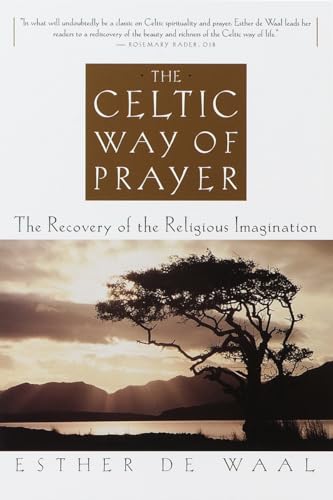
Esther de Waal, one of Celtic Christianity's preeminent scholars, shows how this tradition of worship draws on both the pre-Christian past and on the fullness of the Gospel. It is also an enlightening glimpse at the history, folklore, and liturgy of the Celtic people.
Esther de Waal introduces readers to monastic prayer and praise (the foundation stone of Celtic Christianity), early Irish litanies, medieval Welsh praise poems, and the wealth of blessings derived from an oral tradition that made prayer a part of daily life. Through this invigorating book, readers enter a world in which ritual and rhythm, nature and seasons, images and symbols play an essential role. A welcome contrast to modern worship, Celtic prayer is liberating and, like a living spring, forever fresh.
Die Inhaltsangabe kann sich auf eine andere Ausgabe dieses Titels beziehen.
Über die Autorin bzw. den Autor
Esther de Waal lives in a small cottage on the Welsh/English border. After studying and teaching history at Cambridge University, she married, had four sons, and moved to Canterbury, where she lived in a house that had been part of the medieval monastic community. She leads retreats, lectures, and travels widely. Her major interests are the fields of the Benedictine and Celtic traditions.
Von der hinteren Coverseite
al, one of Celtic Christianity's preeminent scholars, shows how this tradition of worship draws on both the pre-Christian past and on the fullness of the Gospel. It is also an enlightening glimpse at the history, folklore, and liturgy of the Celtic people.
Esther de Waal introduces readers to monastic prayer and praise (the foundation stone of Celtic Christianity), early Irish litanies, medieval Welsh praise poems, and the wealth of blessings derived from an oral tradition that made prayer a part of daily life. Through this invigorating book, readers enter a world in which ritual and rhythm, nature and seasons, images and symbols play an essential role. A welcome contrast to modern worship, Celtic prayer is liberating and, like a living spring, forever fresh.
Auszug. © Genehmigter Nachdruck. Alle Rechte vorbehalten.
Introduction
The rediscovery of the Celtic world has been an extraordinary revelation for many Christians in recent years, an opening up of the depths and riches within our own tradition that many of us had not before suspected. As I reflect on what it has meant to me, I think that above all it has enriched my understanding of prayer. It has taught me, and encouraged me into, a deeper, fuller way of prayer. I have come to see that the Celtic way of prayer is prayer with the whole of myself, a totality of praying that embraces the fullness of my own personhood, and allows me not only to pray with words but also, more important, with the heart, the feelings, using image and symbol, touching the springs of my imagination.
I like to think of it as a journey into prayer. The Celtic understanding of journeying is in itself so rich and so significant. It is peregrinatio, seeking, quest, adventure, wandering, exile--it is ultimately a journey, as I try to show in the first chapter, to find the place of my resurrection, the resurrected self, the self that I might hope to be, to become, the true self in Christ. This journey is possible only because I am finding my roots--that familiar paradox known in all monastic life and a reflection of basic human experience, that only if one is rooted at home in one's own self, in the place in which one finds oneself, is one able to move forward, to open up new boundaries, both exterior and interior, in other words, to embark on a life of continual and never-ending conversion, transformation. To find my roots takes me back to the part of my self that is more ancient than I am, and this is, of course, the power of the Celtic heritage. In my own case there are both my family roots, which are Scottish, and the place where I was born, and where I now once again live, which is the Border country of Wales. But for any of us the Celtic tradition is the ancient or elemental--a return to the elements, the earth, stone, fire, water, the ebb and flow of tides and seasons, the pattern of the year as it swings on its axis from Samhaine, November 1, when all grows dark, to Beltaine, May 1, the coming of light and spring. To pray the Celtic way means above all to be aware of this rhythm of dark and light. The dark and the light are themselves symbols of the Celtic refusal to deny darkness, pain, suffering and yet to exult in rejoicing, celebration in the fullness and goodness of life. This is in itself a recognition of the fullness of my own humanity.
Coming from the farthest fringes of the Western world, Celtic Christianity (an expression I prefer to use rather than speaking of the Celtic Church)1 --> keeps alive what is ancient Christian usage, usage which like that of the East comes from a deep central point before the Papacy began to tidy up and to rationalize. This was more difficult in Ireland, Scotland, and Wales, the Isle of Man, Cornwall and Brittany, the main Celtic areas, simply because of geographical distance and the lack of towns. This point is of more than antiquarian interest: It also speaks to me symbolically, taking me back to the ancient, the early, both in my own self, and in the experience of Christendom, where I encounter something basic, primal, fundamental, universal. I am taken back beyond the party labels and the denominational divisions of the Church today, beyond the divides of the Reformation or the schism of East and West. I am also taken beyond the split of intellect and feeling, of mind and heart, that came with the growth of the rational and analytical approach that the development of the universities brought to the European mind in the twelfth century. Here is something very profound. This deep point within the Christian tradition touches also some deep point in my own consciousness, my own deepest inner self.
This tapestry of the riches of the Celtic way of prayer has about it something of the variety of shapes and colors that I find in a page of the Book of Kells, and so I find myself asking where and how we can begin to unravel one of these extraordinary spirals or threads so that it leads us on into our exploration. I think that the essential starting point is the fact that Celtic Christianity was essentially monastic, as indeed the origins of Christianity in the whole of Britain were strictly monastic.2 --> The Celtic way of prayer was learned from the monasteries; it was from its religious communities that the people learned to pray. As a result, they learned that there was no separation of praying and living; praying and working flow into each other, so that life is to be punctuated by prayer, become prayer. If ordinary people took their ideas on prayer from this ideal of continual prayer, it should not really surprise us that when we uncover something of the way of praying that was handed down in the oral tradition and was collected in Scotland and Ireland at the end of the last century, what we find is lay spirituality, a household religion in which praying is inseparable from an ordinary daily working life.3 -->
Those earliest years in Ireland and Wales forged a powerful mix between monastic Christianity and what existed already in the people to whom this Christian message was now brought. It was the way in which Christianity responded to what it found in these lands that gives it its unique character and emphasis. The Celtic countries lay on the edge of the known Western world, largely outside the Roman Empire, a people lacking the social molds and mental framework and cultural infrastructure the Roman Empire brought elsewhere. These were a rural people, living close to the earth, close to stone and water, and their religious worship was shaped by their awareness of these elemental forces. They were a rural people for whom the clan, the tribe, and kinship were important, a close-knit people who thought of themselves in a corporate way as belonging to one another. They were a warrior people, a people whose myths and legends told them of heroes and heroic exploits. Above all, they were a people of the imagination, whose amazing artistic achievements in geometric design, filigree work, and enameling can be seen in La Tene art, and whose skill with words (spoken not written) flowered in poetry and storytelling. This was a society in which the poet held a highly respected place, played a professional role, and where storytelling was taken seriously and demanded many years of study and learning. All this was taken up by a Christianity that was not afraid of what it found but felt that it was natural to appropriate it into the fullness of Christian living and praying. So the Celtic way of prayer is a reflection of this: It is elemental, corporate, heroic, imaginative. This is its gift to us.
As I have gone deeper in my exploration of the Celtic heritage, I have found that it has touched me profoundly at many levels that had not hitherto been a familiar part of my twentieth-century upbringing and education. I discovered that if I wanted to encounter Celtic Christianity, I had to look at poetry, and so I found myself being taken into the world of poetry and song. My own religious upbringing had been so intellectual and cerebral, a matter of going to church, of reciting the Creed, of saying prayers. And instead here was a world that told me books were not enough, that books could not express the wonder of the world that God had made:
The Father created the world by a miracle;
it is difficult to express its measure.
Letters cannot contain it, letters cannot comprehend it.4 -->
The Celtic journey that I am describing in this book is unlike any other journey I know. Its shape and its end are different, as are the songs I sing while I journey, the company I keep along the road. I have been brought into contact with the visual and the nonverbal, confronted by the power of image and of symbol. I have found...
„Über diesen Titel“ kann sich auf eine andere Ausgabe dieses Titels beziehen.
Suchergebnisse für The Celtic Way of Prayer: The Recovery of the Religious...

Beispielbild für diese ISBN
The Celtic Way of Prayer: The Recovery of the Religious Imagination
Anbieter: World of Books (was SecondSale), Montgomery, IL, USA
Verkäuferbewertung 5 von 5 Sternen

Paperback. Zustand: Fair. Esther de Waal, one of Celtic Christianity's preeminent scholars, shows how this tradition of worship draws on both the pre-Christian past and on the fullness of the Gospel. It is also an enlightening glimpse at the history, folklore, and liturgy of the Celtic people. Esther de Waal introduces readers to monastic prayer and praise (the foundation stone of Celtic Christianity), early Irish litanies, medieval Welsh praise poems, and the wealth of blessings derived from an oral tradition that made prayer a part of daily life. Through this invigorating book, readers enter a world in which ritual and rhythm, nature and seasons, images and symbols play an essential role. A welcome contrast to modern worship, Celtic prayer is liberating and, like a living spring, forever fresh. Artikel-Nr. 00107491790
Gebraucht kaufen
EUR 5,33
Versand gratis
Versand innerhalb von USA
Versand innerhalb von USA
Anzahl: 1 verfügbar
Beispielbild für diese ISBN
The Celtic Way of Prayer: The Recovery of the Religious Imagination
Anbieter: World of Books (was SecondSale), Montgomery, IL, USA
Verkäuferbewertung 5 von 5 Sternen
Paperback. Zustand: Good. Esther de Waal, one of Celtic Christianity's preeminent scholars, shows how this tradition of worship draws on both the pre-Christian past and on the fullness of the Gospel. It is also an enlightening glimpse at the history, folklore, and liturgy of the Celtic people. Esther de Waal introduces readers to monastic prayer and praise (the foundation stone of Celtic Christianity), early Irish litanies, medieval Welsh praise poems, and the wealth of blessings derived from an oral tradition that made prayer a part of daily life. Through this invigorating book, readers enter a world in which ritual and rhythm, nature and seasons, images and symbols play an essential role. A welcome contrast to modern worship, Celtic prayer is liberating and, like a living spring, forever fresh. Artikel-Nr. 00104544112
Gebraucht kaufen
EUR 5,33
Versand gratis
Versand innerhalb von USA
Versand innerhalb von USA
Anzahl: 10 verfügbar
Beispielbild für diese ISBN
The Celtic Way of Prayer: The Recovery of the Religious Imagination
Verlag:
Prh Christian Publishing, 1999
ISBN 10: 0385493746
ISBN 13: 9780385493741
Gebraucht
Paperback
Anbieter: ThriftBooks-Phoenix, Phoenix, AZ, USA
Verkäuferbewertung 5 von 5 Sternen
Paperback. Zustand: Fair. No Jacket. Readable copy. Pages may have considerable notes/highlighting. ~ ThriftBooks: Read More, Spend Less. Artikel-Nr. G0385493746I5N00
Gebraucht kaufen
EUR 5,99
Versand gratis
Versand innerhalb von USA
Versand innerhalb von USA
Anzahl: 1 verfügbar
Beispielbild für diese ISBN
The Celtic Way of Prayer: The Recovery of the Religious Imagination
Verlag:
Prh Christian Publishing, 1999
ISBN 10: 0385493746
ISBN 13: 9780385493741
Gebraucht
Paperback
Anbieter: ThriftBooks-Dallas, Dallas, TX, USA
Verkäuferbewertung 5 von 5 Sternen
Paperback. Zustand: Good. No Jacket. Pages can have notes/highlighting. Spine may show signs of wear. ~ ThriftBooks: Read More, Spend Less. Artikel-Nr. G0385493746I3N00
Gebraucht kaufen
EUR 5,99
Versand gratis
Versand innerhalb von USA
Versand innerhalb von USA
Anzahl: 3 verfügbar
Beispielbild für diese ISBN
The Celtic Way of Prayer: The Recovery of the Religious Imagination
Verlag:
Prh Christian Publishing, 1999
ISBN 10: 0385493746
ISBN 13: 9780385493741
Gebraucht
Paperback
Anbieter: ThriftBooks-Dallas, Dallas, TX, USA
Verkäuferbewertung 5 von 5 Sternen
Paperback. Zustand: Very Good. No Jacket. May have limited writing in cover pages. Pages are unmarked. ~ ThriftBooks: Read More, Spend Less. Artikel-Nr. G0385493746I4N00
Gebraucht kaufen
EUR 5,99
Versand gratis
Versand innerhalb von USA
Versand innerhalb von USA
Anzahl: 1 verfügbar
Beispielbild für diese ISBN
The Celtic Way of Prayer: The Recovery of the Religious Imagination
Verlag:
Prh Christian Publishing, 1999
ISBN 10: 0385493746
ISBN 13: 9780385493741
Gebraucht
Paperback
Anbieter: ThriftBooks-Atlanta, AUSTELL, GA, USA
Verkäuferbewertung 5 von 5 Sternen
Paperback. Zustand: Good. No Jacket. Pages can have notes/highlighting. Spine may show signs of wear. ~ ThriftBooks: Read More, Spend Less. Artikel-Nr. G0385493746I3N00
Gebraucht kaufen
EUR 5,99
Versand gratis
Versand innerhalb von USA
Versand innerhalb von USA
Anzahl: 3 verfügbar
Beispielbild für diese ISBN
The Celtic Way of Prayer: The Recovery of the Religious Imagination
Verlag:
Prh Christian Publishing, 1999
ISBN 10: 0385493746
ISBN 13: 9780385493741
Gebraucht
Paperback
Anbieter: ThriftBooks-Dallas, Dallas, TX, USA
Verkäuferbewertung 5 von 5 Sternen
Paperback. Zustand: Fair. No Jacket. Readable copy. Pages may have considerable notes/highlighting. ~ ThriftBooks: Read More, Spend Less. Artikel-Nr. G0385493746I5N00
Gebraucht kaufen
EUR 5,99
Versand gratis
Versand innerhalb von USA
Versand innerhalb von USA
Anzahl: 1 verfügbar
Beispielbild für diese ISBN
The Celtic Way of Prayer: The Recovery of the Religious Imagination
Verlag:
Prh Christian Publishing, 1999
ISBN 10: 0385493746
ISBN 13: 9780385493741
Gebraucht
Paperback
Anbieter: ThriftBooks-Atlanta, AUSTELL, GA, USA
Verkäuferbewertung 5 von 5 Sternen
Paperback. Zustand: Very Good. No Jacket. May have limited writing in cover pages. Pages are unmarked. ~ ThriftBooks: Read More, Spend Less. Artikel-Nr. G0385493746I4N00
Gebraucht kaufen
EUR 5,99
Versand gratis
Versand innerhalb von USA
Versand innerhalb von USA
Anzahl: 1 verfügbar
Beispielbild für diese ISBN
The Celtic Way of Prayer: The Recovery of the Religious Imagination
Verlag:
Prh Christian Publishing, 1999
ISBN 10: 0385493746
ISBN 13: 9780385493741
Gebraucht
Paperback
Anbieter: ThriftBooks-Reno, Reno, NV, USA
Verkäuferbewertung 5 von 5 Sternen
Paperback. Zustand: Good. No Jacket. Pages can have notes/highlighting. Spine may show signs of wear. ~ ThriftBooks: Read More, Spend Less. Artikel-Nr. G0385493746I3N00
Gebraucht kaufen
EUR 5,99
Versand gratis
Versand innerhalb von USA
Versand innerhalb von USA
Anzahl: 2 verfügbar
Beispielbild für diese ISBN
The Celtic Way of Prayer: The Recovery of the Religious Imagination
Verlag:
Prh Christian Publishing, 1999
ISBN 10: 0385493746
ISBN 13: 9780385493741
Gebraucht
Paperback
Anbieter: ThriftBooks-Phoenix, Phoenix, AZ, USA
Verkäuferbewertung 5 von 5 Sternen
Paperback. Zustand: Good. No Jacket. Pages can have notes/highlighting. Spine may show signs of wear. ~ ThriftBooks: Read More, Spend Less. Artikel-Nr. G0385493746I3N00
Gebraucht kaufen
EUR 5,99
Versand gratis
Versand innerhalb von USA
Versand innerhalb von USA
Anzahl: 2 verfügbar