Inhaltsangabe
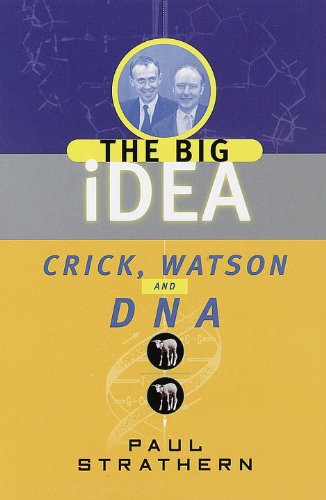
Chronicling the birth of modern genetic science, the author focuses on Francis Crick and James Watson, the researchers who discovered the DNA molecule in the midst of often fierce international competition in the 1950s. Original.
Die Inhaltsangabe kann sich auf eine andere Ausgabe dieses Titels beziehen.
Über die Autorin bzw. den Autor
Paul Strathern has lectured in philosophy and mathematics at Kingston University.
Auszug. © Genehmigter Nachdruck. Alle Rechte vorbehalten.
On the Way to DNA: A History of Genetics
UNTIL LITTLE OVER a century ago, genetics was mostly old wives' tales. People saw what happened, but had no idea how or why it happened.
References to genetics go back as far as biblical times. According to Genesis, Jacob had a method for making sure that his sheep and goats gave birth to spotted and speckled offspring. He did this by making them breed in front of sticks with strips of peeled bark which had a similar mottled effect.
More realistically, the Babylonians understood that for a date palm to be fruitful, pollen from the male palm had to be introduced to the pistils of the female palm.
The ancient Greek philosophers were the first to look at the world in a recognizably scientific fashion. As a result they produced theories about almost everything, and genetics was no exception. Aristotle's observations led him to conclude that the male and female do not make equal contributions to their offspring. Their contributions are qualitatively different: the female gives "matter," the male gives "motion."
A prevalent belief in ancient times held that if a female had previously mated and had progeny, the characteristics of their father would appear in the woman's subsequent progeny by any other male. This fairy story was even dignified with a pseudo-scientific name by the ancient Greeks, who called it telegony (meaning "distant-begetting").
A more interesting theory was pangenesis, which held that each organ and substance of the body secreted its own particles, which then combined to form the embryo.
Such beliefs recur in genetic theory through the centuries, in a manner curiously similar to the actual recurrence of genetic traits. (Pangenesis was to pop up for well over 2000 years, and was even accepted by Darwin.)
Biology, and with it genetics, crossed the threshold into science in the seventeenth century. This was almost entirely due to the microscope, which was invented by the Dutch lens-grinder and counterfeiter Zacharias Jansen in the early 1600s. Microscopes led to the discovery of the cell. (This term was first used by the British physicist Robert Hooke, but was in fact misapplied to the tiny spaces left by dead cells, which reminded him of prison cells.)
The discovery of sex cells (or germ cells) caused great excitement. Soon overenthusiastic microscopists were convinced that they had observed "homunculi" (tiny human forms) inside the cells, and it looked as if the problem of reproduction was solved. More importantly, the English botanist Nehemiah Grew speculated that plants and animals were "contrivances of the same wisdom." He suggested that plants too have sexual organs and exhibit sexual behavior. When the pioneer Swedish biologist Carl Linnaeus introduced his classification for species of plants and animals, the way was opened for more systematic research. The study of hybrids led to further speculation about the nature of genetic material.
For centuries it had been widely accepted that heredity was transmitted by "blood." (Hence the origin of such commonplace expressions as "blue blood," "blood line," "mixed blood" and so forth.) This was not only loose, but inadequate. How could the same parents produce differing offspring from the same "blood"? Also, what accounted for the appearance of characteristics not present in either parent, but seen in long-dead ancestors and distant relatives? For instance, in thoroughbred racehorse breeding, piebalds have been known to recur after a gap of dozens of generations. (This example reveals one of the great lost opportunities of genetics. All English thoroughbreds are descended from the forty-three "Royal Mares" imported by Charles II, and three Oriental stallions imported a few years earlier. The breeding books trace each bloodline back to its origins, with notes on the characteristics of each progeny. Well over a century before genetics was born, any Newmarket trainer had at his fingertips sufficient material to found this science.)
By the mid-eighteenth century the scientists had at last started speculating along lines that were obvious to any racehorse breeder. The idea of evolution began to circulate. One of the early developers of this idea was the eighteenth-century philosopher-poet-scientist Erasmus Darwin (grandfather of the famous Charles). Erasmus Darwin was convinced that species were capable of change. Any creature with "lust, hunger and a desire for security" would organically adapt to its surroundings. But how?
„Über diesen Titel“ kann sich auf eine andere Ausgabe dieses Titels beziehen.
Weitere beliebte Ausgaben desselben Titels

Suchergebnisse für Crick, Watson, and DNA (Big Idea Series)

Beispielbild für diese ISBN
Crick, Watson and DNA: The Big Idea (Big Idea Series)
Anbieter: Wonder Book, Frederick, MD, USA
Verkäuferbewertung 5 von 5 Sternen

Zustand: Very Good. Very Good condition. A copy that may have a few cosmetic defects. May also contain light spine creasing or a few markings such as an owner's name, short gifter's inscription or light stamp. Bundled media such as CDs, DVDs, floppy disks or access codes may not be included. Artikel-Nr. H06L-00387
Gebraucht kaufen
EUR 5,31
Versand gratis
Versand innerhalb von USA
Versand innerhalb von USA
Anzahl: 1 verfügbar
Beispielbild für diese ISBN
Crick, Watson and DNA : The Big Idea
Verlag:
Knopf Doubleday Publishing Group, 1999
ISBN 10: 0385492456
ISBN 13: 9780385492454
Gebraucht
Softcover
Anbieter: Better World Books, Mishawaka, IN, USA
Verkäuferbewertung 5 von 5 Sternen
Zustand: Very Good. Used book that is in excellent condition. May show signs of wear or have minor defects. Artikel-Nr. 46602275-6
Gebraucht kaufen
EUR 5,73
Versand gratis
Versand innerhalb von USA
Versand innerhalb von USA
Anzahl: 1 verfügbar
Beispielbild für diese ISBN
Crick, Watson and DNA : The Big Idea
Verlag:
Knopf Doubleday Publishing Group, 1999
ISBN 10: 0385492456
ISBN 13: 9780385492454
Gebraucht
Softcover
Anbieter: Better World Books, Mishawaka, IN, USA
Verkäuferbewertung 5 von 5 Sternen
Zustand: Very Good. Former library book; may include library markings. Used book that is in excellent condition. May show signs of wear or have minor defects. Artikel-Nr. 14192722-75
Gebraucht kaufen
EUR 5,73
Versand gratis
Versand innerhalb von USA
Versand innerhalb von USA
Anzahl: 1 verfügbar
Beispielbild für diese ISBN
Crick, Watson and DNA: The Big Idea (Big Idea Series)
Anbieter: WeSavings LLC, MONTGOMERY, TX, USA
Verkäuferbewertung 5 von 5 Sternen
Paperback. Zustand: Good. No Jacket. X-Library book. Typical library markings. Ships promptly from Texas. 100% Money-Back Guarantee!!! Artikel-Nr. 5B-OXNF-LMFZ
Gebraucht kaufen
EUR 6,42
Versand gratis
Versand innerhalb von USA
Versand innerhalb von USA
Anzahl: 1 verfügbar