
Verwandte Artikel zu The 80/20 Principle, Expanded and Updated: The Secret...
Inhaltsangabe
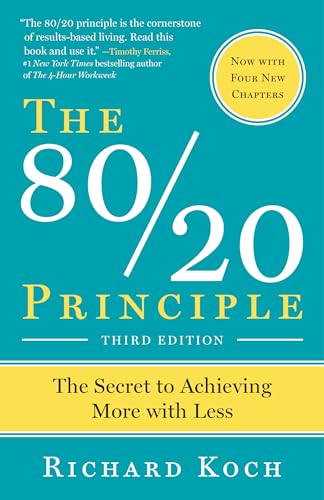
Be more effective with less effort by learning how to identify and leverage the 80/20 principle: that 80 percent of all our results in business and in life stem from a mere 20 percent of our efforts.
The 80/20 principle is one of the great secrets of highly effective people and organizations.
Did you know, for example, that 20 percent of customers account for 80 percent of revenues? That 20 percent of our time accounts for 80 percent of the work we accomplish? The 80/20 Principle shows how we can achieve much more with much less effort, time, and resources, simply by identifying and focusing our efforts on the 20 percent that really counts. Although the 80/20 principle has long influenced today's business world, author Richard Koch reveals how the principle works and shows how we can use it in a systematic and practical way to vastly increase our effectiveness, and improve our careers and our companies.
The unspoken corollary to the 80/20 principle is that little of what we spend our time on actually counts. But by concentrating on those things that do, we can unlock the enormous potential of the magic 20 percent, and transform our effectiveness in our jobs, our careers, our businesses, and our lives.
Die Inhaltsangabe kann sich auf eine andere Ausgabe dieses Titels beziehen.
Über die Autorin bzw. den Autor
Richard Koch is the bestselling author of The 80/20 Individual. An extraordinarily successful entrepreneur, his ventures have included consulting for hotels, restaurants, personal organizers, and the distilling industry. A former consultant with The Boston Consulting Group and former partner of Bain and Company, he currently lives in London, England.
Von der hinteren Coverseite
an be more effective with less effort by learning how to identify and leverage the 80/20 principle--the well-known, unpublicized secret that 80 percent of all our results in business and in life stem from a mere 20 percent of our efforts.
The 80/20 principle is one of the great secrets of highly effective people and organizations.
Did you know, for example, that 20 percent of customers account for 80 percent of revenues? That 20 percent of our time accounts for 80 percent of the work we accomplish? The 80/20 Principle shows how we can achieve much more with much less effort, time, and resources, simply by identifying and focusing our efforts on the 20 percent that really counts. Although the 80/20 principle has long influenced today's business world, author Richard Koch reveals how the principle works and shows how we can use it in a systematic and practical way to vastly increase our effectiveness, and improve our careers and our companies.
The unsp
Auszug. © Genehmigter Nachdruck. Alle Rechte vorbehalten.
Introduction: Welcome to the 80/20 Principle
For a very long time, the Pareto law [the 80/20 Principle] has lumbered the economic scene like an erratic block on the landscape; an empirical law which nobody can explain.
--Josef Steindl
The 80/20 Principle can and should be used by every intelligent person in their daily life, by every organization, and by every social grouping and form of society. It can help individuals and groups achieve much more, with much less effort. The 80/20 Principle can raise personal effectiveness and happiness. It can multiply the profitability of corporations and the effectiveness of any organization. It even holds the key to raising the quality and quantity of public services while cutting their cost. This book, the first ever on the 80/20 Principle, is written from a burning conviction, validated in personal and business experience, that this principle is one of the best ways of dealing with and transcending the pressures of modern life.
What is the 80/20 Principle?
The 80/20 Principle asserts that a minority of causes, inputs, or effort usually lead to a majority of the results, outputs, or rewards. Taken literally, this means that, for example, 80 percent of what you achieve in your job comes from 20 percent of the time spent. Thus for all practical purposes, four-fifths of the effort--a dominant part of it--is largely irrelevant. This is contrary to what people normally expect.
So the 80/20 Principle states that there is an inbuilt imbalance between causes and results, inputs and outputs, and effort and reward. A good benchmark for this imbalance is provided by the 80/20 relationship: a typical pattern will show that 80 percent of outputs result from 20 percent of inputs; that 80 percent of consequences flow from 20 percent of causes; or that 80 percent of results come from 20 percent of effort.
In business, many examples of the 80/20 Principle have been validated. Twenty percent of products usually account for about 80 percent of dollar sales value; so do 20 percent of customers. Twenty percent of products or customers usually also account for about 80 percent of an organization's profits.
In society, 20 percent of criminals account for 80 percent of the value of all crime. Twenty percent of motorists cause 80 percent of accidents. Twenty percent of those who marry comprise 80 percent of the divorce statistics (those who consistently remarry and redivorce distort the statistics and give a lopsidedly pessimistic impression of the extent of marital fidelity). Twenty percent of children attain 80 percent of educational qualifications available.
In the home, 20 percent of your carpets are likely to get 80 percent of the wear. Twenty percent of your clothes will be worn 80 percent of the time. And if you have an intruder alarm, 80 percent of the false alarms will be set off by 20 percent of the possible causes.
The internal combustion engine is a great tribute to the 80/20 Principle. Eighty percent of the energy is wasted in combustion and only 20 percent gets to the wheels; this 20 percent of the input generates 100 percent of the output!
Pareto's discovery: systematic and predictable lack of balance
The pattern underlying the 80/20 Principle was discovered in 1897, about 100 years ago, by Italian economist Vilfredo Pareto (1848-1923). His discovery has since been called many names, including the Pareto Principle, the Pareto Law, the 80/20 Rule, the Principle of Least Effort, and the Principle of Imbalance; throughout this book we will call it the 80/20 Principle. By a subterranean process of influence on many important achievers, especially business people, computer enthusiasts and quality engineers, the 80/20 Principle has helped to shape the modern world. Yet it has remained one of the great secrets of our time--and even the select band of cognoscenti who know and use the 80/20 Principle only exploit a tiny proportion of its power.
So what did Vilfredo Pareto discover? He happened to be looking at patterns of wealth and income in nineteenth-century England. He found that most income and wealth went to a minority of the people in his samples. Perhaps there was nothing very surprising in this. But he also discovered two other facts that he thought highly significant. One was that there was a consistent mathematical relationship between the proportion of people (as a percentage of the total relevant population) and the amount of income or wealth that this group enjoyed. To simplify, if 20 percent of the population enjoyed 80 percent of the wealth, then you could reliably predict that 10 percent would have, say, 65 percent of the wealth, and 5 percent would have 50 percent. The key point is not the percentages, but the fact that the distribution of wealth across the population was predictably unbalanced.
Pareto's other finding, one that really excited him, was that this pattern of imbalance was repeated consistently whenever he looked at data referring to different time periods or different countries. Whether he looked at England in earlier times, or whatever data were available from other countries in his own time or earlier, he found the same pattern repeating itself, over and over again, with mathematical precision.
Was this a freak coincidence, or something that had great importance for economics and society? Would it work if applied to sets of data relating to things other than wealth or income? Pareto was a terrific innovator, because before him no one had looked at two related sets of data--in this case, the distribution of incomes or wealth, compared to the number of income earners or property owners--and compared percentages between the two sets of data. (Nowadays this method is commonplace and has led to major breakthroughs in business and economics.)
Sadly, although Pareto realized the importance and wide range of his discovery, he was very bad at explaining it. He moved on to a series of fascinating but rambling sociological theories, centering on the role of elites, which were hijacked at the end of his life by Mussolini's fascists. The significance of the 80/20 Principle lay dormant for a generation. While a few economists, especially in the US, realized its importance, it was not until after the Second World War that two parallel yet completely different pioneers began to make waves with the 80/20 Principle.
1949: Zipf's Principle of Least Effort
One of these pioneers was the Harvard professor of philology, George K. Zipf. In 1949 Zipf discovered the "Principle of Least Effort," which was actually a rediscovery and elaboration of Pareto's principle. Zipf's principle said that resources (people, goods, time, skills, or anything else that is productive) tended to arrange themselves so as to minimize work, so that approximately 20-30 per cent of any resource accounted for 70-80 per cent of the activity related to that resource.
Professor Zipf used population statistics, books, philology, and industrial behavior to show the consistent recurrence of this unbalanced pattern. For example, he analyzed all the Philadelphia marriage licenses granted in 1931 in a 20-block area, demonstrating that 70 percent of the marriages occurred between people who lived within 30 percent of the distance.
Incidentally, Zipf also provided a scientific justification for the messy desk by justifying clutter with another law: frequency of use...
„Über diesen Titel“ kann sich auf eine andere Ausgabe dieses Titels beziehen.
Suchergebnisse für The 80/20 Principle, Expanded and Updated: The Secret...

Foto des Verkäufers
The 80/20 Principle: The Secret to Achieving More with Less
Anbieter: Dream Books Co., Denver, CO, USA
Verkäuferbewertung 5 von 5 Sternen

Zustand: good. Gently used with minimal wear on the corners and cover. A few pages may contain light highlighting or writing, but the text remains fully legible. Dust jacket may be missing, and supplemental materials like CDs or codes may not be included. May be ex-library with library markings. Ships promptly! Artikel-Nr. DBV.0385491743.G
Gebraucht kaufen
EUR 3,87
Versand gratis
Versand innerhalb von USA
Versand innerhalb von USA
Anzahl: 5 verfügbar
Beispielbild für diese ISBN
The 80/20 Principle: The Secret to Achieving More with Less
Verlag:
Crown Currency (edition Reprint), 1999
ISBN 10: 0385491743
ISBN 13: 9780385491747
Gebraucht
Paperback
Anbieter: BooksRun, Philadelphia, PA, USA
Verkäuferbewertung 5 von 5 Sternen
Paperback. Zustand: Very Good. Reprint. It's a well-cared-for item that has seen limited use. The item may show minor signs of wear. All the text is legible, with all pages included. It may have slight markings and/or highlighting. Artikel-Nr. 0385491743-11-1
Gebraucht kaufen
EUR 5,09
Versand gratis
Versand innerhalb von USA
Versand innerhalb von USA
Anzahl: 2 verfügbar
Beispielbild für diese ISBN
The 80/20 Principle: The Secret to Achieving More with Less
Verlag:
Crown Currency (edition Reprint), 1999
ISBN 10: 0385491743
ISBN 13: 9780385491747
Gebraucht
Paperback
Anbieter: BooksRun, Philadelphia, PA, USA
Verkäuferbewertung 5 von 5 Sternen
Paperback. Zustand: Fair. Reprint. The item might be beaten up but readable. May contain markings or highlighting, as well as stains, bent corners, or any other major defect, but the text is not obscured in any way. Artikel-Nr. 0385491743-7-1
Gebraucht kaufen
EUR 5,27
Versand gratis
Versand innerhalb von USA
Versand innerhalb von USA
Anzahl: 1 verfügbar
Beispielbild für diese ISBN
The 80/20 Principle, Expanded and Updated: The Secret to Achieving More with Less
Anbieter: ThriftBooks-Dallas, Dallas, TX, USA
Verkäuferbewertung 5 von 5 Sternen
Paperback. Zustand: Very Good. No Jacket. May have limited writing in cover pages. Pages are unmarked. ~ ThriftBooks: Read More, Spend Less. Artikel-Nr. G0385491743I4N00
Gebraucht kaufen
EUR 5,96
Versand gratis
Versand innerhalb von USA
Versand innerhalb von USA
Anzahl: 4 verfügbar
Beispielbild für diese ISBN
The 80/20 Principle, Expanded and Updated: The Secret to Achieving More with Less
Anbieter: ThriftBooks-Reno, Reno, NV, USA
Verkäuferbewertung 5 von 5 Sternen
Paperback. Zustand: Very Good. No Jacket. Former library book; May have limited writing in cover pages. Pages are unmarked. ~ ThriftBooks: Read More, Spend Less. Artikel-Nr. G0385491743I4N10
Gebraucht kaufen
EUR 5,96
Versand gratis
Versand innerhalb von USA
Versand innerhalb von USA
Anzahl: 2 verfügbar
Beispielbild für diese ISBN
The 80/20 Principle, Expanded and Updated: The Secret to Achieving More with Less
Anbieter: ThriftBooks-Dallas, Dallas, TX, USA
Verkäuferbewertung 5 von 5 Sternen
Paperback. Zustand: Good. No Jacket. Former library book; Pages can have notes/highlighting. Spine may show signs of wear. ~ ThriftBooks: Read More, Spend Less. Artikel-Nr. G0385491743I3N10
Gebraucht kaufen
EUR 5,96
Versand gratis
Versand innerhalb von USA
Versand innerhalb von USA
Anzahl: 2 verfügbar
Beispielbild für diese ISBN
The 80/20 Principle, Expanded and Updated: The Secret to Achieving More with Less
Anbieter: ThriftBooks-Atlanta, AUSTELL, GA, USA
Verkäuferbewertung 5 von 5 Sternen
Paperback. Zustand: Fair. No Jacket. Readable copy. Pages may have considerable notes/highlighting. ~ ThriftBooks: Read More, Spend Less. Artikel-Nr. G0385491743I5N00
Gebraucht kaufen
EUR 5,96
Versand gratis
Versand innerhalb von USA
Versand innerhalb von USA
Anzahl: 3 verfügbar
Beispielbild für diese ISBN
The 80/20 Principle, Expanded and Updated: The Secret to Achieving More with Less
Anbieter: ThriftBooks-Reno, Reno, NV, USA
Verkäuferbewertung 5 von 5 Sternen
Paperback. Zustand: Good. No Jacket. Former library book; Pages can have notes/highlighting. Spine may show signs of wear. ~ ThriftBooks: Read More, Spend Less. Artikel-Nr. G0385491743I3N10
Gebraucht kaufen
EUR 5,96
Versand gratis
Versand innerhalb von USA
Versand innerhalb von USA
Anzahl: 2 verfügbar
Beispielbild für diese ISBN
The 80/20 Principle, Expanded and Updated: The Secret to Achieving More with Less
Anbieter: ThriftBooks-Dallas, Dallas, TX, USA
Verkäuferbewertung 5 von 5 Sternen
Paperback. Zustand: Fair. No Jacket. Readable copy. Pages may have considerable notes/highlighting. ~ ThriftBooks: Read More, Spend Less. Artikel-Nr. G0385491743I5N00
Gebraucht kaufen
EUR 5,96
Versand gratis
Versand innerhalb von USA
Versand innerhalb von USA
Anzahl: 2 verfügbar
Beispielbild für diese ISBN
The 80/20 Principle, Expanded and Updated: The Secret to Achieving More with Less
Anbieter: ThriftBooks-Phoenix, Phoenix, AZ, USA
Verkäuferbewertung 5 von 5 Sternen
Paperback. Zustand: Very Good. No Jacket. Former library book; May have limited writing in cover pages. Pages are unmarked. ~ ThriftBooks: Read More, Spend Less. Artikel-Nr. G0385491743I4N10
Gebraucht kaufen
EUR 5,96
Versand gratis
Versand innerhalb von USA
Versand innerhalb von USA
Anzahl: 1 verfügbar