
Verwandte Artikel zu Zora Neale Hurston: A Life in Letters
Inhaltsangabe
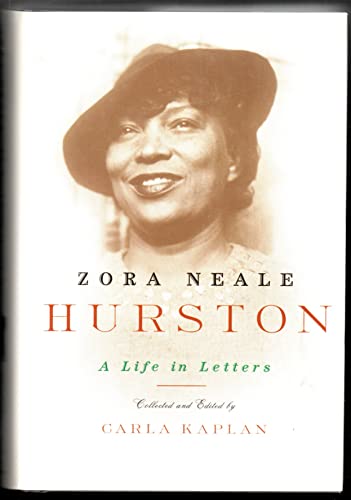
A groundbreaking collection of more than five hundred letters, written to such people as Langston Hughes, Dorothy West, Fannie Hurst, and many others, paints an intimate portrait of the enigmatic woman who became one of the greatest literary figures in American history.
Die Inhaltsangabe kann sich auf eine andere Ausgabe dieses Titels beziehen.
Über die Autorinnen und Autoren
CARLA KAPLAN is a professor of English at the University of Southern California and a noted Hurston scholar. She is the author of The Erotics of Talk: Women's Writings and Feminist Paradigms. She lives in Los Angeles, California.
Carla Kaplan is Professor of English, Gender Studies, and American & Ethnic Studies at the University of Southern California.
Aus dem Klappentext
A landmark collection of more than five hundred letters written by a woman at the heart of the Harlem Renaissanc--an author who remains one of the most intriguing people in American cultural history.
Alice Walker s 1975 Ms. magazine article "Looking for Zora" reintroduced Zora Neale Hurston to the American literary landscape, and ushered in a virtual renaissance for a writer who was a bestselling author at her peak in the 1930s, but died penniless and in obscurity some three decades later.
Since that rediscovery of novelist, anthropologist, playwright, folklorist, essayist, and poet Zora Neale Hurston, her books--from the classic love story Their Eyes Were Watching God to her controversial autobiography, Dust Tracks on the Road--have sold millions of copies. Hurston is now taught in American, African American, and women's studies courses in high schools and universities from coast to coast.
Now, in Zora Neale Hurston: A Life in Letters, the fascinating life of one of the most enigmatic literary figures of the twentieth century comes alive. Through letters to Harlem Renaissance friends Langston Hughes, Alain Locke, Dorothy West, and Carl Van Vechten, and to bestselling author Marjorie Kinnan Rawlings and Fannie Hurst, among others, readers experience the exuberance and trials of Hurston s life. Her letters to her patron, Mrs. Charlotte "Godmother" Osgood Mason, are laced with equal amounts of cynicism and reverence, and offer a fascinating glimpse of the perilously thin line Hurston tread to maintain vital monetary support as she pursued her art and avant-garde lifestyle (which included crossing the country collecting folklore, and a job as story editor at Paramount Pictures in the 1940s).
Meticulously edited and annotated, this landmark collection of letters will provide her fans, as well as those discovering Hurston for the first time, with a penetrating and profound portrait into the life, writings (four novels, a play, an autobiography, and countless essays), and impressive imagination of one of the most amazing characters to grace American letters.
Auszug. © Genehmigter Nachdruck. Alle Rechte vorbehalten.
Chapter 1
"DE TALKIN' GAME"
The Twenties (and Before)
First and foremost a storyteller, with profound appreciation for the power of a well-crafted tale, Hurston moved to New York in 1925 and used her storytelling talent to refashion her life along mythic lines, erasing everything that didn't contribute to the new person she had determined to create. That person would have known hardships and hard times, but mostly in a general way. She might have disappointments, but they would never become obstacles. She would be tough and independent and young (in her early twenties, like her friends). Above all, she would be game for everything, full of enthusiasm and ideas. Nothing would be beyond her. She would live up to her proud heritage as a daughter of Eatonville, America's first incorporated all-black town--even if that meant starting over from scratch.
Accordingly, the only full-scale biography of Zora Neale Hurston starts by describing how "in the first week of January, 1925, Zora Neale Hurston arrived in New York."1 Hurston begins her life over again in the twenties, establishing herself as a writer, social scientist, and active member of the nation's first major upsurge of African American arts.
During this period, she developed her own aesthetic: an embroidered realism equally committed to liveliness and accuracy. Her developing style as a writer mirrored her personality: hardheaded and sentimental, constrained and effusive, objective and fanciful, all at the same time. The Harlem Renaissance--for all its own self-conscious mythmaking--afforded Hurston the necessary ground on which to build this new life. It gave her a collective enterprise in which she could play a valued role. Among its many circles she could find the publishers, editors, writers, artists, scientists, intellectuals, producers, directors, and patrons she needed to develop all the venues in which she sought to bring the African American vernacular to the American public. This period opened the door to a number of intimate friendships, an inner circle of confidants among whom Hurston hoped to find soulmates who could bridge their differences of race, class, gender, and upbringing. Characteristically, Hurston seemed unfazed by the dazzle of New York's Roaring Twenties. Whereas Harlem was a revelation for many African Americans who had never before been in such a teeming community of black people, Hurston had been raised in an all-black town and was well accustomed to urban life by 1925. She knew that this brief flourishing of America's interest in black culture was a golden moment-perhaps she even sensed how very fleeting that fascination would be-and she wasted no time in using it to advance her personal and artistic goals.
Fashioning a serious career in this period meant becoming a good correspondent, keeping in touch with colleagues, friends, agents, editors, and publishers. Frequently, Hurston wrote multiple letters on a given day. Occasionally, she wrote more than one letter in a day to the same person. As far as can be determined, only one letter survives from earlier than the mid-twenties, although it is almost certain that she wrote to family and friends when she was attending Morgan State Academy and later Howard Preparatory. Without such a record, however, much of her early life remains a mystery. This may be how she wanted it.
What Hurston has written of her early years is peculiar. In her autobiography, Dust Tracks on a Road, she offers a story of her origins that reads like pure fiction. She even marks it as "hear-say," a tall tale in the American tradition she called "lying."
As she tells it, her mother found herself without benefit of midwife, friend, or the strength to "even reach down to where I was."2 If an elderly white gentleman had not chanced on her birthing, she would surely have died. Like a "fairy godmother," he counsels Hurston on her future. Included in his advice is an admonition not to "be a nigger" because "Niggers lie and lie." Hurston's only comment on this strange advice is to insist that he was color-blind and harmless. Why did Hurston choose to repeat--or invent--that story in her autobiography? Was she positioning herself as a daughter of two worlds, black and white? Was she suggesting that white patronage--for good or ill--had always been a feature of her life? Did she want her life to read like a racial fairy tale? Or to make a parody of American fairy tales of race?
Wherever we look for information on Hurston's early life, we find interesting fictions she has left behind. The birth dates she gave for herself throughout her life-1898, 1899, 1900, 1901, 1902, 1903, and 1910-are all inaccurate, as scholars have recently discovered.3 Hurston was born on January 15, 1891, making her between seven and nineteen years older than she claimed.4 Neither was she actually born in Eatonville, as she claimed.
Like her parents, Hurston was born in Notasulga, Alabama, a place she describes as "an outlying district of landless Negroes, and whites not too much better off. It was 'over the creek,' which was just like saying on the wrong side of the railroad tracks…There was no rise to the thing." Hurston speculates that "the ordeal of share-cropping on a southern Alabama cotton plantation was crushing to [her father's] ambition."
If Alabama was a desolate place, with conditions one longtime resident described as "outrageous [in] every way that you can think,"5 Eatonville, Florida, when the Hurstons arrived in 1892,6 represented opportunity. The Hurstons prospered there. Hurston's father, John, became a Baptist minister and pastor of the Macedonia Baptist Church, then served as Eatonville's mayor from 1912 to 1916. John Hurston was known as "a vocal and knowledgeable politician...instrumental in the development of some of Eatonville's first municipal laws."7
Eatonville was a fascinating small town founded in 1887 (Hurston gives the date as 1886), distinguished by being the nation's first incorporated black town-and perhaps the nation's oldest continually all-black town as well.8 Hurston's Eatonville is more distinguished yet: a utopian, imagined world where blacks lived near whites "without a single instance of enmity," people lived a "simple" life of "open kindnesses, anger, hate, love, [and] envy," "you got what your strengths would bring you," and where the Hurston family enjoyed a nice "piece of ground with two big Chinaberry trees shading the front gate," many bushes and flowers, "plenty of orange, grapefruit, tangerine, guavas and other fruits in our yard," and an eight-room house. In Hurston's Eatonville, "we had all that we wanted."
Jonah's Gourd Vine, Hurston's first novel, is largely autobiographical and one of two novels (the other never published) that Hurston set in Eatonville. It provides as much (maybe more) information about Hurston's early life as anything else she wrote, including her own autobiography. John "Buddy" Pearson, modeled on Hurston's father, John, is a larger-than-life character. He can carry his little brother "under his arm like a shock of corn." He is a "fine stud" and "splendid specimen" who grows into manhood as "a walking orgasm" and "a living exultation."9 John's sexual energy leads to "meandering" that proves fatal. Like this character, Hurston's father was so powerful that his children called him "Big Nigger." Like John Pearson, he was without "steering gear," a man whose "share" of weaknesses derailed his life and sabotaged his daughter's. He and Hurston were estranged for years. When he died on August 10, 1918, in Memphis,...
„Über diesen Titel“ kann sich auf eine andere Ausgabe dieses Titels beziehen.
Weitere beliebte Ausgaben desselben Titels

Suchergebnisse für Zora Neale Hurston: A Life in Letters

Beispielbild für diese ISBN
Zora Neale Hurston: A Life in
Anbieter: World of Books (was SecondSale), Montgomery, IL, USA
Verkäuferbewertung 5 von 5 Sternen

Zustand: Acceptable. Item in acceptable condition! Textbooks may not include supplemental items i.e. CDs, access codes etc. Artikel-Nr. 00093517473
Gebraucht kaufen
EUR 6,50
Versand gratis
Versand innerhalb von USA
Versand innerhalb von USA
Anzahl: 1 verfügbar
Beispielbild für diese ISBN
Zora Neale Hurston: A Life in Letters
Anbieter: ThriftBooks-Dallas, Dallas, TX, USA
Verkäuferbewertung 5 von 5 Sternen
Hardcover. Zustand: Very Good. No Jacket. May have limited writing in cover pages. Pages are unmarked. ~ ThriftBooks: Read More, Spend Less. Artikel-Nr. G0385490356I4N00
Gebraucht kaufen
EUR 6,51
Versand gratis
Versand innerhalb von USA
Versand innerhalb von USA
Anzahl: 1 verfügbar
Beispielbild für diese ISBN
Zora Neale Hurston: A Life in Letters
Anbieter: ThriftBooks-Atlanta, AUSTELL, GA, USA
Verkäuferbewertung 5 von 5 Sternen
Hardcover. Zustand: Good. No Jacket. Former library book; Pages can have notes/highlighting. Spine may show signs of wear. ~ ThriftBooks: Read More, Spend Less. Artikel-Nr. G0385490356I3N10
Gebraucht kaufen
EUR 6,51
Versand gratis
Versand innerhalb von USA
Versand innerhalb von USA
Anzahl: 1 verfügbar
Beispielbild für diese ISBN
Zora Neale Hurston: A Life in Letters
Anbieter: ThriftBooks-Dallas, Dallas, TX, USA
Verkäuferbewertung 5 von 5 Sternen
Hardcover. Zustand: Fair. No Jacket. Missing dust jacket; Readable copy. Pages may have considerable notes/highlighting. ~ ThriftBooks: Read More, Spend Less. Artikel-Nr. G0385490356I5N01
Gebraucht kaufen
EUR 6,51
Versand gratis
Versand innerhalb von USA
Versand innerhalb von USA
Anzahl: 1 verfügbar
Beispielbild für diese ISBN
Zora Neale Hurston: A Life in Letters
Anbieter: ThriftBooks-Dallas, Dallas, TX, USA
Verkäuferbewertung 5 von 5 Sternen
Hardcover. Zustand: Very Good. No Jacket. Former library book; May have limited writing in cover pages. Pages are unmarked. ~ ThriftBooks: Read More, Spend Less. Artikel-Nr. G0385490356I4N10
Gebraucht kaufen
EUR 6,51
Versand gratis
Versand innerhalb von USA
Versand innerhalb von USA
Anzahl: 1 verfügbar
Beispielbild für diese ISBN
Zora Neale Hurston: A Life in Letters
Anbieter: ThriftBooks-Atlanta, AUSTELL, GA, USA
Verkäuferbewertung 5 von 5 Sternen
Hardcover. Zustand: Very Good. No Jacket. May have limited writing in cover pages. Pages are unmarked. ~ ThriftBooks: Read More, Spend Less. Artikel-Nr. G0385490356I4N00
Gebraucht kaufen
EUR 6,51
Versand gratis
Versand innerhalb von USA
Versand innerhalb von USA
Anzahl: 1 verfügbar
Beispielbild für diese ISBN
Zora Neale Hurston : A Life in Letters
Verlag:
Doubleday Religious Publishing Group, The, 2002
ISBN 10: 0385490356
ISBN 13: 9780385490351
Gebraucht
Hardcover
Anbieter: Better World Books, Mishawaka, IN, USA
Verkäuferbewertung 5 von 5 Sternen
Zustand: Good. Former library copy. Pages intact with minimal writing/highlighting. The binding may be loose and creased. Dust jackets/supplements are not included. Includes library markings. Stock photo provided. Product includes identifying sticker. Better World Books: Buy Books. Do Good. Artikel-Nr. 3235710-6
Gebraucht kaufen
EUR 10,82
Versand gratis
Versand innerhalb von USA
Versand innerhalb von USA
Anzahl: 2 verfügbar
Beispielbild für diese ISBN
Zora Neale Hurston : A Life in Letters
Verlag:
Doubleday Religious Publishing Group, The, 2002
ISBN 10: 0385490356
ISBN 13: 9780385490351
Gebraucht
Hardcover
Anbieter: Better World Books: West, Reno, NV, USA
Verkäuferbewertung 5 von 5 Sternen
Zustand: Very Good. Former library copy. Pages intact with possible writing/highlighting. Binding strong with minor wear. Dust jackets/supplements may not be included. Includes library markings. Stock photo provided. Product includes identifying sticker. Better World Books: Buy Books. Do Good. Artikel-Nr. 4618228-6
Gebraucht kaufen
EUR 10,82
Versand gratis
Versand innerhalb von USA
Versand innerhalb von USA
Anzahl: 1 verfügbar
Beispielbild für diese ISBN
Zora Neale Hurston: A Life in Letters
Verlag:
Doubleday, New York, 2002
ISBN 10: 0385490356
ISBN 13: 9780385490351
Gebraucht
Hardcover
Erstausgabe
Anbieter: Between the Covers-Rare Books, Inc. ABAA, Gloucester City, NJ, USA
Verkäuferbewertung 5 von 5 Sternen
Hardcover. Zustand: Fine. Zustand des Schutzumschlags: Fine. First edition. 880pp. Illustrated with black and white plates. Fine in a fine dust jacket. Artikel-Nr. 615203
Gebraucht kaufen
EUR 22,28
EUR 4,76 Versand
Versand innerhalb von USA
Versand innerhalb von USA
Anzahl: 1 verfügbar