
Verwandte Artikel zu The Rasputin File
Inhaltsangabe
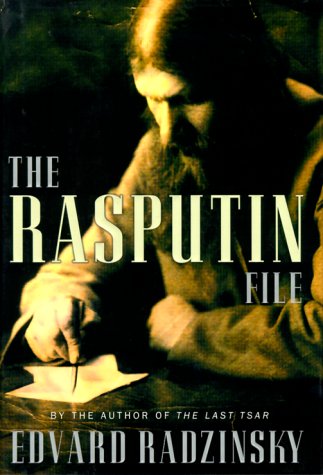
Based on documents long missing from KGB files, this fascinating account of Rasputin, a man who weilded unprecidented power over the last Czar of Russia, attempts to understand this enigmatic and charismatic figure.
Die Inhaltsangabe kann sich auf eine andere Ausgabe dieses Titels beziehen.
Über die Autorin bzw. den Autor
Edvard Radzinsky is the author of the bestselling The Last Tsar and Stalin, and one of Russia's most celebrated playwrights. He lives in Russia, where he is also an award-winning television personality.
Aus dem Klappentext
e of the most fascinating and controversial figures of the twentieth century, has remained cloaked in the myth of his own devising since his extraordinary ascent to power in the court of Nicholas and Alexandra, the last tsar and tsarina of Russia. Until now.
Edvard Radzinsky, the author of the international bestseller The Last Tsar, had long been frustrated by the meager explanations of the malign authority of Grigory Efimovich Rasputin, a Russian peasant, semiliterate monk, and mystic, in the last Romanov court. Then, in 1995, a file from the State Archives that had been missing for years came up for auction at Sotheby's, and was put in Radzinsky's hands. It contained the interrogations of Rasputin's inner circle of admirers and those who kept him under police surveillance--documents never seen by any other historian. With this file, Radzinsky is able to transform the biography of Rasputin from mysterious legend into fact.
Using the depositions of Rasputin's fri
Auszug. © Genehmigter Nachdruck. Alle Rechte vorbehalten.
1
THE FILE: SEARCHING FOR DOCUMENTS
The Prison Ball
I supposed that only when I had found the File would I be able to answer those questions. I had long been aware that the File had to exist.
In the 1970s when I was writing my book about Nicholas, I naturally had occasion to look at the papers of the Extraordinary Commission of the Provisional Government.
In March 1917, after Nicholas's abdication and the triumph of the February Revolution, the solitary confinement cells of the Peter and Paul Fortress became crowded. Delivered to that Russian Bastille, where during the tsar's reign political dissidents had been incarcerated, were the people who had put them there -- those who not long before had controlled Russia's destiny. The tsarist prime ministers Sturmer and Golitsyn; the minister of internal affairs Protopopov; the head of the infamous Department of Police Beletsky and his replacement Alexis Vasiliev; the aged court minister Count Fredericks; the chairman of the Council of State Schlegovitov; the palace castellan Voeikov; the tsarina's closest friend, Anya Vyrubova; and so forth and so on. In a word, the very highest society. So that the fortress's damp cells, constantly subject to flooding, resembled nothing so much as a brilliant Winter Palace ball.
On 4 March 1917, the Provisional Government formed the Extraordinary Commission of Inquiry for the Investigation of Illegal Acts by Ministers and Other Responsible Persons of the Tsarist Regime. And from the Peter and Paul Fortress the ministers were shunted back and forth for interrogation at the Winter Palace, so familiar to them, where the Extraordinary Commission worked, and where only recently they had appeared in medals and ribbons. Or else the Commission investigators would themselves drive out to conduct their interrogations at the fortress. The transcripts of those interrogations were then deciphered and put into shape. And it was Russia's leading poet, the famous Alexander Blok, who did the putting. He has described in his notebooks the atmosphere of the interrogations and the appearance of the Winter Palace with its empty throne room, 'where all the fabric had been torn from the walls and the throne removed, since the soldiers wanted to break it up'.
The transcripts of the interrogations were then prepared for publication. All Russia was supposed to learn, according the Commission plan, just what had transpired behind the scenes in mysterious Tsarskoe Selo, from which the tsar and tsarina had ruled Russia. On the basis of that information the future first Russian parliament was then meant to decide the fates of the tsar, the tsarina, and the ministers -- of those people who had just days before governed Russia.
And one of the main questions concerned the semi-literate Russian peasant Grigory Rasputin.
Section Thirteen
The Commission's executive council and its twenty-seven separate boards of inquiry conducted continuous interrogations of its brilliant prisoners from March 1917 until the Bolshevik coup in October.
A special board of inquiry with the expressive name 'Thirteenth Section' was particularly concerned with 'investigating the activity of the dark forces'. In the political jargon of the day, the 'dark forces' were Rasputin, the tsarina, and those close to them. The 'dark forces', their true influence via Rasputin over the former Tsar Nicholas II in the area of state governance: that was the substance of the Thirteenth Section's work.
The head of the Thirteenth Section was a certain F. P. Simpson, a former head of the Kharkov Provincial Appellate Court. The interrogations themselves were conducted by several investigators: two people with the same last name, Vladimir and Tikhon Rudnev, and Grigory Girchich. They, too, had been reassigned to the Commission from provincial courts. As a kind of guarantee that they would have no links to the capital's former governing clique now under investigation.
And then came the October 1917 coup. The Bolsheviks who seized power put an end to the Provisional Government. Those who the day before had been ministers in that government were sent to the very same cells in the Peter and Paul Fortress. Where not without humour they were greeted by the tsarist ministers whom they had only recently imprisoned in the same place. The Bolsheviks also put an end to the work of the Extraordinary Commission.
But in 1927 the Bolsheviks decided to publish part of the interrogations of the most important tsarist ministers, for the tenth anniversary of their revolution. The publication was supposed to be ideological; that is, it was supposed to demonstrate the 'senescence' of a tsarist regime controlled by the ignorant, debauched peasant Grigory Rasputin.
By that time, Alexander Blok, who worked on the stenographs, had died. The publication of the transcripts was supervised by one of the Extraordinary Commission's most celebrated members, P. Schyogolev, who had agreed to collaborate with the Bolsheviks.
Before the revolution Schyogolev had been editor of the magazine Times Past. A publication 'of wholly revolutionary temper', it had been shut down several times by the tsarist authorities. Leo Tolstoy said that 'if I had been young, I would have taken a revolver in each hand after reading Times Past.' For his magazine's sake he endured a cell in the Peter and Paul Fortress, where he himself would eventually interrogate the tsarist ministers who had imprisoned him. But after the Bolsheviks came to power, the once incorruptible Schyogolev changed completely. He became part of the Bolshevik regime. Evil tongues maintained that his apartment contained a collection of documents and furniture from the Winter Palace.
Seven little volumes entitled Proceedings of the Extraordinary Commission of Inquiry were all that Schyogolev published from the immense quantity of material produced by the interrogations. And those pitiful volumes were for many years the chief documentary basis for all the books written about Rasputin.
It was only four decades later -- in 1964 -- that another sensational document about Rasputin was added to those volumes drawn from the Extraordinary Commission's legacy. And it was after the appearance of that document that my search for the File began.
The Missing File
In 1964 the journal Issues of History published a sensational number that at the time was eagerly read not only by historians. Printed in it for the first time was the 'Resolution of the Investigator F. Simpson of the Extraordinary Commission Regarding the Activity of Rasputin and his Close Associates and their Influence over Nicholas II in the Area of State Governance', a document that until then had been held in a secret repository of the archive of the October Revolution.
The 'Resolution' was a summary of the Thirteenth Section's efforts to clarify Rasputin's role.
I read the issue later when I was starting work on my book about Nicholas II. And the 'Resolution' made a stunning impression on me. In his conclusion Simpson quoted extensively from the testimony of people belonging to Rasputin's most intimate circle: his publisher Filippov; his friend Sazonov, in whose apartment Rasputin had lived and with whose wife he had enjoyed the most intimate relationship; the famous Maria Golovina, a true worshipper of Rasputin who became an involuntary cause of his death; the Petersburg cocottes with whom Rasputin shared tender bonds; and the admirers who fell under his hypnotic influence.
Naturally, I at once started looking for that testimony in the Proceedings published by Schyogolev. And naturally I failed to find it there. For it was the testimony of people who had liked Rasputin. Their point of view was absolutely unacceptable to Schyogolev. And naturally he did not include what they had to say.
The quotations that Simpson...
„Über diesen Titel“ kann sich auf eine andere Ausgabe dieses Titels beziehen.
Suchergebnisse für The Rasputin File

Beispielbild für diese ISBN
The Rasputin File
Verlag:
Bantam Doubleday Dell Publishing Group Inc, 2000
ISBN 10: 0385489099
ISBN 13: 9780385489096
Gebraucht
Hardcover
Anbieter: World of Books (was SecondSale), Montgomery, IL, USA
Verkäuferbewertung 5 von 5 Sternen

Hardback. Zustand: Fair. From the bestselling author of Stalin and The Last Tsar comes The Rasputin File, a remarkable biography of the mystical monk and bizarre philanderer whose role in the demise of the Romanovs and the start of the revolution can only now be fully known. For almost a century, historians could only speculate about the role Grigory Rasputin played in the downfall of tsarist Russia. But in 1995 a lost file from the State Archives turned up, a file that contained the complete interrogations of Rasputin's inner circle. With this extensive and explicit amplification of the historical record, Edvard Radzinsky has written a definitive biography, reconstructing in full the fascinating life of an improbable holy man who changed the course of Russian history. Translated from the Russian by Judson Rosengrant. Artikel-Nr. 00103019042
Gebraucht kaufen
EUR 5,95
Versand gratis
Versand innerhalb von USA
Versand innerhalb von USA
Anzahl: 2 verfügbar
Beispielbild für diese ISBN
The Rasputin File
Anbieter: ThriftBooks-Dallas, Dallas, TX, USA
Verkäuferbewertung 5 von 5 Sternen
Hardcover. Zustand: Fair. No Jacket. Readable copy. Pages may have considerable notes/highlighting. ~ ThriftBooks: Read More, Spend Less. Artikel-Nr. G0385489099I5N00
Gebraucht kaufen
EUR 6,25
Versand gratis
Versand innerhalb von USA
Versand innerhalb von USA
Anzahl: 1 verfügbar
Beispielbild für diese ISBN
The Rasputin File
Anbieter: ThriftBooks-Atlanta, AUSTELL, GA, USA
Verkäuferbewertung 5 von 5 Sternen
Hardcover. Zustand: Fair. No Jacket. Missing dust jacket; Readable copy. Pages may have considerable notes/highlighting. ~ ThriftBooks: Read More, Spend Less. Artikel-Nr. G0385489099I5N01
Gebraucht kaufen
EUR 6,25
Versand gratis
Versand innerhalb von USA
Versand innerhalb von USA
Anzahl: 1 verfügbar
Beispielbild für diese ISBN
The Rasputin File
Anbieter: ThriftBooks-Dallas, Dallas, TX, USA
Verkäuferbewertung 5 von 5 Sternen
Hardcover. Zustand: Very Good. No Jacket. May have limited writing in cover pages. Pages are unmarked. ~ ThriftBooks: Read More, Spend Less. Artikel-Nr. G0385489099I4N00
Gebraucht kaufen
EUR 6,25
Versand gratis
Versand innerhalb von USA
Versand innerhalb von USA
Anzahl: 1 verfügbar
Beispielbild für diese ISBN
The Rasputin File
Anbieter: ThriftBooks-Atlanta, AUSTELL, GA, USA
Verkäuferbewertung 5 von 5 Sternen
Hardcover. Zustand: Good. No Jacket. Former library book; Pages can have notes/highlighting. Spine may show signs of wear. ~ ThriftBooks: Read More, Spend Less. Artikel-Nr. G0385489099I3N10
Gebraucht kaufen
EUR 6,25
Versand gratis
Versand innerhalb von USA
Versand innerhalb von USA
Anzahl: 1 verfügbar
Beispielbild für diese ISBN
The Rasputin File
Anbieter: ThriftBooks-Atlanta, AUSTELL, GA, USA
Verkäuferbewertung 5 von 5 Sternen
Hardcover. Zustand: Good. No Jacket. Missing dust jacket; Pages can have notes/highlighting. Spine may show signs of wear. ~ ThriftBooks: Read More, Spend Less. Artikel-Nr. G0385489099I3N01
Gebraucht kaufen
EUR 6,25
Versand gratis
Versand innerhalb von USA
Versand innerhalb von USA
Anzahl: 1 verfügbar
Beispielbild für diese ISBN
The Rasputin File
Anbieter: Wonder Book, Frederick, MD, USA
Verkäuferbewertung 5 von 5 Sternen
Zustand: Good. Good condition. Good dust jacket. A copy that has been read but remains intact. May contain markings such as bookplates, stamps, limited notes and highlighting, or a few light stains. Artikel-Nr. F04A-10551
Gebraucht kaufen
EUR 7,31
Versand gratis
Versand innerhalb von USA
Versand innerhalb von USA
Anzahl: 1 verfügbar
Beispielbild für diese ISBN
The Rasputin File : The Final Word
Verlag:
Knopf Doubleday Publishing Group, 2000
ISBN 10: 0385489099
ISBN 13: 9780385489096
Gebraucht
Hardcover
Anbieter: Better World Books, Mishawaka, IN, USA
Verkäuferbewertung 5 von 5 Sternen
Zustand: Good. 1st ed. in the U.S.A. Pages intact with minimal writing/highlighting. The binding may be loose and creased. Dust jackets/supplements are not included. Stock photo provided. Product includes identifying sticker. Better World Books: Buy Books. Do Good. Artikel-Nr. 4985119-20
Gebraucht kaufen
EUR 7,54
Versand gratis
Versand innerhalb von USA
Versand innerhalb von USA
Anzahl: 2 verfügbar
Beispielbild für diese ISBN
The Rasputin File
Anbieter: Night Heron Books, Laramie, WY, USA
Verkäuferbewertung 5 von 5 Sternen
hardcover. Zustand: Very Good. Hardcover. Dust Jacket included and in good condition. Name on front end sheet. Minor wear to page edges and corners. No writing, highlighting, or marks in text. From the estate of a smoker. Artikel-Nr. 758800
Gebraucht kaufen
EUR 7,32
EUR 3,78 Versand
Versand innerhalb von USA
Versand innerhalb von USA
Anzahl: 1 verfügbar
Beispielbild für diese ISBN
The Rasputin File
Anbieter: Robinson Street Books, IOBA, Binghamton, NY, USA
Verkäuferbewertung 4 von 5 Sternen

Hardcover. Zustand: Very Good. Zustand des Schutzumschlags: Very good dust jacket. Prompt Shipment, shipped in Boxes, Tracking PROVIDEDVery good hardcover with clean pages and dust jacket. First edition. Artikel-Nr. ware627jd0053
Gebraucht kaufen
EUR 12,36
EUR 8,44 Versand
Versand innerhalb von USA
Versand innerhalb von USA
Anzahl: 1 verfügbar