
Verwandte Artikel zu The Hunger Within: A Twelve-Week Self-Guided Journey...
Inhaltsangabe
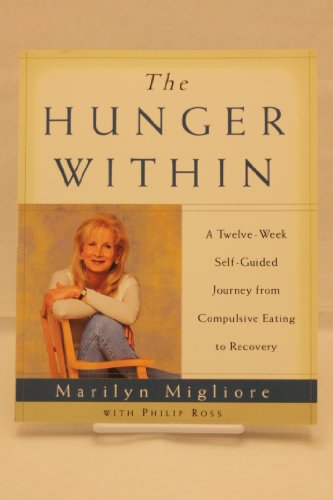
Based on her successful program for over-eaters at St. Luke's-Roosevelt Hospital in New York City, the author shows overweight people how to identify and overcome the psychological problems that prompt "binge" eating and drastic dieting. Original.
Die Inhaltsangabe kann sich auf eine andere Ausgabe dieses Titels beziehen.
Über die Autorin bzw. den Autor
Marilyn Migliore is a certified nutritionist and psychotherapist who has worked as a group and individual counselor for people with eating disorders for more than twenty years. She currently works in private practice and conducts her nationally recognized workshops for compulsive eaters in Manhattan.
Auszug. © Genehmigter Nachdruck. Alle Rechte vorbehalten.
Prologue
Seated at a long oval table in a nondescript room on the ninth floor of an outpatient medical office building in Manhattan, a group of self-conscious adults are introducing themselves.
Fern describes herself in clipped tones as an attorney who is a partner in a small firm that specializes in real estate law. She is a graduate of Ivy League schools and has lived alone in the fifteen years since getting her first job. Unsurprisingly, the most intimate information Fern provides about herself concerns the reason she is here: "I have lost and gained more than five hundred pounds since my teens," she says, pain radiating from eyes that have receded into a fleshy face. "I have taken all kinds of diet pills and have been on six separate liquid diets. I have lost count of the number of weight-loss programs I've 'successfully' attended. I've come to think of dieting as my real profession. And although I realize that the vicious cycle of losing weight, then putting it back on plus some more, happens to more than ninety percent of dieters, that's hardly a consolation. I've never weighed as much as I weigh now, and I feel like I'm caught in a nightmarish maze with no exit."
Knowing nods from three or four women are punctured by a throaty male laugh. "Yeah, tell me about it," chortles Brendan, a mid-fortyish Falstaffian figure who, in every sense, seems larger than life. "If I only had a hundred bucks for every pound I've gained since I gave up drinking ten years ago, I could have invested it in this bull market and retired early." A stockbroker himself, Brendan leans back and tweaks his fireman's suspenders in obvious pleasure at the laughter he has elicited. One's first impressions are that he is a man of insatiable if not unquenchable appetites, who is gifted at lowering his own and others' anxieties through comic self-mockery. Indeed, in the next couple of minutes, Brendan reels off his unsuccessful battles in the pasta wars, his medical woes, his doctor's warnings, in so entertaining a fashion that we are all reduced to giggles and guffaws by someone who is telling us he could keel over any day now.
Brendan would be a hard act to follow for anyone, but perhaps more so for Mary, the homemaker turned nurse after the last of her four children left for college. Hidden inside a drab dress purchased joylessly from a catalogue that specializes in euphemistic names for obesity, Mary looks as if she'd give anything for a place to hide. When she speaks, it is in the hushed voice of a penitent making confession. She lists the years of eating "sins" that have turned her into the "fatty," as she puts it, that we see today. She mentions that most of her overeating has occurred at night, after taking care of her kids and husband, and more recently, of the patients on her hospital shift. She says that food has been her reward, but that her "just desserts" are causing her, among other things, sore joints. Wistfully, she notes that she is no longer able to join her husband in hiking and other outdoor activities they used to enjoy together.
Others share their own short stories, all of which revolve around food and their problematic relationship with it. For all their differences, these people share much more in common than excess pounds. They are all bright. They don't need to be told that a cup of broccoli has fewer calories than a cup of Häagen-Dazs.
They may talk about the temptations of leftovers, about jobs that require lots of dining out, of sweet tooths or problems around the holidays, but on some level they also know it's about none of these things. Fern will understandably make no reference today to her mother's expectations, Brendan to his father's beatings, or Mary to the woman's name and phone number she found last week scribbled on a piece of paper in her husband's trousers. They will talk only about food. Some will actually identify themselves as compulsive eaters.
Perhaps most important, the people sitting around this table today, like the hundreds who have come before them, are fellow travelers on the dieting roller coaster, people whose losing battles have filled them not only with excess pounds but with shame, inadequacy, and self-loathing. They, like you, may not be able to articulate it, but religious or not, they are here in a desperate attempt to save their souls.
If you've picked up this book and have read this far, chances are you know all too well that for most people, including yourself, diets don't work! You have tried different programs. You have read through what seem like a zillion books and magazines about weight, and have ended up at best confused and discouraged, at worst resigned. One magazine tells you to count fat grams and avoid carbohydrates. Another tells you to eat all the chocolate you want. A miracle drug promises to help you drop ten pounds in a week. The latest gastronomical guru says the whole secret is combining Food A with Food B.
And none of it works! None of it works because, for compulsive eaters, nutritional information, good, bad, or indifferent, is irrelevant. You already know that if you take in more calories than you expend, you will gain weight, and vice versa. You know how to count calories when you want to count calories. Not only do you know that exercise is good for you, but you could probably determine without too much difficulty how walking a mile at a twenty-minute pace compares calorically with fifteen minutes on a Stairmaster at Level 3.
All this information is, I repeat, irrelevant. For compulsive eaters, the problem is not lack of information about food or exercise. Food is not the issue. The issue, as you are all too well aware, is the repetitive nature of your compulsive behavior, or what I call your life script, when it comes to the interplay of food and feelings.
What you don't understand is why or how. Why you are stuck in compulsive behaviors that make you unable to eat the way you imagine "normal" people do. How to get out of this emotional quagmire.
In a world filled with psychobabble, it's easy for the meaning of words to be lost. So let me be clear from the outset about what I mean when I refer to compulsive eating. When I use that term, I am talking about any kind of non-hunger-related eating acted out in a repetitive fashion that leads to negative physical and emotional consequences.
Compulsive eating has been compared with sharks on a feeding frenzy. Just listen to the words I've heard my workshop participants use to describe their binges:
"I shoveled the gallon of ice cream into my mouth so quickly that I barely gave myself a chance to breathe. When it was over, I retreated into my bedroom, overwhelmed with feelings of shame."
"I stared at the television set, transfixed like a zombie. It was like I was in a trance. I was completely unaware of what my hands were doing or of the mounting pile of candy wrappers at my feet."
"From the time I entered the supermarket--actually from some point earlier than that--it was as though I had entered, or was pulled, into this strange zone. It felt almost like a gravitational force was drawing me into its orbit and that I was heading for oblivion."
Recognize yourself?
When a compulsive eater enters the...
„Über diesen Titel“ kann sich auf eine andere Ausgabe dieses Titels beziehen.
Suchergebnisse für The Hunger Within: A Twelve-Week Self-Guided Journey...

Beispielbild für diese ISBN
The Hunger Within A Twelve We
Anbieter: World of Books (was SecondSale), Montgomery, IL, USA
Verkäuferbewertung 5 von 5 Sternen

Zustand: Good. Item in good condition. Textbooks may not include supplemental items i.e. CDs, access codes etc. Artikel-Nr. 00070133776
Gebraucht kaufen
EUR 5,08
Versand gratis
Versand innerhalb von USA
Versand innerhalb von USA
Anzahl: 5 verfügbar
Beispielbild für diese ISBN
The Hunger Within: An Twelve Week Guided Journey from Compulsive Eating to Recovery
Verlag:
Main Street Books (edition ), 1998
ISBN 10: 0385487584
ISBN 13: 9780385487580
Gebraucht
Paperback
Anbieter: BooksRun, Philadelphia, PA, USA
Verkäuferbewertung 5 von 5 Sternen
Paperback. Zustand: Very Good. It's a well-cared-for item that has seen limited use. The item may show minor signs of wear. All the text is legible, with all pages included. It may have slight markings and/or highlighting. Artikel-Nr. 0385487584-11-22
Gebraucht kaufen
EUR 5,94
Versand gratis
Versand innerhalb von USA
Versand innerhalb von USA
Anzahl: 1 verfügbar
Beispielbild für diese ISBN
The Hunger Within : An Twelve Week Guided Journey from Compulsive Eating to Recovery
Anbieter: Better World Books, Mishawaka, IN, USA
Verkäuferbewertung 5 von 5 Sternen
Zustand: Very Good. Pages intact with possible writing/highlighting. Binding strong with minor wear. Dust jackets/supplements may not be included. Stock photo provided. Product includes identifying sticker. Better World Books: Buy Books. Do Good. Artikel-Nr. 7942063-6
Gebraucht kaufen
EUR 6,09
Versand gratis
Versand innerhalb von USA
Versand innerhalb von USA
Anzahl: 1 verfügbar
Beispielbild für diese ISBN
The Hunger Within : An Twelve Week Guided Journey from Compulsive Eating to Recovery
Anbieter: Better World Books: West, Reno, NV, USA
Verkäuferbewertung 5 von 5 Sternen
Zustand: Very Good. Pages intact with possible writing/highlighting. Binding strong with minor wear. Dust jackets/supplements may not be included. Stock photo provided. Product includes identifying sticker. Better World Books: Buy Books. Do Good. Artikel-Nr. 7942063-6
Gebraucht kaufen
EUR 6,09
Versand gratis
Versand innerhalb von USA
Versand innerhalb von USA
Anzahl: 1 verfügbar
Beispielbild für diese ISBN
The Hunger Within : An Twelve Week Guided Journey from Compulsive Eating to Recovery
Anbieter: Better World Books, Mishawaka, IN, USA
Verkäuferbewertung 5 von 5 Sternen
Zustand: Good. Pages intact with minimal writing/highlighting. The binding may be loose and creased. Dust jackets/supplements are not included. Stock photo provided. Product includes identifying sticker. Better World Books: Buy Books. Do Good. Artikel-Nr. 4110649-6
Gebraucht kaufen
EUR 6,09
Versand gratis
Versand innerhalb von USA
Versand innerhalb von USA
Anzahl: 1 verfügbar
Beispielbild für diese ISBN
The Hunger Within: An Twelve Week Guided Journey from Compulsive Eating to Recovery
Anbieter: ThriftBooks-Atlanta, AUSTELL, GA, USA
Verkäuferbewertung 5 von 5 Sternen
Paperback. Zustand: Fair. No Jacket. Readable copy. Pages may have considerable notes/highlighting. ~ ThriftBooks: Read More, Spend Less. Artikel-Nr. G0385487584I5N00
Gebraucht kaufen
EUR 7,08
Versand gratis
Versand innerhalb von USA
Versand innerhalb von USA
Anzahl: 1 verfügbar
Beispielbild für diese ISBN
The Hunger Within: An Twelve Week Guided Journey from Compulsive Eating to Recovery
Anbieter: ThriftBooks-Atlanta, AUSTELL, GA, USA
Verkäuferbewertung 5 von 5 Sternen
Paperback. Zustand: Very Good. No Jacket. May have limited writing in cover pages. Pages are unmarked. ~ ThriftBooks: Read More, Spend Less. Artikel-Nr. G0385487584I4N00
Gebraucht kaufen
EUR 7,08
Versand gratis
Versand innerhalb von USA
Versand innerhalb von USA
Anzahl: 1 verfügbar
Beispielbild für diese ISBN
The Hunger Within: A Twelve-Week Self-Guided Journey from Compulsive Eating to Recovery
Anbieter: WorldofBooks, Goring-By-Sea, WS, Vereinigtes Königreich
Verkäuferbewertung 5 von 5 Sternen
Paperback. Zustand: Very Good. The book has been read, but is in excellent condition. Pages are intact and not marred by notes or highlighting. The spine remains undamaged. Artikel-Nr. GOR002805109
Gebraucht kaufen
EUR 28,81
EUR 6,53 Versand
Versand von Vereinigtes Königreich nach USA
Versand von Vereinigtes Königreich nach USA
Anzahl: 1 verfügbar
Beispielbild für diese ISBN
The Hunger Within: A Twelve-Week Self-Guided Journey from Compulsive Eating to Recovery
Anbieter: Revaluation Books, Exeter, Vereinigtes Königreich
Verkäuferbewertung 5 von 5 Sternen
Paperback. Zustand: Brand New. 224 pages. 9.50x7.50x0.50 inches. In Stock. Artikel-Nr. 0385487584
Neu kaufen
EUR 37,28
EUR 11,66 Versand
Versand von Vereinigtes Königreich nach USA
Versand von Vereinigtes Königreich nach USA
Anzahl: 1 verfügbar