
Verwandte Artikel zu Bird by Bird: Some Instructions on Writing and Life
Inhaltsangabe
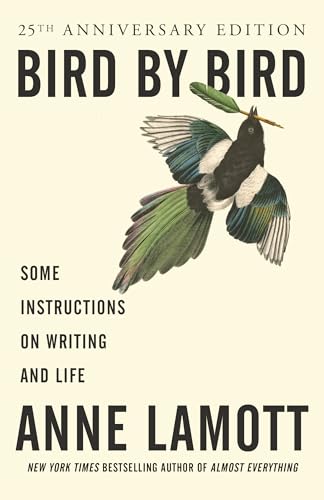
NEW YORK TIMES BESTSELLER • An essential volume for generations of writers young and old. The twenty-fifth anniversary edition of this modern classic will continue to spark creative minds for years to come. Anne Lamott is "a warm, generous, and hilarious guide through the writer’s world and its treacherous swamps" (Los Angeles Times).
“Superb writing advice…. Hilarious, helpful, and provocative.” —The New York Times Book Review
For a quarter century, more than a million readers—scribes and scribblers of all ages and abilities—have been inspired by Anne Lamott’s hilarious, big-hearted, homespun advice. Advice that begins with the simple words of wisdom passed down from Anne’s father—also a writer—in the iconic passage that gives the book its title:
“Thirty years ago my older brother, who was ten years old at the time, was trying to get a report on birds written that he’d had three months to write. It was due the next day. We were out at our family cabin in Bolinas, and he was at the kitchen table close to tears, surrounded by binder paper and pencils and unopened books on birds, immobilized by the hugeness of the task ahead. Then my father sat down beside him, put his arm around my brother’s shoulder, and said, ‘Bird by bird, buddy. Just take it bird by bird.’”
Die Inhaltsangabe kann sich auf eine andere Ausgabe dieses Titels beziehen.
Über die Autorin bzw. den Autor
ANNE LAMOTT is the author of the New York Times bestsellers Almost Everything; Hallelujah Anyway; Help, Thanks, Wow; Small Victories; Stitches; Some Assembly Required; Grace (Eventually); Plan B; Traveling Mercies; and Operating Instructions. She is also the author of seven novels, including Imperfect Birds and Rosie. A past recipient of a Guggenheim Fellowship and an inductee to the California Hall of Fame, she lives in Northern California.
Von der hinteren Coverseite
"Thirty years ago my older brother, who was ten years old at the time, was trying to get a report on birds written that he'd had three months to write. It was due the next day. We were out at our family cabin in Bolinas, and he was at the kitchen table close to tears, surrounded by binder paper and pencils and unopened books on birds, immobilized by the hugeness of the task ahead. Then my father sat down beside him, put his arm around my brother's shoulder, and said, 'Bird by bird, buddy. Just take it bird by bird.'"
Auszug. © Genehmigter Nachdruck. Alle Rechte vorbehalten.
Getting Started
The very first thing I tell my new students on the first day of a workshop is that good writing is about telling the truth. We are a species that needs and wants to understand who we are. Sheep lice do not seem to share this longing, which is one reason they write so very little. But we do. We have so much we want to say and figure out. Year after year my students are bursting with stories to tell, and they start writing projects with excitement and maybe even joy—finally their voices will be heard, and they are going to get to devote themselves to this one thing they’ve longed to do since childhood. But after a few days at the desk, telling the truth in an interesting way turns out to be about as easy and pleasurable as bathing a cat. Some lose faith. Their sense of self and story shatters and crumbles to the ground. Historically they show up for the first day of the workshop looking like bright goofy ducklings who will follow me anywhere, but by the time the second class rolls around, they look at me as if the engagement is definitely off.
“I don’t even know where to start,” one will wail.
Start with your childhood, I tell them. Plug your nose and jump in, and write down all your memories as truthfully as you can. Flannery O’Connor said that anyone who survived childhood has enough material to write for the rest of his or her life. Maybe your childhood was grim and horrible, but grim and horrible is Okay if it is well done. Don’t worry about doing it well yet, though. Just start getting it down.
Now, the amount of material may be so overwhelming that it can make your brain freeze. When I had been writing food reviews for a number of years, there were so many restaurants and individual dishes in my brainpan that when people asked for a recommendation, I couldn’t think of a single restaurant where I’d ever actually eaten. But if the person could narrow it down to, say, Indian, I might remember one lavish Indian palace, where my date had asked the waiter for the Rudyard Kipling sampler and later for the holy-cow tartare. Then a number of memories would come to mind, of other dates and other Indian restaurants.
So you might start by writing down every single thing you can remember from your first few years in school. Start with kindergarten. Try to get the words and memories down as they occur to you. Don’t worry if what you write is no good, because no one is going to see it. Move on to first grade, to second, to third. Who were your teachers, your classmates? What did you wear? Who and what were you jealous of? Now branch out a little. Did your family take vacations during those years? Get these down on paper. Do you remember how much more presentable everybody else’s family looked? Do you remember how when you’d be floating around in an inner tube on a river, your own family would have lost the little cap that screws over the airflow valve, so every time you got in and out of the inner tube, you’d scratch new welts in your thighs? And how other families never lost the caps?
If this doesn’t pan out, or if it does but you finish mining this particular vein, see if focusing on holidays and big events helps you recollect your life as it was. Write down everything you can remember about every birthday or Christmas or Seder or Easter or whatever, every relative who was there. Write down all the stuff you swore you’d never tell another soul. What can you recall about your birthday parties—the disasters, the days of grace, your relatives’ faces lit up by birthday candles? Scratch around for details: what people ate, listened to, wore—those terrible petaled swim caps, the men’s awful trunks, the cocktail dress your voluptuous aunt wore that was so slinky she practically needed the Jaws of Life to get out of it. Write about the women’s curlers with the bristles inside, the garters your father and uncles used to hold up their dress socks, your grandfathers’ hats, your cousins’ perfect Brownie uniforms, and how your own looked like it had just been hatched. Describe the trench coats and stoles and car coats, what they revealed and what they covered up. See if you can remember what you were given that Christmas when you were ten, and how it made you feel inside. Write down what the grown-ups said and did after they’d had a couple of dozen drinks, especially that one Fourth of July when your father made Fish House punch and the adults practically had to crawl from room to room.
Remember that you own what happened to you. If your childhood was less than ideal, you may have been raised thinking that if you told the truth about what really went on in your family, a long bony white finger would emerge from a cloud and point at you, while a chilling voice thundered, “We told you not to tell.” But that was then. Just put down on paper everything you can remember now about your parents and siblings and relatives and neighbors, and we will deal with libel later on.
“But how?” my students ask. “How do you actually do it?”
You sit down, I say. You try to sit down at approximately the same time every day. This is how you train your unconscious to kick in for you creatively. So you sit down at, say, nine every morning, or ten every night. You put a piece of paper in the typewriter, or you turn on your computer and bring up the right file, and then you stare at it for an hour or so. You begin rocking, just a little at first, and then like a huge autistic child. You look at the ceiling, and over at the clock, yawn, and stare at the paper again. Then, with your fingers poised on the keyboard, you squint at an image that is forming in your mind—a scene, a locale, a character, whatever—and you try to quiet your mind so you can hear what that landscape or character has to say above the other voices in your mind. The other voices are banshees and drunken monkeys. They are the voices of anxiety, judgment, doom, guilt. Also, severe hypochondria. There may be a Nurse Ratched–like listing of things that must be done right this moment: foods that must come out of the freezer, appointments that must be canceled or made, hairs that must be tweezed. But you hold an imaginary gun to your head and make yourself stay at the desk. There is a vague pain at the base of your neck. It crosses your mind that you have meningitis. Then the phone rings and you look up at the ceiling with fury, summon every ounce of noblesse oblige, and answer the call politely, with maybe just the merest hint of irritation. The caller asks if you’re working, and you say yeah, because you are.
Yet somehow in the face of all this, you clear a space for the writing voice, hacking away at the others with machetes, and you begin to compose sentences. You begin to string words together like beads to tell a story. You are desperate to communicate, to edify or entertain, to preserve moments of grace or joy or transcendence, to make real or imagined events come alive. But you cannot will this to happen. It is a matter of persistence and faith and hard work. So you might as well just go ahead and get started.
I wish I had a secret I could let you in on, some formula my father passed on to me in a whisper just before he died, some code word that has enabled me to sit at my desk and land flights of creative inspiration like an air-traffic controller. But I don’t. All I know is that the process is pretty much the same for almost everyone I know. The good news is that some days it feels like you just have to keep getting out of your own way so that whatever it is that wants to be written can use you to write it. It is a little like when you have something difficult to discuss with someone, and as you go to do it, you hope and pray that...
„Über diesen Titel“ kann sich auf eine andere Ausgabe dieses Titels beziehen.
Suchergebnisse für Bird by Bird: Some Instructions on Writing and Life

Beispielbild für diese ISBN
Bird by Bird : Some Instructions on Writing and Life
Verlag:
Knopf Doubleday Publishing Group, 1995
ISBN 10: 0385480016
ISBN 13: 9780385480017
Gebraucht
Softcover
Anbieter: Better World Books, Mishawaka, IN, USA
Verkäuferbewertung 5 von 5 Sternen

Zustand: Fine. bird Edition. Used book that is in almost brand-new condition. May contain a remainder mark. Better World Books: Buy Books. Do Good. Artikel-Nr. 4415711-75
Gebraucht kaufen
EUR 6,33
Versand gratis
Versand innerhalb von USA
Versand innerhalb von USA
Anzahl: 1 verfügbar
Beispielbild für diese ISBN
Bird by Bird : Some Instructions on Writing and Life
Verlag:
Knopf Doubleday Publishing Group, 1995
ISBN 10: 0385480016
ISBN 13: 9780385480017
Gebraucht
Softcover
Anbieter: Better World Books: West, Reno, NV, USA
Verkäuferbewertung 5 von 5 Sternen
Zustand: Very Good. bird Edition. Pages intact with possible writing/highlighting. Binding strong with minor wear. Dust jackets/supplements may not be included. Stock photo provided. Product includes identifying sticker. Better World Books: Buy Books. Do Good. Artikel-Nr. 3993537-6
Gebraucht kaufen
EUR 6,33
Versand gratis
Versand innerhalb von USA
Versand innerhalb von USA
Anzahl: 1 verfügbar
Beispielbild für diese ISBN
Bird by Bird : Some Instructions on Writing and Life
Verlag:
Knopf Doubleday Publishing Group, 1995
ISBN 10: 0385480016
ISBN 13: 9780385480017
Gebraucht
Softcover
Anbieter: Better World Books: West, Reno, NV, USA
Verkäuferbewertung 5 von 5 Sternen
Zustand: Good. bird Edition. Former library copy. Pages intact with minimal writing/highlighting. The binding may be loose and creased. Dust jackets/supplements are not included. Includes library markings. Stock photo provided. Product includes identifying sticker. Better World Books: Buy Books. Do Good. Artikel-Nr. 4017337-6
Gebraucht kaufen
EUR 6,33
Versand gratis
Versand innerhalb von USA
Versand innerhalb von USA
Anzahl: 8 verfügbar
Beispielbild für diese ISBN
Bird by Bird : Some Instructions on Writing and Life
Verlag:
Knopf Doubleday Publishing Group, 1995
ISBN 10: 0385480016
ISBN 13: 9780385480017
Gebraucht
Softcover
Anbieter: Better World Books: West, Reno, NV, USA
Verkäuferbewertung 5 von 5 Sternen
Zustand: Good. bird Edition. Pages intact with minimal writing/highlighting. The binding may be loose and creased. Dust jackets/supplements are not included. Stock photo provided. Product includes identifying sticker. Better World Books: Buy Books. Do Good. Artikel-Nr. 3953092-6
Gebraucht kaufen
EUR 6,33
Versand gratis
Versand innerhalb von USA
Versand innerhalb von USA
Anzahl: Mehr als 20 verfügbar
Beispielbild für diese ISBN
Bird by Bird : Some Instructions on Writing and Life
Verlag:
Knopf Doubleday Publishing Group, 1995
ISBN 10: 0385480016
ISBN 13: 9780385480017
Gebraucht
Softcover
Anbieter: Better World Books, Mishawaka, IN, USA
Verkäuferbewertung 5 von 5 Sternen
Zustand: Good. bird Edition. Pages intact with minimal writing/highlighting. The binding may be loose and creased. Dust jackets/supplements are not included. Stock photo provided. Product includes identifying sticker. Better World Books: Buy Books. Do Good. Artikel-Nr. 3953092-6
Gebraucht kaufen
EUR 6,33
Versand gratis
Versand innerhalb von USA
Versand innerhalb von USA
Anzahl: Mehr als 20 verfügbar
Beispielbild für diese ISBN
Bird by Bird : Some Instructions on Writing and Life
Verlag:
Knopf Doubleday Publishing Group, 1995
ISBN 10: 0385480016
ISBN 13: 9780385480017
Gebraucht
Softcover
Anbieter: Better World Books, Mishawaka, IN, USA
Verkäuferbewertung 5 von 5 Sternen
Zustand: Good. bird Edition. Former library copy. Pages intact with minimal writing/highlighting. The binding may be loose and creased. Dust jackets/supplements are not included. Includes library markings. Stock photo provided. Product includes identifying sticker. Better World Books: Buy Books. Do Good. Artikel-Nr. 4017337-6
Gebraucht kaufen
EUR 6,33
Versand gratis
Versand innerhalb von USA
Versand innerhalb von USA
Anzahl: Mehr als 20 verfügbar
Foto des Verkäufers
Bird by Bird: Some Instructions on Writing and Life
Anbieter: Dream Books Co., Denver, CO, USA
Verkäuferbewertung 5 von 5 Sternen
Zustand: good. Gently used with minimal wear on the corners and cover. A few pages may contain light highlighting or writing, but the text remains fully legible. Dust jacket may be missing, and supplemental materials like CDs or codes may not be included. May be ex-library with library markings. Ships promptly! Artikel-Nr. DBV.0385480016.G
Gebraucht kaufen
EUR 6,75
Versand gratis
Versand innerhalb von USA
Versand innerhalb von USA
Anzahl: 3 verfügbar
Foto des Verkäufers
Bird by Bird: Some Instructions on Writing and Life
Anbieter: Dream Books Co., Denver, CO, USA
Verkäuferbewertung 5 von 5 Sternen
Zustand: acceptable. This copy has clearly been enjoyedâ"expect noticeable shelf wear and some minor creases to the cover. Binding is strong, and all pages are legible. May contain previous library markings or stamps. Artikel-Nr. 4EKGLF0080AV_ns
Gebraucht kaufen
EUR 6,75
Versand gratis
Versand innerhalb von USA
Versand innerhalb von USA
Anzahl: 3 verfügbar
Beispielbild für diese ISBN
0405-NA-01
Anbieter: Books From California, Simi Valley, CA, USA
Verkäuferbewertung 4 von 5 Sternen

Unknown Binding. Zustand: Good. Book is slightly bowing/bending. In otherwise great condition with minimal/no other wear, crisp & clean interiors showing unmarked text, and firm binding of the text block. A good reading copy! Artikel-Nr. mon0004174353
Gebraucht kaufen
EUR 3,78
EUR 4,29 Versand
Versand innerhalb von USA
Versand innerhalb von USA
Anzahl: 1 verfügbar
Beispielbild für diese ISBN
Bird by Bird: Some Instructions on Writing and Life
Anbieter: Books From California, Simi Valley, CA, USA
Verkäuferbewertung 4 von 5 Sternen
paperback. Zustand: Good. Artikel-Nr. mon0004225781
Gebraucht kaufen
EUR 4,09
EUR 4,29 Versand
Versand innerhalb von USA
Versand innerhalb von USA
Anzahl: 1 verfügbar