
Verwandte Artikel zu River Teeth: Stories and Writings
Inhaltsangabe
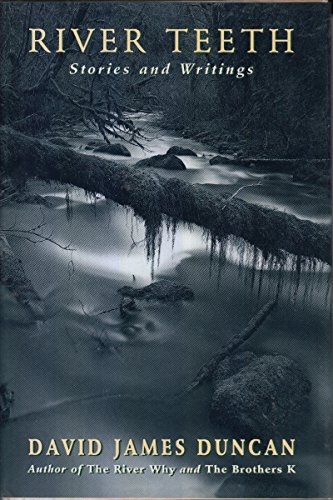
The author of The Brothers K presents several short stories, including one about a self-appointed visionary who guards a river, alternating with real-life reminiscences of his experiences around the rivers of the Northwest.
Die Inhaltsangabe kann sich auf eine andere Ausgabe dieses Titels beziehen.
Über die Autorin bzw. den Autor
David James Duncan is the author of two novels, The River Why and The Brothers K, and River Teeth, a joint memoir and collection of stories. The River Why ranks thirty-fifth on the San Francisco Chronicle list of The 20th Century's 100 Best Books of the American West. The Brothers K is an American Library Association Best Books Award-winner and a New York Times Notable Book. Both novels won the Pacific Northwest Booksellers Award.
Duncan has read and lectured all over the United States on wilderness, the writing life, the nonmonastic contemplative life, the fly fishing life, and nonreligious literature of faith. His work has appeared in Harper's, Outside, Orion, The Sun, Sierra, Big Sky Journal, Northern Lights, Gray's Sporting Journal, and many other publications. He lives with his family on a Montana trout stream.
From the Trade Paperback edition.
Auszug. © Genehmigter Nachdruck. Alle Rechte vorbehalten.
A Definition
When an ancient streamside conifer falls, finally washed or blown from its riverbank down into the water, a complex process of disintegration begins. The fallen tree becomes a naked log, the log begins to lead a kind of afterlife in the river, and this afterlife is, in some ways, of greater benefit to the river than was the original life of the tree.
A living tree stabilizes riverbanks, helps cool water temperatures, provides shade and cover for fish, shelter for mammals and birds. But fallen trees serve some of the same purposes, and other crucial ones besides. The gradual disintegration of a log in a streambed creates a vast transfusion of nutrients--a slow forest to river feast reaching from the saprophytic bottom of the food chain to the predatory, fly-casting, metaphor-making top. Downed trees are also part of a river's filtration system: working in concert in logjams, they become flotsam traps; mud, leaf and carcass traps; Styrofoam, disposable-diaper and beer-can traps. And they're a key element in river hydraulics: a log will force current down, digging a sheltering pocket or spawning bed for trout or salmon; over, creating a whitewater spill that pumps life-giving oxygen into the stream; or around, sometimes digging the salmonid's version of a safe room with a view, the undercut bank.
On the forest streams I know best—those of the Oregon Coast Range clearcuts, "tree farms" and remnant strips of rainforest—the breakdown of even a five- or six-hundred-year-old river log takes only a few decades. Tough as logs are, the grinding of sand, water and ice are relentless. Within a decade or two any drowned conifer but cedar turns punk, grows waterlogged and joins the rocks and crayfish as features of the river's bottom. I often glance down at my feet while fishing and see that the "rock" I'm standing on is really the top of a gigantic log sunk and buried in gravel and sand. And even after burial, decomposition continues. The log breaks into filaments, the filaments become gray mush, the mush becomes mud, washes downriver, comes to rest in side channels. The side channels fill and gradually close. New trees sprout from the fertile muck. The cycle goes on.
There are, however, parts of every drowned tree that refuse to become part of this cycle. There is, in every log, a series of cross-grained, pitch-hardened masses where long-lost branches once joined the tree's trunk. "Knots," they're called, in a piece of lumber. But in the bed of a river, after the parent log has broken down and vanished, these stubborn masses take on a very different appearance, and so perhaps deserve a different name. "River teeth" is what we called them as kids, because that's what they look like. Like enormous fangs, often with a connected, cross-grained root. It took me awhile to realize, when I found my first, that it had once been part of a tree. Having grown up around talk of "headwaters" and "river mouths," it was easier for me to imagine it having washed loose from a literal river's jaw than having once joined a branch to an evergreen.
I don't know how long these teeth last, but even on the rainy coast I'd guess centuries: you sense antiquity when you heft one. Because their pitch content is so high, and hardened pitch outlasts the grainy wood fiber, the oldest teeth lose much of their resemblance to wood. Some look like Neolithic hand tools, others like mammals—miniature seals, otters, manatees. Still others resemble art objects—something intelligently worked, not just worn. And to an extent this is what they become. There is life in rivers, and strength; there are countless grinders and sanders: in a relic the waters have shaped so long, why wouldn't we begin to glimpse the river's mind and blind artistry?
With my trees, logs, and river in place, I'd like to piece together a metaphor: our present-tense human experience, our lives in the inescapable present, are like living trees. Our memory of experience, our individual pasts, are like trees fallen in a river. The current in that river is the passing of time. And a story—a good, shared story—is a transfusion of nutrients from the old river log of memory into the eternal now of life. But as the current of time keeps flowing, the aging log begins to break down. Once-vivid impressions begin to rot. Years run together. We try to share, with an old friend or spouse, some "memorable" past experience and end up arguing instead about details that don't jibe. Chunks of the log begin to vanish completely. Someone approaches us in a crowd, his face lights up, he says his name, tells us of a past connection—and we shake his hand and grin through our horror, unable to place him at all. Some of us realize, after being endlessly corrected, that there are portions of our pasts we can no longer weave into accurate narratives. Others of us realize, after sharing the same accurate narratives for decades, that we have somehow talked our allotment of stories to death, that no one listens any longer, that when we tell these old tales the room fills with a dark water and our listeners' eyes glaze. So we stop telling them. We let them decompose. The last filaments of memory become gray mush, the mush becomes mud, the mud washes downriver. New life, and new stories, sprout from the silence.
There are, however, small parts of every human past that resist this natural cycle: there are hard, cross-grained whorls of memory that remain inexplicably lodged in us long after the straight-grained narrative material that housed them has washed away. Most of these whorls are not stories, exactly: more often they're self-contained moments of shock or of inordinate empathy; moments of violence, uncaught dishonesty, tomfoolery; of mystical terror; lust; preposterous love; preposterous joy. These are our "river teeth"—the time-defying knots of experience that remain in us after most of our autobiographies are gone.
A true river tooth experience is usually old; until the narrative fiber that surrounded the event turns punk and vanishes, one can't be sure it possesses the adamantine quality that is its chief attribute. Most are also fairly brief—just as actual wooden river teeth are fairly small. In my own such experiences I am more often acted upon than actor; more eye than body; more witness than hero. Yet the emotional impact of such experiences is often huge. Some river tooth experiences, if shared with the wrong person, would certainly wound, and could perhaps even kill. Others, whether shared or not, possess the solidity of a geographer's bearing marker and help us find our way. Almost everyone, I believe, owns scores of these old knots and whorls. Yet—perhaps because they lack a traditional narrative's flow from beginning to middle to end—I hear few people speak of such experiences.
There are many things worth telling that are not quite narrative. And eternity itself possesses no beginning, middle or end. Fossils, arrowheads, castle ruins, empty crosses: from the Parthenon to the Bo Tree to a grown man's or woman's old stuffed bear, what moves us about many objects is not what remains but what has vanished. There comes a time, thanks to rivers, when a few beautiful old teeth are all that remain of the two-hundred-foot spires of life we call trees. There comes a river, whose current is time, that does a similar sculpting in the mind. My hope, in sharing a few personal river teeth here, is to let go of what can't be saved, to honor what can and perhaps to make others more aware of, and more willing to accept and share, the same cycle in themselves.
Red Coats
to the daaman
It's a few days before Christmas, downtown Portland. I am three years old. My mother, two brothers, sister and I have come in from the...
„Über diesen Titel“ kann sich auf eine andere Ausgabe dieses Titels beziehen.
Weitere beliebte Ausgaben desselben Titels

Suchergebnisse für River Teeth: Stories and Writings

Beispielbild für diese ISBN
River Teeth
Anbieter: World of Books (was SecondSale), Montgomery, IL, USA
Verkäuferbewertung 5 von 5 Sternen

Zustand: Acceptable. Item in acceptable condition! Textbooks may not include supplemental items i.e. CDs, access codes etc. Artikel-Nr. 00101508556
Gebraucht kaufen
EUR 3,59
Versand gratis
Versand innerhalb von USA
Versand innerhalb von USA
Anzahl: 1 verfügbar
Beispielbild für diese ISBN
River Teeth
Anbieter: World of Books (was SecondSale), Montgomery, IL, USA
Verkäuferbewertung 5 von 5 Sternen
Zustand: Very Good. Item in very good condition! Textbooks may not include supplemental items i.e. CDs, access codes etc. Artikel-Nr. 00108582179
Gebraucht kaufen
EUR 3,59
Versand gratis
Versand innerhalb von USA
Versand innerhalb von USA
Anzahl: 1 verfügbar
Beispielbild für diese ISBN
River Teeth
Anbieter: ThriftBooks-Atlanta, AUSTELL, GA, USA
Verkäuferbewertung 5 von 5 Sternen
Hardcover. Zustand: Good. No Jacket. Pages can have notes/highlighting. Spine may show signs of wear. ~ ThriftBooks: Read More, Spend Less. Artikel-Nr. G0385477279I3N00
Gebraucht kaufen
EUR 5,75
Versand gratis
Versand innerhalb von USA
Versand innerhalb von USA
Anzahl: 1 verfügbar
Beispielbild für diese ISBN
River Teeth
Anbieter: ThriftBooks-Dallas, Dallas, TX, USA
Verkäuferbewertung 5 von 5 Sternen
Hardcover. Zustand: Good. No Jacket. Pages can have notes/highlighting. Spine may show signs of wear. ~ ThriftBooks: Read More, Spend Less. Artikel-Nr. G0385477279I3N00
Gebraucht kaufen
EUR 5,75
Versand gratis
Versand innerhalb von USA
Versand innerhalb von USA
Anzahl: 1 verfügbar
Beispielbild für diese ISBN
River Teeth : Stories and Writings
Verlag:
Bantam Doubleday Dell Publishing Group, 1995
ISBN 10: 0385477279
ISBN 13: 9780385477277
Gebraucht
Hardcover
Erstausgabe
Anbieter: Better World Books: West, Reno, NV, USA
Verkäuferbewertung 5 von 5 Sternen
Zustand: Good. 1st. Former library copy. Pages intact with minimal writing/highlighting. The binding may be loose and creased. Dust jackets/supplements are not included. Includes library markings. Stock photo provided. Product includes identifying sticker. Better World Books: Buy Books. Do Good. Artikel-Nr. 5303039-75
Gebraucht kaufen
EUR 5,93
Versand gratis
Versand innerhalb von USA
Versand innerhalb von USA
Anzahl: 1 verfügbar
Beispielbild für diese ISBN
River Teeth : Stories and Writings
Verlag:
Bantam Doubleday Dell Publishing Group, 1995
ISBN 10: 0385477279
ISBN 13: 9780385477277
Gebraucht
Hardcover
Erstausgabe
Anbieter: Better World Books, Mishawaka, IN, USA
Verkäuferbewertung 5 von 5 Sternen
Zustand: Good. 1st. Pages intact with minimal writing/highlighting. The binding may be loose and creased. Dust jackets/supplements are not included. Stock photo provided. Product includes identifying sticker. Better World Books: Buy Books. Do Good. Artikel-Nr. 4910375-6
Gebraucht kaufen
EUR 5,93
Versand gratis
Versand innerhalb von USA
Versand innerhalb von USA
Anzahl: 1 verfügbar
Beispielbild für diese ISBN
River Teeth
Anbieter: Wonder Book, Frederick, MD, USA
Verkäuferbewertung 5 von 5 Sternen
Zustand: Very Good. Very Good condition. Very Good dust jacket. A copy that may have a few cosmetic defects. May also contain light spine creasing or a few markings such as an owner's name, short gifter's inscription or light stamp. Artikel-Nr. Y12K-00452
Gebraucht kaufen
EUR 6,35
Versand gratis
Versand innerhalb von USA
Versand innerhalb von USA
Anzahl: 1 verfügbar
Beispielbild für diese ISBN
River Teeth
Anbieter: Books From California, Simi Valley, CA, USA
Verkäuferbewertung 4 von 5 Sternen

Hardcover. Zustand: Very Good. First Edition. 1st edition/1st printing. Artikel-Nr. mon0003049841
Gebraucht kaufen
EUR 9,61
EUR 4,27 Versand
Versand innerhalb von USA
Versand innerhalb von USA
Anzahl: 1 verfügbar
Foto des Verkäufers
River Teeth
Verlag:
Doubleday, New York, 1995
ISBN 10: 0385477279
ISBN 13: 9780385477277
Gebraucht
Hardcover
Erstausgabe
Anbieter: Andre Strong Bookseller, Blue Hill, ME, USA
Verkäuferbewertung 5 von 5 Sternen
Hardcover. Zustand: Very Good +. Zustand des Schutzumschlags: very good. First printing. 6 x 8 1/2 inches. 259 pages. First printing with complete number line on copyright page. Condition of the book is Very Good+; Previous owner's name on ffep otherwise looks new on all points. Dust jacket is Very Good; Very light surface wear. STK. Artikel-Nr. 27173
Gebraucht kaufen
EUR 13,22
EUR 5,99 Versand
Versand innerhalb von USA
Versand innerhalb von USA
Anzahl: 1 verfügbar
Foto des Verkäufers
RIVER TEETH: STORIES AND WRITINGS. By David James Duncan.
Verlag:
Doubleday. . 1995, 1995
ISBN 10: 0385477279
ISBN 13: 9780385477277
Gebraucht
Hardcover
Erstausgabe
Anbieter: Coch-y-Bonddu Books Ltd, MACHYNLLETH, Vereinigtes Königreich
Verkäuferbewertung 5 von 5 Sternen
ALL UK PARCELS SENT TRACKED! ALL OVERSEAS PARCELS SENT AIRMAIL, TRACKED! (S/hand, Hardcover, 1995 ). 1995 1st edition. 8vo (146 x 217mm). Ppviii,259. Cloth-backed boards. Slight foxing to edges but a very good copy in slightly used dust-wrapper. From the author of "The River Why", a collection of writings, not especially about fishing, but with a river running through it. "River teeth" are the remains of old-growth trees that fall into Northwestern rivers, and are sculpted by the water. . Artikel-Nr. 62500
Gebraucht kaufen
EUR 21,64
EUR 11,67 Versand
Versand von Vereinigtes Königreich nach USA
Versand von Vereinigtes Königreich nach USA
Anzahl: 1 verfügbar