
Verwandte Artikel zu Zen Keys: A Guide to Zen Practice
Inhaltsangabe
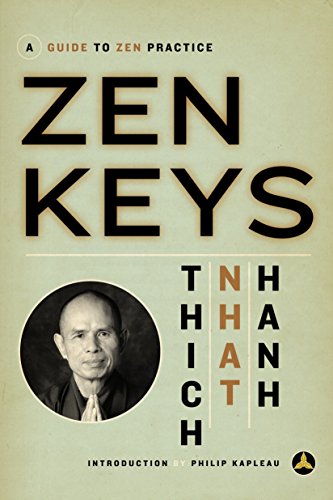
Thich Nhat Hanh brings his warmth and clarity to this unique explication of Zen Buddhism. Beginning with a discussion of daily life in a Zen monastery, Nhat Hanh illustrates the character of Zen as practiced in Vietnam, and gives the reader clear explanations of the central elements of Zen practice and philosophy.
Thorough attention is given to concepts such as Awareness and Impermanence, and to contemporary issues such as the conflicts between modern technology and spirituality. The final section includes a set of 43 koans from the 13th century Vietnamese master, Tran Thai Tong, which are translated here for the first time into English.
Originally published in 1974, Zen Keys has been unavailable for several years but is now reissued by popular demand. Readers will find it as fresh today as when it was first written, and will be struck by the timelessness of its insights. What makes this work particularly compelling is that Nhat Hanh is able to invigorate what in other presentations may seem like empty abstract principles. The example he has set in his own life as a relentless advocate for peace brings strength and a realistic understanding to idealistic Buddhist goals.
In Zen Keys, Thich Nhat Hanh presents the philosophy which has enabled him to be mindful of peace in every moment. An excellent introduction from Philip Kapleau (author of the classic Three Pillars Of Zen ) provides background on the emerging American Zen tradition.
Die Inhaltsangabe kann sich auf eine andere Ausgabe dieses Titels beziehen.
Über die Autorin bzw. den Autor
Thich Nhat Hanh is a Vietnamese Buddhist monk, poet, and peacemaker who was nominated by Dr. Martin Luther King Jr. for the Nobel Peace Prize. The author of many books, including Living Buddha, Living Christ, he lives in France in the monastic community known as Plum Village and lectures and gives retreats regularly in North America.
Von der hinteren Coverseite
Thich Nhat Hanh brings his warmth and clarity to this unique explication of Zen Buddhism. Beginning with a discussion of daily life in a Zen monastery, Nhat Hanh illustrates the character of Zen as practiced in Vietnam, and gives the reader clear explanations of the central elements of Zen practice and philosophy. Thorough attention is given to concepts such as Awareness and Impermanence, and to contemporary issues such as the conflicts between modern technology and spirituality. The final section includes a set of 43 koans from the 13th century Vietnamese master, Tran Thai Tong, which are translated here for the first time into English. Originally published in 1974, Zen Keys has been unavailable for several years but is now reissued by popular demand. Readers will find it as fresh today as when it was first written, and will be struck by the timelessness of its insights. What makes this work particularly compelling is that Nhat Hanh is able to invigorate what in other presentations may seem like empty abstract principles. The example he has set in his own life as a relentless advocate for peace brings strength and a realistic understanding to idealistic Buddhist goals. In Zen Keys, Thich Nhat Hanh presents the philosophy which has enabled him to be mindful of peace in every moment. An excellent introduction from Philip Kapleau (author of the classic Three Pillars Of Zen ) provides background on the emerging American Zen tradition.
Auszug. © Genehmigter Nachdruck. Alle Rechte vorbehalten.
I
THE PRACTICE OF MINDFULNESS
THE LITTLE BOOK
I entered Tu Hioeu Zen Monastery in the Imperial City of Huee when I was sixteen years old. After a brief adjustment to monastic life, I presented myself before the monk responsible for my training and asked him to teach me the Zen ''way.'' He gave me a small book, The Little Manual of Practice, printed in Chinese characters, and asked me to learn it by heart.
I thanked him and went to my room to study. This book—which is famous in Zen circles—is divided into three parts: 1) ''Practice in Everyday Life''; 2) ''Essential Practices for a Novice''; and 3) ''The Teachings of Zen Master Kuai Chan.'' There is no philosophy at all in this book. All three parts discuss only practical problems. The first part teaches how to calm and concentrate the mind. The second discusses the precepts and other practices essential to monastic life. The third is a beautiful exhortation to Zen students to encourage them to remember that their time and life are precious and should not be vainly dissipated. I was assured that not only young novices begin with this book, but that monks even forty and fifty also followed its prescriptions.
Before entering the monastery, I had already received some Western education, and I had the impression that the methods of teaching Buddhism in the monasteries were a little old-fashioned. First we were asked to learn the whole book by heart. Then we were to begin practicing without even being given the theoretical principles underlying it. I shared these concerns with another novice, who told me, ''This is the way followed here. If you want to learn Zen, you must accept it.'' So I resigned myself to beginning my practice in the traditional way.
The first part of The Little Manual, ''Practice in Everyday Life,'' contains gathas, short verses that bring the energy of mindfulness to each act of daily life. For example, when I wash my hands, I bring forth this thought: ''Water flows over these hands. May I use them skillfully to preserve our precious planet.'' When I am sitting in the meditation hall, I think: ''Sitting here is like sitting under the bodhi tree. My body is mindfulness itself, entirely free from distraction.'' And even when using the toilet, I say to myself: ''Defiled or immaculate, increasing or decreasing—these concepts exist only in our minds. The reality of interbeing is unsurpassed.''
''Practice in Everyday Life'' contains a total of fifty gathas. We have to practice intelligently so that we can compose others when we need them. The ones in the manual are only examples. We should modify or even change them and write others more suited to our needs and contemporary conditions. Suppose I am about to use the telephone. There is no gatha for using the telephone in The Little Manual, because at the time the book was written there were no telephones. I have invented a number of gathas, like the following: ''Words can travel thousands of miles. May my words create mutual understanding and love. May they be beautiful as gems, as lovely as flowers.'' I have compiled a book of traditional and modern gathas entitled Present Moment Wonderful Moment: Mindfulness Verses for Daily Living, for your use in the practice.
When I was sixteen, I thought The Little Manual was written for young people and those just beginning the practice of Zen. I thought this method was just for preparation. But today, more than fifty years later, I know that The Little Manual is the very essence of Zen Buddhism.
NECESSARY AWARENESS
I remember a short conversation between the Buddha and a philosopher of his time.
''I have heard that Buddhism is a doctrine of enlightenment. What is your method? What do you practice every day?''
''We walk, we eat, we wash ourselves, we sit down . . .''
''What is so special about that? Everyone walks, eats, washes, sits down . . .''
''Sir, when we walk, we are aware that we are walking; when we eat, we are aware that we are eating. . . . When others walk, eat, wash, or sit down, they are generally not aware of what they are doing.''
In Buddhism, mindfulness is the key. Mindfulness is the energy that sheds light on all things and all activities, producing the power of concentration, bringing forth deep insight and awakening. Mindfulness is at the base of all Buddhist practice.
To shed light on all things? This is the point of departure. If I live without mindfulness, in forgetfulness, I am, as Albert Camus says in his novel The Stranger, living ''like a dead person.'' The ancient Zen masters used to say, ''If we live in forgetfulness, we die in a dream.'' How many among us live ''like a dead person''! The first thing we have to do is to return to life, to wake up and be mindful of each thing we do. Are we aware when we are eating, drinking, sitting in meditation? Or are we wasting our time, living in forgetfulness?
To produce the power of concentration? Mindfulness helps us focus our attention on and know what we are doing. Usually we are a prisoner of society. Our energies are dispersed here and there. Our body and our mind are not in harmony. To begin to be aware of what we are doing, saying, and thinking is to begin to resist the invasion by our surroundings and by all of our wrong perceptions. When the lamp of awareness is lit, our whole being lights up, and each passing thought and emotion is also lit up. Self-confidence is reestablished, the shadows of illusion no longer overwhelm us, and our concentration develops to its fullest. We wash our hands, dress, perform everyday actions as before, but now we are aware of our actions, words, and thoughts.
The practice of mindfulness is not only for novices. It is a lifelong practice for everyone, even the Buddha himself. The power of mindfulness and concentration is the spiritual force behind all of the great men and women of human history.
To bring forth deep insight and awakening? The aim of Zen Buddhism is a clear vision of reality, seeing things as they are, and that is acquired by the power of concentration. This clear vision is enlightenment. Enlightenment is always enlightenment about something. It is not abstract.
MINDFULNESS
This process—to shed light on all things, to produce the power of concentration, and to bring forth deep insight and awakening—is called in Buddhism the ''Threefold Training'': Sila (precepts), samadhi (concentration), and prajña (insight). The word ''sila'' also means mindfulness, because the essence of the precepts is mindfulness. Precepts in Buddhism are not imposed by some outside authority. They arise from our own insight based on the practice of mindfulness. To be attached to the form without understanding the essence is to fall into what Buddhism calls attachment to rules. We realize insight by practicing mindfulness of our body, feelings, mind, and the objects of our mind, which are the world. That is why the first part of The Little Manual consists of mindfulness verses to memorize, and is called ''Practice in Everyday Life.''
When a scientist works in her laboratory, she does not smoke, eat sweets, or listen to the radio. The scientist refrains from doing these things not because they are immoral, but because she knows that they impede perfect concentration on the object of her study. It is the same in Zen. The precepts help us live in mindfulness.
In Zen, insight cannot be obtained just by the intellect—study, hypothesis, analysis, synthesis. The Zen student must use his or her entire being as an instrument of realization; the intellect is only one part of our being, and a part that often pulls us away from living...
„Über diesen Titel“ kann sich auf eine andere Ausgabe dieses Titels beziehen.
Suchergebnisse für Zen Keys: A Guide to Zen Practice

Foto des Verkäufers
Zen Keys: A Guide to Zen Practice
Anbieter: Dream Books Co., Denver, CO, USA
Verkäuferbewertung 5 von 5 Sternen

Zustand: acceptable. This copy has clearly been enjoyedâ"expect noticeable shelf wear and some minor creases to the cover. Binding is strong, and all pages are legible. May contain previous library markings or stamps. Artikel-Nr. 4EKGY30095I0_ns
Gebraucht kaufen
EUR 5,41
Versand gratis
Versand innerhalb von USA
Versand innerhalb von USA
Anzahl: 1 verfügbar
Beispielbild für diese ISBN
Zen Keys : A Guide to Zen Practice
Verlag:
Potter/Ten Speed/Harmony/Rodale, 1994
ISBN 10: 0385475616
ISBN 13: 9780385475617
Gebraucht
Softcover
Anbieter: Better World Books, Mishawaka, IN, USA
Verkäuferbewertung 5 von 5 Sternen
Zustand: Good. Pages intact with minimal writing/highlighting. The binding may be loose and creased. Dust jackets/supplements are not included. Stock photo provided. Product includes identifying sticker. Better World Books: Buy Books. Do Good. Artikel-Nr. 4305650-6
Gebraucht kaufen
EUR 5,96
Versand gratis
Versand innerhalb von USA
Versand innerhalb von USA
Anzahl: 1 verfügbar
Beispielbild für diese ISBN
Zen Keys : A Guide to Zen Practice
Verlag:
Potter/Ten Speed/Harmony/Rodale, 1994
ISBN 10: 0385475616
ISBN 13: 9780385475617
Gebraucht
Softcover
Anbieter: Better World Books, Mishawaka, IN, USA
Verkäuferbewertung 5 von 5 Sternen
Zustand: Good. Former library copy. Pages intact with minimal writing/highlighting. The binding may be loose and creased. Dust jackets/supplements are not included. Includes library markings. Stock photo provided. Product includes identifying sticker. Better World Books: Buy Books. Do Good. Artikel-Nr. 7968776-6
Gebraucht kaufen
EUR 5,96
Versand gratis
Versand innerhalb von USA
Versand innerhalb von USA
Anzahl: 2 verfügbar
Beispielbild für diese ISBN
Zen Keys : A Guide to Zen Practice
Verlag:
Potter/Ten Speed/Harmony/Rodale, 1994
ISBN 10: 0385475616
ISBN 13: 9780385475617
Gebraucht
Softcover
Anbieter: Better World Books: West, Reno, NV, USA
Verkäuferbewertung 5 von 5 Sternen
Zustand: Very Good. Pages intact with possible writing/highlighting. Binding strong with minor wear. Dust jackets/supplements may not be included. Stock photo provided. Product includes identifying sticker. Better World Books: Buy Books. Do Good. Artikel-Nr. 4034309-75
Gebraucht kaufen
EUR 5,96
Versand gratis
Versand innerhalb von USA
Versand innerhalb von USA
Anzahl: 1 verfügbar
Beispielbild für diese ISBN
Zen Keys: A Guide to Zen Practice
Anbieter: ThriftBooks-Phoenix, Phoenix, AZ, USA
Verkäuferbewertung 5 von 5 Sternen
Paperback. Zustand: Good. No Jacket. Former library book; Pages can have notes/highlighting. Spine may show signs of wear. ~ ThriftBooks: Read More, Spend Less. Artikel-Nr. G0385475616I3N10
Gebraucht kaufen
EUR 6,87
Versand gratis
Versand innerhalb von USA
Versand innerhalb von USA
Anzahl: 1 verfügbar
Beispielbild für diese ISBN
Zen Keys: A Guide to Zen Practice
Anbieter: ThriftBooks-Reno, Reno, NV, USA
Verkäuferbewertung 5 von 5 Sternen
Paperback. Zustand: Good. No Jacket. Pages can have notes/highlighting. Spine may show signs of wear. ~ ThriftBooks: Read More, Spend Less. Artikel-Nr. G0385475616I3N00
Gebraucht kaufen
EUR 6,87
Versand gratis
Versand innerhalb von USA
Versand innerhalb von USA
Anzahl: 3 verfügbar
Beispielbild für diese ISBN
Zen Keys: A Guide to Zen Practice
Anbieter: ThriftBooks-Phoenix, Phoenix, AZ, USA
Verkäuferbewertung 5 von 5 Sternen
Paperback. Zustand: Fair. No Jacket. Readable copy. Pages may have considerable notes/highlighting. ~ ThriftBooks: Read More, Spend Less. Artikel-Nr. G0385475616I5N00
Gebraucht kaufen
EUR 6,87
Versand gratis
Versand innerhalb von USA
Versand innerhalb von USA
Anzahl: 2 verfügbar
Beispielbild für diese ISBN
Zen Keys: A Guide to Zen Practice
Anbieter: ThriftBooks-Reno, Reno, NV, USA
Verkäuferbewertung 5 von 5 Sternen
Paperback. Zustand: Good. No Jacket. Former library book; Pages can have notes/highlighting. Spine may show signs of wear. ~ ThriftBooks: Read More, Spend Less. Artikel-Nr. G0385475616I3N10
Gebraucht kaufen
EUR 6,87
Versand gratis
Versand innerhalb von USA
Versand innerhalb von USA
Anzahl: 1 verfügbar
Beispielbild für diese ISBN
Zen Keys: A Guide to Zen Practice
Anbieter: ThriftBooks-Reno, Reno, NV, USA
Verkäuferbewertung 5 von 5 Sternen
Paperback. Zustand: Fair. No Jacket. Readable copy. Pages may have considerable notes/highlighting. ~ ThriftBooks: Read More, Spend Less. Artikel-Nr. G0385475616I5N00
Gebraucht kaufen
EUR 6,87
Versand gratis
Versand innerhalb von USA
Versand innerhalb von USA
Anzahl: 2 verfügbar
Beispielbild für diese ISBN
Zen Keys: A Guide to Zen Practice
Anbieter: ThriftBooks-Phoenix, Phoenix, AZ, USA
Verkäuferbewertung 5 von 5 Sternen
Paperback. Zustand: Good. No Jacket. Pages can have notes/highlighting. Spine may show signs of wear. ~ ThriftBooks: Read More, Spend Less. Artikel-Nr. G0385475616I3N00
Gebraucht kaufen
EUR 6,87
Versand gratis
Versand innerhalb von USA
Versand innerhalb von USA
Anzahl: 3 verfügbar