
Verwandte Artikel zu So, Anyway...
Inhaltsangabe
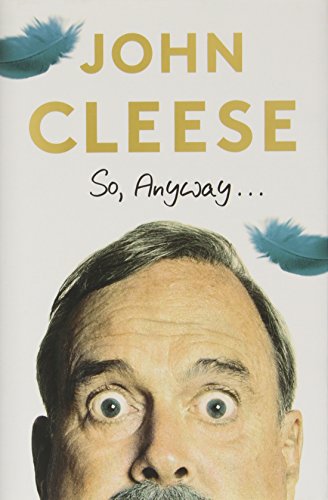
John Cleese’s huge comedic influence has stretched across generations; his sharp irreverent eye and the unique brand of physical comedy he perfected with Monty Python, on Fawlty Towers, and beyond now seem written into comedy’s DNA. In this rollicking memoir, So, Anyway…, Cleese takes readers on a Grand Tour of his ascent in the entertainment world, from his humble beginnings in a sleepy English town and his early comedic days at Cambridge University (with future Python partner Graham Chapman), to the founding of the landmark comedy troupe that would propel him to worldwide renown.
Cleese was just days away from graduating Cambridge and setting off on a law career when he was visited by two BBC executives, who offered him a job writing comedy for radio. That fateful moment—and a near-simultaneous offer to take his university humor revue to London’s famed West End—propelled him down a different path, cutting his teeth writing for stars like David Frost and Peter Sellers, and eventually joining the five other Pythons to pioneer a new kind of comedy that prized invention, silliness, and absurdity. Along the way, he found his first true love with the actress Connie Booth and transformed himself from a reluctant performer to a world class actor and back again.
Twisting and turning through surprising stories and hilarious digressions—with some brief pauses along the way that comprise a fascinating primer on what’s funny and why—this story of a young man’s journey to the pinnacle of comedy is a masterly performance by a master performer.
Die Inhaltsangabe kann sich auf eine andere Ausgabe dieses Titels beziehen.
Über die Autorin bzw. den Autor
JOHN CLEESE cofounded the legendary Monty Python comedy troupe, writing and performing in the first three TV seasons of Flying Circus and in films that include Monty Python and the Holy Grail and Life of Brian. He cowrote and starred in the sitcom Fawlty Towers, and wrote and costarred in A Fish Called Wanda and Fierce Creatures. He has also coauthored two best-selling books on Psychology.
Auszug. © Genehmigter Nachdruck. Alle Rechte vorbehalten.
An excerpt from SO, ANYWAY…
By John Cleese
I made my first public appearance on the stairs up to the school nurse’s room, at St. Peter’s Preparatory School, Weston-super-Mare, Somerset, England, on September 13, 1948. I was eight and five-sixths. My audience was a pack of nine-year-olds, who were jeering at me and baying, “Chee-eese! Chee-eese!” I kept climbing the steps, despite the feelings of humiliation and fear. But above all, I was bewildered. How had I managed to attract so much attention? What had I done to provoke this aggression? And . . . how on earth did they know that my family surname had once been Cheese?
As Matron “Fishy” Findlater gave me the customary new-boy physical examination, I tried to gather my thoughts. My parents had always warned me to keep away from “nasty rough boys.” What, then, were they doing at a nice school like St. Peter’s? And how was I supposed to avoid them?
Much of my predicament was that I was not just a little boy, but a very tall little boy. I was five foot three, and would pass the six-foot mark before I was twelve. So it was hard to fade away into the background, as I often wished to—particularly later when I’d become taller than any of the masters. It didn’t help that one of them, Mr. Bartlett, always referred to me as “a prominent citizen.”
In addition, as a result of my excessive height, I had “outgrown my strength,” and my physical weakness meant that I was uncoordinated and awkward; so much so that a few years later my PE teacher, Captain Lancaster, was to describe me as “six foot of chewed string.” Add to that the fact that I had had no previous experience of the feral nature of gangs of young boys, and you will understand why my face bore the expression of an authentic coward as “Fishy” opened the door and coaxed me out towards my second public appearance.
“Don’t worry, it’s only teasing,” she said. What consolation was that? You could have said the same at Nuremberg. But at least the chanting had stopped, and now there was an expectant silence as I forced myself down the stairs. Then…
“Are you a Roundhead or a Cavalier?”
“What?”
Faces were thrust at me, each one of them demanding, “Roundhead or Cavalier?” What were they talking about?
Had I understood the question, I would almost certainly have fainted, such a delicate little flower was I. (And perhaps I should explain to the more delicately nurtured that I was not being asked to offer my considered views on the relative merits of the opposing forces in the English Civil War, but to reveal whether or not I had been circumcised.) However, my first day at prep school was not a total failure. By the time I got home I had learned the meaning of two new words—“pathetic” and “wet”—though I had to find Dad’s dictionary to look up “sissy.”
Why was I so . . . ineffectual? Well, let’s begin at my beginning. I was born on October 27, 1939, in Uphill, a little village south of Weston-super-Mare, and separated from it by the mere width of a road which led inland from the Weston seafront. My first memory, though, is not of Uphill but of a tree in the village of Brent Knoll, a few miles away, under whose shade I recall lying, while I looked through its branches to the bright blue sky above. The sunlight is catching the leaves at different angles, so that my eye flickers from one patch of colour to the next, the verdant foliage displaying a host of verdant hues. (I thought I would try to get “verdant,” “hues” and “foliage” into this paragraph, as my English teachers always believed that they were signs of creative talent. Though I probably shouldn’t have used “verdant” twice.)
Of course, I’m not sure it is my first memory; I’m sure I used to think it was; and I like to think it was, too, because it would make sense, baby me lying in a pram, contentedly watching the interplay of the glinting verdant foliage and its beautiful hues.
One thing I do know for certain, though, is that shortly before this incident with the tree, the Germans bombed Weston-super-Mare. I’ll just repeat that…
On August 14, 1940, German planes bombed Weston-super-Mare. This is verifiable: it was in all the papers. Especially the Weston Mercury. Most Westonians were confident the raid had been a mistake. The Germans were a people famous for their efficiency, so why would they drop perfectly good bombs on Weston-super-Mare, when there was nothing in Weston that a bomb could destroy that could possibly be as valuable as the bomb that destroyed it? That would mean that every explosion would make a tiny dent in the German economy.
The Germans did return, however, and several times, which mystified everyone. Nevertheless I can’t help thinking that Westonians actually quite liked being bombed: it gave them a sense of significance that was otherwise lacking from their lives. But that still leaves the question why would the Hun have bothered? Was it just Teutonic joie de vivre? Did the Luftwaffe pilots mistake the Weston seafront for the Western Front? I have heard it quite seriously put forward by older Westonians that it was done at the behest of William Joyce, the infamous “Lord Haw-Haw,” who was hanged as a traitor in 1944 by the British for making Nazi propaganda radio broadcasts to Britain during the war. When I asked these amateur historians why a man of Irish descent who was born in Brooklyn would have such an animus against Weston that he would buttonhole Hitler on the matter, they fell silent. I prefer to believe that it was because of a grudge held by Reichsmarschall Hermann Goering on account of an unsavoury incident on Weston pier in the 1920s, probably involving Noël Coward and Terence Rattigan.
My father’s explanation, however, makes the most sense: he said the Germans bombed Weston to show that they really do have a sense of humour.
Whatever the truth of the matter, two days after that first raid we had moved to a quaint little Somerset village called Brent Knoll. Dad had had quite enough of big bangs during his four years in the trenches in France, and since he was up to nothing in Weston that was vital to the war effort, he spent the day after the bombing driving around the countryside near Weston until he found a small farmhouse, owned by a Mr. and Mrs. Raffle, who agreed to take the Cleese family on as paying guests. I love the fact that he didn’t mess around. We were out of there! And it was typically smart of him to find a farm, where, at a time of strict rationing, an egg or a chicken or even a small pig could go missing without attracting too much attention.
Mother told me once that some Westonians privately criticised Dad for retreating so soon. They apparently felt it would have been more dignified to have waited a week or so before running away. I think this view misses the essential point of running away, which is to do it the moment the idea has occurred to you. Only an obsessional procrastinator would cry, “Let’s run for our lives, but not till Wednesday afternoon.”
Back to the tree. I revisited the farm many years later, and, just as I thought I remembered, there was a huge chestnut tree in the middle of the front lawn, under which I might easily have lain in a pram. In 1940 the farmhouse had been one of a row of houses of medium size strung along a road, with fields opposite; it didn’t look very farm-like from the front, but...
„Über diesen Titel“ kann sich auf eine andere Ausgabe dieses Titels beziehen.
Suchergebnisse für So, Anyway...

Beispielbild für diese ISBN
So Anyway
Anbieter: World of Books (was SecondSale), Montgomery, IL, USA
Verkäuferbewertung 5 von 5 Sternen

Zustand: Good. Item in good condition. Textbooks may not include supplemental items i.e. CDs, access codes etc. Artikel-Nr. 00105252132
Gebraucht kaufen
EUR 3,99
Versand gratis
Versand innerhalb von USA
Versand innerhalb von USA
Anzahl: 16 verfügbar
Beispielbild für diese ISBN
So Anyway
Anbieter: World of Books (was SecondSale), Montgomery, IL, USA
Verkäuferbewertung 5 von 5 Sternen
Zustand: Acceptable. Item in acceptable condition! Textbooks may not include supplemental items i.e. CDs, access codes etc. Artikel-Nr. 00105940572
Gebraucht kaufen
EUR 3,99
Versand gratis
Versand innerhalb von USA
Versand innerhalb von USA
Anzahl: 1 verfügbar
Beispielbild für diese ISBN
So, Anyway.
Anbieter: World of Books (was SecondSale), Montgomery, IL, USA
Verkäuferbewertung 5 von 5 Sternen
Hardback. Zustand: Very Good. NEW YORK TIMES BESTSELER - John Cleese's memoir is just about everything one would expect of its author--smart, thoughtful, provocative and above all funny. . . . A picture, if you will, of the artist as a young man.--The Washington Post The legendary writer and performer of Monty Python and Fawlty Towers fame takes readers on a grand tour of his ascent in the entertainment world John Cleese's huge comedic influence has stretched across generations; his sharp irreverent eye and the unique brand of physical comedy he perfected now seem written into comedy's DNA. In this rollicking memoir, Cleese recalls his humble beginnings in a sleepy English town, his early comedic days at Cambridge University (with future Python partner Graham Chapman), and the founding of the landmark comedy troupe that would propel him to worldwide renown. Cleese was just days away from graduating Cambridge and setting off on a law career when he was visited by two BC executives, who offered him a job writing comedy for radio. That fateful moment--and a near-simultaneous offer to take his university humor revue to London's famed West End--propelled him down a different path, cutting his teeth writing for stars like David Frost and Peter Sellers, and eventually joining the five other Pythons to pioneer a new kind of comedy that prized invention, silliness, and absurdity. Along the way, he found his first true love with the actress Connie Booth and transformed himself from a reluctant performer to a world class actor and back again. Twisting and turning through surprising stories and hilarious digressions--with some brief pauses along the way that comprise a fascinating primer on what's funny and why--this story of a young man's journey to the pinnacle of comedy is a masterly performance by a master performer. Artikel-Nr. 00106911082
Gebraucht kaufen
EUR 3,99
Versand gratis
Versand innerhalb von USA
Versand innerhalb von USA
Anzahl: 4 verfügbar
Foto des Verkäufers
So, Anyway.
Anbieter: Dream Books Co., Denver, CO, USA
Verkäuferbewertung 5 von 5 Sternen
Zustand: good. Gently used with minimal wear on the corners and cover. A few pages may contain light highlighting or writing, but the text remains fully legible. Dust jacket may be missing, and supplemental materials like CDs or codes may not be included. May be ex-library with library markings. Ships promptly! Artikel-Nr. DBV.038534824X.G
Gebraucht kaufen
EUR 4,55
Versand gratis
Versand innerhalb von USA
Versand innerhalb von USA
Anzahl: 1 verfügbar
Beispielbild für diese ISBN
So, Anyway.
Verlag:
Crown Archetype (edition First Edition), 2014
ISBN 10: 038534824X
ISBN 13: 9780385348249
Gebraucht
Hardcover
Erstausgabe
Anbieter: BooksRun, Philadelphia, PA, USA
Verkäuferbewertung 5 von 5 Sternen
Hardcover. Zustand: Fair. First Edition. With dust jacket. The item might be beaten up but readable. May contain markings or highlighting, as well as stains, bent corners, or any other major defect, but the text is not obscured in any way. Artikel-Nr. 038534824X-7-1-29
Gebraucht kaufen
EUR 5,18
Versand gratis
Versand innerhalb von USA
Versand innerhalb von USA
Anzahl: 1 verfügbar
Beispielbild für diese ISBN
So, Anyway.
Anbieter: ThriftBooks-Atlanta, AUSTELL, GA, USA
Verkäuferbewertung 5 von 5 Sternen
Hardcover. Zustand: Very Good. No Jacket. May have limited writing in cover pages. Pages are unmarked. ~ ThriftBooks: Read More, Spend Less. Artikel-Nr. G038534824XI4N00
Gebraucht kaufen
EUR 5,87
Versand gratis
Versand innerhalb von USA
Versand innerhalb von USA
Anzahl: 1 verfügbar
Beispielbild für diese ISBN
So, Anyway.
Anbieter: ThriftBooks-Dallas, Dallas, TX, USA
Verkäuferbewertung 5 von 5 Sternen
Hardcover. Zustand: Very Good. No Jacket. Former library book; May have limited writing in cover pages. Pages are unmarked. ~ ThriftBooks: Read More, Spend Less. Artikel-Nr. G038534824XI4N10
Gebraucht kaufen
EUR 5,87
Versand gratis
Versand innerhalb von USA
Versand innerhalb von USA
Anzahl: 1 verfügbar
Beispielbild für diese ISBN
So, Anyway.
Anbieter: ThriftBooks-Atlanta, AUSTELL, GA, USA
Verkäuferbewertung 5 von 5 Sternen
Hardcover. Zustand: Very Good. No Jacket. Former library book; May have limited writing in cover pages. Pages are unmarked. ~ ThriftBooks: Read More, Spend Less. Artikel-Nr. G038534824XI4N10
Gebraucht kaufen
EUR 5,87
Versand gratis
Versand innerhalb von USA
Versand innerhalb von USA
Anzahl: 1 verfügbar
Beispielbild für diese ISBN
So, Anyway.
Anbieter: ThriftBooks-Reno, Reno, NV, USA
Verkäuferbewertung 5 von 5 Sternen
Hardcover. Zustand: Very Good. No Jacket. Former library book; May have limited writing in cover pages. Pages are unmarked. ~ ThriftBooks: Read More, Spend Less. Artikel-Nr. G038534824XI4N10
Gebraucht kaufen
EUR 5,87
Versand gratis
Versand innerhalb von USA
Versand innerhalb von USA
Anzahl: 1 verfügbar
Beispielbild für diese ISBN
So, Anyway.
Verlag:
Crown Archetype (edition First Edition), 2014
ISBN 10: 038534824X
ISBN 13: 9780385348249
Gebraucht
Hardcover
Erstausgabe
Anbieter: BooksRun, Philadelphia, PA, USA
Verkäuferbewertung 5 von 5 Sternen
Hardcover. Zustand: Very Good. First Edition. With dust jacket. It's a well-cared-for item that has seen limited use. The item may show minor signs of wear. All the text is legible, with all pages included. It may have slight markings and/or highlighting. Artikel-Nr. 038534824X-11-18-29
Gebraucht kaufen
EUR 5,87
Versand gratis
Versand innerhalb von USA
Versand innerhalb von USA
Anzahl: 2 verfügbar