
Verwandte Artikel zu The Butler's Guide to Running the Home and Other...
Inhaltsangabe
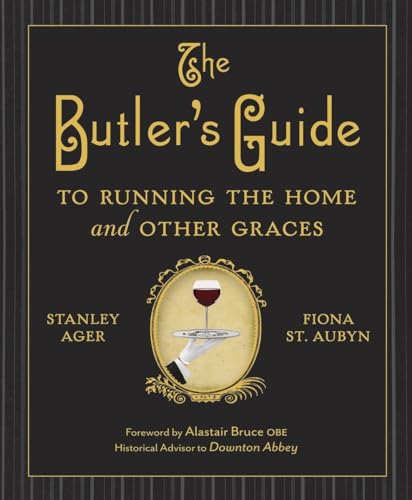
Perched on an island off the shores of Cornwall, England, the soaring castle of St. Michael’s Mount has been home to the St. Aubyn family since 1647. For nearly thirty years, Stanley Ager, one of the most esteemed butlers of the twentieth century, ensured that St. Michael’s Mount was an impeccable place to live and a gracious and welcoming one for guests to visit.
Revered by everyone from royalty to the estate staff, Stanley Ager considered it his calling to run a home gracefully and efficiently. Several of the men whom he trained at St. Michael’s Mount went on to serve in the Royal Household at Buckingham Palace and at British embassies throughout the world. But you don’t need a manor to benefit from Ager’s wisdom on homekeeping. This carefully detailed, charmingly illustrated, eminently useful volume offers important insights and techniques, including how to:
Wipe a glass—or a chandelier—until it sparkles *** Fold napkins precisely—in six different ways *** Polish furniture—or silver—to a mirror finish *** Lay a beautiful table and serve a meal impeccably *** Brush, buff, and maintain any manner of clothes and footwear *** Fold and pack for a trip—for business or pleasure *** Select and pour wine *** Stage “impromptu” romantic picnics *** And, among other graces, open a door soundlessly, roll an umbrella perfectly, and iron a newspaper
Die Inhaltsangabe kann sich auf eine andere Ausgabe dieses Titels beziehen.
Über die Autorin bzw. den Autor
Stanley Ager entered service as a hallboy at the age of fourteen and eventually became head butler at St. Michael’s Mount, where he remained for nearly thirty of his fifty-three years in service. The Butler’s Guide was written after he and his wife, Barbara, retired nearby to Marazion, Cornwall. They are buried on St. Michael’s Mount.
Fiona St. Aubyn is also the author of A Portrait of Georgian London and wrote ClothesCarewith James Wagenvoord. She graduated from the University of Winchester with a degree in creative writing and lives in Hampshire with her family. Fiona St. Aubyn is a granddaughter of the late third Lord St. Levan and his wife the Dowager Lady St. Levan, and her brother now lives at St. Michael’s Mount. She knew Stanley Ager all her life.
Auszug. © Genehmigter Nachdruck. Alle Rechte vorbehalten.
Chapter 1
Ager's Way
In 1975 I retired, after fifty-three years in service. Barbara and I moved out of our house on St. Michael’s Mount, where we had lived for thirty years, and into one in Marazion, the village opposite the castle. We left the Mount on a Friday and had a housewarming party on the Sunday. It had taken us exactly two days to establish ourselves so completely that we didn’t have to look for anything. Our friends were amazed. “It feels as though you’ve been here all your life!” they said. But it was simply a question of experience; we were used to moving house from having been in service. At the start of the London season, the staff were sent up in the afternoon to have the house ready for the family in the evening. We’d arrive to find the house in dust sheets, but by the time the family arrived for dinner, you would never know that anyone had been away.
At first I didn’t feel right being out of uniform and in casual clothes in the morning; otherwise, I was content to retire. After all, I have traveled the world, lived in some magnificent houses and been lucky with my employers. But I still miss the staff. They fought amongst themselves and always caused me far more trouble than the Lord and Lady—yet I miss them most of all.
•••
I was fourteen when I entered service in 1922. I began as hallboy—the lowest servant of all—in Lord Coventry’s household at Croome Court. On my first day it seemed like a house full of servants; there were some forty people of all ages working there. Everyone was friendly except the housekeeper—she didn’t want anything to do with new boys. But she treated her youngest girls just the same way I was treated by the butler, and most butlers were courteous people.
I chose to work for Lord Coventry because he raced in partnership with his daughter, Lady Barbara Smith, and I have always been interested in horse racing. I come from Newmarket, a town north of London that is the home of British horse racing. My father was a head stableman and my brother an apprentice jockey. At one time I thought more about going into racing than about going into service, but after my parents died, entering service seemed the best way of supporting myself.
At the beginning I did most of my work in the servants’ quarters at the back of the house. I didn’t go to the front where the family lived, except for the dining room, until I had worked at Croome Court for six months. When I did, the flowers in the reception rooms struck me first of all. I can still remember the smell of the carnations. I had never seen carnations in such quantity before, and they were all colors—even yellow, and I haven’t seen many yellow ones since. I was awed by the general opulence—the silver candlesticks and inkstands on the writing desks, the tapestries on the walls and the thick rugs, which were quite different from the stone tiles I was used to walking on.
It was not until I worked at the front of the house that I saw the family to speak to. The only time I saw them before that was at prayers, which were held in the dining room at nine o’clock after we laid the table for breakfast. At the end the lady of the house always said, “God make my servants dutiful.” Then the family left the room and we rushed like mad to get breakfast on the table.
At fourteen, I wasn’t considered young to start work. A lad was usually hallboy until he was fifteen and a half, then he became steward’s room boy or third footman. The hallboy and steward’s room boy learnt their trade by waiting on members of staff, and the hallboy looked after the butler’s clothes. Only the grander houses had a steward’s room boy, and few of them had as many as forty servants. Most houses had between twelve and fifteen staff members.
How quickly a lad was promoted depended on his ability rather than on his age. Most third and second footmen were very young footmen. Their duties included serving at table, cleaning silver and caring for clothes. The first footman was usually in his mid-twenties and acted as an assistant to the butler. Very few footmen became butlers until they were in their thirties. Before that a footman might valet the gentleman of the house. Then when he became butler, his most important duty was to see that the house ran smoothly.
Most young servants moved to a different house after about a year or so to gain promotion and to experience how various houses were run. A servant who was looking for another job became very snobbish about the family; we wanted someone who had several houses so we could travel round the country. Two houses weren’t really enough. And they had to go to London in the London season—if they didn’t have a house in London, we wouldn’t look at that job either. We wanted London because of the lovely parties and because in town we could get out more and spend all the money we had saved in the country. This wasn’t very much, as salaries were small—from fifteen to twenty pounds a year, which the hallboy received, to a butler’s ninety pounds a year.
I left Lord Coventry to work for Lady Barbara Smith as steward’s room boy. I stayed there a year before becoming third footman to the Pikes. The first guest I looked after for the Pikes was television pioneer John Logie Baird. He arrived with two scruffy suitcases and preferred a cheap brand of cigarettes to some excellent cigars after dinner. I didn’t think my tip would amount to much. But when he left, he gave me five pounds—more than double my month’s wages.
Next I was second footman to Sir Bryan Godfrey-Faussett, who was at one time equerry to King George V. Then in 1926 I went to Lord Dunsany, a well-known author and playwright. He lived at Dunsany Castle, County Meath, Ireland, and his country house in England was Dunstall Priory in Kent. I began as second footman and valet to his eldest son. After a couple of years, when I was only nineteen, I was promoted to first footman and valet to Lord Dunsany.
I remember a time when H. G. Wells came to stay and the tablecloth accidentally caught fire. H. G. Wells was up in an instant and out of the window. The butler appeared and simply put the fire out with a damp cloth. I don’t know whether this had anything to do with it, but I never saw H. G. Wells at Dunsany again.
I was at Dunsany for four years in all before leaving in 1930 to become full-time valet to the second Lord St. Levan. He lived in St. Michael’s Mount, a castle just off the southern coast of England, in Cornwall. The Mount is about a quarter of a mile from the mainland. It can be reached by causeway eight hours out of twenty-four, but at high tide the sea is fifteen feet deep in the center of the causeway and the Mount becomes an island.
I took the job because I had never been to Cornwall and the second lord said he traveled. I went all round the world with him. Wherever he wanted to go, he just went. If it was cold when we returned to England, we’d pop off again. I made all the arrangements, bought the tickets and more or less made the world smooth for him and his party.
A valet was almost always a bachelor because so much of his time was spent traveling with his employer. So in 1933 after I married Barbara, who was parlormaid at the castle, I left the Mount for my first butlering job. I was twenty-six. For two years I worked for Mr. Dunkels, who was head of the Diamond Corporation, and Barbara worked as head parlormaid (the female equivalent of a butler) in another household.
I left in 1935 to become butler to Colonel Trotter, who lived at Charterhall, Berwickshire, Scotland. The house was a halfway stop for Princess Alice, who...
„Über diesen Titel“ kann sich auf eine andere Ausgabe dieses Titels beziehen.
Suchergebnisse für The Butler's Guide to Running the Home and Other...

Beispielbild für diese ISBN
The Butler's Guide to Running the Home and Other Graces
Verlag:
Clarkson Potter Publishers, 2012
ISBN 10: 0385344708
ISBN 13: 9780385344708
Gebraucht
Hardcover
Anbieter: ThriftBooks-Dallas, Dallas, TX, USA
Verkäuferbewertung 5 von 5 Sternen

Hardcover. Zustand: Very Good. No Jacket. Former library book; May have limited writing in cover pages. Pages are unmarked. ~ ThriftBooks: Read More, Spend Less. Artikel-Nr. G0385344708I4N10
Gebraucht kaufen
EUR 6,31
Versand gratis
Versand innerhalb von USA
Versand innerhalb von USA
Anzahl: 1 verfügbar
Beispielbild für diese ISBN
The Butler's Guide to Running the Home and Other Graces
Verlag:
Clarkson Potter Publishers, 2012
ISBN 10: 0385344708
ISBN 13: 9780385344708
Gebraucht
Hardcover
Anbieter: ThriftBooks-Atlanta, AUSTELL, GA, USA
Verkäuferbewertung 5 von 5 Sternen
Hardcover. Zustand: Good. No Jacket. Pages can have notes/highlighting. Spine may show signs of wear. ~ ThriftBooks: Read More, Spend Less. Artikel-Nr. G0385344708I3N00
Gebraucht kaufen
EUR 6,31
Versand gratis
Versand innerhalb von USA
Versand innerhalb von USA
Anzahl: 1 verfügbar
Beispielbild für diese ISBN
The Butler's Guide to Running the Home and Other Graces
Verlag:
Clarkson Potter Publishers, 2012
ISBN 10: 0385344708
ISBN 13: 9780385344708
Gebraucht
Hardcover
Anbieter: ThriftBooks-Atlanta, AUSTELL, GA, USA
Verkäuferbewertung 5 von 5 Sternen
Hardcover. Zustand: Very Good. No Jacket. Missing dust jacket; May have limited writing in cover pages. Pages are unmarked. ~ ThriftBooks: Read More, Spend Less. Artikel-Nr. G0385344708I4N01
Gebraucht kaufen
EUR 6,31
Versand gratis
Versand innerhalb von USA
Versand innerhalb von USA
Anzahl: 1 verfügbar
Beispielbild für diese ISBN
The Butler's Guide to Running the Home and Other Graces
Verlag:
Clarkson Potter Publishers, 2012
ISBN 10: 0385344708
ISBN 13: 9780385344708
Gebraucht
Hardcover
Anbieter: ThriftBooks-Dallas, Dallas, TX, USA
Verkäuferbewertung 5 von 5 Sternen
Hardcover. Zustand: As New. No Jacket. Pages are clean and are not marred by notes or folds of any kind. ~ ThriftBooks: Read More, Spend Less. Artikel-Nr. G0385344708I2N00
Gebraucht kaufen
EUR 6,31
Versand gratis
Versand innerhalb von USA
Versand innerhalb von USA
Anzahl: 1 verfügbar
Beispielbild für diese ISBN
The Butler's Guide to Running the Home and Other Graces
Verlag:
Clarkson Potter Publishers, 2012
ISBN 10: 0385344708
ISBN 13: 9780385344708
Gebraucht
Hardcover
Anbieter: ThriftBooks-Reno, Reno, NV, USA
Verkäuferbewertung 5 von 5 Sternen
Hardcover. Zustand: Very Good. No Jacket. Former library book; May have limited writing in cover pages. Pages are unmarked. ~ ThriftBooks: Read More, Spend Less. Artikel-Nr. G0385344708I4N10
Gebraucht kaufen
EUR 6,31
Versand gratis
Versand innerhalb von USA
Versand innerhalb von USA
Anzahl: 1 verfügbar
Beispielbild für diese ISBN
The Butler's Guide to Running the Home and Other Graces
Verlag:
Clarkson Potter Publishers, 2012
ISBN 10: 0385344708
ISBN 13: 9780385344708
Gebraucht
Hardcover
Anbieter: ThriftBooks-Dallas, Dallas, TX, USA
Verkäuferbewertung 5 von 5 Sternen
Hardcover. Zustand: Very Good. No Jacket. May have limited writing in cover pages. Pages are unmarked. ~ ThriftBooks: Read More, Spend Less. Artikel-Nr. G0385344708I4N00
Gebraucht kaufen
EUR 6,31
Versand gratis
Versand innerhalb von USA
Versand innerhalb von USA
Anzahl: 2 verfügbar
Beispielbild für diese ISBN
The Butler's Guide to Running the Home and Other Graces
Verlag:
Clarkson Potter Publishers, 2012
ISBN 10: 0385344708
ISBN 13: 9780385344708
Gebraucht
Hardcover
Anbieter: ThriftBooks-Reno, Reno, NV, USA
Verkäuferbewertung 5 von 5 Sternen
Hardcover. Zustand: Very Good. No Jacket. May have limited writing in cover pages. Pages are unmarked. ~ ThriftBooks: Read More, Spend Less. Artikel-Nr. G0385344708I4N00
Gebraucht kaufen
EUR 6,31
Versand gratis
Versand innerhalb von USA
Versand innerhalb von USA
Anzahl: 1 verfügbar
Beispielbild für diese ISBN
The Butler's Guide to Running the Home and Other Graces
Verlag:
Clarkson Potter Publishers, 2012
ISBN 10: 0385344708
ISBN 13: 9780385344708
Gebraucht
Hardcover
Anbieter: ThriftBooks-Phoenix, Phoenix, AZ, USA
Verkäuferbewertung 5 von 5 Sternen
Hardcover. Zustand: Very Good. No Jacket. May have limited writing in cover pages. Pages are unmarked. ~ ThriftBooks: Read More, Spend Less. Artikel-Nr. G0385344708I4N00
Gebraucht kaufen
EUR 6,31
Versand gratis
Versand innerhalb von USA
Versand innerhalb von USA
Anzahl: 1 verfügbar
Beispielbild für diese ISBN
The Butler's Guide to Running the Home and Other Graces
Verlag:
Clarkson Potter Publishers, 2012
ISBN 10: 0385344708
ISBN 13: 9780385344708
Gebraucht
Hardcover
Anbieter: ThriftBooks-Atlanta, AUSTELL, GA, USA
Verkäuferbewertung 5 von 5 Sternen
Hardcover. Zustand: Very Good. No Jacket. Former library book; May have limited writing in cover pages. Pages are unmarked. ~ ThriftBooks: Read More, Spend Less. Artikel-Nr. G0385344708I4N10
Gebraucht kaufen
EUR 6,31
Versand gratis
Versand innerhalb von USA
Versand innerhalb von USA
Anzahl: 1 verfügbar
Beispielbild für diese ISBN
The Butler's Guide to Running the Home and Other Graces
Verlag:
Clarkson Potter Publishers, 2012
ISBN 10: 0385344708
ISBN 13: 9780385344708
Gebraucht
Hardcover
Anbieter: World of Books (was SecondSale), Montgomery, IL, USA
Verkäuferbewertung 5 von 5 Sternen
Hardback. Zustand: Good. Perched on an island off the shores of Cornwall, England, the soaring castle of St. Michael's Mount has been home to the St. Aubyn family since 1647. For nearly thirty years, Stanley Ager, one of the most esteemed butlers of the twentieth century, ensured that St. Michael's Mount was an impeccable place to live and a gracious and welcoming one for guests to visit. Revered by everyone from royalty to the estate staff, Stanley Ager considered it his calling to run a home gracefully and efficiently. Several of the men whom he trained at St. Michael's Mount went on to serve in the Royal Household at Buckingham Palace and at British embassies throughout the world. But you don't need a manor to benefit from Ager's wisdom on homekeeping. This carefully detailed, charmingly illustrated, eminently useful volume offers important insights and techniques, including how to: Wipe a glass--or a chandelier--until it sparkles *** Fold napkins precisely--in six different ways *** Polish furniture--or silver--to a mirror finish *** Lay a beautiful table and serve a meal impeccably *** Brush, buff, and maintain any manner of clothes and footwear *** Fold and pack for a trip--for business or pleasure *** Select and pour wine *** Stage "impromptu" romantic picnics *** And, among other graces, open a door soundlessly, roll an umbrella perfectly, and iron a newspaper. Artikel-Nr. 00108739752
Gebraucht kaufen
EUR 6,48
Versand gratis
Versand innerhalb von USA
Versand innerhalb von USA
Anzahl: 3 verfügbar