
Verwandte Artikel zu The Good Girl's Guide to Getting Lost: A Memoir...
The Good Girl's Guide to Getting Lost: A Memoir of Three Continents, Two Friends, and One Unexpected Adventure - Softcover
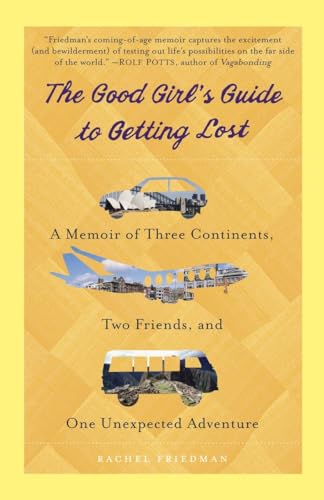
Inhaltsangabe
Rachel Friedman has always been the consummate good girl who does well in school and plays it safe, so the college grad surprises no one more than herself when, on a whim (and in an effort to escape impending life decisions), she buys a ticket to Ireland, a place she has never visited. There she forms an unlikely bond with a free-spirited Australian girl, a born adventurer who spurs Rachel on to a yearlong odyssey that takes her to three continents, fills her life with newfound friends, and gives birth to a previously unrealized passion for adventure.
As her journey takes her to Australia and South America, Rachel discovers and embraces her love of travel and unlocks more truths about herself than she ever realized she was seeking. Along the way, the erstwhile good girl finally learns to do something she’s never done before: simply live for the moment.
Die Inhaltsangabe kann sich auf eine andere Ausgabe dieses Titels beziehen.
Über die Autorin bzw. den Autor
Rachel Friedman is the author of The Good Girl’s Guide to Getting Lost. She’s written for The New York Times, National Geographic Traveler, New York, BUST, Creative Nonfiction, Bitch, The Chronicle of Higher Education, Bon Appetit, and many other publications.
Auszug. © Genehmigter Nachdruck. Alle Rechte vorbehalten.
[1]
Our heroine, verily drowning in self-pity at the tender age of twenty, embarks on a grand adventure that is not yet either grand or an adventure but, rather, a hastily concocted plan to escape the confines of her current existence and the quotidian yet oppressive pressures contained therein.
The plane descends through a thick belt of clouds into blinding light. I haven’t fully registered the transition from night to day until sun pours through the oblong windows, jarring me out of semi-consciousness. For the past eight hours, ever since I waved goodbye to my father at the airport and marched myself onto a plane bound for Dublin, I’ve been wondering if I was in some altered state when I planned this trip, because the reality of it feels distinctly like a bad hangover. Being bathed in golden light only adds to my surreal arrival. Isn’t it supposed to be raining in Ireland?
We thud against the tarmac, and my fellow passengers shuffle to life, folding in half to gather their belongings from beneath the seats. Eager to depart, the frizzy-haired girl in the row ahead of me springs up like a jack-in-the-box as soon as the seat-belt light clicks off for the last time. I remain belted in, doing my best deer-in-headlights impression. I might just stay on this plane all day, ride it round-trip like I did once when I was little and too frightened to get off the revolving ski lift at the top of the mountain. The elderly woman sitting next to me, a tiny person with papery hands and merlot-stained lips, leans over and taps the book sitting in my lap: Angela’s Ashes.
“Oh, that poor Angela,” she sighs in one of those lilting Irish accents that make a grocery list sound like a Yeats poem. “Heaven knows she did the best for those boys, then Frank comes along and airs their business to the whole bloody world.” Her tone is heavy with disdain, as if the author sold naked photos of his mother to the tabloids, not penned a Pulitzer Prize winner about his Irish childhood. Coming from the land of “all publicity is good publicity,” I’d just assumed McCourt’s native country embraced his memoir, proudly adding him to their long list (suspiciously long, really, considering Ireland’s size) of distinguished writers. But like I was wrong about the weather, it seems I am mistaken about this, too.
Here are the facts of the present moment. It’s 2002. I’m twenty years old. I’ve just embarked on four months in a foreign country alone. I’m carrying six hundred dollars in traveler’s checks, money saved up from waitressing last semester. I booked two nights in a Dublin hostel before I left. Other than that, I’ve got no plan. And this greatly confounds me because I always have a plan. At least I used to be the kind of girl who always has a plan.
In a few months, I’ll be a college senior. School has been the organizing principle of my existence for as long as I can remember, and I have no idea what comes after that. My academic parents raised me to be ambitious and goal-oriented. In particular, my father, a film professor, molded me into a second-wave feminist whose duty it was to burst forth into the world and crush the male competition. He used to routinely deconstruct the PG films we watched together to comment on the functioning of the male gaze, say, or to illustrate how gender is performative. I still remember his lecture on The Little Mermaid: “It’s just not equitable. Ariel has to give up everything for this guy—first her voice, then her home. On a very real level, Rachel, she has to give up who she is. What are we to make of this?”
“Jesus, Lester,” my mother would sigh.
I was eight.
But I listened. I always listened.
I was a scholarship kid at a small, eccentric college-preparatory high school, the kind of place where you juggled two dozen AP classes at once. Much of my teenage world revolved around studying, carefully calibrated extracurricular activities, and endless rounds of practice SATs.
There was never a question of whether I would attend college—only where. And I was desperate to go, both because my parents’ divorce when I was fifteen had left me without a place I truly identified as “home” and because I genuinely loved school, where the formula for success was straightforward. Study and you get good grades. Simple, safe. But no class has prepared me for the post-student leap I am facing now, and being an eternal overachiever who bases her self-worth on her GPA, I am woefully ill-equipped to take on the unpredictable, unscheduled life awaiting me after college graduation. I am terrified of this unknown.
In the Dublin airport, confident, purposeful travelers swirl around me, off to meetings and reunions and homes. All of them seem to know exactly where they are headed—except me. For a few moments, I am frozen and directionless, lost amid the drifting crowds. My brain works in slow motion, registering my tasks: pick up suitcase, exchange money, find hostel.
I’ve never been to a foreign country alone, though I’ve been abroad a few times, starting with Germany when I was ten. My brother Dan was stationed there, and I flew over with my parents to visit him. We rented a car and dashed all over Europe. Ten days in at least as many cities, pausing just long enough to snap photos. It was exhausting, and I’m told I didn’t appreciate much of it. Every few years, my brother reminds me, shaking his head with renewed disgust, that I slept (slept!) through the pristine Alps.
After my sophomore year of high school, my parents discharged me to Israel with a temple youth group, even though I had recently articulated that I was “so over Judaism.” But it was difficult to stay pissed off for an entire summer, especially on a bus with twenty-five other teenagers and Yamud, our gigantic, hairy Israeli graduate-student guide who insisted on blasting “We Built This City on Rock and Roll” on his boom box every morning at six a.m. as we boarded the bus, still bleary-eyed. If you were drooping sleepily into the aisle, one of his enormous flailing wrists would smack you in the head. You might slip quietly into a window seat in the back and shut your eyes only to find his meaty fingers jabbing them open.
Each of us was assigned an identifying number and forced to shout it out (in order) at least twelve times a day, making our trip resemble one long Sesame Street episode. Peter, an unruly Canadian, insisted on substituting his name for his number. He was Rastafarian and claimed he was simply “too burned out to remember my number, brotha.” We found this, along with the dreadlock wig he wore over his shaved head and the fact that he smoked an invisible joint for hours at a time, across-the-board hilarious. Our Israeli guides, so unlike our regimented parents back home, just smirked and checked him off the list. They told the bus driver—a skinny man with the same real cigarette burning out of the corner of his mouth, seemingly for days, as if fueled by miracle menorah oil—that we were all accounted for and ready to go.
My souvenir from this first semi-independent trip to a faraway land was a small tattoo. I acquired it in a dingy corner of Jerusalem from one of those muscly guys who have inked every available nook of their flesh canvas. The tattoo is a simple quarter-sized blue flower on the lower-right side of my back: five blue petals with a hint of purple at the base, outlined in black ink. Tiny tendrils poke out like rays of sunlight. I arrived at the tattoo parlor with two quivering guy friends who insisted I go first. I smiled reassuringly up at their worried faces as the needle scratched into my bare flesh. I felt...
„Über diesen Titel“ kann sich auf eine andere Ausgabe dieses Titels beziehen.
Suchergebnisse für The Good Girl's Guide to Getting Lost: A Memoir...

Beispielbild für diese ISBN
The Good Girls Guide to Gettin
Anbieter: World of Books (was SecondSale), Montgomery, IL, USA
Verkäuferbewertung 5 von 5 Sternen

Zustand: Good. Item in good condition. Textbooks may not include supplemental items i.e. CDs, access codes etc. Artikel-Nr. 00067104368
Gebraucht kaufen
EUR 3,58
Versand gratis
Versand innerhalb von USA
Versand innerhalb von USA
Anzahl: 7 verfügbar
Beispielbild für diese ISBN
The Good Girl's Guide to Getting Lost: A Memoir of Three Continents, Two Friends, and One Unexpected Adventure
Anbieter: World of Books (was SecondSale), Montgomery, IL, USA
Verkäuferbewertung 5 von 5 Sternen
Zustand: Good. Good condition ex-library book with usual library markings and stickers. Artikel-Nr. 00106554063
Gebraucht kaufen
EUR 3,92
Versand gratis
Versand innerhalb von USA
Versand innerhalb von USA
Anzahl: 1 verfügbar
Beispielbild für diese ISBN
The Good Girl's Guide to Getting Lost: A Memoir of Three Continents, Two Friends, and One Unexpected Adventure
Anbieter: World of Books (was SecondSale), Montgomery, IL, USA
Verkäuferbewertung 5 von 5 Sternen
Zustand: Good. Item in good condition. Textbooks may not include supplemental items i.e. CDs, access codes etc. Artikel-Nr. 00095846898
Gebraucht kaufen
EUR 3,92
Versand gratis
Versand innerhalb von USA
Versand innerhalb von USA
Anzahl: 11 verfügbar
Beispielbild für diese ISBN
The Good Girl's Guide to Getting Lost: A Memoir of Three Continents, Two Friends, and One Unexpected Adventure
Anbieter: World of Books (was SecondSale), Montgomery, IL, USA
Verkäuferbewertung 5 von 5 Sternen
Zustand: Acceptable. Item in acceptable condition! Textbooks may not include supplemental items i.e. CDs, access codes etc. Artikel-Nr. 00094716658
Gebraucht kaufen
EUR 3,92
Versand gratis
Versand innerhalb von USA
Versand innerhalb von USA
Anzahl: 1 verfügbar
Beispielbild für diese ISBN
The Good Girl's Guide to Getting Lost : A Memoir of Three Continents, Two Friends, and One Unexpected Adventure
Verlag:
Random House Publishing Group, 2011
ISBN 10: 038534337X
ISBN 13: 9780385343374
Gebraucht
Softcover
Anbieter: Better World Books, Mishawaka, IN, USA
Verkäuferbewertung 5 von 5 Sternen
Zustand: Good. Pages intact with minimal writing/highlighting. The binding may be loose and creased. Dust jackets/supplements are not included. Stock photo provided. Product includes identifying sticker. Better World Books: Buy Books. Do Good. Artikel-Nr. 4978355-6
Gebraucht kaufen
EUR 5,98
Versand gratis
Versand innerhalb von USA
Versand innerhalb von USA
Anzahl: 3 verfügbar
Beispielbild für diese ISBN
The Good Girl's Guide to Getting Lost : A Memoir of Three Continents, Two Friends, and One Unexpected Adventure
Verlag:
Random House Publishing Group, 2011
ISBN 10: 038534337X
ISBN 13: 9780385343374
Gebraucht
Softcover
Anbieter: Better World Books, Mishawaka, IN, USA
Verkäuferbewertung 5 von 5 Sternen
Zustand: Good. Former library copy. Pages intact with minimal writing/highlighting. The binding may be loose and creased. Dust jackets/supplements are not included. Includes library markings. Stock photo provided. Product includes identifying sticker. Better World Books: Buy Books. Do Good. Artikel-Nr. 4357468-6
Gebraucht kaufen
EUR 5,98
Versand gratis
Versand innerhalb von USA
Versand innerhalb von USA
Anzahl: 2 verfügbar
Beispielbild für diese ISBN
The Good Girl's Guide to Getting Lost: A Memoir of Three Continents, Two Friends, and One Unexpected Adventure
Anbieter: Wonder Book, Frederick, MD, USA
Verkäuferbewertung 5 von 5 Sternen
Zustand: Good. Good condition. A copy that has been read but remains intact. May contain markings such as bookplates, stamps, limited notes and highlighting, or a few light stains. Artikel-Nr. N03A-04401
Gebraucht kaufen
EUR 6,21
Versand gratis
Versand innerhalb von USA
Versand innerhalb von USA
Anzahl: 1 verfügbar
Beispielbild für diese ISBN
The Good Girl's Guide to Getting Lost: A Memoir of Three Continents, Two Friends, and One Unexpected Adventure
Anbieter: Wonder Book, Frederick, MD, USA
Verkäuferbewertung 5 von 5 Sternen
Zustand: Very Good. Very Good condition. A copy that may have a few cosmetic defects. May also contain light spine creasing or a few markings such as an owner's name, short gifter's inscription or light stamp. Artikel-Nr. N07C-04391
Gebraucht kaufen
EUR 6,21
Versand gratis
Versand innerhalb von USA
Versand innerhalb von USA
Anzahl: 3 verfügbar
Beispielbild für diese ISBN
The Good Girl's Guide to Getting Lost: A Memoir of Three Continents, Two Friends, and One Unexpected Adventure
Anbieter: ThriftBooks-Atlanta, AUSTELL, GA, USA
Verkäuferbewertung 5 von 5 Sternen
Paperback. Zustand: Good. No Jacket. Former library book; Pages can have notes/highlighting. Spine may show signs of wear. ~ ThriftBooks: Read More, Spend Less. Artikel-Nr. G038534337XI3N10
Gebraucht kaufen
EUR 7,09
Versand gratis
Versand innerhalb von USA
Versand innerhalb von USA
Anzahl: 1 verfügbar
Beispielbild für diese ISBN
The Good Girl's Guide to Getting Lost: A Memoir of Three Continents, Two Friends, and One Unexpected Adventure
Anbieter: ThriftBooks-Dallas, Dallas, TX, USA
Verkäuferbewertung 5 von 5 Sternen
Paperback. Zustand: Very Good. No Jacket. May have limited writing in cover pages. Pages are unmarked. ~ ThriftBooks: Read More, Spend Less. Artikel-Nr. G038534337XI4N00
Gebraucht kaufen
EUR 7,09
Versand gratis
Versand innerhalb von USA
Versand innerhalb von USA
Anzahl: 1 verfügbar