
Verwandte Artikel zu Simon: The Genius in My Basement
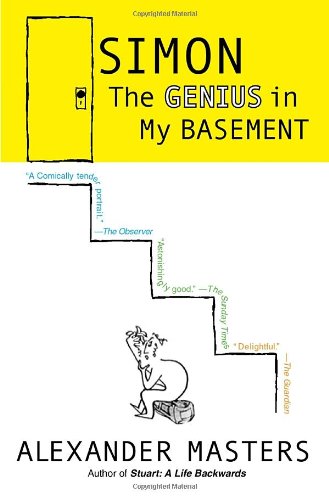
Inhaltsangabe
Alexander Masters tripped over his first book subject on a Cambridge sidewalk, and the result was the multi-award-winning bestseller Stuart: A Life Backwards. His second, he’s found under his floorboards.
One of the greatest mathematical prodigies of the twentieth century, Simon Norton stomps around Alexander’s basement in semidarkness, dodging between stalagmites of bus timetables and engorged plastic bags, eating tinned kippers stirred into packets of Bombay mix. Simon is exploring a theoretical puzzle so complex and critical to our understanding of the universe that it is known as the Monster. It looks like a sudoku table—except a sudoku table has nine columns of numbers.
The Monster has 808017424794512875886459904961710757005754368000000000 columns.
But that’s not the whole story. What’s inside the decaying sports bag he never lets out of his clutches? Why does he hurtle out of the house in the middle of the night? And—good God!—what is that noxious smell that creeps up the stairwell?
Grumpy, poignant, comical—more intimate than either the author or his quarry intended—Simon: The Genius in My Basement is the story of a friendship and a pursuit. Part biography, part memoir, and part popular science, it is a study of the frailty of brilliance, the measures of happiness, and Britain’s most uncooperative egghead eccentric.
Die Inhaltsangabe kann sich auf eine andere Ausgabe dieses Titels beziehen.
Über die Autorin bzw. den Autor
Alexander Masters studied physics and mathematics in London and Cambridge. For five years he worked in hostels for the homeless and ran a street newspaper. He has also worked as a newspaper columnist, a travel writer, an illustrator, and a bedspread salesman.
Auszug. © Genehmigter Nachdruck. Alle Rechte vorbehalten.
chapter 1
Simon was one year old, playing in the dining room, getting under his mother's stilettos.
He was unusually thoughtful. His brothers at this age pounded the toy blocks on the glass coffee table and jabbed them into the electric sockets.
Simon picked up a pink block from the pile beside his knee and smoothed it against the carpet. Carefully, he positioned a blue brick alongside. He reached across-his mother, on her way to lay the side plates and forks, had to make a sharp swerve-for two more pink bricks, and slid them against the blue. With precision, he extracted another blue brick.
Shuffling across the room on his bottom, Simon found four more pink bricks, fumbled them back and continued the arrangement.
His mother, halfway through folding napkins into bishops' miters, stopped in astonishment. She saw at last what he was doing.
One blue, one pink.
One blue, two pinks.
One blue, three pinks.
One blue, four pinks.
From the disarray of Nature, her baby son was enforcing regularity.
It took our species from the birth of prehistory to the dawn of Babylonian civilization to learn mathematics.
Simon was bumping about its foothills in just over twelve months.
At three years, eleven months and twenty-six days, he toddled into cake layers of long multiplication:
Simon's brother Francis had barely managed to recite the digits from one to ten by the time he was four years old; his brother Michael, a fraction quicker, had understood that if you gave him three banana- flavor milkshakes, and asked him to "count" them, the correct answer was "one" for the first, "two" for the second and "three" for the sticky splosh dribbling down his ear.
Percentages, square numbers, factors, long division, his 81 and 91 times tables, making numbers dance about to itchy tunes:
Simon mastered these when he was five.
Occasionally, his attention wandered:
2 The reader meets Simon
That's the sound of a once-in-a-generation genius.
Simon Phillips Norton: Phillips, with an "s," as if one Phillip were not enough to contain his brilliance. He lives under my floorboards.
Dhuunk, dhuunk...
When I first moved here, I had no idea what the noises were. Underground rivers? The next-door neighbors dragging a new pot through to their Tuscan garden? Dhuunk, dhuunk...But after eight years of interpretation I know that it's the great man's feet, stomping from one end of his room to the other. Every second stomp is heavier.
"Sssschlissh": that's the swipe of his puffa ski jacket against the stalagmites of paperbacks he keeps piled on the furniture.
"Zwaap": the sound of his duffel, as he rotates at the end of the room. He sometimes flings it wide, hitting papers. Simon carries this bag about with him everywhere he goes, clutched in the crook of his arm, even if it's just to his front door to let in the gas man.
...dhuunk, dhuunk, dhuunk, zwaap, dhuunk, dhuunk...
Simon's bed is ten feet directly beneath mine. My study is on top of his living room. His stomping space extends the full depth of the building, under my floor. My balcony is the roof of his basement extension, which has herded all the pretty garden plants into a six- foot square at the back of our house and stamped them under concrete slabs.
The phone rings. A charge from Simon: Dhuunk! Dhuunk! Dhuunk!
Snorting. The receiver-...rrinng, clank, clumpump, ping, ping...- wrenched from its holster. Attempts at speech, grunts, bangs of talk- noise; a strangulated word.
Clunk. Phone back in its holster.
Silence.
Dhuunk, dhuunk, dhuunk...
There's another very important sound, which is too difficult to represent typographically: an intermittent, twisted crackle, sharp but thick, with a strong sense of command, resting on a base of plosive disorder. In an exercise book from when he was five there's a squiggle that comes close:
It's the sound of plastic-bag-being-opened-in-a-hurry-and-the- gratification-of-discovering-important-papers-inside. Without understanding this noise, you cannot understand the man.
...ssschliissh, dhuunk, zwaap, zwaap, dhuunk, dhuunk...
Simon has been pacing down there for twenty-seven years, three months, five days, thirteen hours and eight minutes.
Ssssh!
Stop breathing!
Did you catch that?
Still another sort of noise?
A sort of sigh?
That was a thought.
Minus N
Your representation of me as interesting is
inaccurate. I feel ashamed by it.
Simon
Damn! He's gone!
Simon's refused to enter the book!
He is a Minus Norton.
"Why now?" I demanded, jumping up from the carpet when he stomped into my study from the basement. "The reader has started the story. He's spent the money. He feels conned."
"How do you know it's a he who's reading it? It might be a she, hnnn."
"He or she! Who cares?"
"I presume they do," he said cunningly.
Behind him, a bubble of air floated up the stairs and expanded into my rooms of the house, whiffing of damp and sardines.
Then he barged out of the front door, and, the scuff of his sandals becoming rapidly soft and seaside-ish, disappeared toward the Mathematics Faculty.
A book about Simon that doesn't have Simon in it?
I had thought a life of Simon would be tiptoeing on the edge of the shadow of God. Instead, he crashes about my study as though heel joints had never been invented; makes women shriek when they turn on the light in the corridor and find him standing there like an Easter Island statue; his duffel twists him into animal shapes; he hides behind envelopes.
He shocks me awake with his snores.
Writing biographies of living people, the subject is an irritant. Why is he needed? All he does is insist that whatever you've written is wrong.
In fact, when Simon was part of the book, I had to run away from him.
Wouldn't all biographies be better if they gave up trying to fix the person they're writing about, and confined themselves to his glints and reflections-a biography not of Simon but of the perception of Simon? What is a biography, anyway? A platter of gossip and titbits. It's up to the readers to mix these components together in whatever way they find most entertaining and instructive. The subject's out of it. Once word hits page, he's irrelevant.
I'm glad Simon's gone. Good riddance!
In mathematics, you jump onto the subject of numbers through your experience of reality-two flies multiplied by four sudden pulls gives eight wings; three toads, two frogs and one bathtub equals six screams of fury from your father; four bags of crisps and five of your mum's cigarettes make nine orders of stomachache-that's how the newcomer gets introduced to the subject, via the positive, whole numbers: 1, 2, 3, 4, 5, 6...
But mathematicians insist that negative numbers are equally real. It's just a matter of which way you happen to look: going ahead is positive, and going behind is negative.
I'll go behind Simon. Allow me to introduce Biographical Minus N:
Now, let's break into his basement.
4
November 26, 1922: Carter pierced a small hole in the wall through which he could look into the Pharaoh's chamber with a sliver of torch light. Asked if he could see anything he replied, "yes, wonderful things!"
Howard Carter's discovery of Tutankhamen's tomb
But I can't find the light switch.
Which is important when you'restanding at the top of Simon'sstairs with nothing but sardine stenchand book writer's bones to break yourfall. Every other house in our building has a light switch by the stairwell door-why has Simon wrenched his out?
It makes me tense. My nerves clench into a knot. It feels planned.
There are...
„Über diesen Titel“ kann sich auf eine andere Ausgabe dieses Titels beziehen.
Suchergebnisse für Simon: The Genius in My Basement

Beispielbild für diese ISBN
Simon: The Genius in My Basement
Anbieter: World of Books (was SecondSale), Montgomery, IL, USA
Verkäuferbewertung 5 von 5 Sternen

Hardback. Zustand: Fair. Artikel-Nr. 00100494492
Gebraucht kaufen
EUR 4,69
Versand gratis
Versand innerhalb von USA
Versand innerhalb von USA
Anzahl: 1 verfügbar
Beispielbild für diese ISBN
Simon: The Genius in My Basement
Verlag:
Delacorte Press (edition 1), 2012
ISBN 10: 0385341083
ISBN 13: 9780385341080
Gebraucht
Hardcover
Anbieter: BooksRun, Philadelphia, PA, USA
Verkäuferbewertung 5 von 5 Sternen
Hardcover. Zustand: Very Good. 1. With dust jacket. It's a well-cared-for item that has seen limited use. The item may show minor signs of wear. All the text is legible, with all pages included. It may have slight markings and/or highlighting. Artikel-Nr. 0385341083-11-1-29
Gebraucht kaufen
EUR 5,62
Versand gratis
Versand innerhalb von USA
Versand innerhalb von USA
Anzahl: 1 verfügbar
Beispielbild für diese ISBN
Simon : The Genius in My Basement
Verlag:
Random House Publishing Group, 2012
ISBN 10: 0385341083
ISBN 13: 9780385341080
Gebraucht
Hardcover
Erstausgabe
Anbieter: Better World Books, Mishawaka, IN, USA
Verkäuferbewertung 5 von 5 Sternen
Zustand: Very Good. 1St Edition. Former library copy. Pages intact with possible writing/highlighting. Binding strong with minor wear. Dust jackets/supplements may not be included. Includes library markings. Stock photo provided. Product includes identifying sticker. Better World Books: Buy Books. Do Good. Artikel-Nr. 484064-6
Gebraucht kaufen
EUR 6,35
Versand gratis
Versand innerhalb von USA
Versand innerhalb von USA
Anzahl: 1 verfügbar
Beispielbild für diese ISBN
Simon : The Genius in My Basement
Verlag:
Random House Publishing Group, 2012
ISBN 10: 0385341083
ISBN 13: 9780385341080
Gebraucht
Hardcover
Erstausgabe
Anbieter: Better World Books, Mishawaka, IN, USA
Verkäuferbewertung 5 von 5 Sternen
Zustand: Very Good. 1St Edition. Pages intact with possible writing/highlighting. Binding strong with minor wear. Dust jackets/supplements may not be included. Stock photo provided. Product includes identifying sticker. Better World Books: Buy Books. Do Good. Artikel-Nr. 4330606-75
Gebraucht kaufen
EUR 6,35
Versand gratis
Versand innerhalb von USA
Versand innerhalb von USA
Anzahl: 1 verfügbar
Beispielbild für diese ISBN
Simon: The Genius in My Basement
Anbieter: Wonder Book, Frederick, MD, USA
Verkäuferbewertung 5 von 5 Sternen
Zustand: As New. Like New condition. Very Good dust jacket. A near perfect copy that may have very minor cosmetic defects. Artikel-Nr. P07R-00292
Gebraucht kaufen
EUR 6,47
Versand gratis
Versand innerhalb von USA
Versand innerhalb von USA
Anzahl: 1 verfügbar
Beispielbild für diese ISBN
Simon: The Genius in My Basement
Anbieter: Wonder Book, Frederick, MD, USA
Verkäuferbewertung 5 von 5 Sternen
Zustand: Very Good. Very Good condition. Very Good dust jacket. With remainder mark. A copy that may have a few cosmetic defects. May also contain light spine creasing or a few markings such as an owner's name, short gifter's inscription or light stamp. Artikel-Nr. I02B-04736
Gebraucht kaufen
EUR 6,47
Versand gratis
Versand innerhalb von USA
Versand innerhalb von USA
Anzahl: 1 verfügbar
Beispielbild für diese ISBN
Simon: The Genius in My Basement
Anbieter: ThriftBooks-Atlanta, AUSTELL, GA, USA
Verkäuferbewertung 5 von 5 Sternen
Hardcover. Zustand: Very Good. No Jacket. May have limited writing in cover pages. Pages are unmarked. ~ ThriftBooks: Read More, Spend Less. Artikel-Nr. G0385341083I4N00
Gebraucht kaufen
EUR 7,62
Versand gratis
Versand innerhalb von USA
Versand innerhalb von USA
Anzahl: 1 verfügbar
Beispielbild für diese ISBN
Simon: The Genius in My Basement
Verlag:
Delacorte Press, New York, 2011
ISBN 10: 0385341083
ISBN 13: 9780385341080
Gebraucht
Hardcover
Erstausgabe
Anbieter: Abacus Bookshop, Pittsford, NY, USA
Verkäuferbewertung 5 von 5 Sternen
hardcover. Zustand: Fine copy in fine dust jacket. Well-illustrated (illustrator). 1st. 8vo, 360 pp. Artikel-Nr. 110297
Gebraucht kaufen
EUR 11,48
EUR 3,57 Versand
Versand innerhalb von USA
Versand innerhalb von USA
Anzahl: 1 verfügbar
Beispielbild für diese ISBN
The Genius in My Basement: A Sumography of the Genius Simon Norton, Who Disappeared Mysteriously at the End
Anbieter: Revaluation Books, Exeter, Vereinigtes Königreich
Verkäuferbewertung 5 von 5 Sternen
Hardcover. Zustand: Brand New. 360 pages. 8.50x6.00x1.00 inches. In Stock. Artikel-Nr. 0385341083
Neu kaufen
EUR 27,35
EUR 11,93 Versand
Versand von Vereinigtes Königreich nach USA
Versand von Vereinigtes Königreich nach USA
Anzahl: 1 verfügbar