
Verwandte Artikel zu Death: A User's Guide
Inhaltsangabe
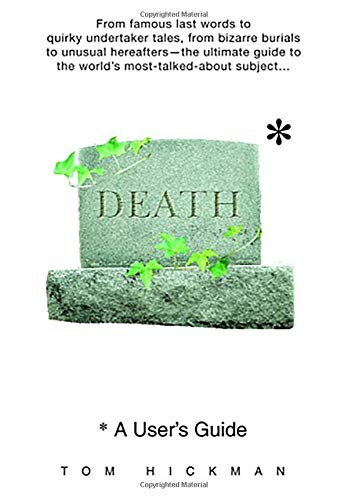
Everything you always wanted to know about life when you’re six feet under.
Let’s face it, death is one of the most important events in life--and it never hurts to be prepared. Herein you’ll explore such provocative questions as: Is there life after death? Is the Hereafter sexist? And most important: How do you know you’re dead? This eye-opening collection of amusing tidbits, historical facts, and macabre curiosities probes the mysterious state that has stymied scholars and spiritualists since the beginning of time.
Did you know…
* An Australian woman had her husband’s ashes inserted in her breast implants, to keep him close
to her heart (see page 118)
* Heavy drinking combined with excess body fat can result in Spontaneous Human Combustion (see page 191)
* Statistically, you’re more likely to be killed by walking (660–1) than by lightning (55,000–1)
(see page 193)
PLUS Sex and Death * Graves of the Rich and Famous * Body Snatching and Grave Robbing * Ghosts, Ghouls, and the Undead *
And Much More!
Die Inhaltsangabe kann sich auf eine andere Ausgabe dieses Titels beziehen.
Über die Autorin bzw. den Autor
Tom Hickman has worked as a journalist on newspapers and national magazines and for the BBC. His books include a biography of Churchill’s wartime bodyguard; the story of the BBC during World War II; the experience of the Bevin Boys, sent to work in the coal mines during the war; and of postwar National Service after it. He has also written a history of changing sexual mores during the twentieth century.
Von der hinteren Coverseite
Everything you always wanted to know about life when you're six feet under.
Let's face it, death is one of the most important events in life--and it never hurts to be prepared. Herein you'll explore such provocative questions as: Is there life after death? Is the Hereafter sexist? And most important: How do you know you're dead? This eye-opening collection of amusing tidbits, historical facts, and macabre curiosities probes the mysterious state that has stymied scholars and spiritualists since the beginning of time.
Did you know...
* An Australian woman had her husband's ashes inserted in her breast implants, to keep him close
to her heart (see page 118)
* Heavy drinking combined with excess body fat can result in Spontaneous Human Combustion (see page 191)
* Statistically, you're more likely to be killed by walking (660-1) than by lightning (55,000-1)
(see page 193)
PLUS Sex and Death * Graves of the Rich and Famous * Body Snatching and Grave Robbing * Ghosts, Ghouls, and the Undead *
And Much More!
Auszug. © Genehmigter Nachdruck. Alle Rechte vorbehalten.
Respecting the Dead
Artifacts for the Afterlife
You can't take it with you, it's said, but for millennia they did. The Neanderthals began the practice of putting goods in graves fifty thousand years ago, give or take the odd ten thousand years. As they were not the hairy, bulbous-browed knuckle-trailers of popular belief but members of the genus Homo sapiens with anatomically modern brains, it's reasonable to conjecture that, like the civilizations that followed, they thought that existence continued in some place beyond the grave, that a journey to get there was involved, and that the dead needed a few creature comforts to undertake it and to make the afterlife the good life when they got there.
Not belonging to a consumerist society, the Neanderthals had little to give: food and drink, the odd flintstone ax, fire charcoals. Food, drink, and fire-lighting implements remained the staples in later history, but eating utensils, household items, clothing, and jewelry were added. Different peoples, not surprisingly, reflected their culture in what they considered essential. On a prosaic level, the Arctic Eurasians from Norway to Siberia send off their dead with the reins of a sled, fish, copious amounts of tobacco, and plentiful tallow--the Arctic Circle is generally a gloomy place. More fundamentally maritime races like the Scandinavians, the Anglo-Saxons, and the South Sea Islanders buried their elite dead with their boats, as did the ancient Egyptians, whose world revolved around the sacred Nile. The Twana Indians of the American Northwest seacoast also buried dead in their canoes, although they placed them in trees. Sometimes the Arctic tribes and the Scandinavians set their dead adrift at sea--alight in the latter case, as the Vikings especially rather liked setting things on fire--emphasizing that a journey was being undertaken.
The practical ancient Greeks (copied by the Romans), assuming that you were likely to have to pay your way in the next world as in this, saw their dead on their way with a coin in their mouths to pay Chiron, the ferryman, who would row them across the river Styx to where they were headed. As a bit of contingency planning the Greeks placed honey cake or bread in the coffin as a bribe to the three-headed dog-demon Cerberus, who guarded the entrance to the underworld. Quite as practical as the Greeks, the Chinese also placed coins in the mouth of the corpse and cakes and bread in the coffin to ward off not Cerberus, but the pack of vicious dogs that awaited the dead--customs continued to this day. But living under a complex and corrupt bureaucracy as they did, and assuming that nothing would be different on the other side, they also placed jade, pearls, and gold leaf in the corpse's mouth. This was to bribe the officials, either in hell to secure their release or in heaven to buy a better class of rebirth on earth. And they still send their dead special paper money, drawn on the Bank of Hell, by burning it. There's a reflection of all this in the British actor Robert Morley asking for his credit cards to be buried with him. After his funeral in 1992 readers of The Times pondered in the letters page what they might appreciate most accompanying them on the other side. Heather Tanner of Woodbridge specified a good map. "I have immense trouble finding my way in this life," she wrote, "so I am extremely worried about the next." "A pair of earplugs," specified Sir David Wilcocks of Cambridge, "in case the heavenly choirs, singing everlastingly, are not in tune." Wrote M. L. Evans of Chester: "In the unfortunate event of the miscarriage of justice and several thousand years ensuing before my sentence is quashed, I will take a fire extinguisher."
The prodigious amount of worldly goods that went along with the elite deceased in ages past included not only precious artifacts but also armor, weaponry, chariots, pets, and horses. Everyone knows something of the wealth that accompanied the pharaohs into their tombs, but prodigality was in every culture. In the three-thousand-year-old grave of a Scythian warrior prince and his consort excavated in southern Siberia in 2001, for instance, more than 46 pounds of treasure was discovered, including a solid gold quiver and solid gold goblets and necklaces; the bodies were dressed in garments covered in more than nine thousand pieces of gold.
Living Death for Wives and Servants
From our perspective, what was most distasteful about trying to ensure that dead rulers, nobles, and heroes could continue in the afterlife in the manner to which they had become accustomed was that it also involved truncating the lives of others. In Sumer (the earliest civilization, from about 3500 b.c.) and the other Mesopotamian cultures of Babylonia and Assyria, in ancient Egypt and early Greece, in Scythia, Mongolia, and Turkey, in Scandinavia and China, and among the Celts of central and western Europe, the Central Americans, and numerous African peoples, it was common practice for servants, soldiers, wives, and dependent children to join their master in the grave. Archaeology suggests that anything between six and eighty people were not unusual for a top banana, but often the funerary retinue was in the hundreds. In the fifth century a.d. five hundred mounted warriors had their throats cut and were buried with Attila the Hun; in the ninth, another five hundred warriors went with the Viking chieftain Raknar into his burial ship. Improbably, according to the thirteenth-century Venetian traveler Marco Polo, more than twenty thousand people who saw the body of the Mongol leader Mangu Khan as it went on pilgrimage to burial enjoyed the privilege of joining him permanently.
It seems that many of those dependent on the powerful were happy to make the one-way trip in their company. They were, after all, going to what was hoped to be a better place; their job was to serve; and anyway prevailing thought was that, as they belonged in the most absolute sense to those who had departed this world, they too were already dead to it.
In the classical ancient world women did commit suicide to join their men in the afterlife, and the Roman writer Pomponius Mela observed that among the Celts some wives willingly cast themselves onto the flames of their husbands' funeral pyres. It was a Viking custom too, as it was among Hindu sects in India as late as the nineteenth century. In the same period new widows in New Guinea could elect to be garrotted (as was the Siberian Scythian princess) to accompany their spouses, or buried alive with them--or not, as they choose. In Fiji widows faced the same options but without the "not."
It's hard to believe that in any period or place human beings who were seen as mere accessories of someone else's life got anywhere by saying "Can we talk about this?" While some wives no doubt accepted their fate, the willingness of others is at least questionable. The myths of Greece and Rome suggested that wives considered it an honor and obligation to die with their deceased lord, but mythology is an idealized collection of as-it-ought-to-have-been stories, and as feminist historians have pointed out, the writers of myth and legend were all male. On this subject they may have been economical with the verite. As to Viking and Hindu wives and concubines electing the fiery exit, there's evidence that, while the choice was meant to be entirely voluntary, considerable pressure was brought to bear on them to "do the right thing." The British who governed India in the nineteenth century were appalled by reports that narcotics were administered to prevent women from changing their minds and that sometimes they were tied to the funeral pyres--which hardly indicated free choice. Noting that during the cremation ceremony the music was deliberately...
„Über diesen Titel“ kann sich auf eine andere Ausgabe dieses Titels beziehen.
Suchergebnisse für Death: A User's Guide

Beispielbild für diese ISBN
Death: A User's Guide
Anbieter: BooksRun, Philadelphia, PA, USA
Verkäuferbewertung 5 von 5 Sternen

Paperback. Zustand: Very Good. It's a well-cared-for item that has seen limited use. The item may show minor signs of wear. All the text is legible, with all pages included. It may have slight markings and/or highlighting. Artikel-Nr. 0385337051-8-1
Gebraucht kaufen
EUR 4,82
Versand gratis
Versand innerhalb von USA
Versand innerhalb von USA
Anzahl: 1 verfügbar
Beispielbild für diese ISBN
Death: a User's Guide
Verlag:
Random House Publishing Group, 2003
ISBN 10: 0385337051
ISBN 13: 9780385337052
Gebraucht
Softcover
Anbieter: Better World Books, Mishawaka, IN, USA
Verkäuferbewertung 5 von 5 Sternen
Zustand: Good. Pages intact with minimal writing/highlighting. The binding may be loose and creased. Dust jackets/supplements are not included. Stock photo provided. Product includes identifying sticker. Better World Books: Buy Books. Do Good. Artikel-Nr. 2303461-6
Gebraucht kaufen
EUR 6,55
Versand gratis
Versand innerhalb von USA
Versand innerhalb von USA
Anzahl: 2 verfügbar
Foto des Verkäufers
Death : A User's Guide
Verlag:
Random House Publishing Group Jul 2003, 2003
ISBN 10: 0385337051
ISBN 13: 9780385337052
Neu
Taschenbuch
Anbieter: AHA-BUCH GmbH, Einbeck, Deutschland
Verkäuferbewertung 5 von 5 Sternen
Taschenbuch. Zustand: Neu. Neuware - Everything you always wanted to know about life when you're six feet under.Let's face it, death is one of the most important events in life--and it never hurts to be prepared. Herein you'll explore such provocative questions as: Is there life after death Is the Hereafter sexist And most important: How do you know you're dead This eye-opening collection of amusing tidbits, historical facts, and macabre curiosities probes the mysterious state that has stymied scholars and spiritualists since the beginning of time. Did you know\* An Australian woman had her husband's ashes inserted in her breast implants, to keep him close to her heart (see page 118) \* Heavy drinking combined with excess body fat can result in Spontaneous Human Combustion (see page 191) \* Statistically, you're more likely to be killed by walking (6601) than by lightning (55,0001) (see page 193) PLUS Sex and Death \* Graves of the Rich and Famous \* Body Snatching and Grave Robbing \* Ghosts, Ghouls, and the Undead \* And Much More! Artikel-Nr. 9780385337052
Neu kaufen
EUR 18,74
EUR 35,00 Versand
Versand von Deutschland nach USA
Versand von Deutschland nach USA
Anzahl: 2 verfügbar
Foto des Verkäufers
Death: A User s Guide
Verlag:
Random House Publishing Group, 2003
ISBN 10: 0385337051
ISBN 13: 9780385337052
Neu
Softcover
Anbieter: moluna, Greven, Deutschland
Verkäuferbewertung 5 von 5 Sternen
Zustand: New. Tom Hickman has worked as a journalist on newspapers and national magazines and for the BBC. His books include a biography of Churchill&rsquos wartime bodyguard the story of the BBC during World War II the experience of the Bevin Boys, sent to wor. Artikel-Nr. 897914484
Neu kaufen
EUR 13,84
EUR 48,99 Versand
Versand von Deutschland nach USA
Versand von Deutschland nach USA
Anzahl: Mehr als 20 verfügbar