
Verwandte Artikel zu Dreaming the Bull
Inhaltsangabe
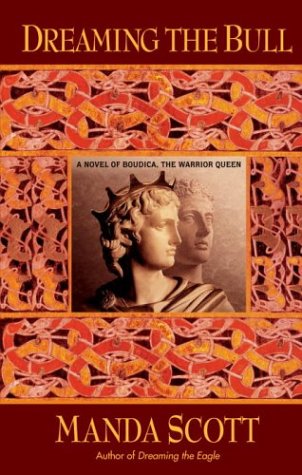
A continuation of the epic story about a legendary Celtic warrior queen finds Boudica pitted against her half brother in a brutal war of attrition, in a tale that takes readers from the desolate plains of ancient Britain to the heart of the Roman Empire. By the author of Dreaming the Eagle.
Die Inhaltsangabe kann sich auf eine andere Ausgabe dieses Titels beziehen.
Über die Autorin bzw. den Autor
Manda Scott is a veterinary surgeon, writer and climber, not necessarily in that order. Born and educated in Scotland, she now lives in Suffolk with two lurchers and too many cats. Hailed by Fay Weldon as “a new voice for a new world,” she is also known as a crime writer. Her first novel, Hen’s Teeth, was shortlisted for the Orange Prize and her most recent, No Good Deed, was nominated for an Edgar Award for Best Novel. The Boudica books are her first historical novels. They are, she says, the books she was born to write.
From the Trade Paperback edition.
Aus dem Klappentext
The second part of the stunning fictionalization of the life of Britain s warrior queen, Boudica, immerses us in a world of druids and dreamers, warriors and lovers, passion and courage. Originally a trilogy, this is now a four-part series.
Boudica means Bringer of Victory (from the early Celtic word boudeg ). She was the last defender of the Celtic culture; the only woman openly to lead her warriors into battle and to stand successfully against the might of Imperial Rome -- and triumph.
Book one, Dreaming the Eagle, took readers from Boudica s girlhood with the Eceni tribe to the climax of the two-day battle when she and her lover, Caradoc, faced the invading Romans. Believing her dead, Breaca s beloved brother, Bán, joined the Roman cause.
Dreaming the Bull, the second book in this compelling series, continues the intertwined stories of Boudica, and Bán, now an officer in the Roman cavalry. They stand on opposite sides in a brutal war of attrition between the occupying army and the defeated tribes, each determined to see the other dead. In a country under occupation, Caradoc, lover to Breaca, is caught and faces the ultimate penalty. Only Bán has the power to save him, and Bán has spent the past ten years denying his past. Treachery divides these two; heroism brings them together again, changed out of all recognition -- but it may not be enough to heal the wounds.
Dreaming the Bull is a heart-stopping story of war and of peace; of love, passion and betrayal; of druids and warring gods, where each life is sacred and each death even more so; and where Breaca and Bán learn the terrible distances they must travel to fulfill their own destinies.
Through the summer, Cunomar came to recognize two different kinds of warriors. The smaller group consisted of those few men and women still alive who had known his mother before the two-day battle against the invading legions. These were her friends and they called her Breaca in the way Cunomar s father and the innermost circle of the honour guard still did. The rest, who had met her only in battle or, worse, knew her only by reputation, gave the warrior s salute in a way that was subtly different and hailed her as the Boudica, bringer of victory. She didn t enjoy that, but in the short span of his life, Cunomar had watched his mother become more comfortable with name, so that it settled on her like a worn cloak and she did not stiffen at the sound of it.
He had heard her use the word herself for the first time that morning as a cold dawn sharpened the air and Nemain, the moon, lowered into her bed in the mountains. Breaca had stood on the back of her mare and addressed the massed ranks of warriors and dreamers, naming them all Boudegae, bringers of victory, and swearing before them that she would fight for as long as it took to rid the land of the invader. -- from Dreaming the Bull
From the Trade Paperback edition.
Auszug. © Genehmigter Nachdruck. Alle Rechte vorbehalten.
CHAPTER 1
He had been branded once before, long ago, when his name was not Julius Valerius. Then Ben had fought the men who held him down, and it had been done badly so that the wound had festered and he had nearly died. Now, kneeling tied and blindfolded in the claustrophobic dark of a wine cellar, beneath a house that was less than three years old and with the snuffed wicks of the candles sending rank smoke into the dark, he yearned for the touch of the iron. When the masked centurion wiped the wine down the line of his breastbone and pressed his thumb in the centre to mark the spot, he leaned forward to meet the pain.
He had forgotten how bad it would be. The shock was blinding. Fire, and something worse than fire, wrapped his heart, closing tight, like a fist. It wrenched at his breath in a way that wounds taken in battle had never done. He forced himself to silence but need not have done; the noise of one man was lost in the echoing chant of forty male voices. The stench of burned flesh drowned in a flood of sweet smoke as someone threw a fistful of incense onto the brazier.
Later he wondered at the expense of that: frankincense cost more than its own weight in gold. At the time, he only knew that, however briefly, the pain of the fire consumed the other, greater pain of his soul, and it was for this that he had come to the god. As to a lake on a hot day, he threw himself into it, riding the heat that spread from his chest until it drew him out of himself and he watched his body from a place apart, one with the fire and yet separate. At its height, when the bearable became unbearable, someone standing behind stripped the blindfold from his eyes and cut the cords at his wrists, and someone else lit the seven lamps before the sun-disc so that, in deepest darkness and blinding pain, the god's light offered solace.
He would have liked to accept the offer, to fall into the waiting, welcoming arms of the deity, to know peace and certain salvation. The men branded on either side of him did exactly that. From his left, he felt the shudder of flesh that matched exactly the moment of surrender when a horse first accepts the bridle. From his right, he heard a whimpered exhalation, as of a man at the climax of love. For these and the others beyond them, divine joy engulfed all pain, erasing its threat for ever.
It was what he had been promised and what he had craved. In an agony that was more of the heart than the body, he cried aloud in the void of his soul for the voice of the god: he was not answered. Too soon the iron was gone, leaving only the ache of scorched flesh and a curl of smoke that rose to join the taint of those who had been branded with him.
The centurion stepped back, swinging the reddening iron. The double curve of the raven blurred and steadied and lit the space between them. Hidden eyes regarded Valerius from behind the god's mask.
"Know now that you are my sons under the Sun, the last for whom I will be Father and special for ever because of it. I will leave this province soon, with the governor, traveling with him to Rome to accept such postings as the emperor chooses to bestow. I will be a centurion of the second cohort of the Praetorian Guard. Should you come to Rome, make yourselves known to me. The new governor will arrive with next month's first auspicious tide. With him will come new officers to replace those who are leaving and new recruits to replace those we have lost. Meantime the welfare of this province, the honour of our emperor and of the legions, is in your hands and those of your brothers under the god.
"You are his now, first and foremost. Before the legions, before all other gods, you belong to Mithras to death and beyond. He is a just god; ask and he will give you strength; weaken and he will destroy you. By the brand will you know and care for one another, and if the god grant that we meet again, I will know you by it also."
They were seven in the row, naked as infants, newly marked and newly named. Not one spoke. On the far side of the room, a man's voice set up the chant of the newborn. It was joined by others and others and, last, by the new initiates until the full weight of forty-nine voices surged onto the walls and fell inwards, deafeningly. As the sound faded, a single lamp was lit beneath the image of the god. The centurion turned and saluted. Behind him the others did likewise. From his place above the candle on the northern wall, smiling Mithras, capped and caped, caught his bull and drew his blade along its throat.
CHAPTER 2
Only the children sleep on the night before battle and sometimes not even them. On the night before the Roman governor of Britannia took ship and left for ever the land he had conquered, two thousand warriors and half as many dreamers gathered awake on a hillside, less than a morning's ride from the most westerly of the frontier forts. Singly and in groups, as their gods and their courage dictated, they prepared themselves for war on a scale not seen since the legions' invasion four years before.
Breaca nic Graine, once of the Eceni and now of Mona, sat alone at the edge of a mountain pool. She breathed on a pebble cupped in the palm of her hand and sent it skipping over the water.
"For luck."
The stone bounced five times, shattering the moon's reflection. Shards of broken light scattered into darkness and were lost. The river ran on unheard, the music of its passing drowned beneath the stutter of bear claws played on hollow skulls nearby. The light of a thousand restless campfires gilded the water's edge, and smoke hazed the air above it. Only by the river was there solitude and darkness and the peace to ask favours of the gods.
"For courage."
The second pebble clipped the edge of the moon and was lost. On the unseen slopes behind, the skull drums reached a crescendo. A woman's voice called to the gods in the language of the northern ancestors. Other voices answered, grunting, and the un-rhythm of the drums changed. It was not good to listen too closely to that; over the years, more than one soul had been lost in the mesh of woven bone-sounds and had never found its way home.
"For Briga's care in battle."
The third stone, more accurate than those before it, bounced nine times and sank into the moon's heart, carrying the prayer directly to the gods without the intermediary of the river. If a warrior wanted to believe in omens, it was a good one. Breaca, known as the Boudica, sat as the moon settled again and was whole, a crisp half-circle of silver lying still on a bed of moving black.
Stooping, she picked up a fourth stone. It was wider and flatter than the others and bounced smoothly on her palm. She breathed a different prayer into it, one for which tradition did not supply the words.
"For Caradoc and for Cunomar, for their joy and their peace if I am taken in battle. Briga, mother of war, of childbirth, and of dying, take care of them for me."
It was not a new prayer; in the three and a half years since her son was born, she had spoken it countless times in the silence of her mind in those moments before the first clash of combat when everything and everyone she loved must be put aside and forgotten. Breaca had learned early that a warrior who wished to live rode into battle with an empty mind lest the distraction of a rising memory should slow her sword arm or the lift of her shield. The difference now, in the rushing dark by the river, with the chaos of preparation held temporarily at bay, was that she had spoken for the first time aloud and had felt the prayer clearly heard. She was beside water, which was Nemain's, and on the eve of battle, which was Briga's, and the gods were alive and walking on the mountainside, called in by the scores of...
„Über diesen Titel“ kann sich auf eine andere Ausgabe dieses Titels beziehen.
Suchergebnisse für Dreaming the Bull

Beispielbild für diese ISBN
Dreaming the Bull
Verlag:
Random House Publishing Group, 2004
ISBN 10: 0385336713
ISBN 13: 9780385336710
Gebraucht
Hardcover
Erstausgabe
Anbieter: Better World Books, Mishawaka, IN, USA
Verkäuferbewertung 5 von 5 Sternen

Zustand: Good. First Edition. Pages intact with minimal writing/highlighting. The binding may be loose and creased. Dust jackets/supplements are not included. Stock photo provided. Product includes identifying sticker. Better World Books: Buy Books. Do Good. Artikel-Nr. 7529448-75
Gebraucht kaufen
EUR 10,82
Versand gratis
Versand innerhalb von USA
Versand innerhalb von USA
Anzahl: 1 verfügbar
Beispielbild für diese ISBN
Dreaming the Bull
Verlag:
Random House Publishing Group, 2004
ISBN 10: 0385336713
ISBN 13: 9780385336710
Gebraucht
Hardcover
Erstausgabe
Anbieter: Better World Books, Mishawaka, IN, USA
Verkäuferbewertung 5 von 5 Sternen
Zustand: Good. First Edition. Former library copy. Pages intact with minimal writing/highlighting. The binding may be loose and creased. Dust jackets/supplements are not included. Includes library markings. Stock photo provided. Product includes identifying sticker. Better World Books: Buy Books. Do Good. Artikel-Nr. 484143-6
Gebraucht kaufen
EUR 10,82
Versand gratis
Versand innerhalb von USA
Versand innerhalb von USA
Anzahl: 1 verfügbar
Beispielbild für diese ISBN
Dreaming the Bull
Verlag:
Delacorte Press Books for Young Readers, 2004
ISBN 10: 0385336713
ISBN 13: 9780385336710
Gebraucht
Hardcover
Anbieter: World of Books (was SecondSale), Montgomery, IL, USA
Verkäuferbewertung 5 von 5 Sternen
Hardback. Zustand: Fair. In AD 60, Boudica, war leader of the Eceni, led her people in a final bloody revolt against the occupying armies of Rome.Dreaming The Bull continues the story of Breaca - now hailed Boudica, the Bringer of Victory, and her half-brother, B n, now an officer in the Roman auxiliary cavalry. Each stands on the opposing side in a brutal war of attrition between the occupying army and the defeated tribes; each is determined to see the other dead. Caught between them are two children, son and daughter to two of the greatest warriors their world has ever seen, while in distant Rome, the Emperor Claudius holds the balance of lives in their hands. Artikel-Nr. 00101878773
Gebraucht kaufen
EUR 21,10
Versand gratis
Versand innerhalb von USA
Versand innerhalb von USA
Anzahl: 1 verfügbar
Beispielbild für diese ISBN
Dreaming the Bull
Verlag:
Delacorte Press Books for Young Readers, 2004
ISBN 10: 0385336713
ISBN 13: 9780385336710
Gebraucht
Hardcover
Anbieter: World of Books (was SecondSale), Montgomery, IL, USA
Verkäuferbewertung 5 von 5 Sternen
Hardback. Zustand: Good. In AD 60, Boudica, war leader of the Eceni, led her people in a final bloody revolt against the occupying armies of Rome.Dreaming The Bull continues the story of Breaca - now hailed Boudica, the Bringer of Victory, and her half-brother, B n, now an officer in the Roman auxiliary cavalry. Each stands on the opposing side in a brutal war of attrition between the occupying army and the defeated tribes; each is determined to see the other dead. Caught between them are two children, son and daughter to two of the greatest warriors their world has ever seen, while in distant Rome, the Emperor Claudius holds the balance of lives in their hands. Artikel-Nr. CIN0385336713G
Gebraucht kaufen
EUR 21,10
Versand gratis
Versand innerhalb von USA
Versand innerhalb von USA
Anzahl: 1 verfügbar