
Verwandte Artikel zu Chasing the Hawk: Looking for My Father, Finding Myself
Inhaltsangabe
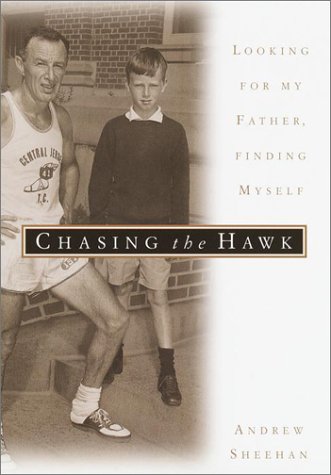
In a poignant memoir, an investigative journalist describes how his struggle to reconnect and rebuild a relationship with his father, George Sheehan, the best-selling author of Running and Being, helped him to come to terms with his father's absence during his childhood and adolescence and with the anger and alcoholism that nearly destroyed his life.
Die Inhaltsangabe kann sich auf eine andere Ausgabe dieses Titels beziehen.
Über die Autorin bzw. den Autor
Andrew Sheehan is an investigative journalist for a television station in Pittsburgh, where he lives with his wife and two sons.
Aus dem Klappentext
e always chased my father, chased after his love, chased him through his many changes.
I chased him even when I thought I was running in the other direction.
Today, even though he is gone, I chase him still.
I know he is the key to my freedom.
To runners around the world, Dr. George Sheehan, author of the landmark New York Times bestseller Running and Being, was nothing short of a guru the country s greatest philosopher of sport.
But to his son Andrew, who had spent his entire boyhood longing for the attention and approval of an emotionally distant father, he was an incomprehensible paradox: a lifelong loner, who was now sunning himself in the spotlight of the nation s press; a hero to millions, who seemed to have no time for his own son.
The events that transformed George Sheehan from doctor to family man to bestselling author and media magnet began at th
Auszug. © Genehmigter Nachdruck. Alle Rechte vorbehalten.
When I think of him now, I see him at dawn, driven from his bed by the sun and headed down to the ocean for his morning dip. But having never actually witnessed it, I find it odd that of all the images I hold of him in my head, this is the one that returns most often. By the time it had become part of his daily routine, I no longer lived at home, and when I visited, I was never up at that hour. Still, it makes a certain kind of sense that this particular ritual should come to mind. Swimming in the morning was something my father did alone, for the specific purpose of being by himself, and I always think of him that way — alone and apart. He was away a good deal of the time, and even when he was among us, he was a solitary man.
In my mind I see him on this morning a few years before his death. He has pulled on his running shorts, grabbed a towel from the bathroom, and, without showering or shaving, is ambling barefoot down the stairs to the front door. Exiting onto the porch, he pauses for a moment. His bony hand rests on his hip as he stares off at the ocean horizon and loses himself in the arrhythmic clank of the rope and clasp against the town flagpole, still flagless at this hour of the morning. The scavenger gulls screech at one another as they hover and descend over the boardwalk, fighting over a loose scrap of garbage. A few other gulls loiter nearby, taking furtive steps, staring sidelong and gangsterish.
The house fronts Ocean Avenue, which as the name implies runs parallel to the beach, and from the porch you can see across the road to the boardwalk, the beach, and the ocean beyond. It’s late September, the official best time of year in my family. The crowds are gone, and the air is cooler, cleaner now. The light has a special clarity that seems to intensify all colors: the blues of sky and ocean, the green of the small patch of grass in front of the house, the yellow sandstone road. This makes for a disarmingly pretty scene, even as the town itself shows the creeping signs of disrepair. The boardwalk, gray now, has begun to warp along the edges. The pier seems to dip in mid-span, and at the far end, an old fisherman’s shack lists leftward, threatening to topple into the water. The beach itself has begun shrinking at an alarming pace, the ocean’s advance now within a hundred feet of the boardwalk.
Like many shore towns, its best days now seem consigned to the past. Still, you sense that an infusion of yuppie cash and sweat could make it into a postcard scene once again, a scene not far removed from the one depicted in the hand-tinted photo from the 1920s that my mother has framed and hung in a bathroom upstairs — minus, of course, the parasol-carrying ladies in full-skirted neck-to-toe dresses. The lower right-hand corner of this bit of tourist memorabilia bears the caption: “The Seashore at Ocean Grove, New Jersey.”
I never lived in Ocean Grove — I was on my own before my parents moved there — and when I visited, I would generally have gone to bed only hours before my father’s sunrise swim, most likely to sleep off another late night of drinking. And yet I see him in my mind’s eye as clearly as if watching from a bedroom window — his spidery frame treading lightly across Ocean Avenue, mindful of bits of glass, treading lightly across the boardwalk, mindful of splinters, and down that small flight of wooden steps to the beach. He has a peculiar, almost feminine waddle to his walk, and in the sand it’s even more pronounced: chest out, shoulders back, arms and hands dangling loosely behind him. With the sun still barely free of the ocean, he saunters to the edge of the wet sand, and for a moment he ponders the ocean’s chaos of blue and gray, his great unending theater.
He has never been conventionally good-looking, but even early on, he had a kind of Bogie-like handsomeness. His teeth have always been crooked, and he has an overbite, so when his lips purse, he looks a bit odd, like a fish. The weak chin is countered by the great hawklike nose which juts from his face like the blade of a hatchet. When he was younger it sat squarely in the middle of a soft, pudgy face, but as he has aged, his face has grown strikingly angular around it. His face has wizened. The lines have deepened, accentuating his blue-gray eyes. A certain Irishness has broken through, and his look has grown kindly.
As he walks into the shallow white water, it’s as though I am walking alongside. Instantly, I feel the cold with him: the shock of it repels and invites at the same time. I can see him grimace, all teeth and squinty eyes, as he wades in waist-deep, and I hear as he hears the repeating crash and withdrawing snore of the waves. Raising his arms above his head, he strides into the deeper water, then plunges under the first wave available. As he invariably did, he lets out a yell of frigid shock upon his reemergence. “WooooooHoooooo.” The faint echo of it bounces off the Victorian guesthouses along Ocean Avenue, and the row of facades stares impassively back. The morning silence returns except for the sounds of gulls and waves. He dives deep, and then deeper still, searching for that even-colder water that rushes blood to his head and every limb.
To know him at all is to know that he loves the water — loves the feel of it and loves the smell. Even here. Even though there is something distinctly Jersey about it. The tar, perhaps, or maybe some hint of gas or petroleum. Even at its most pungent, it doesn’t bother him, because he knows it keeps others away. And it puts him in mind of what Emerson meant in his one-sentence assault on perfectionism: “Everything God made has a crack.” One of his favorite, and oft-quoted, quotes.
He is a quoter of dead philosophers, an intrepid searcher of usable quotes. He scours books for them like a prospector panning for gold, and when something quotable gleams back from a page of black and white, he plucks it out and stashes it with the rest. They pepper his articles and talks, and even in conversation he drops a half dozen within the first five minutes. He has a particular fondness for a quote he attributes to William James. It went underground for a few years but has resurfaced at the time of this scene I have conjured so vividly. “The strenuous life tastes best.” It describes this morning and many mornings like it. There must be challenge, and if there is none, challenge will have to be created.
He has found the strenuous life in running, and more specifically in running marathons, an activity that’s about as strenuous as it could be without being downright masochistic. Having run more than fifty marathons and written about each one, he has become the recipient of improbable fame, imploring others to live strenuously and to taste of life rather than endure its passing. Even now, on this morning. Even though he can run no more marathons, he won’t give up running, and he won’t give up these early swims. His body, so recently asleep, is now completely alive. The smells, the screeching gulls, the salt water around his lips — on an empty stomach, he’s tempted to drink it. Afterward, he’ll swear he could taste it. “Fantastic,” he’ll report.
It’s not that he’s ever been any kind of swimmer. He is not. In fact, he’s never been able to swim more than a few laps in a pool without swallowing water. Despite his great love of the ocean, he is forever drawn back to the land, keeping his forays within fifty yards of shore. He’s never been a fisherman, and, ex-navy man that he is, his brief fantasy of buying a boat sank quickly, scuttled by his fear of machinery, seasickness, and nautical incompetence. He excels, however, at the one water sport of bodysurfing, the...
„Über diesen Titel“ kann sich auf eine andere Ausgabe dieses Titels beziehen.
Suchergebnisse für Chasing the Hawk: Looking for My Father, Finding Myself

Beispielbild für diese ISBN
Chasing the Hawk: Looking for My Father, Finding Myself
Anbieter: World of Books (was SecondSale), Montgomery, IL, USA
Verkäuferbewertung 5 von 5 Sternen

Zustand: Good. Item in good condition. Textbooks may not include supplemental items i.e. CDs, access codes etc. Artikel-Nr. 00093902839
Gebraucht kaufen
EUR 3,69
Versand gratis
Versand innerhalb von USA
Versand innerhalb von USA
Anzahl: 1 verfügbar
Beispielbild für diese ISBN
Chasing the Hawk: Looking for My Father, Finding Myself
Anbieter: World of Books (was SecondSale), Montgomery, IL, USA
Verkäuferbewertung 5 von 5 Sternen
Zustand: Very Good. Item in very good condition! Textbooks may not include supplemental items i.e. CDs, access codes etc. Artikel-Nr. 00095791691
Gebraucht kaufen
EUR 4,23
Versand gratis
Versand innerhalb von USA
Versand innerhalb von USA
Anzahl: 1 verfügbar
Beispielbild für diese ISBN
Chasing the Hawk: Looking for My Father, Finding Myself
Anbieter: Wonder Book, Frederick, MD, USA
Verkäuferbewertung 5 von 5 Sternen
Zustand: Very Good. Very Good condition. Very Good dust jacket. A copy that may have a few cosmetic defects. May also contain light spine creasing or a few markings such as an owner's name, short gifter's inscription or light stamp. Artikel-Nr. E19G-01450
Gebraucht kaufen
EUR 6,21
Versand gratis
Versand innerhalb von USA
Versand innerhalb von USA
Anzahl: 1 verfügbar
Beispielbild für diese ISBN
Chasing the Hawk: Looking for My Father, Finding Myself
Anbieter: Wonder Book, Frederick, MD, USA
Verkäuferbewertung 5 von 5 Sternen
Zustand: Good. Good condition. Good dust jacket. A copy that has been read but remains intact. May contain markings such as bookplates, stamps, limited notes and highlighting, or a few light stains. Bundled media such as CDs, DVDs, floppy disks or access codes may not be included. Artikel-Nr. O08A-00560
Gebraucht kaufen
EUR 6,21
Versand gratis
Versand innerhalb von USA
Versand innerhalb von USA
Anzahl: 1 verfügbar
Beispielbild für diese ISBN
Chasing the Hawk : Looking for My Father, Finding Myself
Verlag:
Random House Publishing Group, 2001
ISBN 10: 038533561X
ISBN 13: 9780385335614
Gebraucht
Hardcover
Erstausgabe
Anbieter: Better World Books, Mishawaka, IN, USA
Verkäuferbewertung 5 von 5 Sternen
Zustand: Good. First Edition. Pages intact with minimal writing/highlighting. The binding may be loose and creased. Dust jackets/supplements are not included. Stock photo provided. Product includes identifying sticker. Better World Books: Buy Books. Do Good. Artikel-Nr. 3234103-6
Gebraucht kaufen
EUR 6,52
Versand gratis
Versand innerhalb von USA
Versand innerhalb von USA
Anzahl: 1 verfügbar
Beispielbild für diese ISBN
Chasing the Hawk : Looking for My Father, Finding Myself
Verlag:
Random House Publishing Group, 2001
ISBN 10: 038533561X
ISBN 13: 9780385335614
Gebraucht
Hardcover
Erstausgabe
Anbieter: Better World Books: West, Reno, NV, USA
Verkäuferbewertung 5 von 5 Sternen
Zustand: Good. First Edition. Pages intact with minimal writing/highlighting. The binding may be loose and creased. Dust jackets/supplements are not included. Stock photo provided. Product includes identifying sticker. Better World Books: Buy Books. Do Good. Artikel-Nr. 3234103-6
Gebraucht kaufen
EUR 6,52
Versand gratis
Versand innerhalb von USA
Versand innerhalb von USA
Anzahl: 1 verfügbar
Beispielbild für diese ISBN
Chasing the Hawk : Looking for My Father, Finding Myself
Verlag:
Random House Publishing Group, 2001
ISBN 10: 038533561X
ISBN 13: 9780385335614
Gebraucht
Hardcover
Erstausgabe
Anbieter: Better World Books, Mishawaka, IN, USA
Verkäuferbewertung 5 von 5 Sternen
Zustand: Very Good. First Edition. Pages intact with possible writing/highlighting. Binding strong with minor wear. Dust jackets/supplements may not be included. Stock photo provided. Product includes identifying sticker. Better World Books: Buy Books. Do Good. Artikel-Nr. 9271471-6
Gebraucht kaufen
EUR 6,52
Versand gratis
Versand innerhalb von USA
Versand innerhalb von USA
Anzahl: 1 verfügbar
Beispielbild für diese ISBN
Chasing the Hawk: Looking for My Father, Finding Myself
Verlag:
Delacorte Press, New York, 2001
ISBN 10: 038533561X
ISBN 13: 9780385335614
Gebraucht
Soft cover
Anbieter: Browse Awhile Books, Tipp City, OH, USA
Verkäuferbewertung 5 von 5 Sternen
Soft cover. Zustand: As New. Advance Reading Copy. Artikel-Nr. 01034109
Gebraucht kaufen
EUR 7,10
EUR 6,03 Versand
Versand innerhalb von USA
Versand innerhalb von USA
Anzahl: 1 verfügbar
Beispielbild für diese ISBN
Chasing the Hawk: Looking for My Father, Finding Myself
Anbieter: Robinson Street Books, IOBA, Binghamton, NY, USA
Verkäuferbewertung 4 von 5 Sternen

Hardcover. Zustand: Very Good. Prompt Shipment, shipped in Boxes, Tracking PROVIDEDVery good. Clean text. Email for further information. Artikel-Nr. bing827x11818
Gebraucht kaufen
EUR 11,99
EUR 8,19 Versand
Versand innerhalb von USA
Versand innerhalb von USA
Anzahl: 1 verfügbar
Beispielbild für diese ISBN
Chasing the Hawk: Looking for My Father, Finding Myself
Anbieter: Robinson Street Books, IOBA, Binghamton, NY, USA
Verkäuferbewertung 4 von 5 Sternen
Hardcover. Zustand: Very Good. Prompt Shipment, shipped in Boxes, Tracking PROVIDEDVery good. Clean text. Email for further information. Artikel-Nr. bing827x11817
Gebraucht kaufen
EUR 11,99
EUR 8,19 Versand
Versand innerhalb von USA
Versand innerhalb von USA
Anzahl: 1 verfügbar