
Verwandte Artikel zu A Still Small Voice
Inhaltsangabe
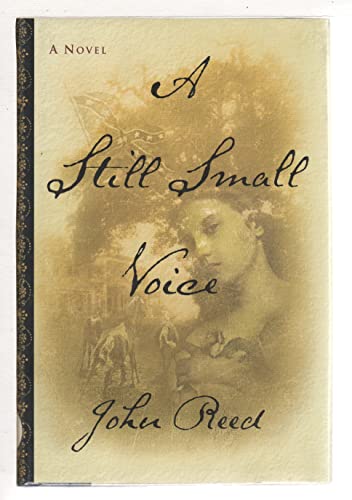
Orphan Alma Flynt's comfortable life in Cotterpin Creek, Kentucky, and her growing relationship with John Warren, the youngest son of her wealthy neighbors, the Clevelands, is turned upside down by the hardship, devastation, loss, and grief of the Civil War. A first novel.
Die Inhaltsangabe kann sich auf eine andere Ausgabe dieses Titels beziehen.
Über die Autorin bzw. den Autor
John Reed attended Hampshire College and received an MFA in Creative Writing from Columbia University. His poetry and short stories have appeared in numerous literary magazines, and he was a contributing editor for <i>Open City</i>. He lives in New York City. <b>A Still Small Voice</b> is his first novel.
Aus dem Klappentext
a storyteller's grace and a poet's touch, <b>A Still Small Voice</b> is the magnificent work of a gifted young novelist. Taking its place beside the great novels of the Civil War, John Reed's sweeping saga is at once a passionate love story and a powerful human drama set against a vivid backdrop of a nation at war.<br><br>The year is 1859. As this breathtaking novel opens, seven-year-old Alma Flynt arrives in the small Kentucky town of Cotterpin Creek to begin a new life in her aunt's home. There, a whole new world opens up before her eyes-a world of impossible grace and comfort, of lush pastures and billowing bluegrass. And there, Alma will meet a family who will shape the course of her life. <br><br>The Clevelands, with their sprawling mansion and gleaming thoroughbred horses, are magnificent. But from the beginning, one Cleveland draws all her attention-the youngest son, John Warren. Of their childhood bond, Alma later recalls: "The stubborn fact was, without the slightest h
Auszug. © Genehmigter Nachdruck. Alle Rechte vorbehalten.
Spring '52
I was born with very red hair.
But it was not red like a strawberry or cherry. It was red like the red of a sun ripened peach.
I was delivered by my aunt at 7 a.m. on April 11, 1852. I can't say for certain if I really do remember that day or if I just have an active imagination. Perhaps it is just something that my people told me--but I know that the sun was soft that morning on the hanging curtains, and that there was a glint of it on the wooden bowl which held the warm water and the sponge of my first bath.
My mum and dad lived in Richmond, in a cottage with white lilies in the garden and green vines on the brick. Mother's name was Ellen Flynt--her maiden name, Penrose. She sewed fancy carrying bags for ladies. Father was Philip Flynt, a cobbler with a shop beside the house. He was a light haired man who matured too quickly, and relied heavily on his wife for picnics. Her eyes were green like mine. That is what I have heard.
I have heard other things.
I have heard that my mother once grew a six pound squash in the garden, and that she would not cook it. I have heard that my father was not overly concerned with things of a worldly nature, and that at our table, he always set an extra place for wanderers and travelers.
I have heard that my crib was made of young birch and that it smelled sweet like a bowl of fruit. . . .
I have also heard that of those who came to America from Europe, many had set out to escape some extraordinarily trying circumstances. And I have heard that of those who came from China, many immigrated due to similar conditions (though the Chinese especially seemed to endure more hardships in the years to come, with the building of the railroads across the west). And I have heard from some that the Irish brought cholera. And I have heard from others that the Chinese brought cholera. And still others have told me that nobody is to blame for cholera--that sometimes it simply grows, like moss on a rock.
There is a baker, a Mister Joseph Brintons, whose shop was beside the old cobbler's house in Richmond. When I visited there, he told me that when my mother and father were infected with cholera, two soldiers were posted outside of our home. They pushed provisions through the windows, and were given instructions to fire on anyone who tried to enter the house. Mister Brintons does not know under whose authority they were acting, and he is not sure that it was the right thing. But he is also not sure that it was the wrong thing, as nobody else was infected. He told me that in the spring of '56, a doctor named Wickersham stood at the front door shouting instructions to my father, and then to me, when, like my mother, my father became too sick to stand. "Mix salt and molasses into warm water," said the doctor, "and make them drink it." Mister Brintons said that I never fell ill, and that though I was a young girl (just four years old) I dutifully accomplished the doctor's ministrations. He said that by the second day there was a collection of friends and neighbors who stood outside the house holding candles--gathered in prayer. But that is something I do not recall.
My recollection begins with a dying woman that I do not remember knowing. She was pale, and lay under a white blanket on a brass bed. She called me her princess, and asked that I promise to take care of my father, who was downstairs on a bed in the kitchen. I did. He was lying on a mattress on the dining table. I patted him with a damp cloth, and squeezed water into his mouth with a sponge. He had a tea towel over his face that he would not let me remove. He was afraid his breathing would infect me. Before sunrise, he too had rested his fingers in his palm, his last breath expired.
I do remember rather well the loneliness of the time that followed. I have heard it was a day. I have heard it was a week. I have heard it was much too long for a child to be alone. And that, I believe. . . .
Many times, the old cobbler's house on Peach Road has been described to me. It was a two story white house with a brick wall in the back. There was a steep staircase to the second floor. The rooms were narrow. The windows were small. I was told that the bricks of the hearth were re-used to build the hearth of the house that now stands on that lot. And I have seen that house--but it is simply a stranger's house, and there is nothing to make me feel that it was ever my own.
Richmond is now regrown--reblossomed, like a flower from a bulb. And when I stood in the streets of the rebuilt town, I did not recognize a single pebble--not a stone, not a shrub, not a tree, not the color of the sky.
And my childhood seemed a long time ago indeed--as I stood there on New Peach Road, and listened to the clop of horse hooves on cobblestone, to children tossing beanbags and jumping rope, to merchants selling flowers, and a man selling popped corn. I listened to the sound of hammering and sawing, and the shouts of men rebuilding--to all those sounds of Richmond from twenty-five years before. And then I heard the echo of ten years before that--of cannon and miniZ balls whistling overhead, of mad cries, and the long silences when air set still. And from beyond those years, in all the multitude of sounds between me and my girlhood, I strained to hear the sound of my own soft footsteps, and the sound of my own child's brush drawing through my own red hair. . . .
But all I heard was the sound of horse hooves clop on the cobblestone, of children tossing beanbags and jumping rope, of merchants selling flowers and a man selling popped corn.
Even so, since that visit, I sometimes imagine my mum and dad--Mum in a blue dress and a white apron, and Dad with his thin blond hair. They are standing in the slender stairwell with their hands outstretched. I cannot hear their voices, but I read their moving lips.
That's it, Alma, they say to me, as I rise from my hands and knees to take my first step. . . .
„Über diesen Titel“ kann sich auf eine andere Ausgabe dieses Titels beziehen.
Suchergebnisse für A Still Small Voice

Beispielbild für diese ISBN
A Still Small Voice
Verlag:
Delacorte Press (edition ), 2000
ISBN 10: 0385334052
ISBN 13: 9780385334051
Gebraucht
Hardcover
Anbieter: BooksRun, Philadelphia, PA, USA
Verkäuferbewertung 5 von 5 Sternen

Hardcover. Zustand: Very Good. With dust jacket. It's a well-cared-for item that has seen limited use. The item may show minor signs of wear. All the text is legible, with all pages included. It may have slight markings and/or highlighting. Artikel-Nr. 0385334052-11-1-29
Gebraucht kaufen
EUR 5,35
Versand gratis
Versand innerhalb von USA
Versand innerhalb von USA
Anzahl: 1 verfügbar
Beispielbild für diese ISBN
A Still Small Voice
Anbieter: ThriftBooks-Atlanta, AUSTELL, GA, USA
Verkäuferbewertung 5 von 5 Sternen
Hardcover. Zustand: Good. No Jacket. Former library book; Pages can have notes/highlighting. Spine may show signs of wear. ~ ThriftBooks: Read More, Spend Less. Artikel-Nr. G0385334052I3N10
Gebraucht kaufen
EUR 7,22
Versand gratis
Versand innerhalb von USA
Versand innerhalb von USA
Anzahl: 1 verfügbar
Beispielbild für diese ISBN
A Still Small Voice
Verlag:
Random House Publishing Group, 2000
ISBN 10: 0385334052
ISBN 13: 9780385334051
Gebraucht
Hardcover
Anbieter: Better World Books, Mishawaka, IN, USA
Verkäuferbewertung 5 von 5 Sternen
Zustand: Very Good. Pages intact with possible writing/highlighting. Binding strong with minor wear. Dust jackets/supplements may not be included. Stock photo provided. Product includes identifying sticker. Better World Books: Buy Books. Do Good. Artikel-Nr. 38825255-6
Gebraucht kaufen
EUR 10,34
Versand gratis
Versand innerhalb von USA
Versand innerhalb von USA
Anzahl: 1 verfügbar
Foto des Verkäufers
A STILL SMALL VOICE.
Verlag:
Delacorte, New York, 2000
ISBN 10: 0385334052
ISBN 13: 9780385334051
Gebraucht
Hardcover
Erstausgabe
Signiert
Anbieter: Bookfever, IOBA (Volk & Iiams), Ione, CA, USA
Verkäuferbewertung 5 von 5 Sternen
Zustand: FINE. First printing. The author's first novel, set in Kentucky against the backdrop of the Civil War. It opens in 1859, when "seven-year-old Alma Flynt arrives in the small Kentucky town of Cotterpin Creek to begin a new life in her aunt's home. There, a whole new world opens up before her eyes-a world of impossible grace and comfort, of lush pastures and billowing bluegrass. And there, Alma will meet a family who will shape the course of her life. But like a swift storm cloud, the Civil War descends on Cotterpin Creek. . Swept into the chaos are the Clevelands, and John Warren himself, leaving their fading mansion and sprawling horse farm behind. And when the fighting is over, for Alma, yet another journey begins on the day a strange, battered, starved, and tormented young soldier staggers back into her life." SIGNED on the title page. 351 pp. Fine in fine dust jacket (appears unread.). Artikel-Nr. 83452
Gebraucht kaufen
EUR 41,19
EUR 4,40 Versand
Versand innerhalb von USA
Versand innerhalb von USA
Anzahl: 1 verfügbar