
Verwandte Artikel zu The Seven Stages of Money Maturity: Understanding the...
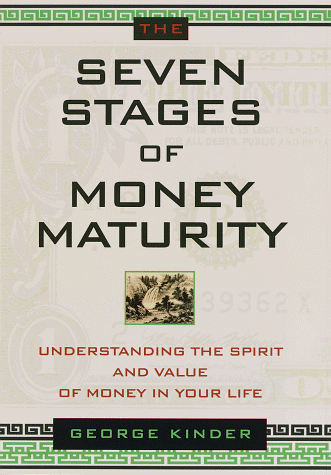
The Seven Stages of Money Maturity: Understanding the Spirit and Value of Money in Your Life - Hardcover
Inhaltsangabe
Draws on Buddhist wisdom and practical money management skills to describe the seven financial developmental stages and explains how to use these stages to develop an understanding of the role and value of money in one's life
Die Inhaltsangabe kann sich auf eine andere Ausgabe dieses Titels beziehen.
Über die Autorin bzw. den Autor
George Kinder divides his time between Cambridge, Massachusetts, and Maui, Hawaii. He leads his seminar, the Seven Stages of Money Maturity, in locations all over the country.
Aus dem Klappentext
l, seminal breakthrough work... Kinder penetrates money's enigmas and mythologies with the artist's delicate touch, the critic's discriminating eye . . . and the insightful sensitivity of a good human being. This book is a gift."<br>--Richard Wagner, former chairman, Institute of Certified Financial Planners <br><br>Replace anxiety, self-sabotage, and self-doubt around money with the sense of ease and freedom you deserve in <b>The Seven Stages of Money Maturity</b>, a one-of-a-kind guide in the life-changing tradition of <b>The 9 Steps to Financial Freedom</b> and <b>Your Money or Your Life</b>. A renowned Buddhist teacher as well as a Harvard-trained, nationally prominent certified financial planner, George Kinder draws on both disciplines to guide us toward a full understanding of the spiritual and psychological issues that surround money. <br><br>Although many of us may assume that issues of money and spirit are separate, incompatible questions, George Kinder s
Auszug. © Genehmigter Nachdruck. Alle Rechte vorbehalten.
Meeting Money Maturity
Midway in our life's journey, I went astray from the straight road and woke to find myself alone in a dark wood.
--Dante Alighieri
The mass of men lead lives of quiet desperation. What is called resignation is confirmed desperation.
--Henry David Thoreau
"I understand what you're saying," he said, "even though I hate admitting it to myself. "
The statement took me by surprise. I had known this man in a passing way for years, and I both admired and disliked him. My admiration came from his success as a financial planner, the same profession I practice. He was known far and wide for creating one of the largest, most multifaceted planning firms in America. But I disliked him because he stood publicly for a point of view I reject--that making money, lots of money, is an end in itself. So I was taken aback when he came up after my presentation on Money Maturity to a national meeting of financial planners and asked me if I wanted to have coffee. I could tell there was something on his mind.
He came right to the point. "I know how to make money," he said. "I've poured all my savings into the stock market for years. Now I've got more than enough to live on for the rest of my life. My problem isn't making more money."
"Then what is it?" I asked.
"The money's not enough," he answered. His tone shifted from confident to plaintive. "I have wealth, but something is missing. I don't know what it is. All I know is I'm not happy. That's why I wanted to talk to you. After hearing what you had to say, I think you may be able to tell me what to do next."
I may be a financial advisor by profession, but I often find myself working more like a priest in the confessional than a money manager. His was an admission I had heard many times before.
During the morning I had spoken on integrating money goals with personal objectives, a topic I have been presenting to my colleagues for years now. Financial professionals have discovered that if they don't understand what their clients are truly seeking, all their good advice goes for nought. In my presentation that afternoon, I had gone back to basics. Money, I explained, can be seen as the place where our internal selves engage the external world. If either side--internal or external, self or money--is slighted, the whole of life suffers.
Now, talking to my colleague over the coffee cups, I picked up on that theme in his life. "That distress you feel inside, that pain--it's there to wake you up," I said.
His face screwed up quizzically. "What do you mean?" he asked.
"It's a signal, an alarm. It's telling you, in no uncertain terms, that it's time to find out who you really are in relation to money."
"But what's that got to do with anything?" he snapped. His expression changed from quizzical to protective, as if I were getting altogether too close for comfort.
"Look at it this way. You could put all your financial statements from the past few years in front of me, and I still wouldn't know what I really need to understand in order to even begin to help you decide what to do next," I answered. "How can I work with you if I don't know who you are? Think about it. It's your own discomfort with yourself that is keeping you from seeing your way ahead."
His defensiveness gave way to curiosity.
"You've been thinking all along there's only one question about money--'How much?'" I continued. "But the truly important question is 'What does money have to do with who I am?' You think you're a success, but your feelings tell you otherwise. They're telling you 'When it comes to money, you're a mess.' Finding Money Maturity means resolving your inner conflicts around money. It really comes down to discovering a sense of ease around money. Without ease, where's the success?"
For a second or two, he was silent, thinking. Then he said, "Tell me. How do I find that ease?"
The Promise of Money Maturity
My colleague's search for ease in his relationship to money--even his difficulty in understanding that ease and freedom were what he was really seeking--is hardly unusual. The same drive for a deep-seated sense of peace on the financial side of life occupies center stage in the concerns of client after client I've worked with. And it's not just an issue for the well heeled, like my successful financial-planning colleague. The desire to achieve ease and freedom around money is as true for those who come from impoverished backgrounds and the middle class as it is for those who inherit wealth or make it big in the business world. Experiencing ease around dollars and cents is what I call Money Maturity.
When clients come to me to handle their money, or when I talk to participants in my seminars, I hear the desire for Money Maturity implicit in every statement they make about what they want their relationship to money to be. No doubt you yourself have said similar things. For example:
"I want to be wealthy in life, not necessarily in money, but I know the two are related."
"I want to be able to do whatever I want to do without thinking about the money."
"I don't want to always be afraid around money."
"I want to be free."
"I want to feel balance between life and money. Too often money wins and life loses."
"I don't want to worry about money."
"I want to get what I need without feeling guilty about it."
"I want to work and contribute in ways that are meaningful to me without having to worry about how much money I'll get from it."
"I want to feel I can be myself without money tripping me up."
"I want to know money won't get in the way of my doing what needs to be done."
"I want to be able to focus on finding value in what I do rather than finding money in what I do."
"I want to feel that I don't have to give up who I am or violate my deepest values just to get money."
Each of these statements is a cry for freedom--a desire to build the life you want from the deepest part of yourself. Just like my financial-planning colleague, you are seeking what is missing inside. You want to discover who you are in relation to money and, on the basis of that knowledge, experience freedom in the financial part of your life. That's exactly what Money Maturity offers.
Most financial advisors and books about money approach finance as if it were simply a skill to learn, the same sort of thing as hitting a fastball or speaking French like a diplomat. Money Maturity does include skills, such as understanding investment options and using a budget effectively, but it goes much deeper--to the feelings, the heart, and, yes, the soul.
Money Maturity helps resolve the troubling emotional conflicts around money that never seem to go away. For many of us money represents anything but peace. If you answer yes to any of these of these questions, you know what I mean:
Do you sabotage yourself around money--by, say, saving toward a goal only to fritter your money away in a shopping spree, charging less for your work than you need to make a living, or refusing to save for the future?
Do you feel chained to a job that limits your ability to express yourself and hampers your freedom, just because you need the money?
Are you so caught up in the rat race, and so fearful that somebody else will take your place if you stop for a breather, that you can't relax, not even for the weekend?
Does the pursuit of money leave you so drained that at the end of the day you don't have the energy for what you truly love to do--play tennis,...
„Über diesen Titel“ kann sich auf eine andere Ausgabe dieses Titels beziehen.
Suchergebnisse für The Seven Stages of Money Maturity: Understanding the...

Beispielbild für diese ISBN
The Seven Stages of Money Maturity : Understanding the Spirit and Value of Money in Your Life
Anbieter: World of Books (was SecondSale), Montgomery, IL, USA
Verkäuferbewertung 5 von 5 Sternen

Zustand: Good. Item in good condition. Textbooks may not include supplemental items i.e. CDs, access codes etc. Artikel-Nr. 00107306645
Gebraucht kaufen
EUR 5,86
Versand gratis
Versand innerhalb von USA
Versand innerhalb von USA
Anzahl: 1 verfügbar
Beispielbild für diese ISBN
The Seven Stages of Money Maturity : Understanding the Spirit and Value of Money in Your Life
Anbieter: ThriftBooks-Atlanta, AUSTELL, GA, USA
Verkäuferbewertung 5 von 5 Sternen
Hardcover. Zustand: Fair. No Jacket. Former library book; Readable copy. Pages may have considerable notes/highlighting. ~ ThriftBooks: Read More, Spend Less. Artikel-Nr. G0385324049I5N10
Gebraucht kaufen
EUR 5,94
Versand gratis
Versand innerhalb von USA
Versand innerhalb von USA
Anzahl: 1 verfügbar
Beispielbild für diese ISBN
The Seven Stages of Money Maturity : Understanding the Spirit and Value of Money in Your Life
Anbieter: ThriftBooks-Atlanta, AUSTELL, GA, USA
Verkäuferbewertung 5 von 5 Sternen
Hardcover. Zustand: Very Good. No Jacket. Former library book; May have limited writing in cover pages. Pages are unmarked. ~ ThriftBooks: Read More, Spend Less. Artikel-Nr. G0385324049I4N10
Gebraucht kaufen
EUR 5,94
Versand gratis
Versand innerhalb von USA
Versand innerhalb von USA
Anzahl: 1 verfügbar
Beispielbild für diese ISBN
The Seven Stages of Money Maturity : Understanding the Spirit and Value of Money in Your Life
Anbieter: ThriftBooks-Atlanta, AUSTELL, GA, USA
Verkäuferbewertung 5 von 5 Sternen
Hardcover. Zustand: Very Good. No Jacket. Missing dust jacket; May have limited writing in cover pages. Pages are unmarked. ~ ThriftBooks: Read More, Spend Less. Artikel-Nr. G0385324049I4N01
Gebraucht kaufen
EUR 5,94
Versand gratis
Versand innerhalb von USA
Versand innerhalb von USA
Anzahl: 1 verfügbar
Beispielbild für diese ISBN
The Seven Stages of Money Maturity : Understanding the Spirit and Value of Money in Your Life
Verlag:
Bantam Doubleday Dell Publishing Group, 1999
ISBN 10: 0385324049
ISBN 13: 9780385324045
Gebraucht
Hardcover
Anbieter: Better World Books, Mishawaka, IN, USA
Verkäuferbewertung 5 von 5 Sternen
Zustand: Good. Pages intact with minimal writing/highlighting. The binding may be loose and creased. Dust jackets/supplements are not included. Stock photo provided. Product includes identifying sticker. Better World Books: Buy Books. Do Good. Artikel-Nr. 483882-6
Gebraucht kaufen
EUR 10,01
Versand gratis
Versand innerhalb von USA
Versand innerhalb von USA
Anzahl: 1 verfügbar
Beispielbild für diese ISBN
The Seven Stages of Money Maturity : Understanding the Spirit and Value of Money in Your Life
Verlag:
Bantam Doubleday Dell Publishing Group, 1999
ISBN 10: 0385324049
ISBN 13: 9780385324045
Gebraucht
Hardcover
Anbieter: Better World Books: West, Reno, NV, USA
Verkäuferbewertung 5 von 5 Sternen
Zustand: Very Good. Pages intact with possible writing/highlighting. Binding strong with minor wear. Dust jackets/supplements may not be included. Stock photo provided. Product includes identifying sticker. Better World Books: Buy Books. Do Good. Artikel-Nr. 4211439-75
Gebraucht kaufen
EUR 10,01
Versand gratis
Versand innerhalb von USA
Versand innerhalb von USA
Anzahl: 1 verfügbar
Beispielbild für diese ISBN
The Seven Stages of Money Maturity : Understanding the Spirit and Value of Money in Your Life
Anbieter: Wonder Book, Frederick, MD, USA
Verkäuferbewertung 5 von 5 Sternen
Zustand: Very Good. Signed Copy . Very Good dust jacket. Inscribed by author on front endpage.Owner's label on front endpage. Artikel-Nr. K03OS-00615
Gebraucht kaufen
EUR 15,13
Versand gratis
Versand innerhalb von USA
Versand innerhalb von USA
Anzahl: 1 verfügbar
Beispielbild für diese ISBN
Seven Stages of Money Maturity
Anbieter: WorldofBooks, Goring-By-Sea, WS, Vereinigtes Königreich
Verkäuferbewertung 5 von 5 Sternen
Hardback. Zustand: Very Good. The book has been read, but is in excellent condition. Pages are intact and not marred by notes or highlighting. The spine remains undamaged. Artikel-Nr. GOR003788209
Gebraucht kaufen
EUR 17,31
EUR 6,52 Versand
Versand von Vereinigtes Königreich nach USA
Versand von Vereinigtes Königreich nach USA
Anzahl: 1 verfügbar
Beispielbild für diese ISBN
The Seven Stages of Money Maturity: Understanding the Spirit and Value of Money in Your Life
Verlag:
Delacorte Press, New York, 1999
ISBN 10: 0385324049
ISBN 13: 9780385324045
Gebraucht
Hardcover
Erstausgabe
Signiert
Anbieter: Ground Zero Books, Ltd., Silver Spring, MD, USA
Verkäuferbewertung 5 von 5 Sternen
Hardcover. First edition. Presumed first printing. Sewn binding. Cloth over boards. ix, [1], 369 p. Illustrations. Index, Financial advisor and Buddhist teacher George Kinder draws on ancient Buddhist wisdom and his pecuniary expertise to offer readers the practical and philosophical skills they need to achieve peace, freedom, and security in their lives. Very good in very good dust jacket. Signed by author. Artikel-Nr. 62071
Gebraucht kaufen
EUR 39,91
EUR 4,31 Versand
Versand innerhalb von USA
Versand innerhalb von USA
Anzahl: 1 verfügbar
Beispielbild für diese ISBN
The Seven Stages of Money Maturity: Understanding the Spirit and Value of Money in Your Life
Verlag:
Bantam Doubleday Dell Publishing Group, 1999
ISBN 10: 0385324049
ISBN 13: 9780385324045
Neu
Hardcover
Anbieter: Revaluation Books, Exeter, Vereinigtes Königreich
Verkäuferbewertung 5 von 5 Sternen
Hardcover. Zustand: Brand New. 369 pages. 9.75x6.50x1.25 inches. In Stock. Artikel-Nr. 0385324049
Neu kaufen
EUR 57,79
EUR 14,55 Versand
Versand von Vereinigtes Königreich nach USA
Versand von Vereinigtes Königreich nach USA
Anzahl: 1 verfügbar