
Verwandte Artikel zu Body and Soul: A Novel
Inhaltsangabe
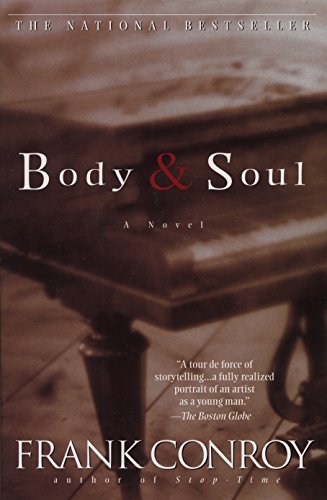
In the dim light of a basement apartment, six-year-old Claude Rawlings sits at an old white piano, picking out the sounds he has heard on the radio and shutting out the reality of his lonely world.
The setting is 1940s New York, a city that is "long gone, replaced by another city of the same name." Against a backdrop that pulses with sound and rhythm, Body & Soul brilliantly evokes the life of a child prodigy whose musical genius pulls him out of squalor and into the drawing rooms of the rich and a gilt-edged marriage.
But the same talent that transforms him also hurtles Claude into a lonely world of obsession and relentless ambition. From Carnegie Hall to the smoky jazz clubs of London, Body & Soul burns with passion and truth--at once a riveting, compulsive read and a breathtaking glimpse into a boy's heart and an artist's soul.
Die Inhaltsangabe kann sich auf eine andere Ausgabe dieses Titels beziehen.
Über die Autorin bzw. den Autor
Frank Conroy was born in 1936 and graduated from Haverford College in 1958. He is currently teaching at the University of Iowa, where he is director of the prestigious Writeer’s Workshop. Conroy has written an autobiography Stop-Time, published in 1967, and his collection of stories, Midair, was published in 1985. His work has appeared in The New Yorker, Esquire, GQ, Harper’s Magazine, and Partisan Review. He divides his time between Iowa City and Nantucket.
Von der hinteren Coverseite
In the dim light of a basement apartment, six-year-old Claude Rawlings sits at an old white piano, picking out the sounds he has heard on the radio and shutting out the reality of his lonely world.
The setting is 1940s New York, a city that is "long gone, replaced by another city of the same name." Against a backdrop that pulses with sound and rhythm, "Body & Soul brilliantly evokes the life of a child prodigy whose musical genius pulls him out of squalor and into the drawing rooms of the rich and a gilt-edged marriage.
But the same talent that transforms him also hurtles Claude into a lonely world of obsession and relentless ambition. From Carnegie Hall to the smoky jazz clubs of London, "Body & Soul burns with passion and truth--at once a riveting, compulsive read and a breathtaking glimpse into a boy's heart and an artist's soul.
Auszug. © Genehmigter Nachdruck. Alle Rechte vorbehalten.
His first view of the outside was through the small, fan-shaped window of the basement apartment. He would climb up on the table and spend hours peering through the bars at the legs and feet of people passing by on the sidewalk, his child's mind falling still in contemplation of the ever-changing rhythms and tempos of legs and feet moving across his field of vision. An old woman with thin calves, a kid in sneakers, men in wingtips, women in high heels, the shiny brown shoes of soldiers. If anyone paused he could see detail - straps, eyelets, a worn heel, or cracked leather with the sock showing through - but it was the movement that he liked, the passing parade of color and motion. No thoughts in his head as he stood or knelt at the window, but rather, from the images of motion, a pure impression of purposefulness. Something was going on outside. People were going places. Often, as he turned away from the window, he would muse on dimly sensed concepts of direction, volition, change, and the existence of the unseen. He was six years old, and much of his thinking, especially when he was alone, went on without words, went on beneath the level of language.
The apartment was small and dark, and he was locked inside until that terrific moment each day when his mother came home with her taxicab. He understood about the cab. There were passengers. She picked them up in the street and took them from one place to another (as the people walking outside were going from one place to another), but she herself had no destination. She went where the passengers told her to go, and remained, in a sense, a witness, like himself. The cab started out in front of the apartment in the morning and returned at night. It appeared to him to be going around in circles.
Usually he would hear her coming down the iron stairs to the door. She was big, and moved slowly, the entire iron structure clanging with each step. Then a moment's silence, the sound of the key opening the locks, and the door would swing open. In the dimness he could see her shift her six-foot-tall, three-hundred-pound body to come through. He could hear the sound of her breathing, a steady, laborious sighing, as she entered the room.
"Claude!" Her voice was clear and musical.
He stepped into her field of vision.
"There you are," she said. "Get me some beer."
He went to the kitchenette, took a quart of Pabst Blue Ribbon out of the refrigerator, pried off the cap, got a glass, and returned to the front room. He placed the beer on the low table in front of the couch and backed off a step. She sat down and put her change maker and a roll of bills next to the beer, along with a folded copy of the newspaper PM from her hip pocket.
"I don't care if the Nazis win," she said. "It couldn't be worse than this." She poured a glass of beer, drank it in one go, and refilled. "He gives me a two dollar ticket! What for? Too far from the curb, he says, the dumb mick. Too far from the curb! Are you kidding? You don't have anything else to do but persecute the working class?" She poured again.
Claude sat down on the floor. He was attentive to her mood, to its direction, in case escape was necessary. Sometimes when he ran around the couch or slipped under her arm she would lose interest. He knew that almost always when she hit him, she held back. He'd seen her open the door once to find a drunk pissing in the small area at the foot of the iron stairs. She'd felled the man with one blow to his chest, methodically kicking his ass and then his head until he lost consciousness, and then pulled him slowly up the stairs by his collar, step by step, to the street. There had been blood on the stairs, red spots on the black.
Now she worked the levers and emptied the change maker, stacking the coins neatly, counting them, and making notes on a scrap of paper. She counted the bills - mostly ones, but with an occasional five – her wide lips moving soundlessly as she tallied up. Finally she would separate the money into two piles, one to take out in the morning and the other to go into the steel box she kept in the top drawer of the bureau in her bedroom.
In the kitchenette she opened another quart of beer, selected a couple of cans, and began preparing his supper. She made noise in the cramped space, banging pots and pans abstractedly, tossing various utensils in the sink without looking. Claude could smell the coils of the hot plate when she turned it on. He sat on a tall stool at the counter and ate what she put before him. (She herself had eaten outside.) She would drink until her eyelids grew heavy, and then go into her bedroom and close the door, not to emerge until morning.
He slept on an army-surplus cot in the back room, which was filled with boxes of old trip cards (to be retained for two years by order of the taxi commissioner), stacks of newspapers, old suitcases, a set of spare tires, boxes of motor oil, a steamer trunk, bookcases, racks of her old clothes, and up against the back wall, half buried under piles of books and sheet music, a small, white console piano with sixty-six keys and a mirror over the keyboard. In this room Claude had found a radio, a small one with a fuzzy green cardboard case about half the size of a loaf of bread, which he had placed on a folding chair beside the head of his cot. He would he with his ear near the speaker, listening to music, or to the voices. When the voices spoke, he often spoke with them, repeating the words and phrases a split second after they came out of the speaker. He could do this well, with speed and accuracy, even when he did not understand what the words meant.
In the morning she let him out, with twenty-five cents, to go to the corner for a quart of milk and two hard rolls. He paused at the top of the stairs. Already, windows were open on the upper floors of the tenements, women with their elbows on the sills, staring at the street, occasionally shouting to each other. Sunlight angled in over the elevated train tracks on Third Avenue to flare off the windshields of parked cars. It was hot, and the sidewalk smelled of city dust.
In the store, Claude waited his turn, watching to see if the storekeeper would use the long pole. Sure enough, someone wanted a box of cornflakes and the old man took the pole, reached up to a shelf near the ceiling, squeezed the grip, and with astonishing gentleness enclosed the box in pincers and extracted it. When he released the grip the box fell directly into his other hand. There was a deftness, a precision, to this almost automatic act that Claude found fascinating. He put the quarter on the counter, received the milk and rolls in a brown paper bag, and began to turn away.
"Tell your mother I'd like to talk to her," the old man said.
Claude nodded and held the bag to his chest. He waited to see if the old man was going to say anything else, but a customer moved between them.
Back in the apartment, he ate and drank and watched his mother clip the change maker to her belt. She wore work pants and a gray shortsleeved shin. With a sigh, she bent her big body and tied her open-toed sandals. "I'll talk to him when I get a chance," she said. "I know what he wants, anyway."
"What does he want?"
"Money." She paused, staring at the floor. Wide-set blue eyes, straight nose, a big chin and mouth. A Slavic face, although her people had been Irish. "It's always money." She got up and left, double locking the door behind her.
Most of the day he spent in the back room at the piano, making sounds and listening to them. He had learned to pick out little melodies - sometimes phrases from the radio, sometimes bits of his own invention - and play them over and over until his fingers got tired. He might play...
„Über diesen Titel“ kann sich auf eine andere Ausgabe dieses Titels beziehen.
Suchergebnisse für Body and Soul: A Novel

Beispielbild für diese ISBN
Body and Soul: A Novel
Anbieter: World of Books (was SecondSale), Montgomery, IL, USA
Verkäuferbewertung 5 von 5 Sternen

Paperback. Zustand: Fair. In the dim light of a basement apartment, six-year-old Claude Rawlings sits at an old white piano, picking out the sounds he has heard on the radio and shutting out the reality of his lonely world. The setting is 1940s New York, a city that is "long gone, replaced by another city of the same name." Against a backdrop that pulses with sound and rhythm, Body & Soul brilliantly evokes the life of a child prodigy whose musical genius pulls him out of squalor and into the drawing rooms of the rich and a gilt-edged marriage. But the same talent that transforms him also hurtles Claude into a lonely world of obsession and relentless ambition. From Carnegie Hall to the smoky jazz clubs of London, Body & Soul burns with passion and truth--at once a riveting, compulsive read and a breathtaking glimpse into a boy's heart and an artist's soul. Artikel-Nr. 00058963704
Gebraucht kaufen
EUR 5,14
Versand gratis
Versand innerhalb von USA
Versand innerhalb von USA
Anzahl: 7 verfügbar
Beispielbild für diese ISBN
Body and Soul: A Novel
Anbieter: World of Books (was SecondSale), Montgomery, IL, USA
Verkäuferbewertung 5 von 5 Sternen
Paperback. Zustand: Good. In the dim light of a basement apartment, six-year-old Claude Rawlings sits at an old white piano, picking out the sounds he has heard on the radio and shutting out the reality of his lonely world. The setting is 1940s New York, a city that is "long gone, replaced by another city of the same name." Against a backdrop that pulses with sound and rhythm, Body & Soul brilliantly evokes the life of a child prodigy whose musical genius pulls him out of squalor and into the drawing rooms of the rich and a gilt-edged marriage. But the same talent that transforms him also hurtles Claude into a lonely world of obsession and relentless ambition. From Carnegie Hall to the smoky jazz clubs of London, Body & Soul burns with passion and truth--at once a riveting, compulsive read and a breathtaking glimpse into a boy's heart and an artist's soul. Artikel-Nr. 00102144818
Gebraucht kaufen
EUR 5,14
Versand gratis
Versand innerhalb von USA
Versand innerhalb von USA
Anzahl: 14 verfügbar
Foto des Verkäufers
Body and Soul: A Novel
Anbieter: Dream Books Co., Denver, CO, USA
Verkäuferbewertung 5 von 5 Sternen
Zustand: acceptable. This copy has clearly been enjoyedâ"expect noticeable shelf wear and some minor creases to the cover. Binding is strong, and all pages are legible. May contain previous library markings or stamps. Artikel-Nr. DBV.038531986X.A
Gebraucht kaufen
EUR 5,86
Versand gratis
Versand innerhalb von USA
Versand innerhalb von USA
Anzahl: 1 verfügbar
Beispielbild für diese ISBN
Body and Soul: A Novel
Anbieter: BooksRun, Philadelphia, PA, USA
Verkäuferbewertung 5 von 5 Sternen
Paperback. Zustand: Fair. The item might be beaten up but readable. May contain markings or highlighting, as well as stains, bent corners, or any other major defect, but the text is not obscured in any way. Artikel-Nr. 038531986X-7-1
Gebraucht kaufen
EUR 6,02
Versand gratis
Versand innerhalb von USA
Versand innerhalb von USA
Anzahl: 1 verfügbar
Beispielbild für diese ISBN
Body & Soul
Anbieter: ThriftBooks-Atlanta, AUSTELL, GA, USA
Verkäuferbewertung 5 von 5 Sternen
Paperback. Zustand: Good. No Jacket. Pages can have notes/highlighting. Spine may show signs of wear. ~ ThriftBooks: Read More, Spend Less. Artikel-Nr. G038531986XI3N00
Gebraucht kaufen
EUR 7,05
Versand gratis
Versand innerhalb von USA
Versand innerhalb von USA
Anzahl: 3 verfügbar
Beispielbild für diese ISBN
Body & Soul
Anbieter: ThriftBooks-Dallas, Dallas, TX, USA
Verkäuferbewertung 5 von 5 Sternen
Paperback. Zustand: Good. No Jacket. Pages can have notes/highlighting. Spine may show signs of wear. ~ ThriftBooks: Read More, Spend Less. Artikel-Nr. G038531986XI3N00
Gebraucht kaufen
EUR 7,05
Versand gratis
Versand innerhalb von USA
Versand innerhalb von USA
Anzahl: 3 verfügbar
Beispielbild für diese ISBN
Body & Soul
Anbieter: ThriftBooks-Reno, Reno, NV, USA
Verkäuferbewertung 5 von 5 Sternen
Paperback. Zustand: Good. No Jacket. Pages can have notes/highlighting. Spine may show signs of wear. ~ ThriftBooks: Read More, Spend Less. Artikel-Nr. G038531986XI3N00
Gebraucht kaufen
EUR 7,05
Versand gratis
Versand innerhalb von USA
Versand innerhalb von USA
Anzahl: 3 verfügbar
Beispielbild für diese ISBN
Body & Soul
Anbieter: ThriftBooks-Phoenix, Phoenix, AZ, USA
Verkäuferbewertung 5 von 5 Sternen
Paperback. Zustand: Very Good. No Jacket. May have limited writing in cover pages. Pages are unmarked. ~ ThriftBooks: Read More, Spend Less. Artikel-Nr. G038531986XI4N00
Gebraucht kaufen
EUR 7,05
Versand gratis
Versand innerhalb von USA
Versand innerhalb von USA
Anzahl: 1 verfügbar
Beispielbild für diese ISBN
Body & Soul
Anbieter: ThriftBooks-Phoenix, Phoenix, AZ, USA
Verkäuferbewertung 5 von 5 Sternen
Paperback. Zustand: Good. No Jacket. Pages can have notes/highlighting. Spine may show signs of wear. ~ ThriftBooks: Read More, Spend Less. Artikel-Nr. G038531986XI3N00
Gebraucht kaufen
EUR 7,05
Versand gratis
Versand innerhalb von USA
Versand innerhalb von USA
Anzahl: 3 verfügbar
Beispielbild für diese ISBN
Body & Soul
Anbieter: ThriftBooks-Dallas, Dallas, TX, USA
Verkäuferbewertung 5 von 5 Sternen
Paperback. Zustand: Very Good. No Jacket. May have limited writing in cover pages. Pages are unmarked. ~ ThriftBooks: Read More, Spend Less. Artikel-Nr. G038531986XI4N00
Gebraucht kaufen
EUR 7,05
Versand gratis
Versand innerhalb von USA
Versand innerhalb von USA
Anzahl: 1 verfügbar